 sales@towardsfnb.com
 +1 804-441-9344
 Download Sample
 Schedule a Meeting
 Table of Content
February 2026



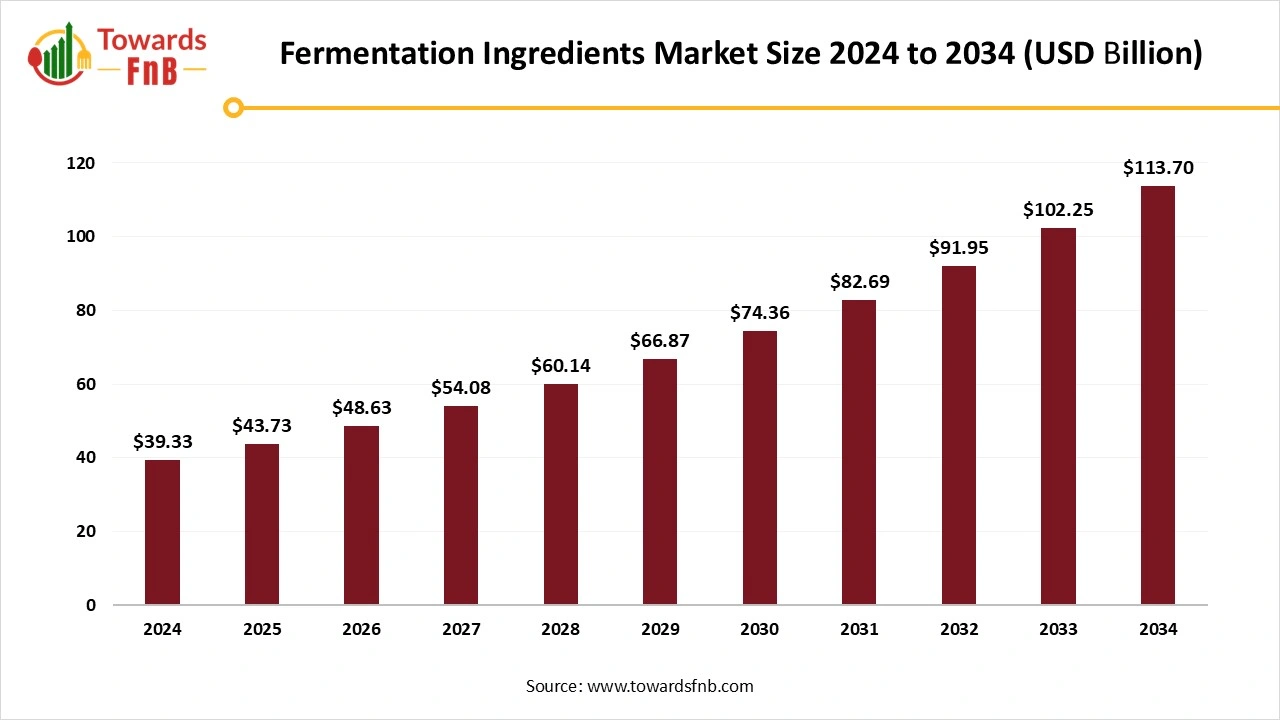
The global fermentation ingredients market size was valued at USD 39.33 billion in 2024 and is expected to grow steadily from USD 43.73 billion in 2025 to reach nearly USD 113.70 billion by 2034, with a CAGR of 11.2% during the forecast period from 2025 to 2034. The market is primarily driven by consumer demand for natural, clean-label products and the increasing popularity of probiotics and functional foods.
| Study Coverage | Details |
| Growth Rate from 2025 to 2034 | CAGR of 11.2% |
| Market Size in 2025 | USD 43.73 Billion |
| Market Size in 2026 | USD 48.63 Billion |
| Market Size by 2034 | USD 113.70 Billion |
| Largest Market | North America |
| Base Year | 2024 |
| Forecast Period | 2025 to 2034 |
| Regions Covered | North America, Europe, Asia-Pacific, Latin America, and Middle East & Africa |
The fermentation ingredients market is a global industry focused on producing and selling ingredients derived from microbial fermentation for use in various products. It includes a wide range of products like amino acids, organic acids, enzymes, and vitamins, which are used across sectors such as food and beverages, pharmaceuticals, animal feed, and cosmetics. This market is growing significantly due to increasing consumer demand for natural, functional, and sustainable ingredients.
Recent advancements in technology are transforming fermentation from a traditional practice into a precision-driven science with exciting new uses. Precision fermentation employs genetically modified microorganisms to create specific compounds with outstanding purity and consistency. The integration of digital technologies has significantly enhanced process control in fermentation. The application of artificial intelligence and synthetic biology is being used to optimize microbes for higher production yields and the creation of new ingredients. Additional innovations include non-thermal methods such as pulsed electric fields and high-pressure processing to manage microbial growth, along with sophisticated analytical tools for better detection, safety, and quality assurance.
Research & Development (R&D)
Raw Material Sourcing
Processing
Distribution & Logistics
Why did North America Dominate the Fermentation Ingredients Market?
North America dominated the market in 2024, propelled by consumer interest in plant-based options, natural products, and clean label ingredients. Increased innovations in fermentation technology and processes are contributing to market advancement in the North American region, particularly in more developed economies like the United States. The food and beverage sector in North America is expanding rapidly, driven by a rising appetite for fermented foods that offer diverse flavors and nutritional benefits, which significantly influences the use of fermented ingredients in this segment.
U.S. Fermentation Ingredients Market Analysis
The fermentation ingredients market in the US is advancing, motivated by the demand for clean-label and functional food and beverage options that promote benefits such as better gut health. This market is broadening across food and beverage, pharmaceutical, and industrial sectors, spurred by consumer awareness, technological progress, and the transition towards plant-based and sustainable choices. For example, Every Company, based in San Francisco, recently secured a $2 million grant from the US Department of Defense to investigate setting up a precision fermentation facility within the country.
Asia Pacific’s Fastest Growing Fermentation Ingredients Market
Asia Pacific expects significant growth during the forecast period. This growth is linked to swift urbanization and increasing disposable incomes, which have changed consumer preferences towards clean-label and natural preservative products. Such shifts have prompted manufacturers to produce fermented ingredients at scale. Additionally, advancements in production methods and government initiatives have been crucial in driving the market forward in the region. Significant investments in research and development, along with enhanced production strategies, are expediting market growth. The increasing awareness among consumers regarding the health benefits associated with fermented components, including improved digestion and immunity, is encouraging their inclusion in a variety of products such as food, beverages, pharmaceuticals, and personal care items.
India Fermentation Ingredients Market
India is projected to have the highest growth rate during the forecast period. The global market for precision fermentation ingredients is expanding rapidly in India, fueled by increasing demand for dairy substitutes and natural components, supportive government policies, growth in the food and beverage sector, and rising consumer preference for sustainable, natural ingredients. Furthermore, government backing for biotechnology innovation and collaborations within the industry are promoting faster adoption across the food, nutraceutical, and personal care industries.
Europe's Fermentation Ingredients Market Expansion with Sustainability and Technology
Europe has a rich history of consuming fermented products like yogurt, cheese, and alcoholic drinks, which drives the need for fermentation ingredients. Concerns regarding sustainability have led to the acceptance of fermentation methods that minimize waste and lower carbon emissions. Europe is leading in technological advancements, especially in enzyme engineering and microbial fermentation, which improves the production efficiency of fermentation ingredients. The European Union has also allocated dedicated funding, including €50 million through Horizon Europe and the European Innovation Council (EIC) in 2024, to support the scaling of precision fermentation and algae-based food startups.
Germany's Fermentation Ingredients Market Analysis
The German market for fermentation ingredients is a notable and expanding segment within Europe, driven by the growing consumer interest in natural, sustainable, and health-enhancing ingredients, particularly within the food and beverage sector. The rising demand for sustainable and ethically sourced food is promoting the use of fermentation for developing animal-free alternatives to dairy, eggs, and meat. The German government offers financial support and resources for research and development initiatives within the fermentation industry.
Growing MEA Fermentation Ingredients Market
The fermentation ingredients market in the Middle East and Africa (MEA) is anticipated to undergo significant growth. Major factors propelling this growth include the rising demand for clean-label, natural, and functional food products, increasing urbanization, and an expanding food processing industry. There is expected to be a notable rise in the demand for amino acids, which are extensively utilized in the food and beverage, pharmaceutical, and personal care sectors. South Africa and the Gulf Cooperation Council (GCC) countries are pivotal contributors, with investments targeted at food innovation and the growth of local manufacturing by multinational corporations.
UAE Fermentation Ingredients Market Analysis
In the UAE, the fermentation ingredients market is witnessing considerable growth, fueled by the heightened demand for natural, nutritious, and functional ingredients within the food and beverage, pharmaceutical, and personal care industries. Key reasons behind this growth include a rise in consumer health consciousness, a move towards sustainable and plant-based alternatives, and advancements in fermentation technologies. Prominent locations such as Dubai and Abu Dhabi are drawing investments, and the government is proactively encouraging food technology innovation through initiatives like the establishment of precision fermentation hubs.
South America Fermentation Ingredients Market Potential
The market for fermentation ingredients in South America is a swiftly expanding industry, driven by the increasing consumer interest in natural, clean-label products. The main factors contributing to this trend include the growth of the food and beverage sector, where fermented ingredients enhance flavor, texture, and nutritional value, as well as the rise of industrial biotechnology applications. This market encompasses a variety of products, including organic acids, amino acids, and enzymes, utilised in the food, beverage, and pharmaceutical industries.
Brazilian Fermentation Ingredients Market Analysis
As the Brazilian craft beer revolution gains momentum, the quest for specific yeast strains and enzymes has emerged. Independent brewers are increasingly focusing on artisanal fermented beer varieties. This trend toward homemade and small-batch fermented foods highlights the growing demand for fermented cultures, probiotics, and organic acids. As a result, there is a notable shift among consumers in Brazil’s food and beverage sector towards health-conscious, natural, and high-quality fermented products.
Why did Liquid Segment Dominated The Fermentation Ingredients Market?
The liquid segment led the fermentation ingredients market in 2024, due to its ease of use, better absorption, and smooth mixability in various food and beverage applications. This product is becoming increasingly popular. The growing consumer demand for items such as probiotic drinks and functional beverages, which are typically formulated in liquid form, also drives its popularity. Manufacturers appreciate liquids for their easy measurement and rapid dispersion during production.
The Powder Segment is Observed to Grow at the Fastest Rate During the Forecast Period.
Powders are favored in the market because of their longer shelf life, ease of storage and transportation, and versatility in a wide range of food, beverage, and nutraceuticals products. These benefits make powders both cost-effective and convenient for food manufacturers and consumers, contributing significantly to their market share.
The granular segment is also experiencing notable growth due to several key functional advantages. These include ease of handling, standardized dosing, and stability, which are highly valued in various industrial applications and consumer products.
Why did the Natural Segment Dominate the Fermentation Ingredients Market?
The natural segment held the dominating share of the market in 2024. More people are choosing sustainable, healthy, and clean label products. This trend comes from a growing awareness of gut health and a desire to avoid synthetic additives. Many consumers prefer natural products, which fits well with fermentation. Fermentation is a natural process that creates beneficial ingredients like probiotics and helps make plant-based alternatives to animal products.
The Synthetic Segment is Seen to Grow at a Notable Rate During the Predicted Timeframe.
Because it offers a cost-effective, scalable, and sustainable way to produce a wide range of ingredients with consistent quality. This approach bypasses the limitations of traditional agriculture, such as weather dependency, land use, and animal welfare concerns, while meeting the growing consumer demand for plant-based, animal-free, clean-label, and functional products.
How did the Yeast Segment Dominate the Fermentation Ingredients Market?
The yeast segment dominated the market with the largest share in 2024, owing to its adaptability, well-established uses, and affordability. It is a favored host for generating a variety of components such as proteins, enzymes, and flavors. Its capability for genetic manipulation enables high production on inexpensive substrates, rendering it an effective and reliable choice for commercial manufacturing in the food, beverage, and pharmaceutical sectors.
The Bacterial Cultures Segment is Expected to Grow at the Fastest Rate in the Market During the Forecast Period.
Microbes are useful because they can produce both traditional fermented foods, which offer good taste and probiotics, and valuable ingredients through precision fermentation. They can develop specific enzymes, proteins, and flavoring agents through genetic engineering. Additionally, they help produce nutritious and sustainable alternatives, such as proteins that are purely plant-based.
The enzymes segment is expanding significantly during the forecast period, because enzymes are crucial for fermentation, enhancing efficiency and product quality in food and beverage industries. They break down complex carbohydrates, improve flavor and texture, and serve as natural alternatives to chemical additives, making them vital across various sectors from baking to textiles.
Which Application Segment Dominated the Fermentation Ingredients Market?
The food & beverages segment held the largest share of the market in 2024. The surge in consumer interest for healthier, more natural products and a diverse array of uses such as flavor enhancement, preservation, and nutritional enrichment is significant. This growth is also driven by the increasing popularity of fermented items like yogurt and kombucha, the rise of the plant-based protein sector, and innovations that facilitate the creation of clean-label, value-added food and beverages.
The Pharmaceuticals Segment is Seen to Expand at the Fastest Rate During the Forecast Period.
Attributed to its function in producing crucial and intricate medical elements like antibiotics, vitamins, and biologics. This expansion is supported by the escalating demand for chronic disease treatments, improvements in biotechnology that enable cost-effective production of these substances, and a heightened focus on bio-based and sustainable medicine.
The biofuels segment serves as a key growth catalyst in the market, mainly owing to global initiatives aimed at addressing climate change, boosting energy security, and favorable government regulations. The fermentation process itself is a leading and well-understood technique for ethanol production, recognized for its cost-effectiveness and simplicity in comparison to alternative methods.
Summ Ingredients
Layn Natural Ingredients
Corporate Information
History and Background
Key Developments and Strategic Initiatives
Mergers & Acquisitions
Partnerships & Collaborations
Product Launches / Innovations
Key Technology Focus Areas
R&D Organisation & Investment
SWOT Analysis
Strengths
Weaknesses / Challenges
Opportunities
Threats / Risks
Recent News & Strategic Updates
By Form
By Type
By Source
By Application
By Region



February 2026
February 2026
February 2026
February 2026