April 2026



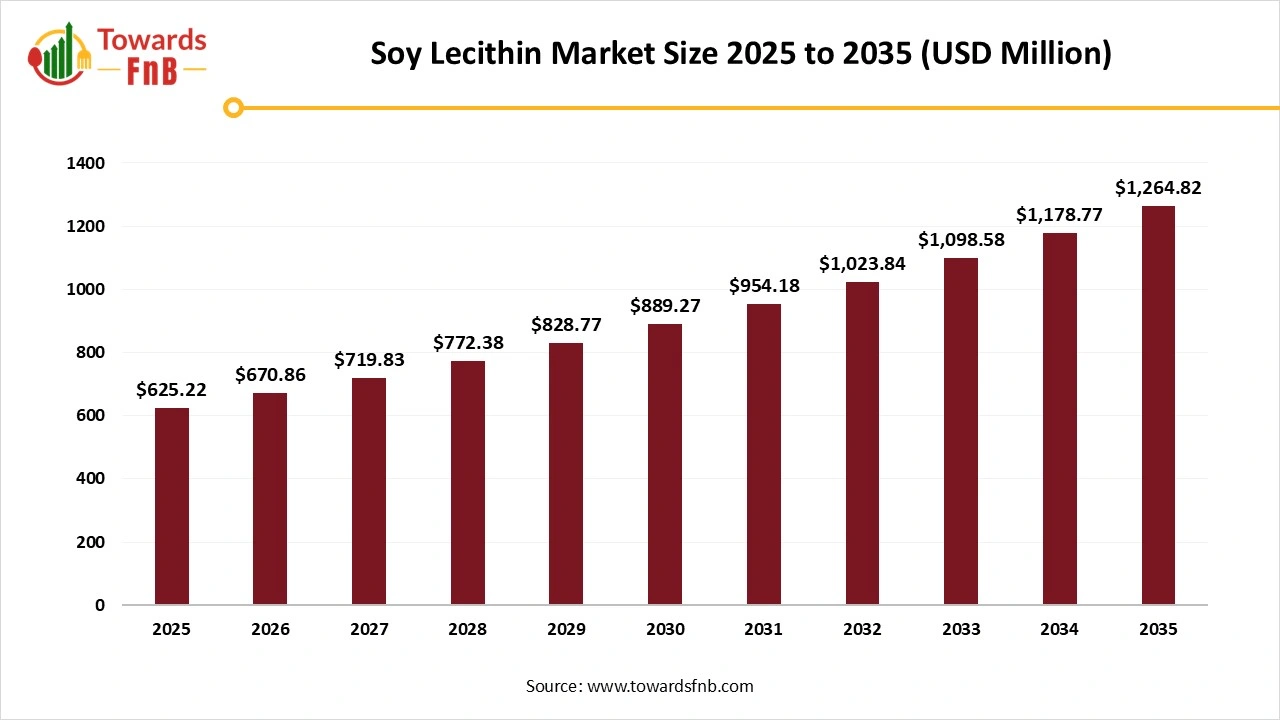
The global soy lecithin market size estimated at USD 625.22 million in 2025 and is predicted to increase from USD 670.86 million in 2026 to nearly reaching USD 1,264.82 million by 2035, growing at a CAGR of 7.3% during the forecast period from 2026 to 2035. This growth is due to demand for natural emulsifiers in the food, pharmaceuticals and cosmetics industry.
| Study Coverage | Details |
| Growth Rate from 2026 to 2035 | CAGR of 7.3% |
| Market Size in 2026 | USD 670.86 Million |
| Market Size in 2027 | USD 719.83 Million |
| Market Size by 2035 | USD 1,264.82 Million |
| Largest Market | Asia Pacific |
| Base Year | 2025 |
| Forecast Period | 2026 to 2035 |
| Regions Covered | North America, Europe, Asia-Pacific, Latin America, and Middle East & Africa |
Soy lecithin, derived from raw soybeans, is a naturally occurring fatty compound composed of glycerols, fatty acids, choline, and phosphoric acid. It is commonly utilized in the manufacturing, pharmaceutical, and food industries. The food and beverages sector is undergoing a significant transformation with the rise of processed and convenience food, and soy-based lecithins are no exception. The growing preference for natural emulsifiers over synthetic alternatives is driving the demand for soy-based products like soy lecithin. .
Advances in extraction technologies are enhancing the efficiency and quality of lecithin production. Concurrently, ongoing research and development of new applications continue to expand market potential. Liposomes have revolutionized the delivery of active ingredients in pharmaceuticals, cosmetics, and food products, with soy lecithin playing a central role in this transformation. Artificial intelligence is also reshaping the soybean lecithin industry by optimizing production processes and supply chain management.
Raw Material Procurement
Processing
Distribution
How did the Asia Pacific Dominate the Soy Lecithin Market in 2025?
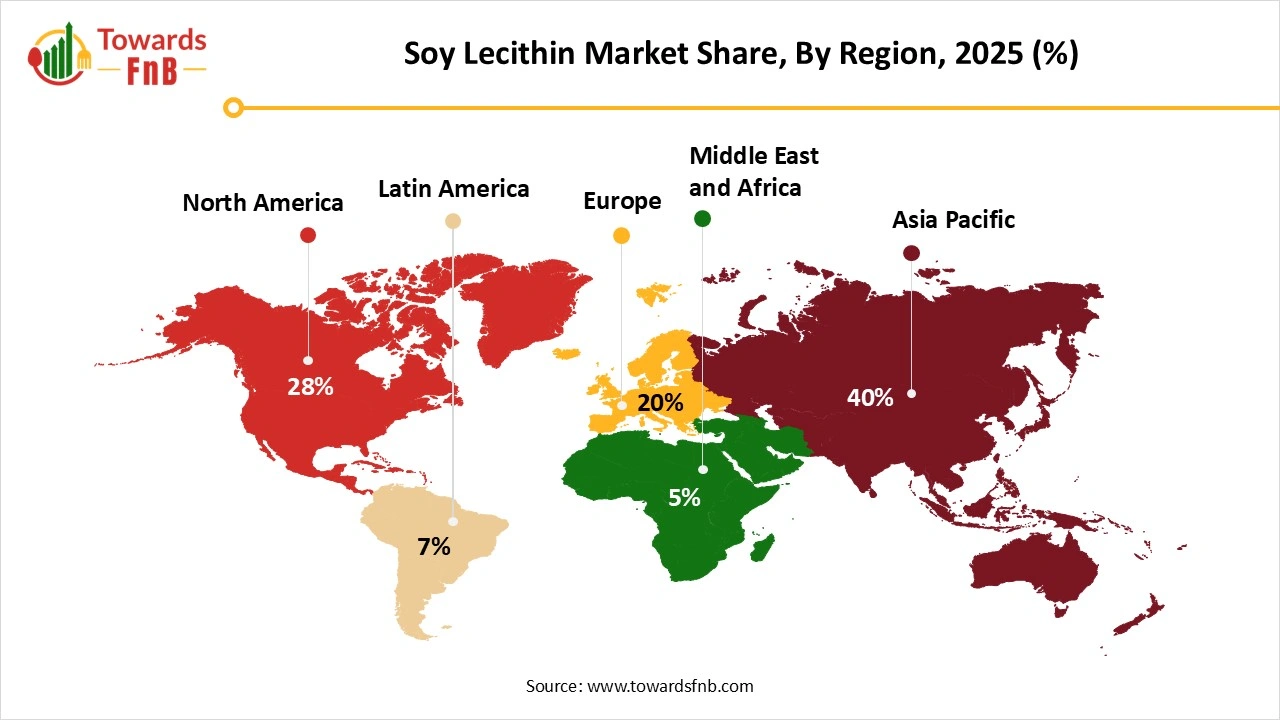
Asia Pacific dominated the market in 2025. Soy lecithin has established itself as a critical functional ingredient in Asia's manufacturing ecosystem. Its emulsifying, stabilizing, and dispersing properties make it essential in food processing, feed production, and pharmaceutical formulation. These diverse applications contribute to consistent baseline demand across the region. Contributing factors to the demand for soy lecithin in this region include a growing population, urbanization, rising disposable incomes, and changing lifestyles.
Asia Pacific Soy Lecithin Market Size 2025 to 2035
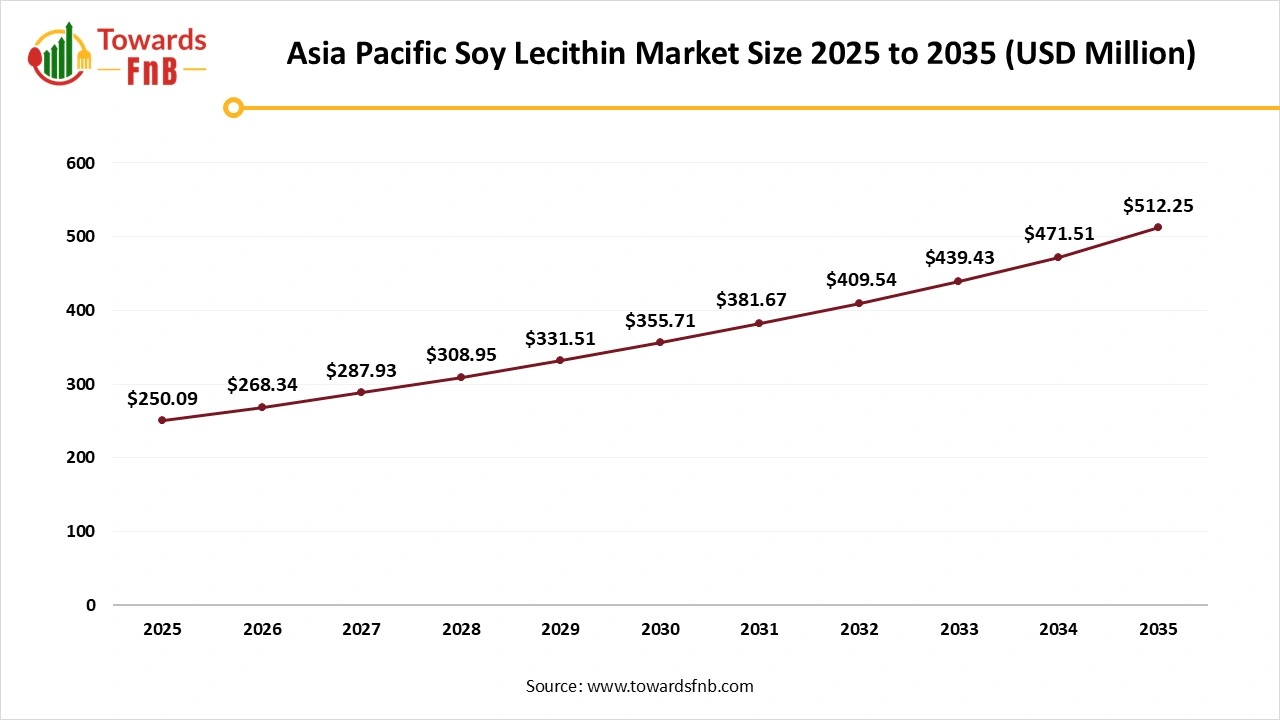
The Asia Pacific soy lecithin market size was calculated at USD 250.09 million in 2025 with projections indicating a rise from USD 268.34 million in 2026 to approximately USD 512.25 million by 2035, expanding at a CAGR of 7.43% throughout the forecast period from 2026 to 2035.
India Soy Lecithin Market Analysis
The soy lecithin market in India is steadily expanding due to its applications across the food, pharmaceutical, animal feed, and cosmetic sectors. India has emerged as a significant exporter of soy lecithin, which is a key emulsifier used extensively in the food, pharmaceutical, cosmetic, and feed industries. As global demand for non-GMO, plant-based ingredients rise, Indian soy lecithin, often derived from non-GMO soybean sources, has gained traction. India is one of the largest producers of soybeans in Asia, providing an abundant and cost-effective raw material base for soy lecithin production.
North America Soy Lecithin Market Analysis
North America expects fastest growth during the forecast period. The market in North America is primarily driven by the rising demand for plant-based and clean label ingredients across various industries. Numerous government initiatives aimed at developing the food and beverage sector and increasing investments by pharmaceutical companies to open new production centers significantly shape the industrial landscape. Furthermore, the presence of several market players, such as American Lecithin Company, Bunge, Cargill Incorporated, and Archer Daniels Midland Company, is expected to boost the growth of the soy lecithin sector in this region.
U.S. Soy Lecithin Market Analysis
The growth of the U.S. soy lecithin market is driven by a combination of health-conscious consumer preferences, rising demand for natural food additives, and the expanding applications of soy lecithin across various industrial sectors. As a natural emulsifier and stabilizer, soy lecithin is increasingly being added to food and beverage products, especially those positioned as clean-label and non-GMO.
Europe Soy Lecithin Market Analysis
The European soy lecithin market is experiencing significant growth driven by increasing demand across diverse industries such as food & beverages, pharmaceuticals, cosmetics, and animal feed. Countries such as Germany, France and the UK have important markets due to the widespread use of soy lecithin in bakery, confectionery and drug yoga. Preference for non-GMO and organic soy lecithin is particularly strong, in line with strict regulations in the region regarding genetically modified ingredients. In the pharmaceutical and nutraceuticals sectors, soy lecithin is increasingly utilized for drug delivery systems and dietary supplements, showcasing its multifunctional benefits.
UK Soy Lecithin Market Analysis
The UK soy lecithin market is projected to experience steady growth, driven by the rising use of lecithin in bakery products and health supplements. This market is witnessing rapid innovation in plant-based and allergen-free formulations that utilize non-GMO, organic soy lecithin variants. There is ongoing development of novel extraction and processing techniques, such as enzymatic and cold-press methods, to enhance purity and functional properties. Emphasis is placed on clean, vegan, and plant-based ingredients, as well as medications and cosmetics. Major players in the UK market include Cargill, Bunge, and Lipoid, which are continuously innovating in the market.
Soy Lecithin Market Share, By Product Type, 2025 (%)
| Segments | Shares (%) |
| Liquid Soy Lecithin | 60% |
| De-oiled (Powder) Soy Lecithin | 15% |
| Modified Soy Lecithin | 12% |
| Fractionated Soy Lecithin | 8% |
| Enzymatically Modified Lecithin | 5% |
Why did the Liquid Soy Lecithin Segment Dominate the Soy Lecithin Market in 2025?
The liquid soy lecithin segment held the dominant share of the market in 2025. The liquid form of soy lecithin offers several advantages over its powdered counterpart; it is more easily dispersed in liquids, making it an ideal choice for various food, cosmetic, and pharmaceutical formulations. Its liquid nature also allows for more precise dosing and easier incorporation into recipes or product formulations.
The Modified Soy Lecithin Segment is Expected to Grow at the Fastest Rate During the Forecast Period
As consumer demands evolve, the significance of high-performance, natural ingredients like modified soy lecithin will continue to rise. The enzymatic modification process enhances the ingredient’s emulsifying, dispersing, and stabilizing capabilities. With its clean-label appeal, improved functionality, and customization options, it is becoming an essential component in modern manufacturing across food, pharmaceuticals, and cosmetics.
Soy Lecithin Market Share, By Purity/Grade, 2025 (%)
| Segments | Shares (%) |
| Food-Grade Soy Lecithin | 55% |
| Feed-Grade Soy Lecithin | 15% |
| Pharmaceutical-Grade Soy Lecithin | 10% |
| Industrial-Grade Soy Lecithin | 20% |
How did the Food-Grade Soy Lecithin Segment Dominate the Soy Lecithin Market in 2025?
The food-grade soy lecithin segment held the largest share of the market in 2025, driven by the increasing demand for natural emulsifiers in bakery, confectionery, and processed food. Soy lecithin is a valuable ingredient in the food industry because of its ability to emulsify, improve texture, extend shelf life, and provide nutritional value. Its cost-effectiveness and wide availability make it a popular choice for food manufacturers aiming to produce high-quality products.
The Feed-Grade Soy Lecithin Segment is Expected to Grow Significantly During the Predicted Period
Driven by the rising global demand for sustainable and effective feed additives in livestock and aquaculture industries. Feed-grade soy lecithin is an excellent source of phospholipids, and its choline content is essential for the growth of animals. Incorporating soy lecithin into animal feed enhances nutrient absorption, energy density, feed efficiency, and overall animal performance.
Soy Lecithin Market Share, By End-Use Industry, 2025 (%)
| Segments | Shares (%) |
| Food Processing Companies | 60% |
| Feed Manufacturers | 15% |
| Pharmaceutical & Biotech Firms | 12% |
| Personal Care & Cosmetics | 5% |
| Industrial Users | 8% |
Which End-Use Industry Segment Dominated the Soy Lecithin Market in 2025?
The food processing companies segment dominated the market with the largest share in 2025. An increasing number of small food manufacturers are driving demand for soy lecithin in specialized applications, including ready-to-eat meals, baked goods, and confectionery. As customer demand for convenience and processed meals grows, soy lecithin's role in the food sector has expanded significantly. Its ability to mix and stabilize materials that would otherwise separately makes it valuable in creating smooth, consistent, and high-quality food products.
The pharmaceutical & personal care sector segment is expected to grow at the fastest rate during the forecast period.The demand for soy lecithin in pharmaceuticals is influenced by increased consumer awareness regarding health and wellness. As more individuals seek natural and clean-label products, the preference for non-GMO lecithin has surged.
Bunge Global SA
NextGen Actives
By Product Type
By Purity / Grade
By End-Use Industry
By Region




Principal Consultant
Vidyesh Swar, Senior Research Analyst at Towards Food & Beverages, specializes in market research, focusing on supply-demand evaluation, pricing analysis, alternative proteins, plant-based foods, and sustainable food technologies within the industry.
Learn more about Vidyesh Swar
Reviewed By
Aditi Shivarkar, with 14+ years in Food and Beverages market research, specializes in food, beverage, and eco-friendly packaging. She ensures accurate, actionable insights, driving Towards FnB's excellence in industry trends and sustainability.
Learn more about Aditi ShivarkarApril 2026
April 2026
April 2026
April 2026

Soy Lecithin Market

 +1 804-441-9344
 Download Sample
 Schedule a Meeting