April 2026



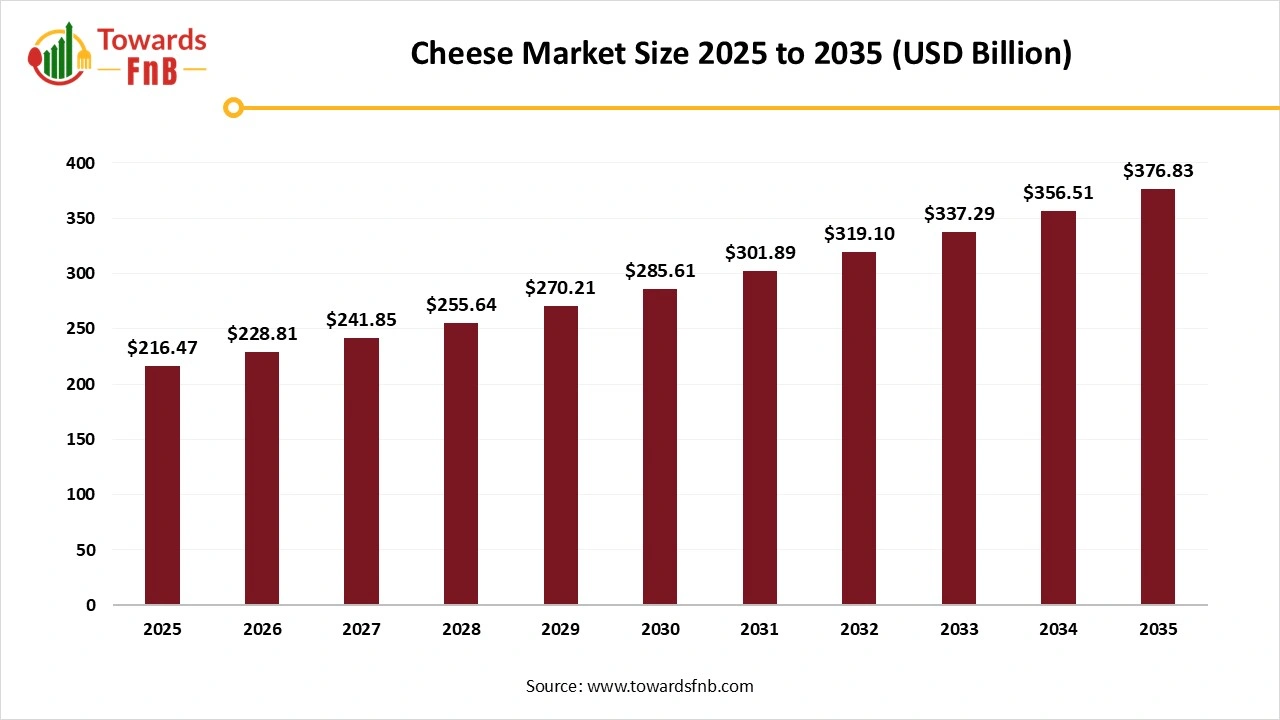
The global cheese market size was evaluated at USD 216.47 billion in 2025 and is expected to rise from USD 228.81 billion in 2026 to nearly reaching USD 376.83 billion by 2035, growing at a CAGR of 5.7% during the forecast period from 2026 to 2035. Rapid urbanization, change in taste of consumers and demand for western cuisine are the major factors influencing the market growth.
| Study Coverage | Details |
| Growth Rate from 2026 to 2035 | CAGR of 5.7% |
| Market Size in 2026 | USD 228.81 Billion |
| Market Size in 2027 | USD 241.85 Billion |
| Market Size by 2035 | USD 376.83 Billion |
| Largest Market | Europe |
| Base Year | 2025 |
| Forecast Period | 2026 to 2035 |
| Regions Covered | North America, Europe, Asia-Pacific, Latin America, and Middle East & Africa |
Cheese is the fermented milk-based food products, made with the different flavors and types. It is estimated that more than 500 distinct cheese varieties are currently produced worldwide. Growing demand for the ready to eat and convenience food majorly driving the market. The rise food delivery industry through on-demand services like DoorDash, Grubhub, and Uber Eats increasing the demand for the convenience food and thus fostering the cheese market. Furthermore, increasing demand for western food menu like burger, pizzas and pastas loaded with cheese, growing outlets of fast food chains like dominos McDonalds, pizza hut, Subway etc. fueling the demand for the cheese and increase the cheese production.
The use of functional ingredients derived from plant by-products in cheese making might serve as a method for enhancing the overall quality of the products. The implementation of automatic and semi-automatic machines has greatly enhanced efficiency in cheese manufacturing. These systems can manage substantial amounts quickly, boosting efficiency and allowing businesses to satisfy demand more adeptly. Automation has diminished the necessity for manual work, decreasing production costs and enhancing production capacity. The diversification of cheese flavors is also broadening the market. One instance is BOOSTRACTTM, a flavor modulation technology that increases or amplifies the sensation of kokumi. This distinct, all-natural method enhances the mouthfeel and richness of the taste experience, while simultaneously concealing undesirable flavor notes and intensifying the flavor traits that consumers most prefer.
Rising health awareness among consumers challenging the cheese demand as the cheese contain high fat and high sodium. Therefore, consumers are choosing alternative for the conventional cheese. Increasing allergies and lactose intolerance further impede the cheese market growth. Cheesemaking is majorly dependent on the milk and the price of milk is dependent on the feed cost, climate change and supply which can influence the price of the product.
Raw Material Procurement
Cheese Processing
Cheese Packaging
Europe Dominated the Cheese Market in 2025
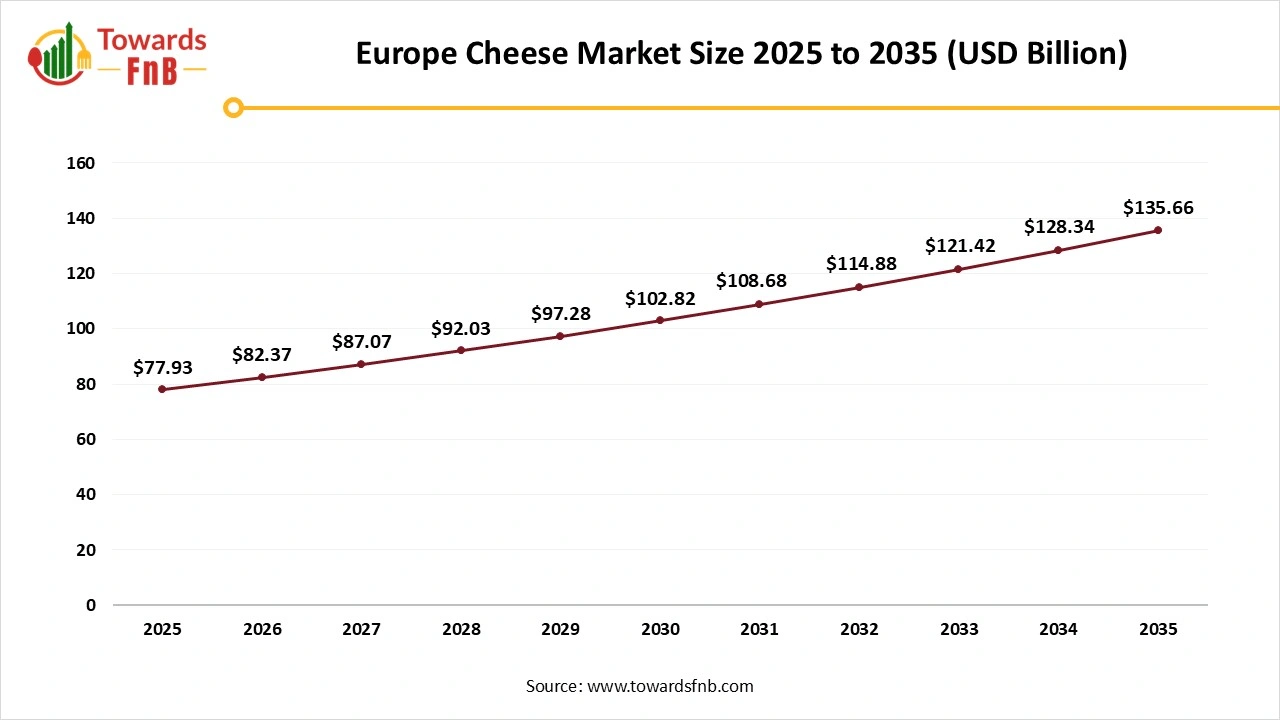
The Europe cheese market size was evaluated at USD 77.93 billion in 2025 and is expected to rise from USD 82.37 billion in 2026 to nearly reaching USD 135.66 billion by 2035, growing at a CAGR of 5.7% during the forecast period from 2026 to 2035.
In 2024, cheese production in the EU was projected to increase by almost 1%, hitting around 10.5 million tons, as stated in a recent USDA World Markets and Trade report. This growth is fueled by strong internal consumption and steady demand for exports. The main producers are Germany, France, Italy, the Netherlands, and Poland, account for almost 75% of the EU's overall cheese production. Cheese manufacturing continues to be a major focus for the European dairy industry because of its consistent profits and strong market need. Besides being a cherished food, cheese holds an important place in European culture and customs. Cheese-making festivals and contests take place in various European nations, with numerous cities and regions boasting their own distinctive cheese-making customs.
Recent data showed that a significant change in dairy consumption habits in German consumers, with a rise in cheese consumption. As per the Federal Agency for Agriculture and Food, the mean per unit of population consumption of cheese increased by 1 Kg, attained 25.4 kg in 2024. Additionally, domestic cheese manufacturing rose from 2.66 million tons to 2.74 million tons. The growing awareness regarding health increasing the demand for organic and sustainable cheese. Along with this, localized diversity of Germany and strong appreciation for heritage cheese varieties contributing for the expansion of cheese market.
North America Observed to Grow at the Fastest Rate in the Market During the Forecast Period
Different varieties of cheese is the major driving factor growth of the North America cheese market. There is a cheese to please every taste including mozzarella, cheddar and artisanal cheese. Customers have different varieties to choose like hard cheeses, soft cheeses, blue cheeses, dairy-free alternatives, and fortified cheese to fulfil dietary preferences and culinary experiences and boosting the market. Various organizations are supporting the production of cheese in America.
U.S. cheese production in 2025 is projected to rise, about 1.6 percent, due to increased milk production and financing in processing technology. Cheese producers in important dairy states, comprising California, Wisconsin, Minnesota, Texas, and Idaho are enhancing capacity, concentrating on in-demand products like mozzarella, cheddar, and specialty cheeses to fulfil both local and international demand. Exports of U.S. cheese is also expected to rise in 2025, fostered by increased price competitiveness and continued demand from Mexico and prominent regions in Southeast Asia and the Middle East. Food service industries such as hotels, café, and restaurants are including cheese in their food to captivate the consumers and to expand the business.
Asia Pacific is a notable player in the regional market, contributing to growth due to a large consumer base, widespread food service industry, and growing Western culture influence. The growing demand for western-style cuisines and changing dairy preferences are driving production as well as consumption of cheese in Asia. The rapid urbanization and investments in local manufacturing giants are fostering the Asian cheese industry.
China is a major player in the regional market, contributing to growth due to the country's large population, rapid urbanization, and increased disposable income availability. China has a vast food service industry that drives significant innovations to cater to local tastes and preferences. The growing development of cheese with various flavors and textures is resonating with Chinese consumers.
India and Japan are the significant players in the regional market, growth driven by countries' increased urban areas and Western food culture influence. The growing innovations in plant-based cheese alternatives. The growing disposable income and changing consumer preferences are contributing to this growth. a
Cheese market in the middle east and Africa growing significantly
The Middle East and Africa are witnessing a transformation in Western culinary culture, influenced by globalization, urbanization, and increased exposure to international cuisines. This cultural shift has resulted in a heightened demand for Western cheese varieties, including cheddar, mozzarella, and gouda. As populations gain familiarity with these cheeses through diverse culinary experiences, their preferences are evolving, leading to increased consumption of Western cheese products.
The cheese market in the United Arab Emirates plays a crucial role within the country's multifaceted food industry, which is characterized by robust global connections and rising consumer demand. The development of this market has been influenced by the diverse demographic composition of the country, where both local tastes and international influences propel the demand for cheese products. Cheese consumption in the UAE is steadily increasing, driven by changes in dietary habits, the growth of foodservice establishments, and a rapid expansion in retail sales.
In Latin America, a variety of cheeses are produced, including cream cheese, mozzarella, burrata, and macaroni cheese, each boasting distinctive textures and flavors. The primary producers in the region are stimulating market growth through increased demand for milk, cultures, enzymes, and additives. Shifting dietary preferences, particularly in urban areas, have further accelerated cheese consumption. The cow's milk segment, especially encompassing natural and cheddar cheeses, remains dominant due to its versatility, availability, and well-established production methods.
Brazil's cheese market is witnessing significant growth, driven by a demand for diverse, premium, and artisanal varieties. This growth is supported by strong local production, particularly in the Minas Gerais and Canastra regions, alongside considerable imports, predominantly from Argentina. Minas Gerais is recognized as the foremost cheese-making center in Brazil, with its production grounded in three fundamental pillars: tradition, diversity, and quality. The region has been engaged in cheese production since at least the 18th century, highlighting approximately 20 regions and 30 distinct types of cheese produced across these territories.
Cheese Market Share, By Product, 2025 (%)
| Segments | Shares (%) |
| Cheddar | 37% |
| Mozzarella | 20% |
| Parmesan | 10% |
| Blue Cheese | 8% |
| Others | 25% |
The Cheddar Cheese Segment Dominated the Cheese Market With the Largest Share in 2025
Creamy and premium taste of cheddar cheese attracting the consumers. Furthermore, the originality of cheddar cheese makes it a top pick for different dishes, including pizza, pasta, burger and sandwiches. Buyers are consistently opting for distinctive and customized cheese products that to combat with their taste preferences and dietary needs. Companies are offering customized cheddar cheese option in response to the consumer’s demand.
The Mozzarella Cheese Segment is Seen to Grow at a Notable Rate During the Predicted Timeframe
Mozzarella cheese has important properties like melting and stretching and therefore widely used by the producers of Pizza in which it is vital component. Mozzarella is a cheese with lower sodium content, featuring roughly less than half the sodium found in other well-known cheeses, such as feta and Parmesan, containing 138 milligrams per serving. This represents approximately 6% of the American Heart Association's suggested daily limit of 2,300 mg of sodium or fewer. Mozzarella cheese contains beneficial probiotics for the gut, such as Lactobacillus casei and Lactobacillus fermentum. These benefits of mozzarella cheese are boosting the market.
Cheese Market Share, By Source, 2025 (%)
| Segments | Shares (%) |
| Animal-based | 99% |
| Plant-based | 1% |
The Animal-Based Cheese Segment Led the Market in 2025
Rising demand for the dairy and dairy markets increasing the animal-based cheese market. Cow’s milk is the widely used for the cheese production, almost 7,921,662 tons of cheese manufactured in the EU in 2022, of which Italy contributed for 13%. Milk of Goat, sheep, and buffalo is also widely used in the cheese making.
The Plant-Based Cheese Segment is Expected to Grow at the Fastest Rate in the Market During the Forecast Period
Approximately 75% of the world's population experiences lactose intolerance, with prevalence rates between 50% and 90% in areas such as Africa, South America, and Asia, and 15% to 5% in Europe and North America, indicating that they are refraining from consuming products with lactose and utilize milk-free alternatives. Plant-based cheese substitutes, specifically, present considerable opportunities for meeting consumer dietary requirements and tackling sustainability issues. The need for plant-based cheese substitutes is growing rapidly, with sales across six European nations hitting EUR 194 million in 2023, around 7% increase in merely one year.
Cheese Market Share, By Type, 2025 (%)
| Segments | Shares (%) |
| Natural | 81% |
| Processed | 19% |
The Natural Cheese Type Segment Held the Dominating Share of the Cheese Market in 2025
Rising consumer demand for healthy and natural food primarily driving the market. Natural cheese developers are consistently innovating to launch innovative flavors and varieties. Rising trend of veganism and plant-based alternatives also the demand for sustainability fostering the demand for natural cheese.
The Processed Cheese Segment is Seen to Grow at a Notable Rate During the Predicted Timeframe
The processed cheese demand has increased significantly during recent days because of increasing customers interest in practical yet inexpensive food items. Processed cheese composed of natural cheese along with emulsifiers and other compounds which give its smooth texture combined with prolonged shelf life.
The B2C Distribution Channel Segment Dominated the Cheese Market with the Largest Share in 2025
B2C marketing channels are important for industries to directly connect with their target consumers. These channels help industries to attract broader range of consumers, create brand awareness, and boost customer involvement. For example, social media platforms give potential platform for companies to involve and interact with their consumers, allowing for real-time feedback and personalized communication. Various supermarket, hypermarkets and convenience store provide easy access for the cheese and cheese products and increase the demand.
The B2B Distribution Channel Segment is Observed to Grow at the Fastest Rate During the Forecast Period
Increasing market of food and beverage, food service sector rising the demand for the cheese. Cheese tastings is one of the excellent platforms for promotion of product, enhancing relationships, and creating business opportunities. For manufacturers, distributors, and importers, hosting such programs gives a platform to show the quality and value of their cheeses, introducing them thoughtfully to an audience of corporate buyers, including retailers, restaurateurs and wholesalers.
Paras Dairy
Sargento
Ever.Ag
By Product
By Source
By Type
By Distribution Channel
By Region




Principal Consultant
Vidyesh Swar, Senior Research Analyst at Towards Food & Beverages, specializes in market research, focusing on supply-demand evaluation, pricing analysis, alternative proteins, plant-based foods, and sustainable food technologies within the industry.
Learn more about Vidyesh Swar
Reviewed By
Aditi Shivarkar, with 14+ years in Food and Beverages market research, specializes in food, beverage, and eco-friendly packaging. She ensures accurate, actionable insights, driving Towards FnB's excellence in industry trends and sustainability.
Learn more about Aditi ShivarkarApril 2026
April 2026
April 2026
April 2026

Cheese Market


 +1 804-441-9344
 Download Sample
 Schedule a Meeting