April 2026



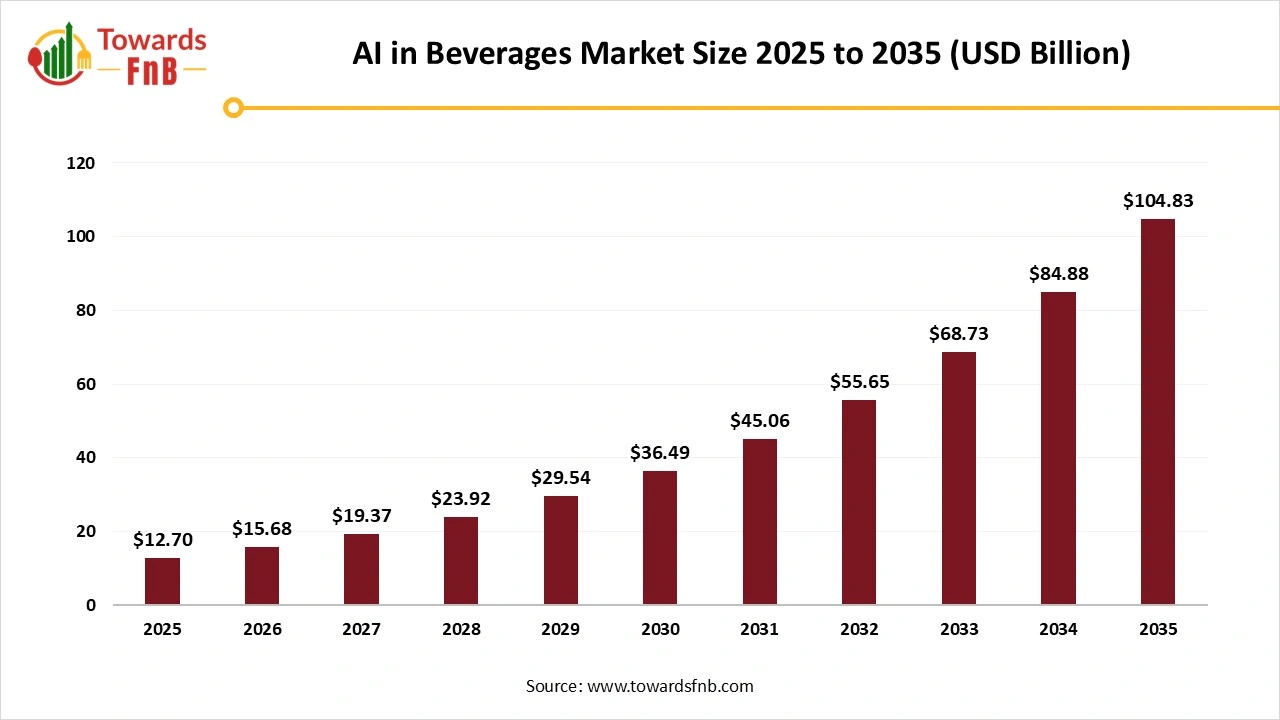
The global ai in beverages market size was valued at USD 12.70 billion in 2025 and is expected to grow steadily from USD 15.68 billion in 2026 to reach nearly USD 104.83 billion by 2035, with a CAGR of 23.5% during the forecast period from 2026 to 2035. The acceleration in new product development and the increasing need for personalized marketing drive market growth.
| Study Coverage | Details |
| Growth Rate from 2026 to 2035 | CAGR of 23.5% |
| Market Size in 2026 | USD 15.68 Billion |
| Market Size in 2027 | USD 19.37 Billion |
| Market Size by 2035 | USD 104.83 Billion |
| Largest Market | North America |
| Base Year | 2025 |
| Forecast Period | 2026 to 2035 |
| Regions Covered | North America, Europe, Asia-Pacific, Latin America, and Middle East & Africa |
AI in beverages utilizes AI to optimize marketing, development, and manufacturing of various beverages. AI performs diverse tasks like quality control, personalised experiences, product development, supply chain, and sustainable operations in the beverages industry. AI offers benefits like lowering waste, creating personalised marketing, developing personalised flavor, reducing disruptions, and monitoring bottling lines.
AI in beverages market growth is driven by the increasing need for enhancing the packaging process, the development of innovative flavor drinks, the need for predicting beverage demand, focus on interactive services, the development of smart packaging, and the popularity of functional drinks.
AI plays a key role in the beverages industry. AI easily understands the ingredients dataset and develops new beverages. AI lowers beverage production time and creates plant-based beverages. AI easily predicts the success of new beverages and optimizes the filtration process. AI detects faulty bottles and optimizes the packaging process. AI easily analyzes social media trends and understands consumer purchasing behavior. AI analyzes the fastest delivery routes and lowers the overstock of beverages.
AI develops tailored rewards for consumers and focuses on lowering waste. AI detects hazards in the manufacturing process and develops high-potential flavors. AI develops a voice-ordering system and lowers resource usage. Additionally, companies like Yum China, Nestlé, Starbucks, Heineken, Diageo, and others use AI for various purposes.
| Technology | Use | Technology Used By Companies |
| Automation and Robotics | Fill, Cap, and Label Bottles Sorting Pallets Optimizing Storage |
Nestle Artly Coffee Coca-Cola |
| Machine Learning | Quality Assurance Demand Forecasting Product Formulation |
PepsiCo Diageo The Coca-Cola Company |
| Computer Vision | Quality Inspection Leak Detection Packaging Assembly Verification Hygiene Monitoring |
Heineken The Coca-Cola Company |
| Generative AI | Novel Flavor Development Enhanced Consumer Experience Supply Chain Optimization Personalized Marketing |
AB InBev Mars Heineken |
What made North America Dominate the AI in Beverages Market?
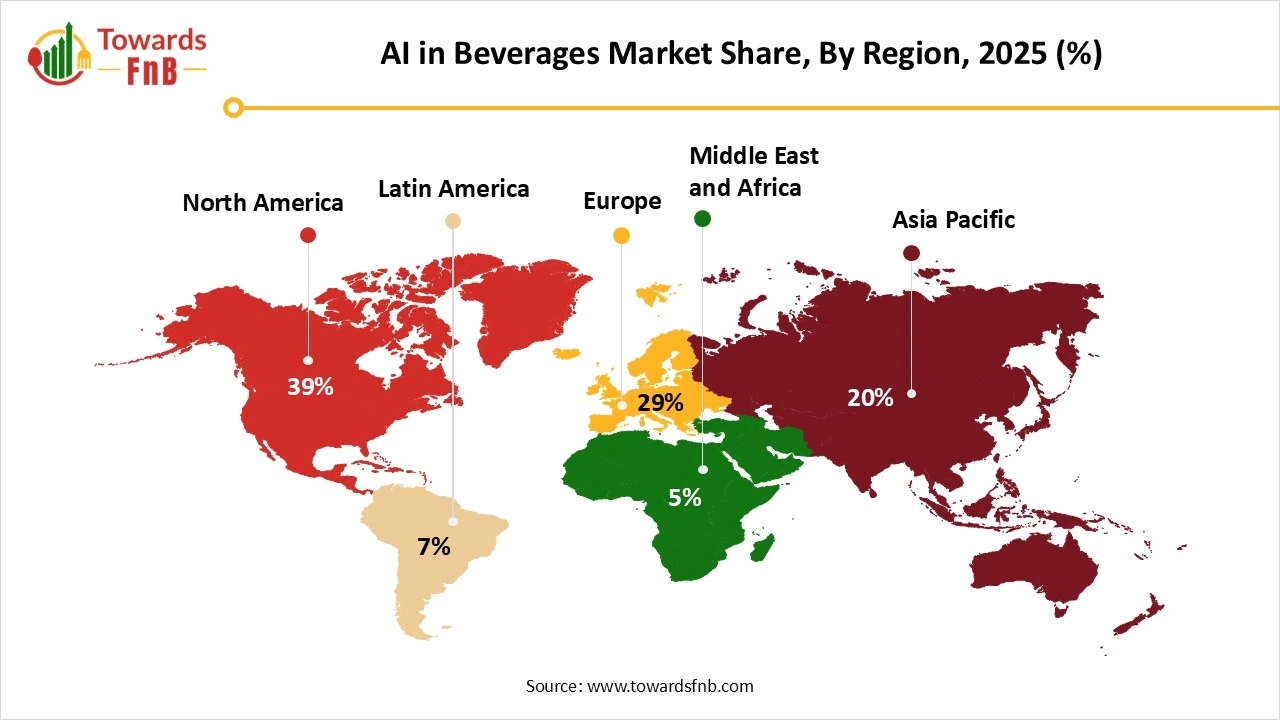
North America dominated the AI in beverages market with approximately 39.5% share in 2025. The strong presence of data centers and growing consumer demand for high-quality beverages increases the adoption of AI in beverages. The increasing use of machine learning in the beverage industry for flavor profiling and food safety compliance helps market expansion. The increasing investment in robotics technology and the strong presence of the Coca-Cola Company drive the overall market growth.
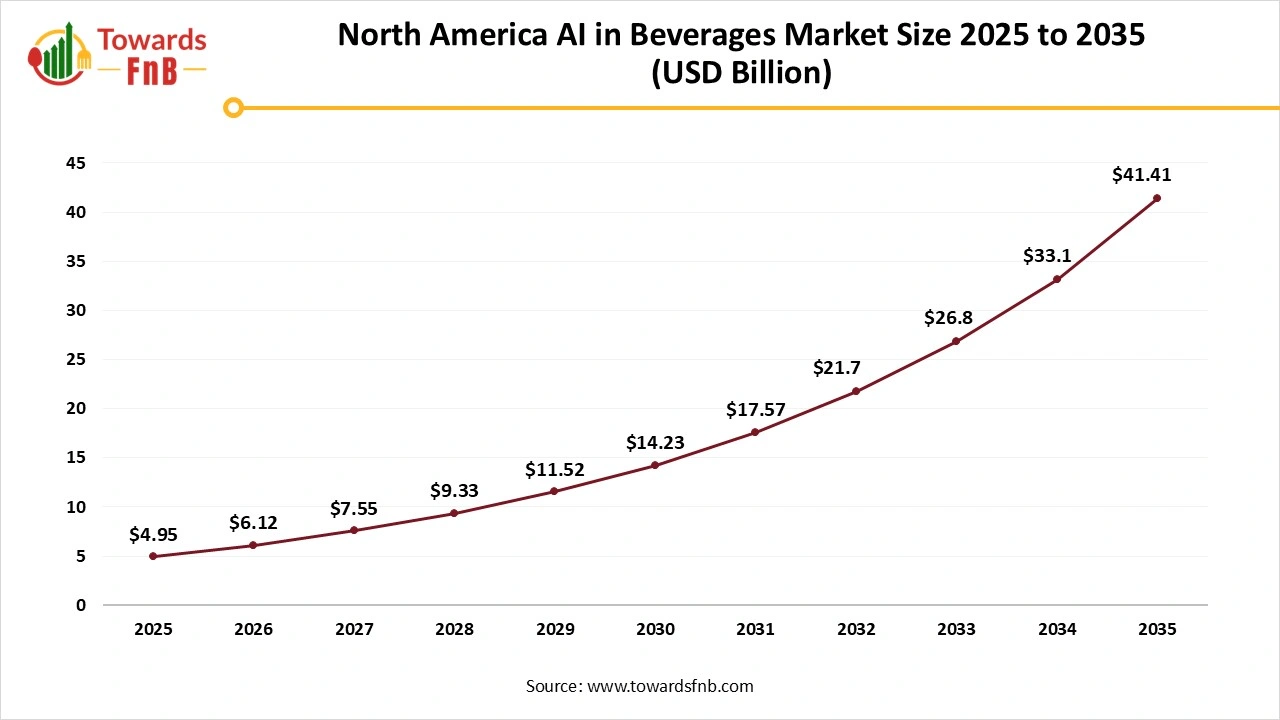
North America AI in Beverages Market Size 2025 to 2035
The North America AI in beverages market size was calculated at USD 4.95 billion in 2025 with projections indicating a rise from USD 6.12 billion in 2026 to approximately USD 41.41 billion by 2035, expanding at a CAGR of 23.67% throughout the forecast period from 2026 to 2035.
United States at the Forefront of AI in Beverages Industry
The United States is the highest contributor to the market. The consumer preference for personalized beverage options and the well-established IT systems increase demand for AI in beverages. The increasing use of generative AI marketing in beverage companies and the heavy investment in the development of customized AI beverages boost expansion. The company's focus on optimizing the production process and the increased consumption of convenient beverages drive the market growth.
How Big is the U.S. AI in Beverages Market?
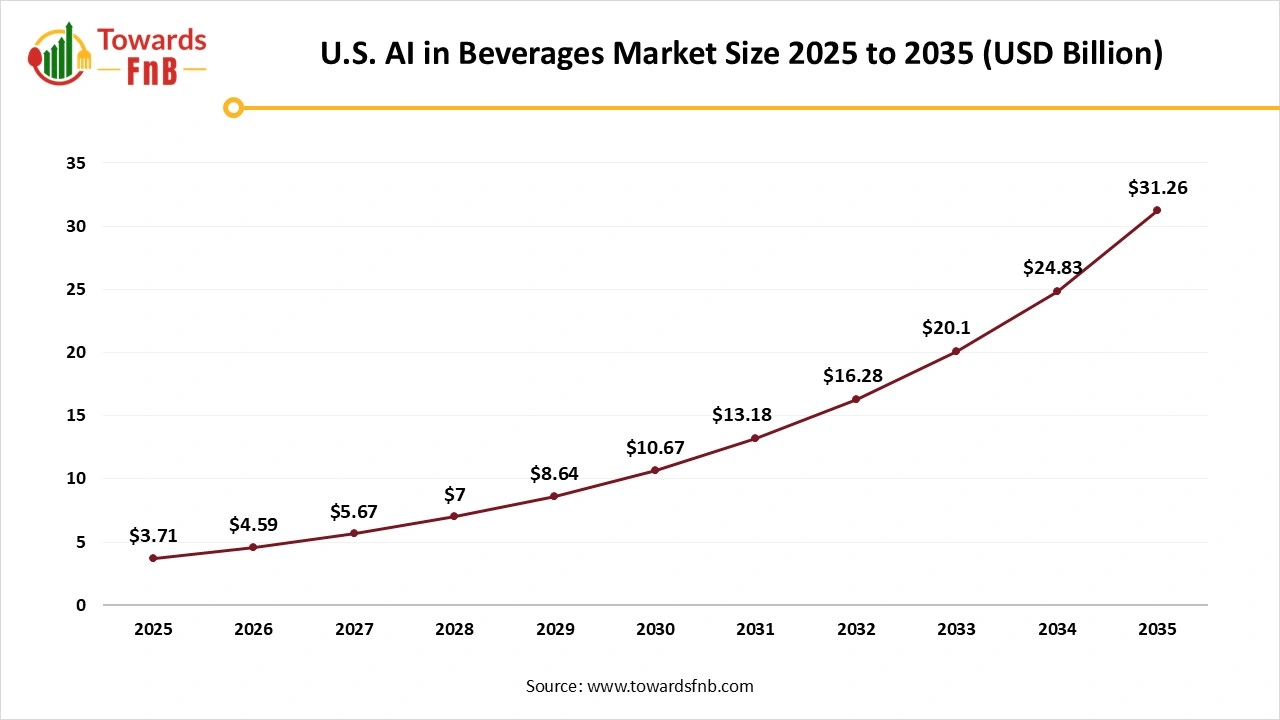
The U.S. AI in beverages market size estimated at USD 3.71 billion in 2025 and is predicted to increase from USD 4.59 billion in 2026 to nearly reaching USD 31.26 billion by 2035, growing at a CAGR of 23.75% during the forecast period from 2026 to 2035.
Asia Pacific AI in Beverages Market Trends
Asia Pacific is experiencing the fastest growth in the market during the forecast period. The growing consumption of zero-sugar beverages and the focus on smart inventory management increase the adoption of AI in beverages. The increasing need for detecting contaminants in real-time and the expanded online delivery platforms increases adoption of AI. The rapid growth in Quick Service Restaurants and a strong focus on analyzing customer behavior increase demand for AI, supporting the market growth.
China's Role in AI-Driven Beverage Production
China is a major contributor to the market in the Asia Pacific region. The growing development of AI-enabled ordering systems and the company's focus on creating hyper-personalized advertisement fuels market expansion. The need for automated quality control and the increasing use of automated systems in cafes increases the adoption of AI. The focus on rapid product development and heavy investment in digital technology supports the overall market growth.
AI in Beverages Market Share, By Technology, 2025 (%)
| Segments | Shares (%) |
| Machine Learning | 36% |
| Computer Vision | 20% |
| Natural Language Processing | 15% |
| Robotics & Automation | 29% |
Why does the Machine Learning Segment Dominate the AI in Beverages Market?
The machine learning segment dominated the AI in beverages market with approximately 36% share in 2025. The strong focus on predicting consumer demand and the need for automated grading of products increases the adoption of machine learning. The development of tailored products and the need for analyzing sales data increases adoption of machine learning. The strong focus on predicting equipment failures and optimizing processing speeds increases adoption of machine learning, driving the overall market growth.
The Robotics & Automation Segment is the Fastest-Growing in the Market During the Forecast Period
The growing demand for heavy lifting in the beverage industry and the focus on solving labor shortages increases adoption of robotics & automation. The explosion of e-commerce and focus on optimizing energy usage increases the adoption of robotics, supporting the overall market growth.
AI in Beverages Market Share, By Application, 2025 (%)
| Segments | Shares (%) |
| Quality Control & Safety Compliance | 34% |
| Consumer Engagement & Personalization | 14% |
| Product Development & Flavor Profiling | 20% |
| Predictive Maintenance | 16% |
| Supply Chain & Inventory Management | 16% |
How did the Quality Control & Safety Compliance Segment hold the Largest Share in the AI in Beverages Market?
The quality control & safety compliance segment held the largest revenue share of approximately 34% in the AI in beverages market in 2025. The strong focus on detecting defects in bottles and the need for analyzing equipment performance increase demand for AI in the beverage industry. The stricter regulatory compliance and the focus on real-time monitoring increases adoption of AI. The increasing use of automated quality inspection and the proactive quality management drive the market growth.
The Consumer Engagement and Personalization Segment is Experiencing the Fastest Growth in the Market During the Forecast Period
The development of dietary needs beverages and the focus on browsing behavior of consumers increases demand for AI. The shift towards personalised experiences and the focus on answering questions increases the adoption of AI. The focus on seamless interactions and the need for increasing conversion rates requires AI, supporting the market growth.
AI in Beverages Market Share, By End User, 2025 (%)
| Segments | Shares (%) |
| Large Beverage Manufacturers | 68% |
| Small & Medium-Sized Enterprises (SMEs) | 18% |
| Quick Service Restaurants (QSRs) & Cafes | 14% |
Which End User Dominated the AI in Beverages Market?
The large beverage manufacturers segment dominated the AI in beverages market with approximately 68% share in 2025. The large companies focus on simulating flavor combinations, and the high-volume production lines increase demand for AI. The need for lowering equipment downtime and the availability of vast consumer data increases adoption of AI. The strong focus on analyzing consumer trends and a strategic partnership with key technology players drive market growth.
The Small & Medium-Sized Enterprises Segment is the Fastest-Growing in the Market During the Forecast Period
The smaller companies focus on optimizing resource allocation, and detecting defects in the sorting process increases demand for AI. The need for understanding market trends and enhancing inventory management increases the adoption of AI.
| Segments | Shares (%) |
| Alcoholic Beverages | 45% |
| Non-Alcoholic Beverages (Soft Drinks, Juices) | 30% |
| Dairy-based Beverages | 25% |
How did the Alcoholic Beverages Segment hold the Largest Share in the AI in Beverages Market?
The alcoholic beverages segment held the largest revenue share of approximately 45% in the market in 2025. The growing expansion of boutique spirits and the development of new alcoholic beverage products increase demand for AI. The focus on improving the filtration process of alcoholic beverages and the need for tailored recommendations require AI. The rapid growth in craft beers and the presence of companies like Heineken, AB InBev, & others drives the market growth.
The Non-Alcoholic Beverages Segment is Experiencing the Fastest Growth in the Market During the Forecast Period
The consumer demand for lower sugar beverages and the increased consumption of simple refreshment drinks increase demand for AI for the rapid development of products. The increased production of energy drinks and the creation of plant-based drinks increases adoption of AI for selecting ingredients. The availability of non-alcoholic options on e-commerce platforms supports the overall market growth.
XCoffee
Shiru
Diageo
By Technology
By Application
By End User
By Beverage Type
By Region





Principal Consultant
Vidyesh Swar, Senior Research Analyst at Towards Food & Beverages, specializes in market research, focusing on supply-demand evaluation, pricing analysis, alternative proteins, plant-based foods, and sustainable food technologies within the industry.
Learn more about Vidyesh Swar
Reviewed By
Aditi Shivarkar, with 14+ years in Food and Beverages market research, specializes in food, beverage, and eco-friendly packaging. She ensures accurate, actionable insights, driving Towards FnB's excellence in industry trends and sustainability.
Learn more about Aditi ShivarkarApril 2026
April 2026
April 2026
April 2026

AI in Beverages Market

 +1 804-441-9344
 Download Sample
 Schedule a Meeting