April 2026



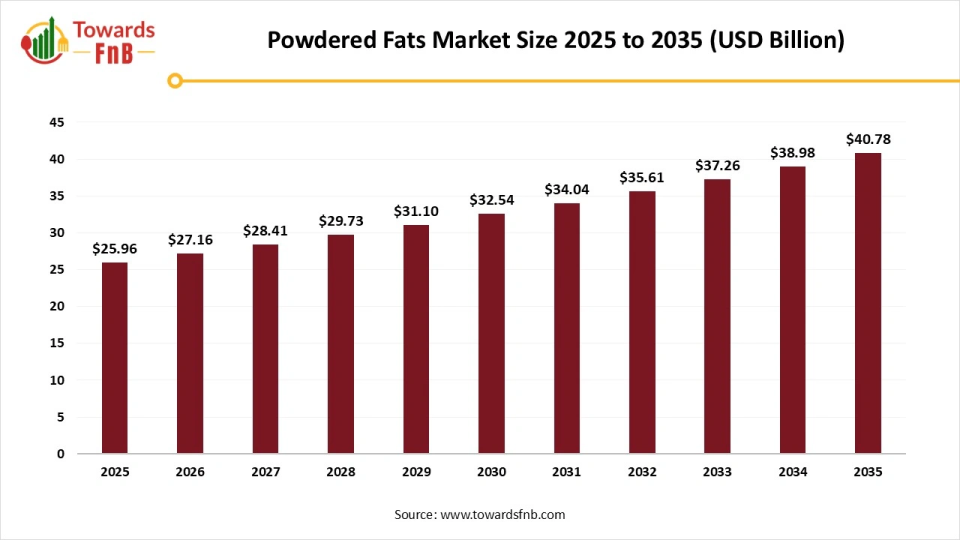
The global powdered fats market size reached at USD 25.96 billion in 2025 and is anticipated to increase from USD 27.16 billion in 2026 to an estimated USD 40.78 billion by 2035, witnessing a CAGR of 4.62% during the forecast period from 2026 to 2035. The growing demand for plant-based fats and the rise in bakery mixes drive market growth.
| Study Coverage | Details |
| Growth Rate from 2026 to 2035 | CAGR of 4.62% |
| Market Size in 2026 | USD 27.16 Billion |
| Market Size in 2027 | USD 28.41 Billion |
| Market Size by 2035 | USD 40.78 Billion |
| Largest Market | Asia Pacific |
| Base Year | 2025 |
| Forecast Period | 2026 to 2035 |
| Regions Covered | North America, Europe, Asia-Pacific, Latin America, and Middle East & Africa |
Powdered fats are fat powders made up of encapsulating oils. They consist of an encapsulation structure and have high flowability. They have a high fat content and are shelf-stable. They are easy to store and have a high oxidative stability. They have low moisture content and excellent dispersibility. They offer benefits like cost efficiency, consistent quality, and improved sensory profile. Powdered fats are widely used in bakery, seasonings, beverages, ice cream mixes, nutraceuticals, and convenience food. They include coconut fat powder, butter powder, groundnut fat powder, palm fat powder, cream powder, and many more.
The powdered fats industry growth is driven by the increased production of dry mixes, higher demand for clean-label fat powder, growth in instant beverages, increased use of bakery mixes, growing demand for shelf-stable ingredients, shift to healthy fats, advancements in microencapsulation, high baby food demand, and the transition to low-carb lifestyles.
The powdered fats industry is undergoing a key technological transformation driven by demand for improving nutritional profiles, superior solubility, and advanced encapsulation. Technological transformations, such as IoT incorporation, advanced microencapsulation, digital twins, automation integration, smart manufacturing, and simulation, help in the production of higher yields and maintaining higher quality. The integration of AI is a key shift driven by demand for analyzing ingredient interactions.
AI manufactures tailored powdered fats formulations and optimizes the complex emulsion process. It detects adulteration and monitors manufacturing equipment. AI predicts the need for raw materials and lowers the water wastage. It also helps in enhancing the texture of powdered fats and enhances efficiency. AI predicts the shelf-life of powdered fats and ensures compliance in the production process. Overall, AI helps in enhancing the productivity of powdered fats.
Raw Material Procurement
Processing and Preservation
Quality Testing and Certifications
Why Asia Pacific Dominated the Powdered Fats Market?
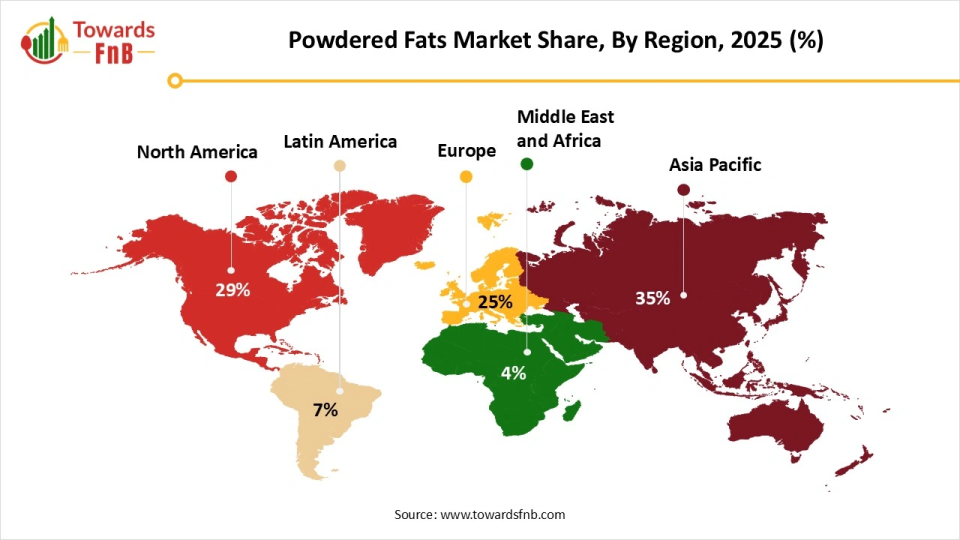
Asia Pacific held a major market share in 2025. The robust industrialization and the increased production of bakery product increase demand for powdered fats. Consumers priority for dairy alternatives and the high spending on high-fat nutrition increase the adoption of powdered fats. The popularity of instant food products and the growing revolution in food processing increases the adoption of powdered fats. Cost-effective production and the presence of companies like Kerry Group, Wilmar International, Fonterra, Cargill, & Aarkay Food Products drive market growth.
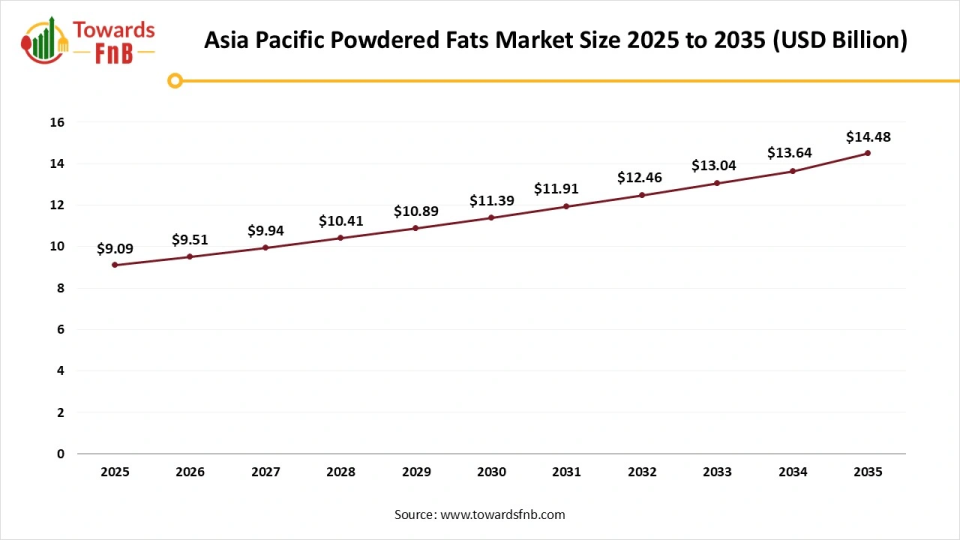
Asia Pacific Powdered Fats Market Size 2025 to 2035
The Asia Pacific powdered fats market size was calculated at USD 9.09 billion in 2025 with projections indicating a rise from USD 9.51 billion in 2026 to approximately USD 14.48 billion by 2035, expanding at a CAGR of 4.77% throughout the forecast period from 2026 to 2035.
India’s Strategic Role in Powdered Fats
India is experiencing rapid growth in the market. The robust growth in convenience snacks and the expansion of ultra-processed food increase demand for powdered fats. The strong culture of café and the surge in instant mixes increase the adoption of powdered fats. Well-established edible oil production and the increased use of palm fat powders support the overall market growth.
How is North America Growing in the Powdered Fats Market?
North America is experiencing the fastest growth in the market during the forecast period. The popularity of packaged food items and the surge in high-fat diets increase demand for powdered fats. The increased popularity of non-dairy alternatives and the rise in convenience mixes production increase the adoption of powdered fats. The popularity of fat-based sports nutrition and the advanced powdered fats production infrastructure drive the market growth.
Power of Powdered Fats in the United States
The U.S. is a prominent contributor to the market. The transition to dairy-free alternatives and the rising trend of low-carb diets increase the adoption of powdered fats. The popularity of dry mixes and the shift to low-carb ingredients increases the adoption of powdered fats. The increased demand for vegan fat powders and the ongoing innovations in spray drying support the overall market growth.
The Palm & Palm Kernel Segment Dominated the Market in 2025
The palm & palm kernel segment dominated the powdered fats market in 2025, due to the growing demand for coffee creamers and a strong focus on the texture of bakery items. The increased use of palm fat powder in the animal feed industry helps with expansion. The excellent technical functionalities, high stability, abundance, functional versatility, high melting point, and cost-effectiveness of palm & palm kernel drives the segment growth.
The coconut segment is expected to show the fastest growth over the forecast period. The demand for lactose-free products and a strong focus on dairy replacements increases demand for coconut. The surging manufacturing of functional beverages and the rise of healthy fat consumption increase the adoption of coconut. The increased use of coconut fat powder in smoothies and bakery items supports the segment growth.
The Spray Drying Segment Led the Market in 2025
The spray drying segment led the powdered fats market in 2025. The large-scale powdered fat production and development of dry mixes use spray drying technology. The popularity of coffee whiteners and the focus on preventing oxidation of fat powders increase the use of spray drying. The superior encapsulation, ease of handling, improved functionality, high throughput, and low cost of spray-dried powdered fats drive segment growth.
The freeze drying segment is expected to witness the fastest growth in the market over the forecast period. The growing premium nutrition industry and the consumer preference for specialized diets increase the adoption of freeze-dried powdered fat that is produced using freeze-drying. The superior stability, optimal texture, low water activity, improved structural integrity, and optimal rehydration in freeze drying support the segment growth.
The Bakery & Confectionery Segment Held the Largest Market Share in 2025
The bakery & confectionery segment held the largest revenue share of the powdered fats market in 2025, driven by the focus on enhancing the performance of baked goods and the need to lower cold storage requirements. The focus on improving confectionery mouthfeel and the increased availability of ready-to-eat (RTE) baked goods increase the adoption of powdered fats. The popularity of indulgent bakery items and the globally growing confectionery sector drive segment growth.
The dairy & non-dairy products segment is expected to expand rapidly in the market in the coming years, due to the boom of lactose-free items and the increased manufacturing of instant dairy products. The rising nutritional shakes consumption and huge demand for infant dairy formulas increase the adoption of powdered fats. The popularity of fat-filled milk powder and the cost-effectiveness of fat powder support the overall growth of the segment.
Marine Biologics
Lactalis
EPI Ingredients
By Source
By Processing Technology
By Application
By Region




Principal Consultant
Vidyesh Swar, Senior Research Analyst at Towards Food & Beverages, specializes in market research, focusing on supply-demand evaluation, pricing analysis, alternative proteins, plant-based foods, and sustainable food technologies within the industry.
Learn more about Vidyesh Swar
Reviewed By
Aditi Shivarkar, with 14+ years in Food and Beverages market research, specializes in food, beverage, and eco-friendly packaging. She ensures accurate, actionable insights, driving Towards FnB's excellence in industry trends and sustainability.
Learn more about Aditi ShivarkarApril 2026
April 2026
April 2026
April 2026

Powdered Fats Market

 +1 804-441-9344
 Download Sample
 Schedule a Meeting