April 2026



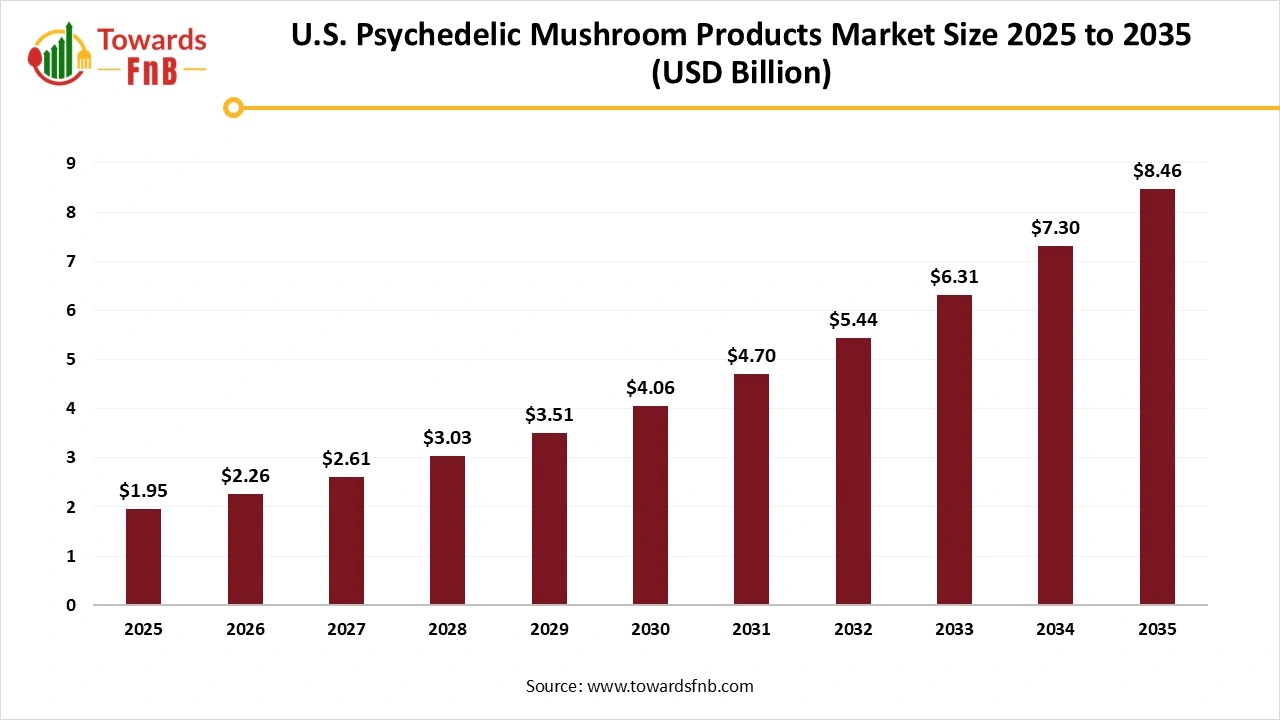
The U.S. psychedelic mushroom products market size stood at USD 1.95 billion in 2025 and is expected to grow from USD 2.26 billion in 2026 to reach approximately USD 8.46 billion by 2035, expanding at a CAGR of 15.8% from 2026 to 2035. Expanding decriminalization efforts and growing consumer shift toward natural, alternative treatments further support market expansion. Additionally, the surge in microdosing trends and the availability of convenient product formats through online channels are accelerating adoption.
| Study Coverage | Details |
| Growth Rate from 2026 to 2035 | CAGR of 15.8% |
| Market Size in 2026 | USD 2.26 Billion |
| Market Size in 2027 | USD 2.61 Billion |
| Market Size by 2035 | USD 8.46 Billion |
| Base Year | 2025 |
| Forecast Period | 2026 to 2035 |
| Segments Covered | Product Type, Application, Distribution Channel, End User, Dosage Type, Source |
Psychedelic mushroom products are products developed from psychoactive compounds. They have active compounds like psilocybin, beta-carbolines, psilocin, non-psilocybin varieties, and secondary alkaloids. They help in addiction recovery, physical pain management, mental health treatment, spiritual growth, subtle mood lifts, and personality changes. Diverse products include edibles, capsules, whole mushrooms, teas, grow kits, chocolates, and powders. Psychedelic mushroom products are widely used for spiritual, recreational, and therapeutic applications.
The U.S. psychedelic mushroom products industry growth is driven by the growing legalization, rising treatments for mental health, increasing mainstream acceptance, growing commercialization, increased product diversity, increasing rates of PTSD, surging media influence, strong institutional support, and growing investment in psychedelic startups.
The U.S. psychedelic mushroom products industry is undergoing key technological changes driven by demand for clinical validation, selective cultivation, consistency, and standardization. Advancements like robotics, synthetic biology, automated vertical farming, machine learning, and genetic engineering help in high-throughput production and increasing yield. The artificial intelligence (AI) integration is facilitated by the demand for personalizing experiences and enhancing product safety.
AI discovers new psychoactive molecules and optimizes the cultivation conditions. AI analyzes the best dosing for consumers and easily adjusts environmental factors. It predicts the best harvest time and lowers the R&D time. It assesses toxicity, analyzes minor discolorations, and enhances harvest yield. It also tracks patient mood and verifies product purity. Overall, AI helps in compound discovery and the development of customized treatment.
Raw Material Procurement
Processing and Preservation
Quality Testing and Certifications
The Psilocybin-Infused Products Segment Dominated the Market with 38% of Market Share in 2025
The psilocybin-infused products segment dominated the U.S. psychedelic mushroom products market with a 38% share in 2025 due to the consumer preference for palatable formats. The strong consumer focus on mental health and the need to address addiction increases demand for psilocybin-infused products. The increased interest in holistic mental wellness and the changing societal attitudes increase the adoption of psilocybin-infused products. The rise in dried mushrooms drives the segment growth.
The microdosing products segment held the second-largest market share of 22% in 2025 and is expected to grow at the fastest CAGR of 18.9% during the forecast period due to the adoption of microdosing by professionals. The focus on increasing energy and managing mental wellness increases demand for microdosing products. The mainstream normalization and performance enhancement of microdosing products support segment growth.
The psilocybin mushrooms segment held the third-largest market share of 18% in 2025 due to the growing consumption among experienced users. The development of new solutions for mental health and the expansion of clinical-grade cultivation increase the adoption of psilocybin mushrooms. The cultural acceptance and medicinal potential of psilocybin mushrooms boost segment growth.
The psilocybin extracts segment held the fourth-largest market share of 12% in 2025 due to its higher potency. The focus on treating anxiety and the popularity of pharmaceutical-grade dosing increase the adoption of psilocybin extracts. The nutraceutical trends and the expansion of clinical settings increase the adoption of psilocybin extracts. The advanced extraction techniques and the increased research drive the market growth.
The Mental Health Treatment Segment Led the Market with 44% of Market Share in 2025
The mental health treatment segment led the U.S. psychedelic mushroom products market with a 44% share in 2025 and is expected to grow at the fastest CAGR of 17.8% during the forecast period due to the increased demand for PTSD treatment. The growing mental health conditions and the need for holistic alternatives increase the adoption of psychedelic mushroom products. The growing burden of mental health and the shift to psychedelic-assisted therapy drive segment growth.
The recreational use segment held the second-largest market share of 26% in 2025 due to the rising cultural acceptance. The strong focus on personal growth and the low addiction potential increase demand for psychedelic mushroom products. The development of processed products and the focus on personal healing increase the adoption of psychedelic mushroom products. The increased experimentation in younger demographics supports segment growth.
The cognitive enhancement segment held the third-largest market share of 18% in 2025 due to the availability of creativity enhancement tools. The focus on improving cognitive function and enhancing synaptic density increases demand for psychedelic mushroom products. The popularity of natural nootropics and the focus on brain fog relief increase the adoption of psychedelic mushroom products. The increased use of non-stimulant alternatives boosts segment growth.
The spiritual & wellness use segment held the fourth-largest market share of 12% in 2025 due to the interest in mindfulness. The trend of self-optimization and the expansion of wellness retreats increases demand for psychedelic mushroom products. The focus on improving mental clarity and expanding retreat centers increases the adoption of psychedelic mushroom products. The rise in wellness tourism supports segment growth.
The Online Retail Segment Held the Largest Market Share of 36% in 2025
The online retail segment held the largest revenue share of 36% in the U.S. psychedelic mushroom products market in 2025 and is expected to grow at the fastest CAGR of 18.2% during the forecast period due to the increased availability of subscription-based microdosing kits. The preference for maintaining privacy and the availability of processed mushrooms increase the adoption of online retail. The rise in digital-native consumers and discreet shipping in online retail drives the segment growth.
The specialty stores segment held the second-largest market share of 28% in 2025 due to the expansion of legal dispensaries in regulated regions. The demand for curated experiences and consumer focus on understanding dosing increases the adoption of specialty stores. The expansion of pre-dosed products and product quality control increases the adoption of specialty stores, supporting the segment growth.
The clinics & therapeutic centers segment held the third-largest market share of 22% in 2025 due to the availability of insurance coverage. The focus on controlled administration and the need to maximize therapeutic potential increases the adoption of clinics & therapeutic centers. The availability of medical supervision and promising clinical evidence boost segment growth.
The underground/informal channels segment held the fourth-largest market share of 14% in 2025 due to the presence of cost-sensitive consumers. The growing scientific evidence and the medicalization barriers increase the adoption of underground/informal channels. The microdosing demand and the growth in online gray markets support segment growth.
The Adults (25-45 Years) Segment Contributed the Biggest Market Share of 42% in 2025
The adults (25-45 years) segment contributed the biggest revenue share of 42% in the U.S. psychedelic mushroom products market in 2025 due to the increased stress levels. Adults' preference for self-treating and the growing number of health-conscious adults increase demand for psilocybin-infused products. The popularity of microdosing among tech professionals and the strong preference for small-processed options drive the segment growth.
The clinical patients segment held the second-largest market share of 26% in 2025 and is expected to grow at the fastest CAGR of 18.5% during the forecast period due to the growth in prescription-based therapy. The focus on treating nicotine dependency and the priority to plant-based remedies increases the adoption of psychedelic mushroom products. Increased acceptance by healthcare providers supports segment growth.
The older adults (45+ years) segment held the third-largest market share of 18% in 2025 due to the interest in cognitive longevity. The growing rate of late-life depression and the rise in treatment-resistant conditions increase demand for psychedelic mushroom products. The strong focus on life enhancement and the growing awareness of the anxiety boost segment growth.
The young adults (18-24 years) segment held the fourth-largest market share of 14% in 2025 due to the growing social media influence. The higher depression rates and the focus on cognitive enhancement in young adults increase demand for psychedelic mushroom products. Growing experimentation and the increased awareness of mental health crises boost segment growth.
The Microdose Segment Dominated the Market with 46% of Market Share in 2025
The microdose segment dominated the U.S. psychedelic mushroom products market with a 46% share in 2025 and is expected to grow at the fastest CAGR of 18.6% during the forecast period due to its minimal side effects. The strong focus on enhancing mood and the focus on the enhancement of a functional lifestyle increase demand for microdosing. The sub-perceptual benefits, manageability, and convenience of microdose drives segment growth.
The standard dose segment held the second-largest market share of 34% in 2025 due to its growing use in therapeutic and recreational applications. The need to lower adverse psychological events and focus on treatment-resistant depression increases the adoption of the standard dose. Consumer familiarity, rising potency, and mainstream acceptance of standard doses support the overall segment growth.
The high dose (therapeutic) segment held the third-largest market share of 20% in 2025 due to the increased use in clinical therapies. Growing public confidence and the high preference for microdosing increase the adoption of high doses. The treatment of severe PTSD and the safety of guided treatments increase the adoption of high doses. The rise in certified therapy centers boosts segment growth.
The Natural Mushrooms Segment Held a Dominant Market Share of 62% in 2025
The natural mushrooms segment held a dominant revenue share of 62% in the U.S. psychedelic mushroom products market in 2025 due to the increasing use of organic mushrooms. The simplified production, perceived purity, ease of cultivation, and widespread accessibility of natural mushrooms help with market expansion. The growing microdosing trend and the DIY growing kits increase the adoption of natural mushrooms, driving the overall segment growth.
The synthetic psilocybin segment held the second-largest market share of 38% in 2025 and is expected to grow at the fastest CAGR of 17.3% during the forecast period due to its pharmaceutical-grade consistency. The increased use of synthetic psilocybin in mental health applications helps with expansion. Regulatory approval, reliability, process efficiency, and pharmaceutical scalability of synthetic psilocybin support the segment growth.
Quirky Monkey
Mycopreneur
By Product Type
By Application
By Distribution Channel
By End User
By Dosage Type
By Source


Principal Consultant
Vidyesh Swar, Senior Research Analyst at Towards Food & Beverages, specializes in market research, focusing on supply-demand evaluation, pricing analysis, alternative proteins, plant-based foods, and sustainable food technologies within the industry.
Learn more about Vidyesh Swar
Reviewed By
Aditi Shivarkar, with 14+ years in Food and Beverages market research, specializes in food, beverage, and eco-friendly packaging. She ensures accurate, actionable insights, driving Towards FnB's excellence in industry trends and sustainability.
Learn more about Aditi ShivarkarApril 2026
April 2026
March 2026
March 2026

U.S. Psychedelic Mushroom Products Market


 +1 804-441-9344
 Download Sample
 Schedule a Meeting