April 2026



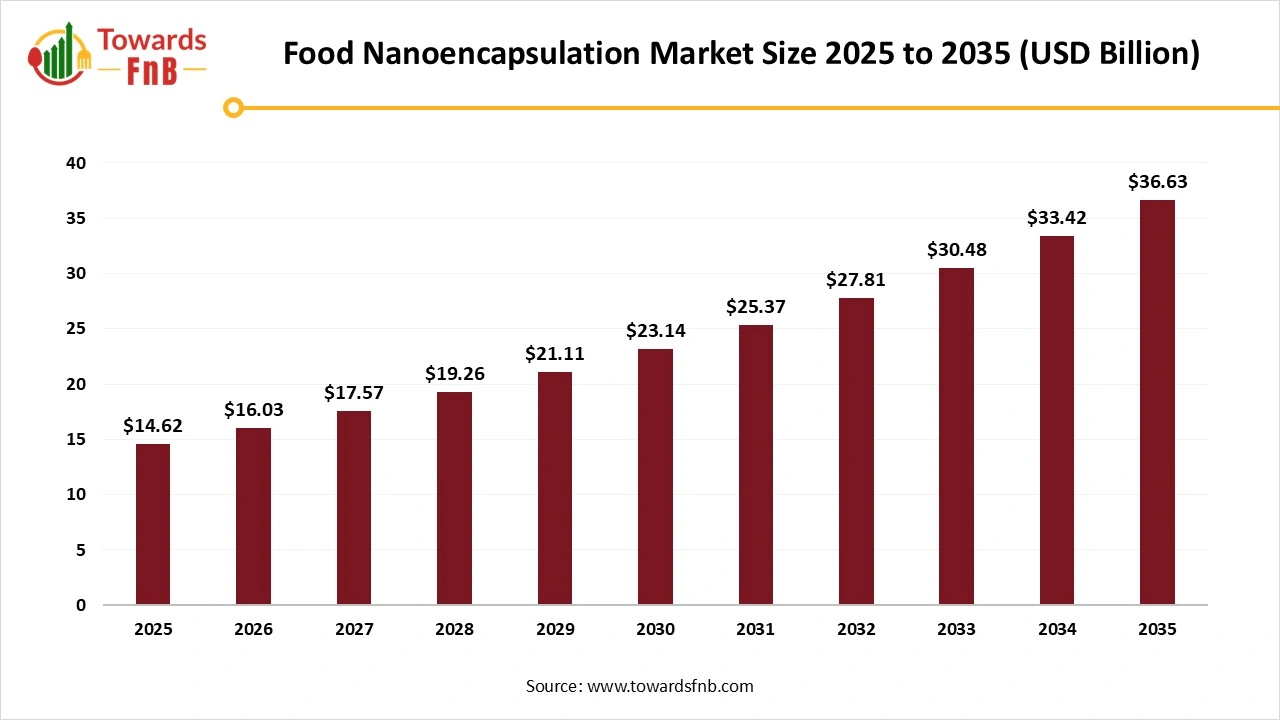
The global food nanoencapsulation market size reached at USD 14.62 billion in 2025 and is anticipated to increase from USD 16.03 billion in 2026 to an estimated USD 36.63 billion by 2035, witnessing a CAGR of 9.62% during the forecast period from 2026 to 2035. The focus on shelf-life extension and the rise in personalised nutrition drives market growth.
| Study Coverage | Details |
| Growth Rate from 2026 to 2035 | CAGR of 9.62% |
| Market Size in 2026 | USD 16.03 Billion |
| Market Size in 2027 | USD 17.57 Billion |
| Market Size by 2035 | USD 36.63 Billion |
| Largest Market | North America |
| Base Year | 2025 |
| Forecast Period | 2026 to 2035 |
| Regions Covered | North America, Europe, Asia-Pacific, Latin America, and Middle East & Africa |
Food nanoencapsulation is the process that enclosed bioactive compounds in nano-sized carriers. The various nanoencapsulation materials are NLCs, whey protein, gelatin, alginate, gum Arabic, cyclodextrins, vitamins, nanoemulsions, casein, cellulose, omega-3, and others. The techniques used for food nanoencapsulation are solvent diffusion, coacervation, electrospraying, spray drying, and inclusion complexation. It offers benefits like enhanced protection, improved absorption, sensory improvement, enhanced solubility, improved texture, and targeted release. Food nanoencapsulation is widely used across applications like nutraceuticals delivery, ingredient masking, food fortification, salad dressing, and smart food packaging.
The food nanoencapsulation market growth is driven by demand for improving stability, focus on masking textures, need to enhance the longevity of food, move to fortified foods, advancements in nanoemulsions, development of clean-label preservatives, expansion of preventive health, focus on nano-based nutrition delivery, and nanocarriers advancements.
The food nanoencapsulation market is experiencing key technological shifts like machine learning, Python, digital tracking, process automation control, and predictive simulation, driven by demand for monitoring the freshness, consistency, and stability of food. The technological innovations focus on precision delivery and targeted release. The major innovation is the use of AI that enhances the stability of the product.
AI optimizes the complex formulation and easily analyzes the biological databases. AI cuts the manufacturing time and easily detects food pathogens. AI predicts ingredient performance under various conditions and helps to develop intelligent packaging. AI enhances the safety of nanoencapsulation of ingredients and easily manufactures stable formulations. Overall, AI speeds up research in the food nanoencapsulation industry.
Raw Material Procurement
Processing and Preservation
Quality Testing and Certifications
| Technique | Description | Benefits |
| Nanoprecipitation | Preparation of Lipophilic Solution | Superior Particle Quality Enhanced Stability Safety High Payload Capacity |
| Coacervation | Separation of Aqueous and Homogeneous Polymer Solution | Unstable Ingredients Safeguarding Masking Unwanted Taste Enhances Flavorings High Encapsulation Efficiency Controlled Release |
| Electrospraying | Electrohydrodynamic Atomization | High Quality One-Step Process Protects Bioactives Tunable Morphology Aggregation Prevention Unpleasant Flavor Masking |
| Spray Drying | Conversion of Liquid Solutions into Solid Nanoparticles | Low Storage Cost Enhances Stability Improves Solubility of Functional Ingredients High-Efficiency Flavor Masking |
How North America Dominated the Food Nanoencapsulation Market?
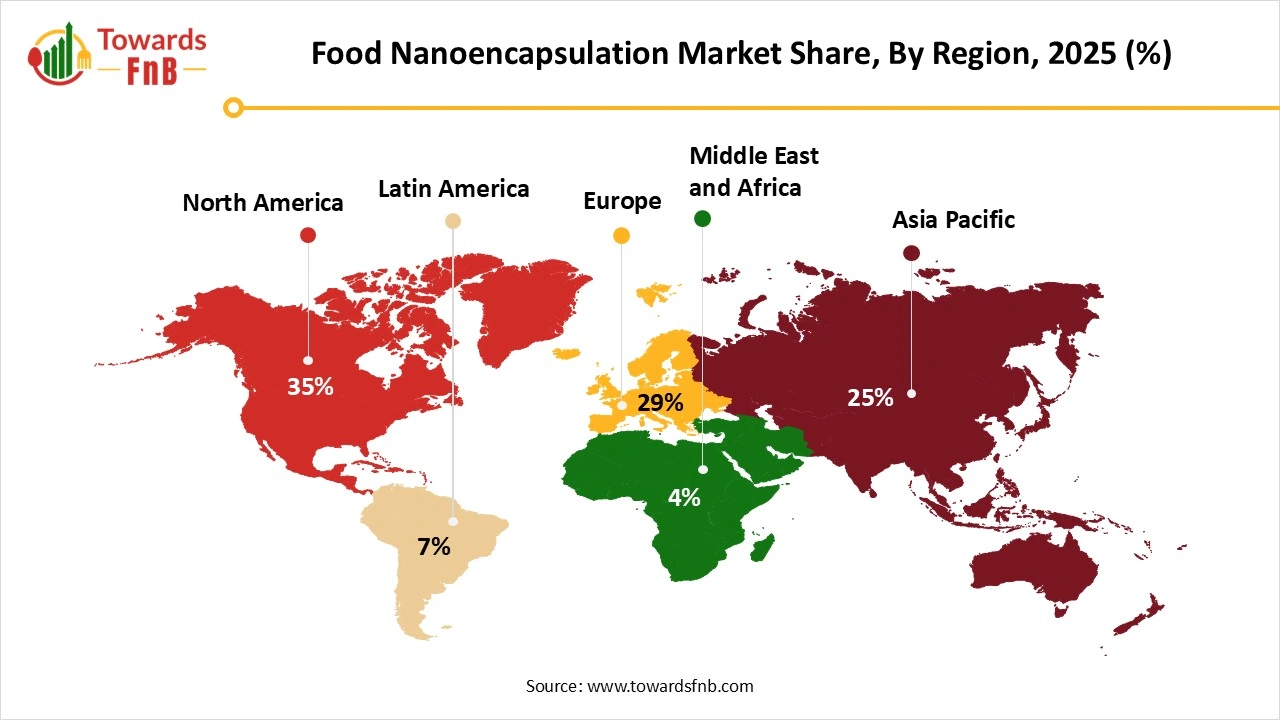
North America dominated the food nanoencapsulation market in 2025. The high awareness about functional food and the increased advancement in the food industry increase demand for food nanoencapsulation. The heavy presence of food manufacturers and the ongoing nanotechnology research increases the adoption of food nanoencapsulation. The growing development of biodegradable materials and the trending fortified foods require food nanoencapsulation, driving the overall market growth.
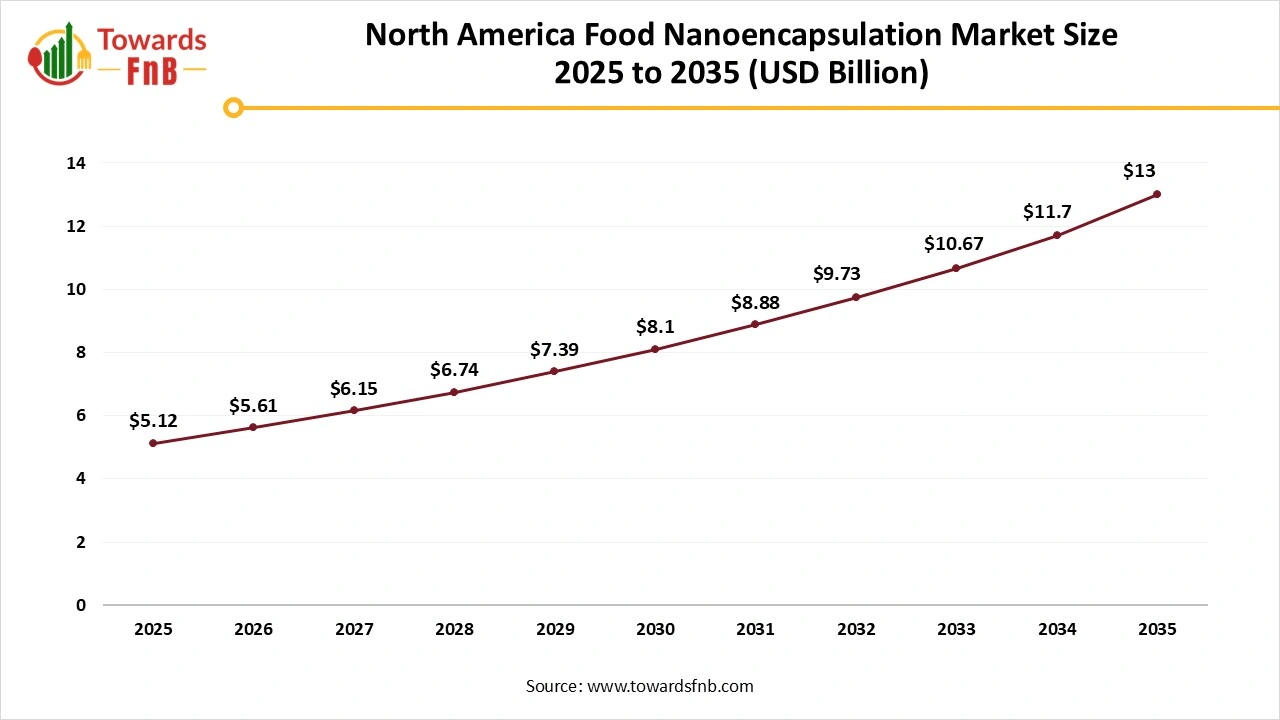
North America Food Nanoencapsulation Market Size 2025 to 2035
The North America food nanoencapsulation market size was calculated at USD 5.12 billion in 2025 with projections indicating a rise from USD 5.61 billion in 2026 to approximately USD 13 billion by 2035, expanding at a CAGR of 9.77% throughout the forecast period from 2026 to 2035.
Role of Food Nanoencapsulation in the United States
The United States is a major contributor to the market. The strong consumer preference for nutritious food and the increased nanotechnology investment increase demand for food nanoencapsulation. The stricter food safety requirements and the presence of food ingredient manufacturers increases adoption of food nanoencapsulation. The growth in on-the-go food items and the increased use of natural encapsulation materials support the overall market growth.
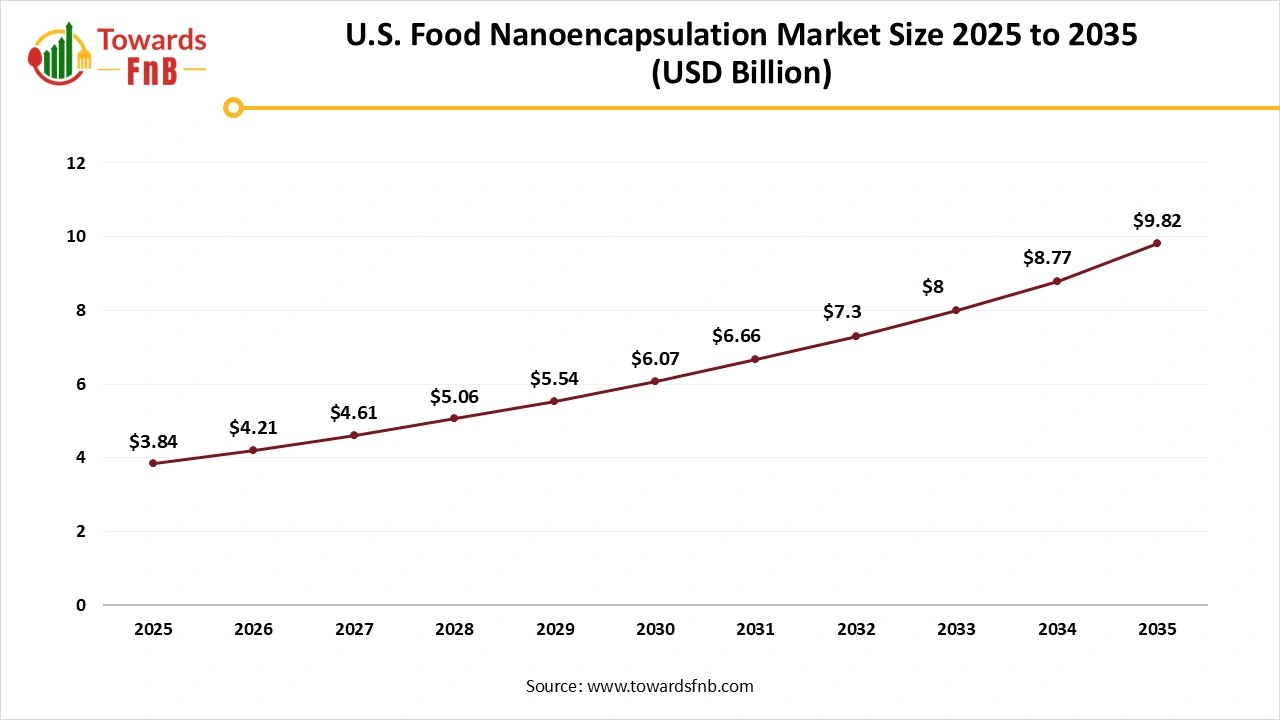
U.S. Food Nanoencapsulation Market Size 2025 to 2035
The U.S. food nanoencapsulation market size was valued at USD 3.84 billion in 2025 and is expected to grow steadily from USD 4.21 billion in 2026 to reach nearly USD 9.82 billion by 2035, with a CAGR of 9.84% during the forecast period from 2026 to 2035.
Asia Pacific Food Nanoencapsulation Market Trends
Asia Pacific is experiencing the fastest growth in the market during the forecast period. The growth in consumers seeking nutraceuticals and the strong focus on food preservation techniques increase demand for food nanoencapsulation. The increased innovation in food formulation and the growth in nutrition fortification increase the adoption of food nanoencapsulation. The focus on shelf-life extension of food items and the increased wellness consciousness in Asian countries increases demand for food nanoencapsulation, supporting the overall market growth.
Expansion of Food Nanoencapsulation in China
China is witnessing rapid growth in the industry. The higher demand for probiotics-enriched foods and the focus on food stability increase demand for food nanoencapsulation. The rise in spending on convenience products and the increased use of nanotechnology across food applications increase the adoption of food nanoencapsulation. The greater production of nutritional supplements boosts market growth.
Europe Food Nanoencapsulation Market Trends
Europe is significantly growing in the market. The growing demand for food that aids digestion and the focus on preserving sensitive ingredients increase the demand for food nanoencapsulation. The high food safety rules and the greater investment in food innovation increase the adoption of food nanoencapsulation. The trending tailored-made diets and the rising development of nano-enabled items drive the market growth.
Germany’s Excellence in Food Nanoencapsulation
Germany is substantially growing in the market. The massive food research industry and the need to enhance the stability of ingredients increase demand for food nanoencapsulation. The leading food science ecosystem and the well-established small enterprises increases adoption of food encapsulation. The increased utilization of standard microencapsulation and the German government's focus on quality create a higher demand for food nanoencapsulation, supporting the overall growth of the market.
Food Nanoencapsulation Market Share, By Encapsulation Technique, 2025 (%)
| Segments | Shares (%) |
| Nanoemulsification | 45% |
| Nanoliposomes | 25% |
| Nanoprecipitation | 15% |
| Inclusion Complexes | 5% |
| Nanoparticles (Polymeric & lipid-based) | 10% |
What made the Nanoemulsification Segment Dominate the Food Nanoencapsulation Market?
The nanoemulsification segment dominated the food nanoencapsulation market in 2025. The surge in the growth of functional beverages and the increased requirement for natural ingredients increases demand for nanoemulsification. The rise in industrial food production and the heavy production of dietary supplements increases demand for nanoemulsification. The excellent organoleptic properties, controlled masking, production scalability, and enhanced bioavailability of nanoemulsification drive the market growth.
The Nanoliposomes Segment is the Fastest-Growing in the Market During the Forecast Period
The growing popularity of smart foods and the need to enhance the texture of creams require nanoliposomes. The growth in active food packaging and the focus on enhancing bioactive compounds in beverages increase demand for liposomes. The natural composition, superior encapsulation efficiency, and enhanced oxidation resistance of nanoliposomes support the overall market growth.
Food Nanoencapsulation Market Share, By Core Material, 2025 (%)
| Segments | Shares (%) |
| Encapsulated Ingredient (Vitamins & Minerals) | 50% |
| Probiotics & Enzymes | 12% |
| Nutraceuticals (Omega-3, Carotenoids, Polyphenols) | 18% |
| Flavors & Aromas | 13% |
| Organic Acids & Preservatives | 7% |
How did the Encapsulated Ingredient Segment hold the Largest Share in the Food Nanoencapsulation Market?
The encapsulated ingredient segment held the largest revenue share in the food nanoencapsulation market in 2025. The greater demand for infant formula and the need for odor masking in some ingredients increase the demand for encapsulated ingredient. The increased global consumption of nutrient-enriched food and focus on enhancing nutrient solubility increase the adoption of encapsulated ingredient. The improved manufacturing and innovations like tailored delivery of encapsulated ingredient drives market growth.
The Nutraceuticals Segment is Experiencing the Fastest Growth in the Market During the Forecast Period
The strong focus on protecting active ingredients and masking the bitter taste of nutraceuticals increases demand for food nanoencapsulation. The shift towards the consumption of foods that support preventive health and need to increase solubility in food matrices increases demand for nanoencapsulation. The strong focus on enhancing sensory characteristics boosts the market growth.
Food Nanoencapsulation Market Share, By Application, 2025 (%)
| Segments | Shares (%) |
| Functional Foods | 20% |
| Dietary Supplements | 40% |
| Infant Nutrition | 8% |
| Sports & Clinical Nutrition | 10% |
| Bakery | 8% |
| Dairy & Confectionery | 14% |
Which Application Dominated the Food Nanoencapsulation Market?
The dietary supplements segment dominated the food nanoencapsulation market in 2025. The focus on efficient delivery of nutrition to the human body and the heavy requirement for the protection of sensitive compounds increase demand for nanoencapsulation. The masking odor of dietary supplements and the development of personalised nutrition product requires food nanoencapsulation. The heavy utilization of omega-3 fatty acids and the strong presence of dietary supplements in the North American region drive market growth.
The Functional Foods Segment is the Fastest-Growing in the Market During the Forecast Period
The strong focus on developing strong immunity and interest in healthy products increases demand for functional food. The need to maximize health benefits and the growing fortification of nutritional ingredients in foods increases demand for food nanoencapsulation. The consumer focus on the functional benefits of functional foods supports market growth.
Council for Scientific and Industrial Research (CSIR)
FrieslandCampina Ingredients
By Encapsulation Technique
By Core Material
By Application
By Region





Principal Consultant
Vidyesh Swar, Senior Research Analyst at Towards Food & Beverages, specializes in market research, focusing on supply-demand evaluation, pricing analysis, alternative proteins, plant-based foods, and sustainable food technologies within the industry.
Learn more about Vidyesh Swar
Reviewed By
Aditi Shivarkar, with 14+ years in Food and Beverages market research, specializes in food, beverage, and eco-friendly packaging. She ensures accurate, actionable insights, driving Towards FnB's excellence in industry trends and sustainability.
Learn more about Aditi ShivarkarApril 2026
April 2026
April 2026
April 2026

Food Nanoencapsulation Market


 +1 804-441-9344
 Download Sample
 Schedule a Meeting