April 2026



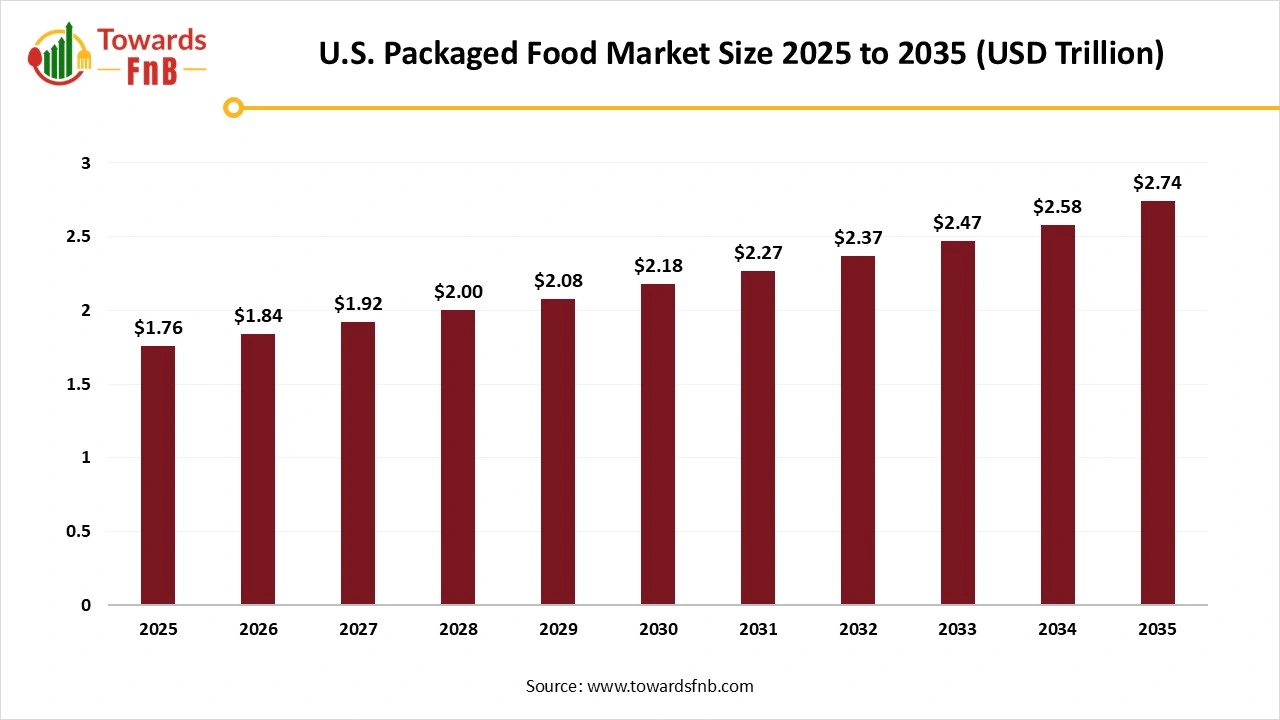
The U.S. packaged food market size stood at USD 1.76 trillion in 2025 and is predicted to grow from USD 1.84 trillion in 2026 to approximately USD 2.74 trillion by 2035, expanding at a CAGR of 4.53% from 2026 to 2035. The growing demand for gluten-free packaged food and urban lifestyles drives market growth.
| Study Coverage | Details |
| Growth Rate from 2026 to 2035 | CAGR of 4.53% |
| Market Size in 2026 | USD 1.84 Billion |
| Market Size in 2027 | USD 1.92 Billion |
| Market Size by 2035 | USD 2.74 Billion |
| Base Year | 2025 |
| Forecast Period | 2026 to 2035 |
Packaged food is food items wrapped in various containers to protect them from environmental damage. The functions of packaged food are convenience, protection, easy transportation, and preservation. The packaged food is packed using materials like metals, edible films, plastic, aseptic, glass, and polypropylene. It offers benefits like extended shelf life, portability, accessibility, food safety, nutrition management, branding, and portion control. Packaged food includes frozen goods, shelf-stable snacks, ready-to-eat (RTE) meals, packaged dairy, and pre-sealed raw food.
The U.S. packaged food industry is growing due to busy work schedules, burgeoning demand for non-GMO packaged food, rise in home delivery, focus on long-term storage, increasing use of biodegradable packaging, rise in transparent sourcing, growing interest in clean labels, popularity of bold flavors, and development of lactose-free packaged food.
The U.S. packaged food industry is going through several technological shifts driven by demand for transparency, inventory management, and safety. Advancements, such as machine learning, robotics, smart packaging, 3D food printing, blockchain, and automation, help innovate food design, optimizing inventory, and improving efficiency. The industry is experiencing a major shift, which is the incorporation of AI.
AI easily detects improper labeling and optimizes the design of packaging. AI analyzes the taste of products and easily monitors the conditions of storage. AI lowers the use of materials and identifies the product's freshness. It analyzes packaging errors and accurate shelf life of the product, increasing packaging efficiency. It also develops sustainable packaging solutions and detects seal breaches. Overall, AI helps boost the productivity of packaged food.
Raw Material Procurement
Processing and Preservation
Quality Testing and Certifications
The Bakery & Confectionery Segment Dominated the Market with 22% Market Share in 2025
The bakery & confectionery segment dominated the U.S. packaged food market with a 22% share in 2025 due to the growing consumer demand for indulgence foods. The hectic schedules of consumers and the popularity of bread in American diets increase the development of bakery & confectionery items. The strong presence of in-store bakeries and innovations in gluten-free offerings helps with market expansion. The ongoing innovation in packaging technology drives segment growth.
The dairy products segment held the second-largest share of 18% in the market in 2025 due to increased consumption of functional dairy items. The focus on calcium intake and the growing trend of cooking at home increase the adoption of dairy products. The ongoing advancements in plant-based dairy help with expansion. The popularity of packaged cheese snacks and the increased consumption of high-protein dairy drinks support segment growth.
The meat, poultry & seafood segment held the third-largest share of 16% in the market in 2025 due to the awareness of high-protein diets. The high demand for pre-seasoned meat and the transition to antibiotic-free proteins increase the adoption of meat, poultry, & seafood. The enhancement in supply chains and the popularity of portion-controlled boost segment growth.
The frozen & ready meals segment held the fourth-largest share of 17% in the market in 2025 and is expected to grow at the fastest CAGR of 5.6% during the forecast period due to the move towards convenience food. The longer working hours and the focus on curbing food waste increase demand for frozen & ready meals. The higher demand for ethnic meals and the expansion of single-person households support segment growth.
The Flexible Packaging Segment Led the Market with 46% Market Share in 2025
The flexible packaging segment led the U.S. packaged food market with a 46% share in 2025 and is expected to grow at the fastest CAGR of 5.2% during the forecast period due to its lightweight properties. Consumer preference for easy-to-open packaging and the government's focus on lowering waste increase the adoption of flexible packaging. The excellent barrier technology, vibrant graphics, and cost-efficiency of flexible packaging drive segment growth.
The rigid packaging segment held the second-largest share of 34% in the market in 2025 due to the growing demand in the dairy and beverage industry. The consumer demand for excellent portability and the need to maintain food freshness increase the adoption of rigid packaging. The growing online delivery and the strong focus on recycling increase the use of rigid packaging. The resealable mechanism of rigid packaging supports the segment growth.
The semi-rigid packaging segment held the third-largest share of 20% in the market in 2025 due to the increasing use in fresh food packaging. The demand for microwaveable containers and the focus on lowering shipping costs increase the adoption of semi-rigid packaging. The growing use of semi-rigid packaging in ready-to-eat foods boosts segment growth.
The Supermarkets & Hypermarkets Segment Held the Largest Market Share of 40% in 2025
The supermarkets & hypermarkets segment held the largest revenue share of 40% in the U.S. packaged food market in 2025 due to its readily accessible aisles. The well-established presence of private labels and the rise in high-volume purchasing increase the adoption of supermarkets & hypermarkets. The presence of reliable supply chains and the consumer demand for physical product inspection increases the adoption of supermarkets & hypermarkets. The offers like buy-one-get-one in supermarkets & hypermarkets drive segment growth.
The online retail segment held the second-largest share of 20% in the market in 2025 and is expected to grow at the fastest CAGR of 8.1% during the forecast period due to the increased adoption of digital grocery. The consumer preference for avoiding store visits and the availability of high-speed internet increase the adoption of online retail. The demand for non-GMO products and the improved mobile apps support segment growth.
The convenience stores segment held the third-largest share of 18% in the market in 2025 due to the quick purchasing habits. The growing workforce participation and the increased stocking of organic products increase the adoption of convenience stores. The high adoption rate of ready-to-cook products and the growing foot traffic increase the adoption of convenience stores, supporting the segment growth.
The specialty stores segment held the fourth-largest share of 12% in the market in 2025 due to the high preference for curated products. The growing consumer demand for products made without artificial additives and the shift to artisanal products increase the adoption of specialty stores. The explosive growth in specialty retail and the changing dietary preferences boost segment growth.
The Adults Segment Contributed the Highest Market Share of 55% in 2025
The adults segment contributed the highest revenue share of 55% in the U.S. packaged food market in 2025 due to their busy work schedules. Adults focus on reducing cooking time, and a higher demand for low-calorie items increases the adoption of packaged food. Adults focus on purchasing ease, and the growing number of urban workers increases the adoption of packaged food. The surging number of female workers and the adult consumer preference for single-serve options drive segment growth.
The children segment held the second-largest share of 25% in the market in 2025 and is expected to grow at the fastest CAGR of 4.7% during the forecast period due to the preference for fun-format foods. Parents' preference for prepackaged meals and healthier snacking increases the adoption of packaged food. They focus on managing children's nutrition, and the increased availability of cartoon characters' packaging supports segment growth.
The elderly segment held the third-largest share of 20% in the market in 2025 due to the heavy demand for specialized diets. The growing demand for easy-to-digest foods and the strong focus on easy preparation increase the adoption of packaged foods. The focus on managing health and the growing independent living requires packaged food, boosting the segment growth.
The Mid-Range Segment Dominated the Market with 45% Market Share in 2025
The mid-range segment dominated the U.S. packaged food market with a 45% share in 2025 due to the increased consumption of better-for-you products. The consumer's strong focus on cleaner labelling and the need to ensure product safety increases the adoption of mid-range products. Increased trust in branded food products and the ongoing flavor innovations increase the adoption of mid-range products, driving the overall segment growth.
The economy segment held the second-largest share of 30% in the market in 2025 due to the growing consumer trust in private label products. The higher demand for heat-and-serve food and the focus on low-sugar options increase demand for the economy range. The increased adoption of sustainable packaged goods and the inflationary pressure increase the adoption of the economy range products. The consumer preference for cost savings supports segment growth.
The premium segment held the third-largest share of 25% in the market in 2025 and is expected to grow at the fastest CAGR of 6.2% during the forecast period due to the rising premiumization trends. The increased demand for products providing health benefits and the huge spending on convenience foods increase the adoption of the premium range. The huge demand for organic products and innovative branding boosts the segment growth.
PepsiCo
Fruitist
The Kroger Co.
By Product Type
By Packaging Type
By Distribution Channel
By Consumer Type
By Price Range


Principal Consultant
Vidyesh Swar, Senior Research Analyst at Towards Food & Beverages, specializes in market research, focusing on supply-demand evaluation, pricing analysis, alternative proteins, plant-based foods, and sustainable food technologies within the industry.
Learn more about Vidyesh Swar
Reviewed By
Aditi Shivarkar, with 14+ years in Food and Beverages market research, specializes in food, beverage, and eco-friendly packaging. She ensures accurate, actionable insights, driving Towards FnB's excellence in industry trends and sustainability.
Learn more about Aditi ShivarkarApril 2026
April 2026
April 2026
March 2026

U.S. Packaged Food Market


 +1 804-441-9344
 Download Sample
 Schedule a Meeting