
Dairy Food Market Size, Growth, and Trends 2025 to 2035

The global dairy food market size is forecasted to expand from USD 1.07 trillion in 2026 to reach around USD 1.84 trillion by 2035, at a CAGR of 6.2% over the forecast period from 2026 to 2035. The market growth is driven by rising consumer demand for nutritious and protein-rich foods, along with increasing awareness of health and wellness.

Last Updated: 27 February 2026 Category: B2C Food & Beverages Products Insight Code: 5545 Format: PDF / PPT / Excel

Dairy Food Market Size, Share, and Forecast Analysis

The global dairy food market size reached at USD 1.01 trillion in 2025 and is expected to grow steadily from USD 1.07 trillion in 2026 to reach nearly USD 1.84 trillion by 2035, with a CAGR of 6.2% during the forecast period from 2026 to 2035. Demand for milk and milk-based products as meat alternative option for fulfil nutritional demand significantly driving the market.
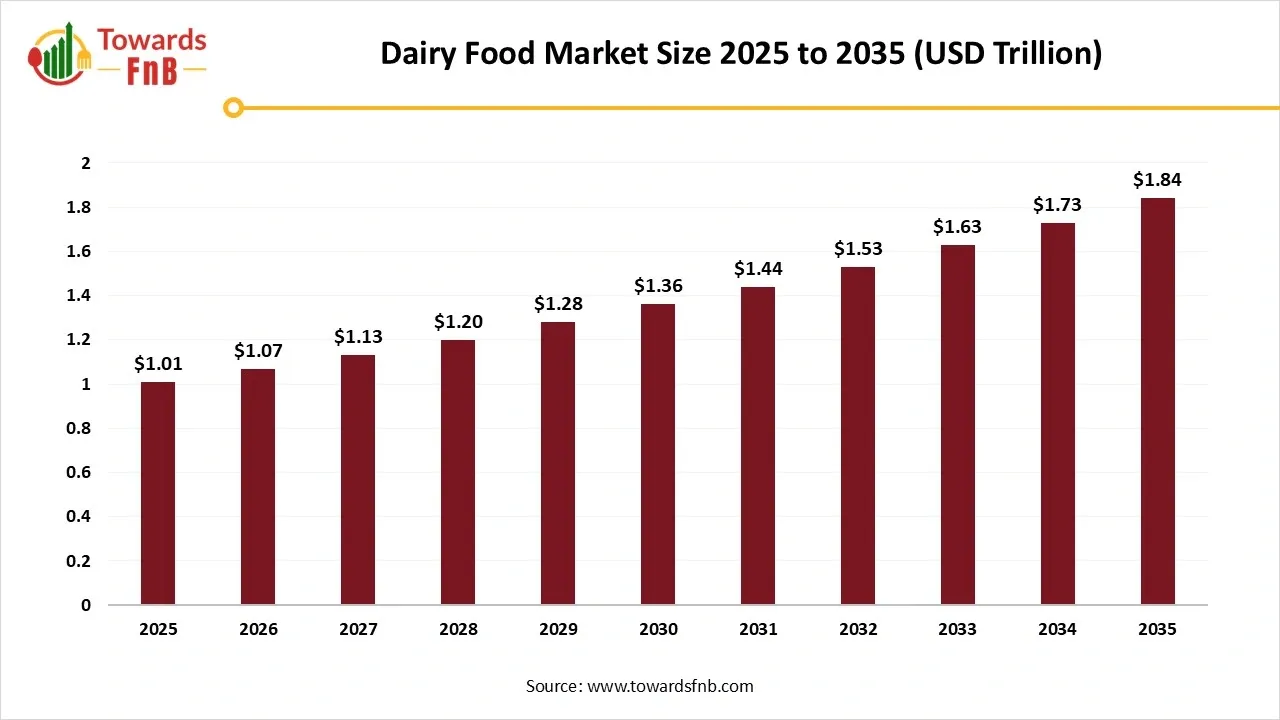
Dairy Food Market 2025 to 2035

Key Highlights

  • By region, Asia Pacific dairy food market dominated the market with the largest share of 41% in 2025. Almost around half of people in the region prioritize their diet, looking for products that complete their nutritional and personal needs, thus, boosting the market. 
  • By region, North America is observed to grow at the fastest rate during the forecast period. Rising consumption of dairy foods in North America is mainly driven by emerging awareness of health benefits related with dairy consumption. 
  • By source, the cattle segment held the largest share of the market in 2025. In comparison to other dairy animals, cattle offer numerous benefits regarding milking convenience, udder dimensions, capacity for milk storage, and milk production.
  • By source, the sheep segment is seen to grow at a notable rate during the predicted timeframe. Sheep milk serves as a superb source of high-quality protein, calcium, phosphorus, magnesium, zinc, and various vitamins. 
  • By type, the lactose segment led the dairy food market in 2025. Lactose is recognized for its ability to improve the absorption and retention of calcium, magnesium, and manganese and therefore increased demand for the lactose milk.
  • By type, the lactose-free segment is expected to grow at the fastest rate in the market during the forecast period. About 70% of the global population faces a high risk of developing lactose intolerance, which accounts for the growing significance of lactose-free products in the market.
  • By product type, the milk segment held the largest share of the market in 2025. Increasing net income, rising population and increasing health consciousness significantly increasing the demand for the milk.
  • By product type, the cheese segment is observed to grow at the fastest rate during the forecast period. Increasing demand for western food menu like burger, pizzas and pastas loaded with cheese, growing outlets of fast-food chains fueling the demand for the cheese.
  • By distribution channel, supermarkets and hypermarkets dominated the dairy food market with the largest share in 2025. They offer the probable convenience by providing a one-stop shopping experience.
  • By distribution channel, the convenience stores segment is seen to grow at a notable rate during the predicted timeframe. Convenience stores are typically small, local stores that provide consumers a different range of dairy food products.

Dairy Food Industry Coverage

Study Coverage Details
Growth Rate from 2026 to 2035 CAGR of 6.2%
Market Size in 2026 USD 1.07 Trillion
Market Size in 2027 USD 1.13 Trillion
Market Size by 2035 USD 1.84 Trillion
Largest Market Asia Pacific
Base Year 2025
Forecast Period 2026 to 2035
Regions Covered North America, Europe, Asia-Pacific, Latin America, and Middle East & Africa

Surge In Nutritional Food Demand Fostering the Market

Dairy foods are loaded with nutrients that are beneficial for good bone health, including calcium, protein, vitamin D, phosphorus and potassium. In low and lower-middle-income nations where access to animal-based foods is restricted, dairy foods play important role in completing the community’s nutritional demands. More than 6 billion consumers globally consume milk and milk-based items and most of these consumers live in developing regions.

Demand for milk and milk products in developing nations is rising with increasing incomes, rising population, urbanization and changes in dietary habits. The fostering demand for milk and dairy foods give a good chance for producers and members involved in supply chain in strong-potential, outer-urban areas to improve their livelihoods through boosted production of dairy foods and leads to the growth of dairy food market . 

  • The increasing customers focus on health and well-being is thriving invention in functional and fortified dairy foods. Producers are researching different methods to improve the natural nutritional advantages of dairy while creating products that tackle specific health concerns. Consumers are also adopting plant-based dairy products in response to health concern, environmental awareness and animal-welfare. 
  • For instance, In March 2024, the U.S. Food and Drug Administration accepted authorized health claim regarding the consuming yogurt and its relationship with a lowered risk of type 2 diabetes. 
  • Integration of AI in the dairy segment has revolutionized the dairy food market. Machine learning algorithms can assist large amounts of data on customer preferences, nutritional demands, and flavor profiles to help the formulation of novel products. This data-driven innovative method could substantially lower the time and resources needed to launch new dairy food items to market. Inventions in refrigeration and transportation technologies are combating the problems associated to product wastage and shelf life. 
  • Sustainability is now considered as vital factor in dairy foods industry, to reduce the impact on environment. Acid whey and milk permeate are the byproducts developed by dairy foods industries, may be reused for the development of valuable finished products and components. 
  • Different government initiatives and funding for the development of the dairy sector, livestock management and agriculture increasing the production of dairy foods and expanding the dairy food market . 
  • A tripartite agreement established among FAO, the Department of Animal Husbandry and Dairying Government of India, and NDDB to formalize their institutional cooperation. This agreement will establish distinct roles and responsibilities for expanding milk value chain activities, improving infrastructure, and guaranteeing the long-term viability of dairy farming throughout the region. Through FAO's foundational work and NDDB’s significant investment, this joint effort is set to revolutionize the dairy industry in Morena and Sheopur, guaranteeing sustained success for farmers while tackling essential environmental issues.

Market Opportunity 

Emerging Trends in Flavor Innovation Leveraging the Market

Flavor innovation and diversification in dairy foods providing the opportunities for the new product development with exotic flavors to attract consumers. By acquiring complete knowledge of flavor trends and using advanced flavor development technology, producers are developing the newer products. Rising demand for ethnic and authentic flavors further boosting the dairy food market. Flavor improvement of fermented dairy foods using microorganisms is encouraging as a method that permits an internal approach to create target aroma compounds.

Market Challenge 

Price Surges and Supply Chain Breakdown Impeding the Growth

Increasing cost of feed, fuel, processing and labor rising the ultimate cost of the dairy foods. Surging costs can affect profit margins and demand for effective cost management strategies. Supply chain incapabilities, majorly in the unorganized segment, can lead to high wastage and low product quality. In last few years, the worldwide dairy food market has faced unparalleled supply chain breakdowns, compelled by a combination of geopolitical tensions, pandemics, and natural calamities.

Dairy Food Market Regional Insights 

Asia Pacific Dairy Food Market Dominated the Market with the Largest Share in 2025

Almost around half of people in the region prioritize their diet, looking for products that complete their nutritional and personal needs. One out of three consumers in Asia Pacific have bone health as their primary concern therefore there is increase in demand for milk and dairy foods. Government initiatives for milk promotion, with the help of school milk program, also act as an accelerator the expansion of demand. Worldwide competitiveness is also fostering new uses for milk-based food products, increasing demand for cheese variety, rise in niche items markets and prolonged shelf life of the product. 

Asia Pacific Dairy Food Market Size 2025 to 2035

The Asia Pacific dairy food market size was valued at USD 414.1 billion in 2025 and is expected to grow steadily from USD 438.7 billion in 2026 to reach nearly USD 763.6 billion by 2035, with a CAGR of 6.31% during the forecast period from 2026 to 2035.
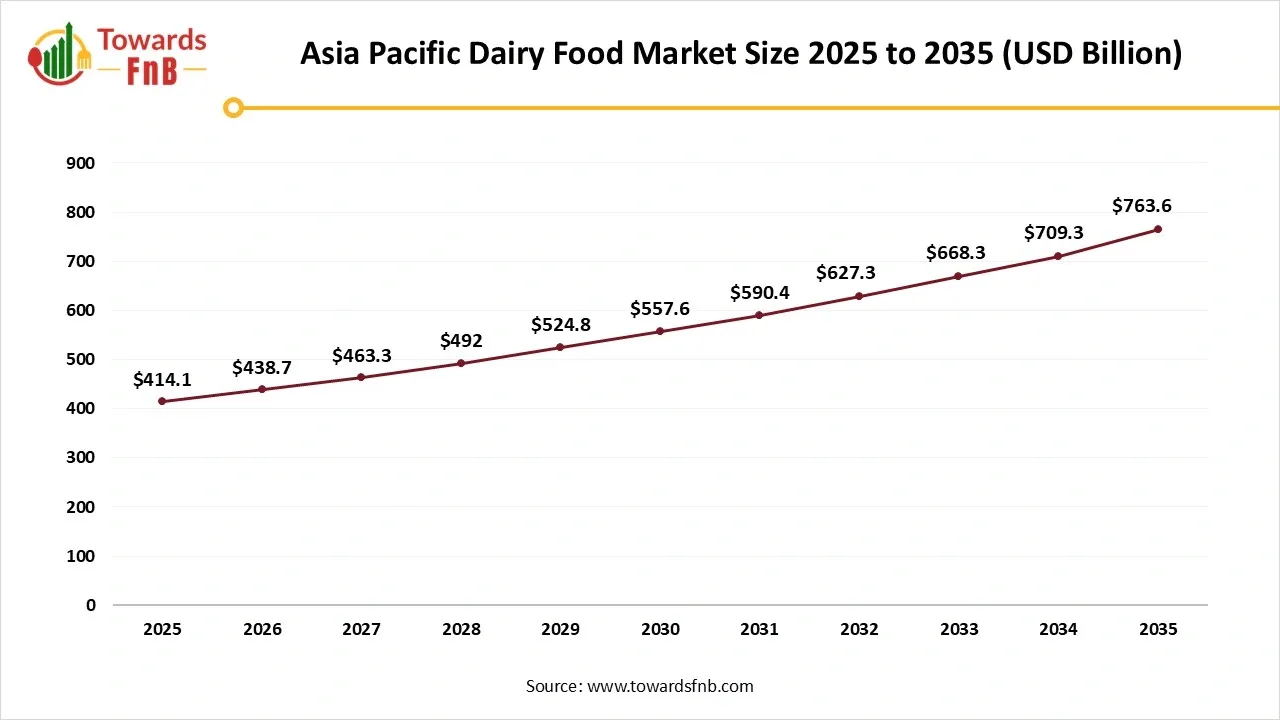
Asia Pacific Dairy Food Market Size 2025 to 2035

China’s Evolving Dairy food market 

Dairy food market of China held the prominent position in the market. China's dairy industry has transformed into a significant player in production, consumption, and trade, utilizing years of growth to gain a competitive advantage. Chinese dairy firms are becoming more embedded in the international market. As living standards improve, dairy products have become essential in the Chinese diet, transforming from basic breakfast milk to a variety of dairy items such as cheese and milk tea, indicating a wider consumption pattern. In the first half of 2024, New Zealand continues to be the top exporter of dairy products to China, holding a 51% market share. Almost fifty percent of the import volume from New Zealand consists of powders, with milk and cream following. As living standards improve, dairy food products are now essential to the Chinese diet, transitioning from basic breakfast milk to a variety of dairy foods such as cheese and milk tea, showcasing a more complex consumption pattern and boosting dairy food market . 

North America Expected to Grow at the Fastest Rate in the Market During the Forecast Period

Rising consumption of dairy foods in North America is mainly driven by emerging awareness of health benefits related with dairy consumption. Increase in the demand of food products such as milk, cheese, butter and skimmed milk powder boosting the market. The rising acceptance of the dairy foods due to the nutritional benefits and the heavy consumption of cheese in daily diet accelerate the market expansion. 
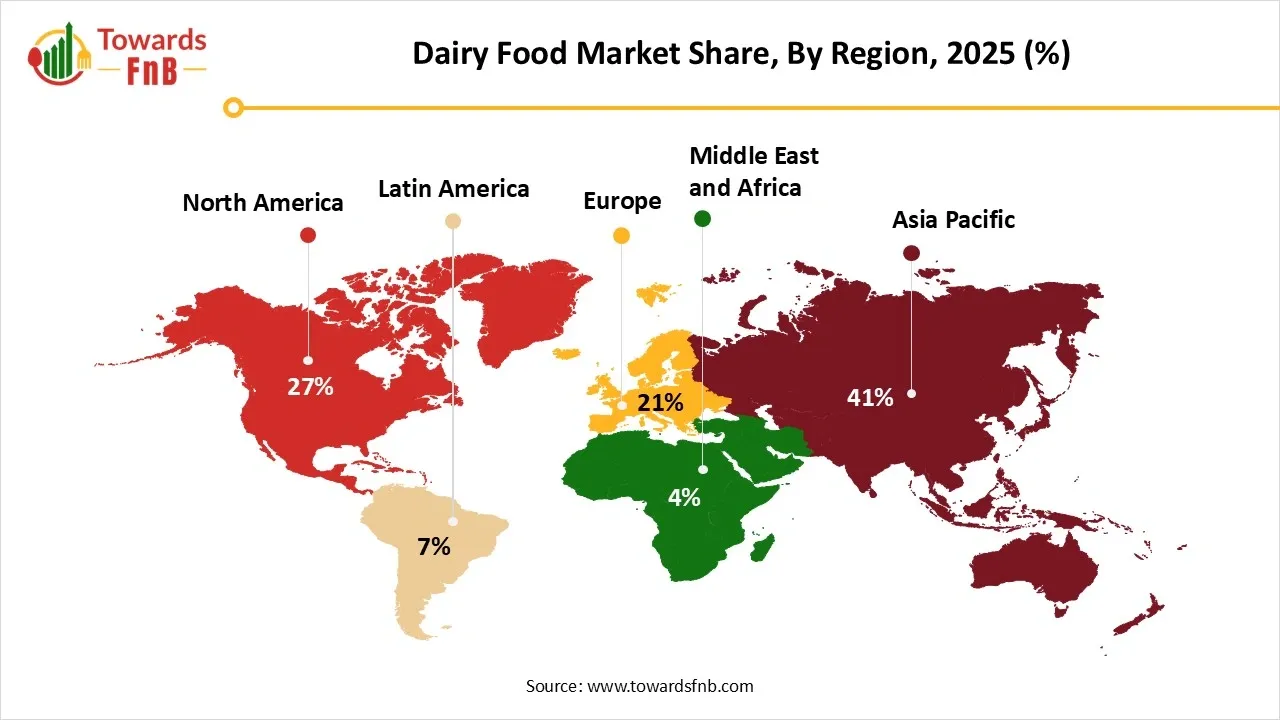
Dairy Food Market Share, By Region, 2025 (%)

Emerging Dairy Food Market of United States

Dairy food market of United States expanding significantly in recent years. Increasing demand for the healthy and nutritious food, innovation in technology and increasing e-commerce platform fostering the market in United States. From milk and cheese to ice cream, yogurt, and other dairy-based ingredients, U.S. dairy firms are striving to provide their nutritious, safe, and cost-effective products to consumers globally, while also generating employment opportunities. The U.S. dairy sector is set to create a new "golden age" for U.S. dairy exports, with anticipated sales hitting $8.2 billion in 2024, marking the second-highest export value on record and a $223 million rise from the previous year, based on recent figures from the U.S. Department of Agriculture (USDA).

Dairy Food Market Segmental Insights

Source Insights

Dairy Food Market Share, By Source, 2025 (%)

Segments Shares (%)
Cattle 55%
Sheep 20%
Goat 15%
Camel 10%
  • Cattle: Dominated with 55%, as dairy products from cattle make up the largest share due to the widespread availability and high milk yield of cows.
  • Sheep: Fast-growing with 20%, driven by increasing demand for sheep's milk-based dairy products, particularly in Mediterranean and Middle Eastern regions.
  • Goat: Holds 15%, with steady demand for goat's milk and goat cheese, particularly among consumers with lactose intolerance or seeking specialty dairy.
  • Camel: Holds 10%, with a niche market for camel milk, especially in certain regions where camel dairies are prevalent.

The Cattle Segment Held the Largest share of the Dairy Food Market in 2025

Milk and dairy-based foods are majorly produced by urban dairy farmers and dairying is the side the side business for the farmers. Although urbanization often drives dairying to outskirts and rural regions, there remains a strong consumer demand for fresh milk from farms. In comparison to other dairy animals, cattle offer numerous benefits regarding milking convenience, udder dimensions, capacity for milk storage, and milk production. Indeed, cow's milk makes up the biggest portion of the global milk production. The leading producers of cow milk include India, the United States, and China. 

The Sheep Segment is Seen to Grow at a Notable Rate During the Predicted Timeframe

Sheep milk serves as a superb source of high-quality protein, calcium, phosphorus, magnesium, zinc, and various vitamins. The significance of sheep's milk in terms of nutrition stems from its makeup. Even though sheep's milk contains more nutrients than cow's milk, it is seldom consumed as a beverage. Typically, it is utilized for cheesemaking, but in specific nations, some is produced into yogurt or other fermented dairy products and expanding the market. The production of sheep milk occurs primarily in Asia and Africa, followed by Europe, with a total global output of 10.61 million tons. The largest producers of sheep milk are China, followed by Turkey and Greece. Sheep milk is primarily produced in the Mediterranean area, where the key dairy sheep breeds are also located.

Type Insights

Dairy Food Market Share, By Type, 2025 (%)

Segments Shares (%)
Lactose 70%
Lactose-Free 30%
  • Lactose: Dominated with 70%, as traditional dairy products containing lactose are the most consumed type of dairy globally.
  • Lactose-Free: Fast-growing with 30%, driven by the increasing demand for lactose-free dairy products, particularly among consumers with lactose intolerance.

The Lactose Segment Led the Dairy Food Market in 2025

Lactose, the primary carbohydrate found in milk, is a distinctive sugar synthesized in the mammary glands of mammals. It is recognized for its ability to improve the absorption and retention of calcium, magnesium, and manganese and therefore increased demand for the lactose milk. Following the process of cheesemaking, over 90% of the lactose is found in whey. Several studies have indicated that whey is a valuable source of high-nutrition compounds that can enhance the efficiency of the dairy industry.

The Lactose-Free Segment is Expected to Grow at the Fastest Rate in the Market During the Forecast Period

About 70% of the global population faces a high risk of developing lactose intolerance, and its prevalence has risen over the past ten years, which accounts for the growing significance of lactose-free products in the market. Furthermore, increasing demand for the natural, organic and clean label product also driving the market. 

Product Type Insights

The Milk Segment held the Largest Share of the Dairy Food Market in 2025

Increasing net income, rising population and increasing health consciousness significantly increasing the demand for the milk. Milk gives comparatively fast returns for small-scale producers and is a vital source of cash income. On an average 150 million households around the world are involved in milk production. 

The Cheese Segment is Observed to Grow at the Fastest Rate During the Forecast Period

Increasing demand for western food menu like burger, pizzas and pastas loaded with cheese, growing outlets of fast food chains like dominos McDonalds, pizza hut, Subway etc. fueling the demand for the cheese and increase the cheese production. Cheese has substantial power with areas such as the US and SE Asia projected to rise imports. In 2024, that increased capacity and the fostered growth in milk production was anticipated to drive a 2% rise in cheese production of 6.5 million tons.

Distribution Channel Insights

Dairy Food Market Share, By Distribution Channel, 2025 (%)

Segments Shares (%)
Supermarket/Hypermarket 50%
Specialty Stores 20%
Convenience Stores 17%
Online Retail 13%
  • Supermarket/Hypermarket: Dominated with 50%, as supermarkets and hypermarkets are the primary distribution channels for dairy products, offering a wide variety of choices for consumers.
  • Specialty Stores: Holds 20%, with specialty stores providing niche dairy products, including organic, lactose-free, and artisanal dairy options.
  • Convenience Stores: Fast-growing with 17%, as convenience stores increasingly stock dairy products for on-the-go consumers.
  • Online Retail: Holds 13%, with growing demand for dairy products purchased online, offering convenience and access to a broader range of options.

Supermarkets and Hypermarkets Dominated the Market With the Largest Share in 2025

Supermarkets offer the probable convenience by providing a one-stop shopping experience. Supermarkets can buy items in large amounts, which reduces their costs. These savings are further passed on to consumers in the form of reduced costs. Hypermarkets provide extensive types of fresh dairy food products. Therefore, consumers majorly prefer supermarkets or hypermarkets for buying dairy foods. 

The Convenience Stores Segment is Seen to Grow at a Notable Rate During the Predicted Timeframe

Convenience stores are typically small, local stores that provide consumers a different range of dairy food products. The products present in a convenience store are with reduced costs than those available in larger retail stores. Anyone in hurry can easily approach the convenience store for buying goods without wasting much time.

Regulatory Activities for Dairy Food in 2025

  • In February 2025, India’s Food Safety and Standards Authority (FSSAI) issued strict regulations for dairy analogues and set novel standards for cheese powder as a mandatory logo for milk products with improved labeling and to prevent consumer confusion. FSSAI has emphasized strict regulations for dairy analogs and plant-based dairy alternatives for preventing them from being mis-sold as real dairy products. These products are mandatory to provide labeling of non-dairy or analog on the menu. (Source: Legality Simplified)
  • In March 2025, for the development of agriculture, animal husbandry, and dairying in India, the Union Cabinet took two key decisions. The decision has made agriculture, dairy, and animal husbandry the cornerstone of India’s economy for ensuring rural employment and economic stability. The Union Cabinet has approved a central sector scheme, the revised national program for dairy development (NPDD), that is with an additional budget of Rs 1,000 crore. The cabinet has brought a total of Rs 2,790 crore for the 15th finance commission period from 2021-22 to 2025-26. (Source: PIB Gov)
  • In July 2025, the Penn State Center for Agricultural and Shale Law conducted the federal milk marketing orders presentation in its Quarterly Dair Legal Webinar Series. These reforms were published in the Federal Register in January. This quarter's free one-hour webinar covers the regulatory and legal developments in the U.S. dairy industry from the preceding quarter, which includes an in-depth look at a single focus topic of law, government policy, and regulation that interests dairy professionals of all kinds. (Source: Youtube)
  • In March 2025, China regulated updates to the release of the Amendment Sheet for its National Food Safety Standards for Sterilized Milk, set for entering into force in September. Stakeholders will need to conduct their own review of the regulations for assessing any market or regulatory effects on business. (Source: USDA-FSA)

Recent Developments in the Dairy Food Market

Mother Dairy

  • Business expansion: In March 2025, Mother Dairy invested Rs 1,400 crore-Rs 1,500 crore to rise its production capacity in the coming 2-3 years. The milk and milk products company presently has 12 firms. Other than investments in these firms, the industry has come up with three new firms in Gujarat, Andhra Pradesh and Maharashtra’s Nagpur. 

Straus Family Creamery

  • Launch: In January 2024, US organic dairy industry Straus Family Creamery introduced a new range of organic low-fat kefirs with plain and blueberry flavors. Reusable glass is used for packaging to comply with goals such as climate-resilient practices and zero-waste goals. 

Danone and Microsoft

  • Collaboration: In July 2024, Danone collaborated with Microsoft to incorporate artificial intelligence across its supply chain. The Danone Microsoft AI Academy planned to educate 100,000 employees of the yogurt manufacturer to acquire skills beneficial in “the AI-driven economy”. The dairy industry announced that the program will feature efforts aimed at enhancing its employees' familiarity with AI. 

Dairy Food Market Leading Companies

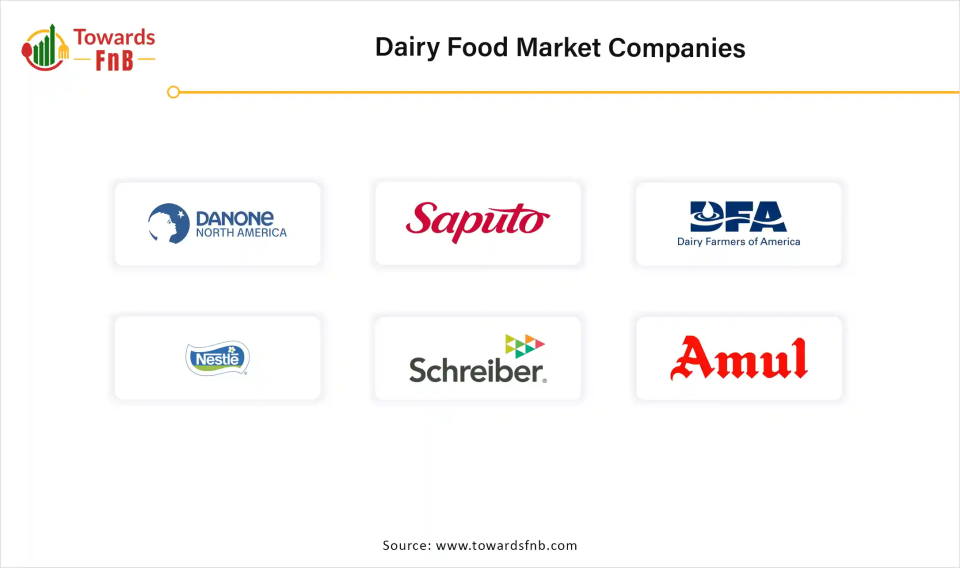
Dairy Food Market Companies

  • Danone North America
  • Saputo Inc.
  • Dairy Farmers of America
  • Karnataka Cooperative Milk Producers' Federation Limited
  • Nestle Dairy
  • Schreiber Foods
  • Agropur
  • Amul
  • Land O'Lakes
  • Mother Dairy
  • Fonterra
  • Hatsun Agro Product Limited
  • Mengniu Dairy
  • Parag Milk Foods
  • Dudhsagar Dairy
  • Kraft Heinz Co
  • Arla Foods
  • Odisha State Cooperative Milk Producers' Federation
  • Dynamix Dairy
  • Haryana Dairy Development Cooperative Federation Ltd
  • Kwality Limited
  • Prairie Farms Dairy
  • Lactalis
  • Yili

Segments Covered in the Report

By Source

  • Cattle
  • Sheep
  • Goat
  • Camel

By Type

  • Lactose
  • Lactose-Free

By Product Type

  • Milk
    • Powdered
    • Liquid
  • Cheese
  • Butter
  • Dessert
  • Yogurt
  • Others

By Distribution Channel

  • Supermarket/Hypermarket
  • Specialty Stores
  • Convenience Stores
  • Online Retail

By Region

  • North America
  • Europe
  • Asia Pacific
  • Middle East and Africa (MEA)
  • Latin America

FAQ's

Answer : The global dairy food market is projected to grow from USD 1.01 trillion in 2025 to approximately USD 1.84 trillion by 2034, at a CAGR of 6.2%. Growth is fueled by increasing demand for milk-based nutrition and rising consumption of dairy as a meat alternative.

Answer : Key growth drivers include rising health consciousness, growing demand in developing regions, and evolving dietary habits favoring protein-rich and calcium-fortified foods. The expansion of organized retail and functional dairy innovations further support growth.

Answer : Rising costs of feed, energy, and labor are inflating production expenses. In addition, supply chain disruptions, particularly in unorganized markets, and environmental concerns linked to dairy farming are significant hurdles for the sector.

Answer : Asia Pacific leads the global dairy market due to high population, evolving diets, and strong government support. North America is projected to grow fastest owing to increasing health awareness, high cheese consumption, and dairy-based nutritional products.

Meet the Team

Vidyesh Swar

Principal Consultant

Vidyesh Swar, Senior Research Analyst at Towards Food & Beverages, specializes in market research, focusing on supply-demand evaluation, pricing analysis, alternative proteins, plant-based foods, and sustainable food technologies within the industry.

Aditi Shivarkar

Reviewed By

Aditi Shivarkar, with 14+ years in Food and Beverages market research, specializes in food, beverage, and eco-friendly packaging. She ensures accurate, actionable insights, driving Towards FnB's excellence in industry trends and sustainability.

Related Insights

Dairy Food Market
Updated Date : 27 February 2026   |   Report Code : 5545
WhatsApp