April 2026



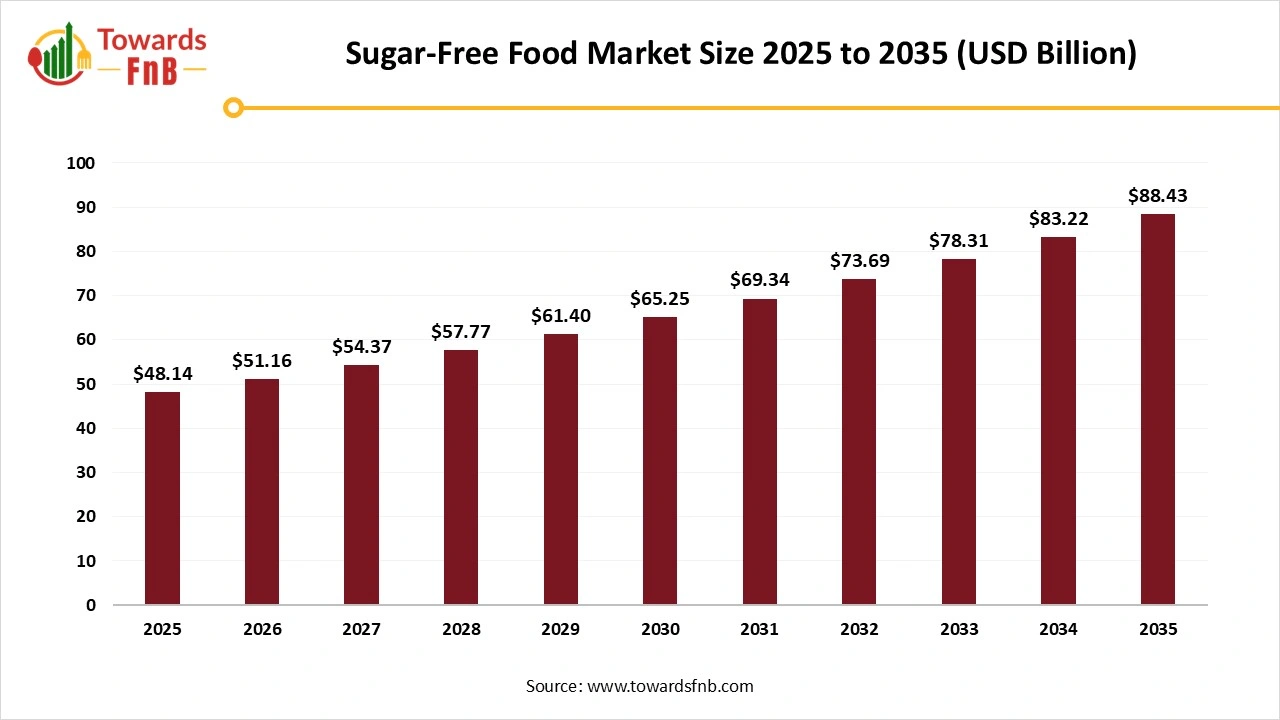
The global sugar-free food market size reached at USD 48.14 billion in 2025 and is anticipated to grow from USD 51.16 billion in 2026 to an estimated USD 88.43 billion by 2035, witnessing a CAGR of 6.27% during the forecast period from 2026 to 2035. The growing health awareness due to the increasing prevalence of the chronic illness such as diabetes is driving the growth of the market.
| Study Coverage | Details |
| Growth Rate from 2026 to 2035 | CAGR of 6.27% |
| Market Size in 2026 | USD 51.16 Billion |
| Market Size in 2027 | USD 54.37 Billion |
| Market Size by 2035 | USD 88.43 Billion |
| Largest Market | North America |
| Base Year | 2025 |
| Forecast Period | 2026 to 2035 |
| Regions Covered | North America, Europe, Asia-Pacific, Latin America, and Middle East & Africa |
The sugar-free food business has grown significantly as a result of rising health concerns, increased prevalence of diabetes, and shifting customer preferences for healthier choices. These products include sugar-free snacks, beverages, bakery items, chocolates, dairy substitutes, and confectionery manufactured with natural or artificial sweeteners such as stevia, monk fruit, erythritol, and allulose.
They are popular among diabetics, weight-conscious people, and those following low-carb or ketogenic diets. Sugar-free foods can help with blood sugar management, reduce the risk of obesity and heart disease, and enhance oral health. With increasing government controls on sugar intake and rising demand for functional meals, the sugar-free food market is likely to develop even more, fueled by product innovation, increased availability, and enhanced flavor profiles.
One of the main drivers for the growth of the sugar-free food and beverages market is the growing consumption of health risks, which are linked with sugar consumption. The growing commonness of chronic diseases such as diabetes, obesity, and heart disease has led consumers to shift towards healthier and sugar-free alternatives. Apart from this, developed efforts and the expansion of low-calorie and sugar-free product lines too.
One of the major growth factors for the sugar-free food market is that consumers are choosing products that are free from artificial ingredients and excessive amounts of sugar too. They are also becoming more conscious about the environmental impact of different food choices, which leads them to find out more about organic products and sustainably sourced products. As the awareness of sugar-free products negative health impact, which are actively looking for sugar-free or low-sugar products, is expanding the market.
| Market Driver | (~) % Impact on CAGR Forecast | Geographic Relevance | Impact Timeline |
| Rising health awareness & diabetes prevalence | +3.0% to +4.0% | Global, highest demand in North America & Europe; rising in Asia Pacific | Medium to Long term (2025–2035) |
| Shift toward lifestyle & diet conscious consumption | +2.5% to +3.5% | Global, with early adopters in developed markets and rapid uptake in urban APAC | Medium (2025–2030) |
| Retail expansion & e commerce availability | +1.5% to +2.5% | North America and Europe lead, urban Asia Pacific catching up | Short to Medium term (2025–2030) |
| Product innovation in taste & formulation | +1.5% to +2.0% | Global, especially in markets with sophisticated consumer preferences | Short to Medium term (2025–2030) |
| Market Restraint | (~) % Impact on CAGR Forecast | Geographic Relevance | Impact Timeline |
| Limited consumer taste perception vs sugared alternatives | ~ 2.0% to 3.0% | Global, with stronger resistance in markets where traditional sweet products dominate (Latin America, Asia) | Short term (2025–2028) |
| Higher cost of sugar substitutes (e.g., stevia, monk fruit) | ~ 1.5% to 2.5% | Global, particularly in price sensitive markets of Asia Pacific and Latin America | Medium term (2025–2032) |
| Regulatory labeling challenges & consumer confusion | ~ 1.0% to 1.8% | Europe and North America where labeling standards are more stringent | Medium term (2025–2030) |
| Dependence on relatively limited sugar free innovation pipeline | ~ 1.0% to 1.5% | North America & Europe (markets expecting premium formulation quality) | Long term (2025–2035) |
The sugar-free food market is expanding rapidly due to increasing health awareness, rising diabetes cases, and stricter regulations on sugar consumption.Key opportunities include catering to diabetics, health-conscious consumers, and followers of low-carb diets by offering innovative products such as natural sweetener based snacks, beverages, bakery items, and dairy alternatives.
The growth of e-commerce, emerging markets, and food service adoption further drive demand, while regulatory pressures like sugar taxes encourage reformulation. Advances in sweetener technology and AI-driven personalization also create room for innovation, making the market highly lucrative for brands focusing on healthier alternatives.
There are many challenges and limitations in sugar-free food market i.e. Aspartame which consists of two amino acids like phenylalanine and aspartic acid which form a dipeptide, and it is chemically synthesized by around 200 times sweeter than sucrose. Second is saccharin which is previously used in tabletop sweeteners, soft drinks, canned fruits and numerous pharmaceutical products and side effect of saccharin is that it can make bladder cancer. Also, from the stevia rebaudina stevia plant, the sweetness is obtained which is a natural sweetener used in yogurt and drinks, baked goods or tabletop sweeteners too. The other side effects are increased appetite and weight gain too.
Raw Material Procurement
Processing
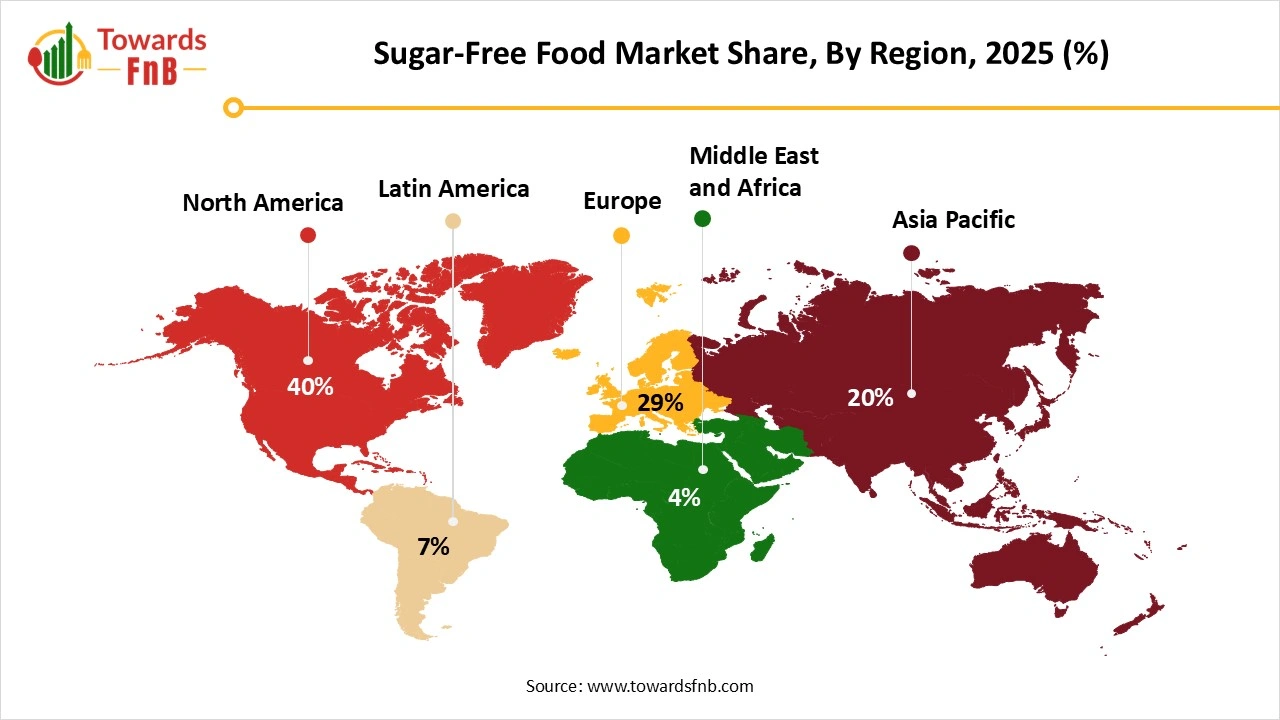
North America Dominated the Sugar-Free Food Market in 2025
The growth of the market is attributed due increasing inclination towards a reduction in sugar consumption as they are heavily prioritizing health and wellness with a concentrated focus on sugar intake, which automatically deliberates in their decision-making skills. With respect to this, out of 100, nearly 46% of consumers are aware of sugar reduction in the US, whereas in Canada, 55% are conscious of the same, which is specifically due to older generations due to a lot of health issues and concerns.
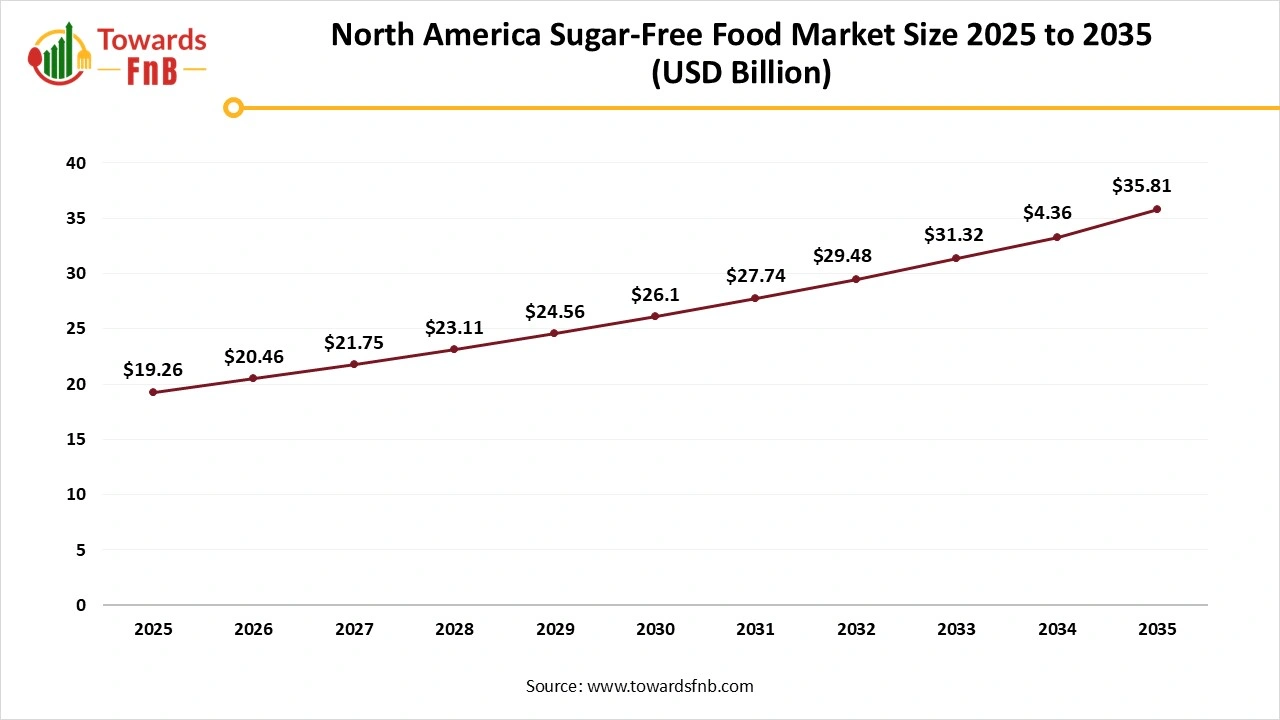
North America Sugar-Free Food Market Size 2025 to 2035
The North America sugar-free food market size was valued at USD 19.26 billion in 2025 and is anticipated to grow from USD 20.46 billion in 2026 to an estimated USD 35.81 billion by 2035, witnessing a CAGR of 6.4% during the forecast period from 2026 to 2035.
The sugar-reduction trend is due to sugar-related claims, which are particularly due to rising pairs with energy, vegan, and plant-based claims, as global top companies are launching sugar-claim products such as Coca-Cola and PepsiCo, companies that are constantly launching the products that are sugar-claim ones. With respect to this,
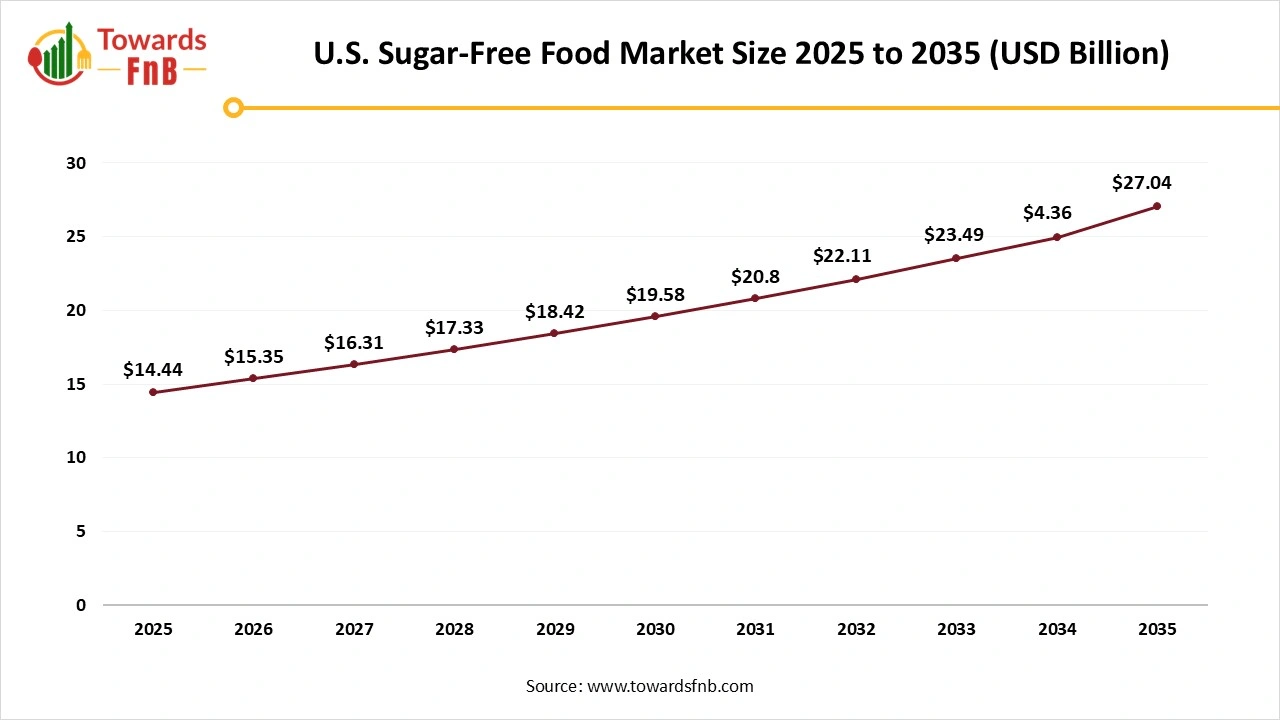
U.S. Sugar-Free Food Market Size 2025 to 2035
The U.U. sugar-free food market size was calculated at USD 14.44 billion in 2025 and is anticipated to increses from USD 15.35 billion in 2026 to an estimated USD 27.04 billion by 2035, witnessing a CAGR of 6.47% during the forecast period from 2026 to 2035.
Regulations Amending the Food and Drug Regulations (Canada): It will come into force on 1 January 2026, which will require food manufacturers and sugar producers in Canada to adjust product formulation and labelling too to meet the required amount of sugar in packaged food products. Compliance will lead to reformulation, especially in high-sugar category food to match with new serving sizes and nutritional labelling standards too.
Asia Pacific Expects the Fastest Growth in the Sugar-Free Food Market During the Forecast Period
The growing awareness regarding the health and people focusing in the healthy diet boosts the demand for the sugar free food. As health awareness is growing, Asian consumers are seeking these foods while exploring new products that match nutrition and sustainability. According to this, 33% of parents in the Asian countries are planning each meal well in advance for their children, which shows how Asian consumers are aware of health consciousness and its trends. With respect to this,
Europe Sugar-Free Food Market Trends
The European sugar-free foods market is experiencing significant growth, driven by increasing health consciousness among consumers, a rising prevalence of diabetes and obesity, and a growing demand for healthier alternatives to traditional sugary products. As awareness of the adverse health effects associated with excessive sugar consumption rises, the demand for sugar-free options, such as beverages, snacks, and confectionery, is expanding rapidly. Market players are focusing on product innovation, leveraging natural sweeteners, and expanding distribution channels to capture this growing segment.
The growth of the sugar-free food market in Germany is mainly driven by increasing health consciousness among consumers who are seeking healthier alternatives to traditional snacks. The rising prevalence of diabetes and obesity has heightened demand for low-sugar and sugar-free options. Additionally, growing awareness of the negative effects of excessive sugar intake is influencing consumer preferences. The availability of innovative, tasty, and convenient sugar-free snack products is also boosting market growth.
Middle East and Africa Sugar-Free Food Market Trends
In the Middle East and Africa (MEA), the sugar-free food market has experienced notable growth in recent years. This growth is driven by increasing health consciousness, the rising prevalence of diabetes and obesity, and shifting consumer preferences toward healthier alternatives. Urbanization, along with higher disposable incomes in countries like South Africa, Nigeria, Saudi Arabia, and the UAE, has led to increased consumption of low-calorie and sugar-free products.
In Saudi Arabia, the sugar-free food market is primarily driven by rising health consciousness among consumers, the increased prevalence of diabetes and obesity, and a shift toward healthier food choices. Growing awareness of the adverse effects of sugar consumption has led consumers to seek alternative products that offer similar taste without health risks. Additionally, there is a surge in demand for natural and organic products, which further influences market growth.
Inferred Consumption Trends: Sugar‑Free Products in Africa & Ghana (2020–2026)
| Region / Focus | Key Drivers / Insights | Target Audience / Consumer Segment |
| Africa – General Trend | Rising diabetes and obesity prevalenceUrbanization and lifestyle changesExposure to global health campaigns | Health-conscious consumers across urban and semi-urban areas |
| Ghana – Specific Consumption | High baseline sugar consumption creating market potential | Urban middle classHealth-aware consumers People with lifestyle diseases |
Consumption Trends:
Latin America Sugar-Free Food Market Trends
The sugar-free food market in Latin America is propelled by growing health consciousness and an increase in lifestyle-related chronic conditions. As consumers increasingly prioritize wellness, the region is witnessing a shift toward low-sugar, functional snack options that align with global health trends. This demand is further reinforced by rising urbanization, an expanding middle class, and a growing awareness of the adverse effects of excessive sugar intake.
Sugar-Free Food Market Share, By Type, 2025 (%)
| Segments | Shares (%) |
| Sugar-Free Beverages | 50% |
| Sugar-Free Food Products | 20% |
| Sugar-Free Nutrition & Health Supplements | 10% |
| Table-Top Sweeteners | 5% |
| Other Sugar-Free Products | 15% |
The Sugar-Free Beverage Segment Dominated the Sugar-Free Food Market in 2025
It is due to rising consumer awareness of health and fitness trends and growing demand for low-calorie and sugar-free beverages too. Another reason is functional beverage consumption, improved production techniques, growing research and development techniques, and lastly, the expansion of low-calorie and sugar-free product lines.
The sugar-free food products segment expects a significant growth in the market during the forecast period. This growth is due to the growing influence of beverages for the sugar-free food and beverages, and this segment is fundamentally driven by less sweetener-based carbonated drinks and energy drinks among the Gen Z and millennial population for their busy lifestyle demand.
Sugar-Free Food Market Share, By Sweetening Type, 2025 (%)
| Segments | Shares (%) |
| Sugar Substitute Sweetened Sugar-Free Products | 75% |
| Naturally Sweetened Sugar-Free Products | 25% |
The Substitute-Sweetened Sugar-Free Products Segment Dominated the Sugar-Free Food Market in 2025
This segment is divided into three types: artificial sweeteners, natural sweeteners, and sugar alcohols too. Artificial sweeteners include aspartame, sucralose, and acesulfame potassium, which are prevalently used due to high sweetness intensity and stability in baking, among which polyols are alcohol sugars that are classified as a group of carbohydrates that have a sweet taste but are not counted under the sweet category.
Naturally sweetened sugar-free products segment expects a significant growth in the market during the forecast period. The natural sweetened sugar are agave nectar, cane sugar, coconut sugar and corn syrup which is linked with high fructose corn syrup content. Sweeteners like fruit juice, honey, molasses and maple syrup contains natural sugar and also contain natural ingredients too.
Sugar-Free Food Market Share, By Distribution Channel, 2025 (%)
| Segments | Shares (%) |
| Supermarkets & Hypermarkets | 60% |
| Convenience Stores | 10% |
| Online Retail | 17% |
| Other Distribution Channels | 13% |
The Supermarkets/Hypermarkets Segment Dominated the Sugar-Free Food Market in 2025
This surge is due to factors like the rising prevalence of lifestyle-related diseases like diabetes, which is a significant driver for the sugar-free candy market. Another reason is the rising consumer preference for healthy and low-calorie options, and lastly, technological advancements in sweeteners are making sugar-free options.
The online retail segment expects a significant growth in the market during the forecast period. The demand for online retail platforms is because of the availability of different e-commerce platforms such as Amazon, Flipkart, Big Basket, and so on, through which consumers can conveniently order sugar-free food and beverages at the comfort of their home system and make its payment too.
By Type
By Sweetening Type
By Distribution Channel
By Region






Principal Consultant
Vidyesh Swar, Senior Research Analyst at Towards Food & Beverages, specializes in market research, focusing on supply-demand evaluation, pricing analysis, alternative proteins, plant-based foods, and sustainable food technologies within the industry.
Learn more about Vidyesh Swar
Reviewed By
Aditi Shivarkar, with 14+ years in Food and Beverages market research, specializes in food, beverage, and eco-friendly packaging. She ensures accurate, actionable insights, driving Towards FnB's excellence in industry trends and sustainability.
Learn more about Aditi ShivarkarApril 2026
April 2026
April 2026
April 2026

Sugar-Free Food Market


 +1 804-441-9344
 Download Sample
 Schedule a Meeting