April 2026



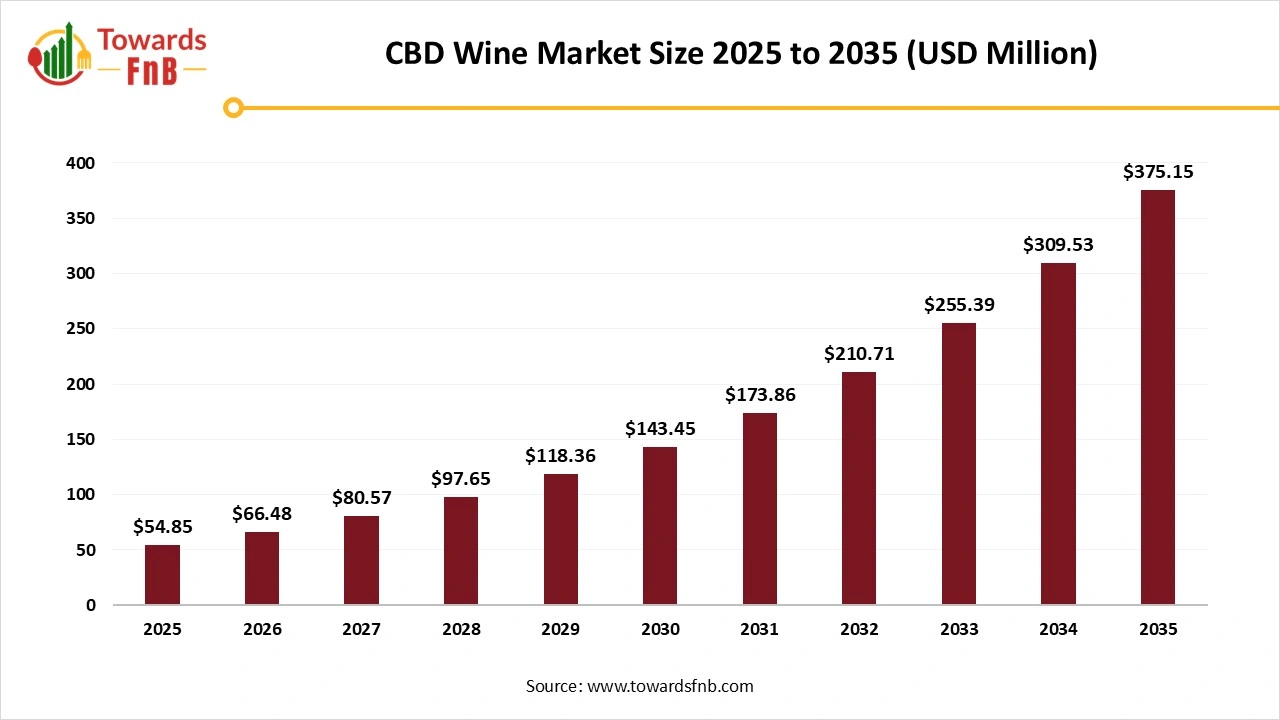
The global CBD wine market size estimated at USD 54.85 million in 2025 and is predicted to increase from USD 66.48 million in 2026 to nearly reaching USD 375.15 million by 2035, growing at a CAGR of 21.2% during the forecast period from 2026 to 2035. The user demand has developed due to growing awareness of CBD advantages, which is a move towards functional beverages, and huge consumption of cannabis-linked products.
| Study Coverage | Details |
| Growth Rate from 2026 to 2035 | CAGR of 21.2% |
| Market Size in 2026 | USD 66.48 Million |
| Market Size in 2027 | USD 80.57 Million |
| Market Size by 2035 | USD 375.15 Million |
| Largest Market | North America |
| Base Year | 2025 |
| Forecast Period | 2026 to 2035 |
| Regions Covered | North America, Europe, Asia-Pacific, Latin America, and Middle East & Africa |
In 2026, the CBD wine market emerged from its "novelty" phase into a high-growth segment of the Functional Luxury Beverage industry. The market is fueled by the "sober-curious" movement, and Gen Z's pivot away from high-alcohol drinks toward wellness-oriented alternatives.
Fermentation is the most fragile step of winemaking. Current smart tanks are filled with sensors that track temperature, sugar levels, and oxygen in actual time. Automated systems can create adjustments to ensure consistency and avoid faults, lowering the risk of stuck fermentation or off flavors. For winemakers, such tanks integrate accuracy with smoothness, which saves valuable time during harvest. Some designs mix with cloud-based platforms, which enable winemakers to manage the development from any location. Fundraisers can take comfort in knowing that wines are manufactured with a level of accuracy that they is less likely to experience quality problems.
Package Design and Prototyping
Recycling and Waste Management
Logistics and Distribution
How North America Dominated the CBD Wine Market?
North America dominated the CBD wine market with approximately 45% to 56.5% in 2025 as penetrating into an era of well-designed structure being assisted by regional economic realignment, the growth of intra-continental trade corridors, and nearshoring momentum for an into-continental trade corridor. The import-export scenarios are excessively being designed by post-potential supply chain transparency and a step-by-step method towards resilient and regionally diversified sourcing designs. At the current time. Fixing sustainability makes many compulsions for pushing compliance-ready sourcing and finding in a clear manner.
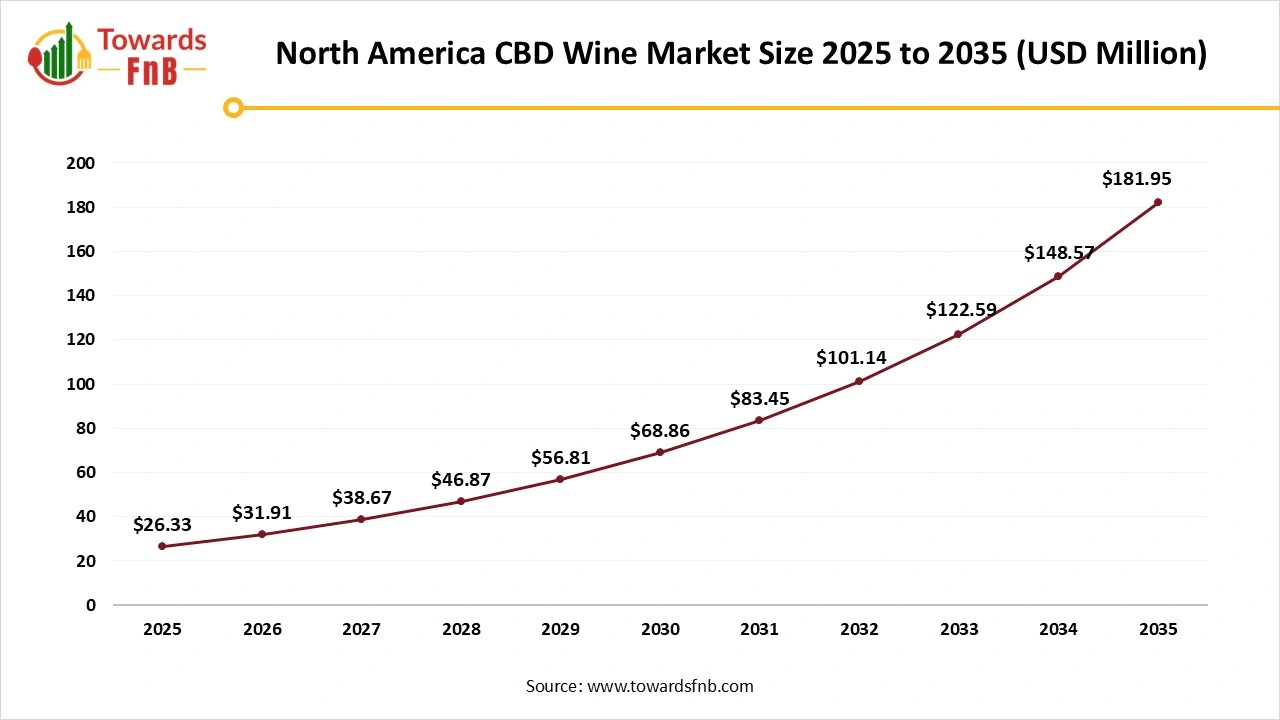
North America CBD Wine Market Size 2025 to 2035
The North America CBD wine market size was calculated at USD 26.33 million in 2025 with projections indicating a rise from USD 31.91 million in 2026 to approximately USD 181.95 million by 2035, expanding at a CAGR of 21.32% throughout the forecast period from 2026 to 2035.
How is the CBD Wine Market Growing in Canada?
The CBD wine market is developing in Canada as it continues to develop, which is being driven by growing domestic usage and the export possibilities, as the urge for reliable, precise, and user-friendly measurement machines, such as refractometers, is increasing. Future-ready possibilities count on the mixing of digital technologies like IoT-allowed technologies serve an actual-time data transmission and automated calibration elements. Such inventions can mainly develop operational efficiency for vineyards, wineries, and quality control laboratories.
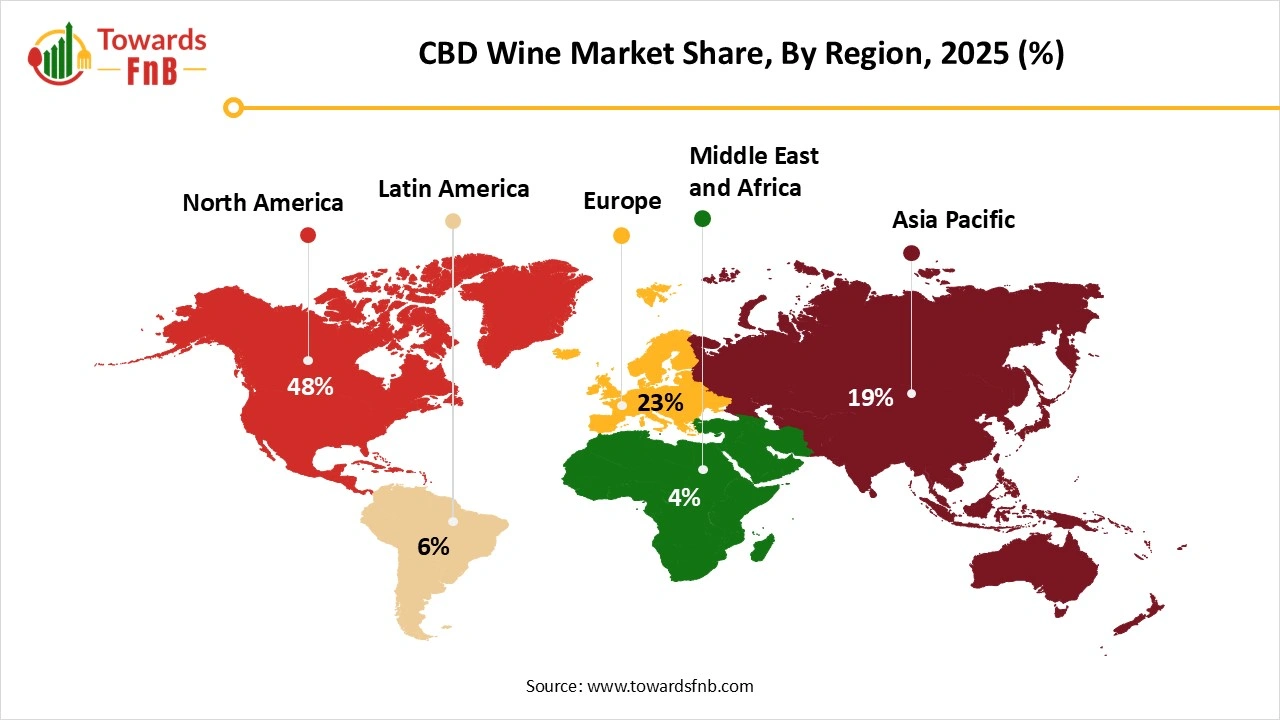
Asia Pacific Expects the Fastest Growth in the Market During the Forecast Period
The market is an emerging niche within the broader functional beverages category, combining cannabidiol (CBD) a non-psychoactive compound from hemp with wine or wine-like products to create beverages that appeal to wellness-oriented consumers looking for relaxation without traditional alcohol effects. While global CBD-infused wine is still a small segment overall, Asia Pacific is one of the leading regions, driven by rising urbanization, disposable incomes, and evolving consumer lifestyles in countries like Japan, Australia, China, and India.
CBD Wine Market Share, By Source, 2025 (%)
| Segments | Shares (%) |
| Hemp-based | 72.4% |
| Marijuana-based | 27.6% |
How the Hemp-Based Segment Dominated the CBD Wine Market in 2025?
The hemp-based segment dominated the market with 72.4% share in 2025, as hemp is a variety of the cannabis sativa plant, which does not have THC, which is a cannabinoid that is the crucial psychoactive factor of marijuana. It can also be sourced from CBD, which is another cannabinoid and is initially checked by the FDA as part of the huge review into cannabis-sourced products. Some of the apparent health claims linked with CBD include reduced inflammation, reduced anxiety, pain management, and improved mood.
The Marijuana-Based Segment is Projected to Experience the Fastest CAGR During the Forecast Period
Marijuana, including wine, is an inventive product that some of the organizations are currently exploring as it is legal to generate. They are usually safe, as they do have the potential for an alcohol-like level of overdose as alcohol. In the current scenario, people have selected to make a non-alcoholic wine that retains the incredible flavor of wine grapes such as Chardonnay and Merlot. Such kinds of wine have tetrahydrocannabinol (THC), which is a well-known compound in terms of marijuana classified for its psychoactive, medicinal effects, and recreating.
CBD Wine Market Share, By Product Type, 2025 (%)
| Segments | Shares (%) |
| Still Wine (Red/White) | 48.5% |
| Sparkling/Rosé | 51.5% |
How the Still Wine Segment Dominated the CBD Wine Market in 2025?
The Still wine segment dominated the market with a 48.5% share in 2025, as, from a chemical term, it is a kind of product without carbon dioxide. These wines are being fermented at higher temperatures than while wines. Red wines fermenting heat ranges from 20 degrees Celsius to 32 degrees Celsius, while the rosé and white wines are fermented at temperatures between 12 degrees Celsius and 22 degrees Celsius. The color of such a type of wine varies from purple, generally young red wines, to ruby red for mature wines, to a reddish brown for aged red wines.
The Sparkling Segment is Projected to Experience the Fastest CAGR During the Forecast Period
These wines are filled with carbon dioxide (C02) gas, which makes small bubbles. Such bubbles add a positive liveliness and dynamism to the wine, which makes a fragile experience exceptional. The initial grape types used in the sparkling wine manufacturing include Pinot Noir, Pinot Meunier, and Chardonnay. Such grapes deliver their different elements to the final result, which contributes to the various flavor profiles of every sparkling wine.
CBD Wine Market Share, By Alcohol-Content, 2025 (%)
| Segments | Shares (%) |
| Alcoholic | 58% |
| Non-Alcoholic | 42% |
How the Alcoholic Segment Dominated the CBD Wine Market in 2025?
The alcoholic segment dominated the market with 58% share in 2025, as CBD (cannabidiol) is the first active ingredient in the cannabis plants, which is non-psychoactive as it has no such result with no gravity at any cost. People use CBD in the form of oils, gummies, vaping products, and capsules to diagnose anxiety, chronic pain, and insomnia. The most prevalent reason for integrating CBD and alcohol is very indirect. Some people genuinely consume CBD alongside alcohol to assist with some of the unneeded side effects of drinking, like headaches or nausea.
The Non-Alcoholic Segment is Projected to Experience the Fastest CAGR During the Forecast Period
This segment inside the beverage sector, which combines cannabidiol with regular non-alcoholic wine products, has experienced high demand. This industry aligns with users who find the therapeutic advantages of CBD, such as anxiety reduction and relaxation, without the harmful effects of alcohol. Its overall importance lies in solving the growing demand for functional, healthier, and wellness-oriented beverage selection.
CBD Wine Market Share, By Distribution , 2025 (%)
| Segments | Shares (%) |
| Off-trade | 67.6% |
| On-trade | 32.4% |
How the Off-Trade Segment Dominated the CBD Wine Market in 2025?
The off-trade segment dominated the market with 67.6% share in 2025, as the CBD sector has become mature because of nano emulsions, transdermal patches, and liposomal technology. Such inventions develop the bioavailability of CBD, which enables it to absorb more smoothly into the blood flow. For retailers, this displays as a possibility to shelf out by serving products in a CBD POS system that reflects innovative delivery science.
The On-Trade Segment is Projected to Experience the Fastest CAGR During the Forecast Period
CBD is a complicated product that frequently needs explanation linking to its advantages, dosage, and non-psychoactive nature. On-Trade staff, such as servers and bartenders, can deliver in-person consultations to assist shoppers, which makes informed decisions as a main driver of offline sales. Physical retailers behave as a complicated ‘vetting” surface as the industry witnesses' problems with disabled items and changing THC levels, which launches on-trade places.
By Source
By Product Type
By Alcohol Content
By Distribution
By Region




Principal Consultant
Vidyesh Swar, Senior Research Analyst at Towards Food & Beverages, specializes in market research, focusing on supply-demand evaluation, pricing analysis, alternative proteins, plant-based foods, and sustainable food technologies within the industry.
Learn more about Vidyesh Swar
Reviewed By
Aditi Shivarkar, with 14+ years in Food and Beverages market research, specializes in food, beverage, and eco-friendly packaging. She ensures accurate, actionable insights, driving Towards FnB's excellence in industry trends and sustainability.
Learn more about Aditi ShivarkarApril 2026
April 2026
April 2026
April 2026

CBD Wine Market


 +1 804-441-9344
 Download Sample
 Schedule a Meeting