April 2026



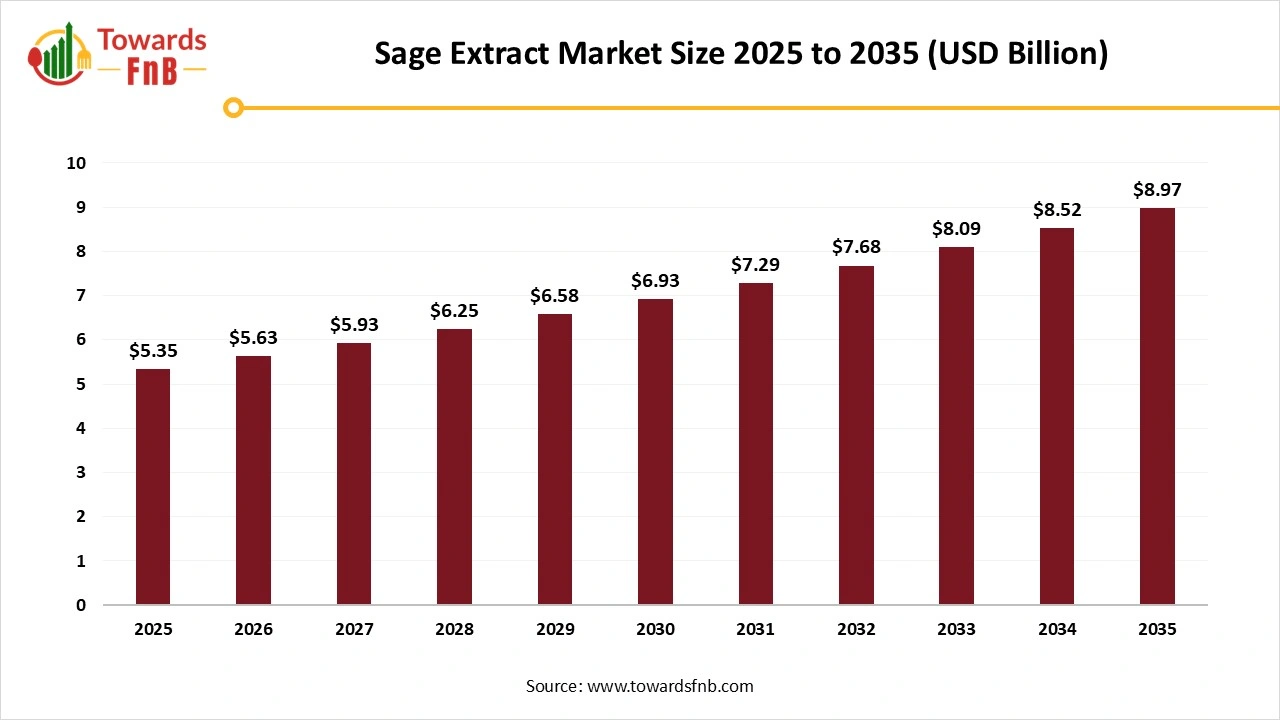
The global sage extract market size reached at USD 5.35 billion in 2025 and is anticipated to increase from USD 5.63 billion in 2026 to an estimated USD 8.97 billion by 2035, witnessing a CAGR of 5.3% during the forecast period from 2026 to 2035. Rising consumer preference for natural and plant-based ingredients in food, nutraceuticals, pharmaceuticals and personal care products is driving the market.
| Study Coverage | Details |
| Growth Rate from 2026 to 2035 | CAGR of 5.3% |
| Market Size in 2026 | USD 5.63 Billion |
| Market Size in 2027 | USD 5.93 Billion |
| Market Size by 2035 | USD 8.97 Billion |
| Largest Market | Europe |
| Base Year | 2025 |
| Forecast Period | 2026 to 2035 |
| Regions Covered | North America, Europe, Asia-Pacific, Latin America, and Middle East & Africa |
The global sage extract market involves the production of concentrated substances derived from the Salvia officinalis plant. These extracts, rich in bioactive compounds like rosmarinic acid and thujone, are utilized for their antimicrobial, antioxidant, and cognitive-enhancing properties across the pharmaceutical, nutraceuticals, and personal care sectors to promote holistic wellness. Growing demand for functional food and herbal medicine, with rising consumer awareness regarding herbal products driving the market.
| Market Driver | (~) % Impact on CAGR Forecast | Geographic Relevance | Impact Timeline |
| Growing consumer interest in natural & herbal ingredients | +3.0% to +4.0% | North America & Europe lead; rapidly rising in urban Asia Pacific | Medium to Long term (2025–2035) |
| Expansion of functional food, beverage & dietary supplement use cases | +2.5% to +3.5% | Global, especially where botanical wellness trends are established | Medium (2025–2032) |
| Demand for clean label and plant based formulations | +2.0% to +3.0% | North America & Europe, growing Asia Pacific | Short to Medium term (2025–2030) |
| Retail & e commerce distribution expansion | +1.5% to +2.5% | Global strong in North America & Europe, rising adoption in APAC | Short to Medium term (2025–2030) |
| Market Restraint | (~) % Impact on CAGR Forecast | Geographic Relevance | Impact Timeline |
| Price sensitivity of premium botanical extracts | ~ 2.0% to 3.0% | Asia Pacific & Latin America where cost constraints limit premium ingredient adoption | Short term (2025–2028) |
| Supply chain variability for raw botanicals | ~ 1.5% to 2.5% | Europe & North America when seasonal or weather related crop issues occur | Medium term (2025–2032) |
| Regulatory compliance & labeling barriers | ~ 1.0% to 1.8% | Europe & North America with strict rules for supplement and food additive claims | Medium term (2025–2030) |
| Limited awareness in some emerging markets | ~ 1.0% to 1.5% | Africa, parts of Asia Pacific outside urban wellness segments | Long term (2025–2035) |
Various methods for the extraction and identification of sage bioactive compounds, utilizing different solvents, have developed recently. Green extraction techniques, such as Supercritical Fluid Extraction, Ultrasound-Assisted Extraction, and Microwave-Assisted Extraction, represent innovative and sustainable methods aimed at reducing energy, time, and solvent consumption. These methods strive to replace conventionally used organic solvents with alternatives that produce high-quality and safe products. Additionally, encapsulation technology has significantly advanced the food industry by enhancing the incorporation and stabilization of bioactive compounds within various food systems.
Raw Material Procurement
Processing
Quality Control
Which Region Dominated the Sage Extract Market in 2025?
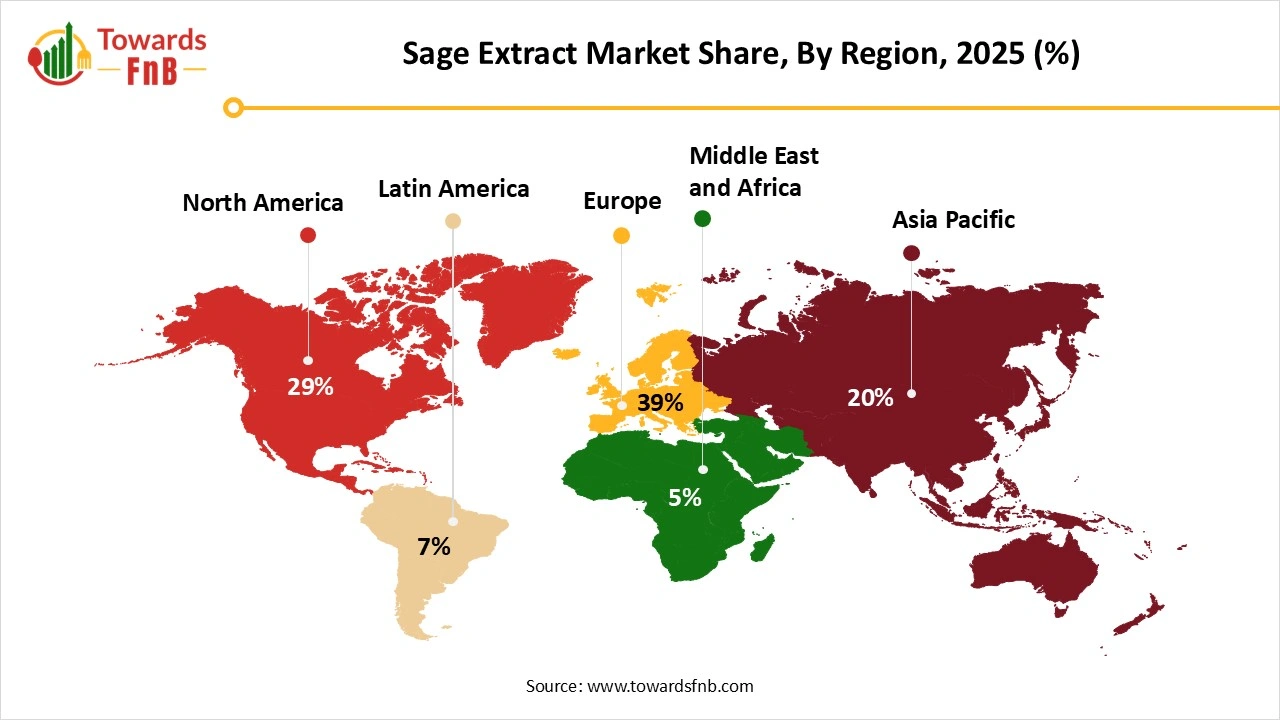
Europe dominated the market with a share of approximately 39% in 2025. The growing consumer preference for natural and alternative treatments makes Europe a promising market for natural ingredients in health products like sage extracts. The European manufacturing industry is well-established and open to innovation. Additionally, rising interest in preventive healthcare is driving demand for medicinal products. The evolution of the market is supported by advancements in extraction technology and a growing focus on sustainable sourcing. As European consumers prioritize wellness and natural remedies, the demand for high-quality sage extracts continues to rise, positioning the region as a key player in the global herbal extract industry.
Europe Sage Extract Market Size 2025 to 2035
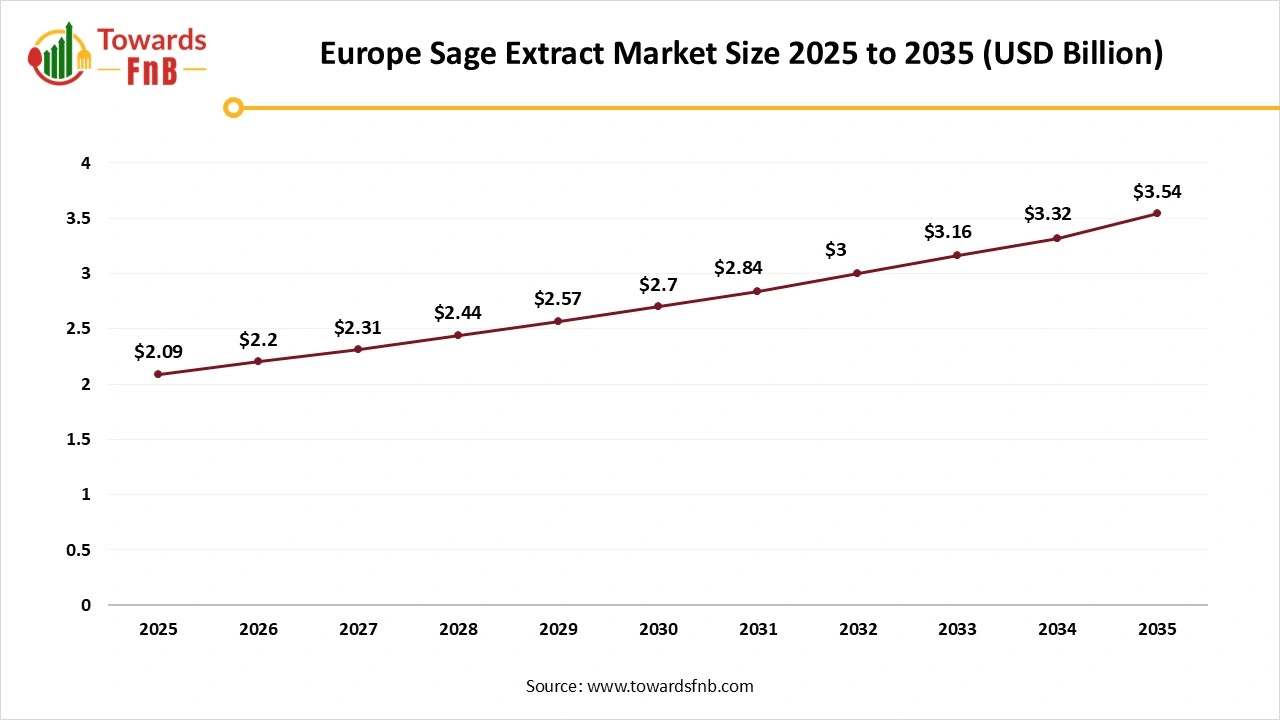
The Europe sage extract market size was calculated at USD 2.09 billion in 2025 with projections indicating a rise from USD 2.2 billion in 2026 to approximately USD 3.54 billion by 2035, expanding at a CAGR of 5.41% throughout the forecast period from 2026 to 2035.
Germany Sage Extract Market Trends
Germany has the largest consumer market in Europe, where consumers are increasingly health-conscious. The growing interest in plant-based products, combined with a robust extraction industry, is expanding the market. This upward trend can be attributed to the rising demand for herbal products in the health and wellness sector, fostering market stability and encouraging trade growth. Consumers are actively seeking ways to enhance their mental performance, citing reasons such as work-related stress, increased cognitive demands, and a desire to maintain mental sharpness as they age.
Asia Pacific Sage Extract Market Trends
Asia Pacific expects fastest growth in the market during the forecast period. The increasing preference for clean-label, organic, and sustainably sourced ingredients is significantly driving the adoption of high-quality sage extract in the cosmetics, aromatherapy, and wellness sectors. Rapid economic development in key Asia Pacific markets, including China, India, and Southeast Asian nations, is leading to increased investment in natural ingredient supply chains. Furthermore, the expanding pharmaceutical industry in China, the increasing use of clary sage oil for aromatherapy in Japan, and the overall rising consumer preference for natural health-promoting products are driving the market.
China Sage Extract Market Trends
In Traditional Chinese Medicine, red sage has been utilized for thousands of years for its heart-boosting and antioxidant properties. Textbooks of Traditional Chinese Medicine describe Danshen known as red sage, as a common remedy for promoting blood circulation and treating heart diseases, such as atherosclerosis, thrombosis, and hypertension. In the food industry, it serves as a natural flavoring and preservative. In the pharmaceutical and nutraceutical sectors, it is formulated into supplements to support overall health and well-being. Shaanxi Lonier Herb Bio-Technology Co., Ltd. stands out with its high-quality products, strong R&D capabilities, and global reach. Other companies demonstrate competitiveness in various aspects, such as sustainable sourcing, innovative extraction technology, and cost-effectiveness. These companies play an important role in promoting the development of the sage extract industry in China.
North America Sage Extract Market Trends
The North American sage extract market is experiencing significant growth, driven by increasing consumer awareness of natural health products, a rising demand for herbal supplements, and expanding applications across the food, beverage, and pharmaceutical industries. The region's well-established herbal supplement sector, combined with favorable regulatory environments and technological innovations, positions North America as a key growth area in the global sage extract landscape. Additionally, market growth is being fueled by a trend towards organic and sustainably sourced ingredients, along with a growing interest in traditional herbal medicine.
U.S. Sage Extract Market Trends
In the United States, the sage extract market is also witnessing growth due to several factors. Consumers are increasingly opting for natural ingredients in personal care, health, and wellness products, which boosts the demand for Clary Sage Extract. There is a particular focus on mental health, with sage extract gaining popularity for its mood-enhancing properties.
Why did the Conventional Segment Dominate the Sage Extract Market in 2025?
The conventional segment dominated the market with approximately 72% share in 2025, attributed to its cost-effectiveness, high production volume, and established use in food, pharmaceutical, and cosmetic applications. Conventional sage herb extract is derived from sage plants grown using synthetic pesticides, herbicides, or fertilizers. As a result, this type of extract is often less expensive than organic sage herb extract.
The Organic Segment is Projected to Grow at the Fastest Rate During the Forecast Period.
Driven by increasing consumer awareness of natural and sustainable products. The surge in demand for organic sage extracts is also fueled by a rising preference for plant-based ingredients and growing concerns about the side effects of synthetic chemicals.
Which Form Segment Dominated the Sage Extract Market in 2025?
The liquid/fluid segment held the largest market share at approximately 51% in 2025. Liquid formats are essential for applications requiring high bioavailability and immediate integration, such as tinctures, flavored syrups, and "shot" format wellness beverages in the food and beverages industry. Their growth is particularly strong in the personal care and cosmetics sectors, where homogeneous mixing in lotions and serums is critical.
The Powder Segment is Seen to Grow at a Notable Rate During the Predicted Timeframe.
Powdered sage extracts are favored for their longer shelf life and versatility in product formulations, especially in dietary supplements and functional foods. Powders allow for precise dosing and are compatible with capsules, tablets, and functional food products. The increase in consumer preference for functional ingredients and better-for-you products has bolstered the demand for easy-to-use, concentrated powdered ingredients.
Which Application Segment Dominated the Sage Extract Market in 2025?
The food and beverage segment held the largest market share in 2025. The composition of sage extract includes volatile oils and plant-based antioxidants that work together to help delay spoilage, particularly in fat-containing products like sauces, gravies, and ready-to-cook meals. Brands seeking stability and shelf life without synthetic ingredients find sage extract to be an ideal fit. Sage flavor extract is excellent for use in dairy products, frozen dessert, and savory recipes, enhancing the flavor of soups, stews, and sauces by complementing other herbs and spices.
Which Distribution Channel Dominated the Sage Extract Market in 2025?
The B2B/direct segment dominated the market by holding a share of approximately 65% in 2025. This segment thrives on building trust, which is crucial for health-related products. The market relies on long-term relationships between suppliers and manufacturers to ensure a steady supply of high-quality products, a characteristic of the B2B model.
The B2C/Retail Segment is Expected to Grow at the Fastest Rate During the Forecast Period.
The rise of e-commerce platforms and the increasing adoption of online shopping are driving growth in this segment. Online retailers provide detailed product information, consumer reviews, and competitive pricing, enhancing the shopping experience and attracting a growing customer base.
Nutribl
Berocca®
Stratum Nutrition
By Nature
By Form
By Application
By Distribution Channel
By Region




Principal Consultant
Vidyesh Swar, Senior Research Analyst at Towards Food & Beverages, specializes in market research, focusing on supply-demand evaluation, pricing analysis, alternative proteins, plant-based foods, and sustainable food technologies within the industry.
Learn more about Vidyesh Swar
Reviewed By
Aditi Shivarkar, with 14+ years in Food and Beverages market research, specializes in food, beverage, and eco-friendly packaging. She ensures accurate, actionable insights, driving Towards FnB's excellence in industry trends and sustainability.
Learn more about Aditi ShivarkarApril 2026
April 2026
April 2026
April 2026

Sage Extract Market


 +1 804-441-9344
 Download Sample
 Schedule a Meeting