April 2026



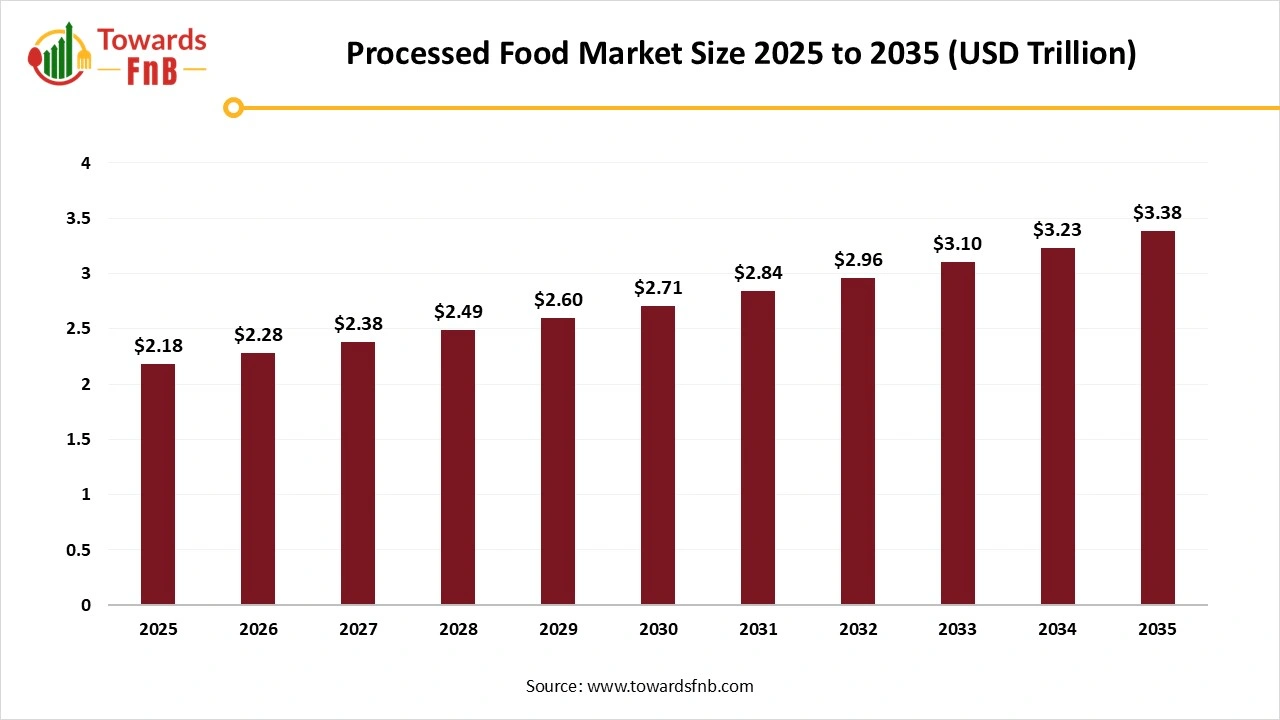
The global processed food market size reached at USD 2.18 trillion in 2025 and is anticipated to increase from USD 2.28 trillion in 2026 to an estimated USD 3.38 trillion by 2035, witnessing a CAGR of 4.48% during the forecast period from 2026 to 2035. The market is attributed to the increasing demand for convenience food products.
| Study Coverage | Details |
| Growth Rate from 2026 to 2035 | CAGR of 4.48% |
| Market Size in 2026 | USD 2.18 Trillion |
| Market Size in 2027 | USD 2.38 Trillion |
| Market Size by 2035 | USD 3.38 Trillion |
| Largest Market | North America |
| Base Year | 2025 |
| Forecast Period | 2026 to 2035 |
| Regions Covered | North America, Europe, Asia-Pacific, Latin America, and Middle East & Africa |
The processed food market deals with food that is modified from its natural state via methods including canning, freezing, cooking, and the addition of preservatives to improve the convenience, flavor, and shelf life of the food. Processed foods generally can contribute to heart-related issues and provide lower nutritional value. The market growth for processed foods is witnessing rapid growth due to the increasing demand for convenience food products and increasing consumer preference towards changing lifestyles. Leading to rapid consumption of ready-to-cook and ready-to-eat foods, urbanization has played an important role in changing dietary patterns, which is further expected to drive market growth.
Some of the significant factors driving the market are the increasing popularity of freezing and canning methods. By consuming high-quality foods rich in minerals and vitamins, many consumers are becoming aware of leading healthy lifestyles. To adopt convenient and easy food options, this trend is enhancing urban populations. In addition, increased spending power is also accelerating the demand for canning techniques and driving the popularity of canned food in food processing. Furthermore, the demand for convenience has increased due to busy lifestyles. Innovations in packaging, advancements in food processing technology, and urbanization are also expected to increase processed foods that are more accessible and affordable, which further drives the market.
The food industry is also keeping pace with innovation, with advancing technology across all industries. The food processing industry is transforming rapidly due to the integration of technological advancements. To sterilize food products while retaining their natural nutritional value, taste, and aroma, various experts leverage state-of-the-art techniques and aseptic processing. In addition, processed food products are packed in a sterile environment, and make sure that products don't need any artificial additives and preservatives for longer shelf life, which increases the demand for processed foods. In addition, to meet the requirements of modern-day consumers, processed foods offer innovative solutions and reduce wastage, which is further expected to revolutionize the growth of the processed food market in the coming years.
The increasing awareness of artificial additives and preservatives is a major challenge that may hinder market growth. Consumers are rapidly looking for alternatives to highly processed foods and are becoming more health-conscious toward natural alternatives. Due to this, clean-label, natural, and organic food products are gradually improving on retail shelves across the globe. In addition, this preference has led to slow growth in various applications, such as unhealthy ingredients and excessive preservatives, which are further expected to restrain the growth of the market during the forecast period.
U.S. Processed Food Market Size and Growth 2025 to 2034
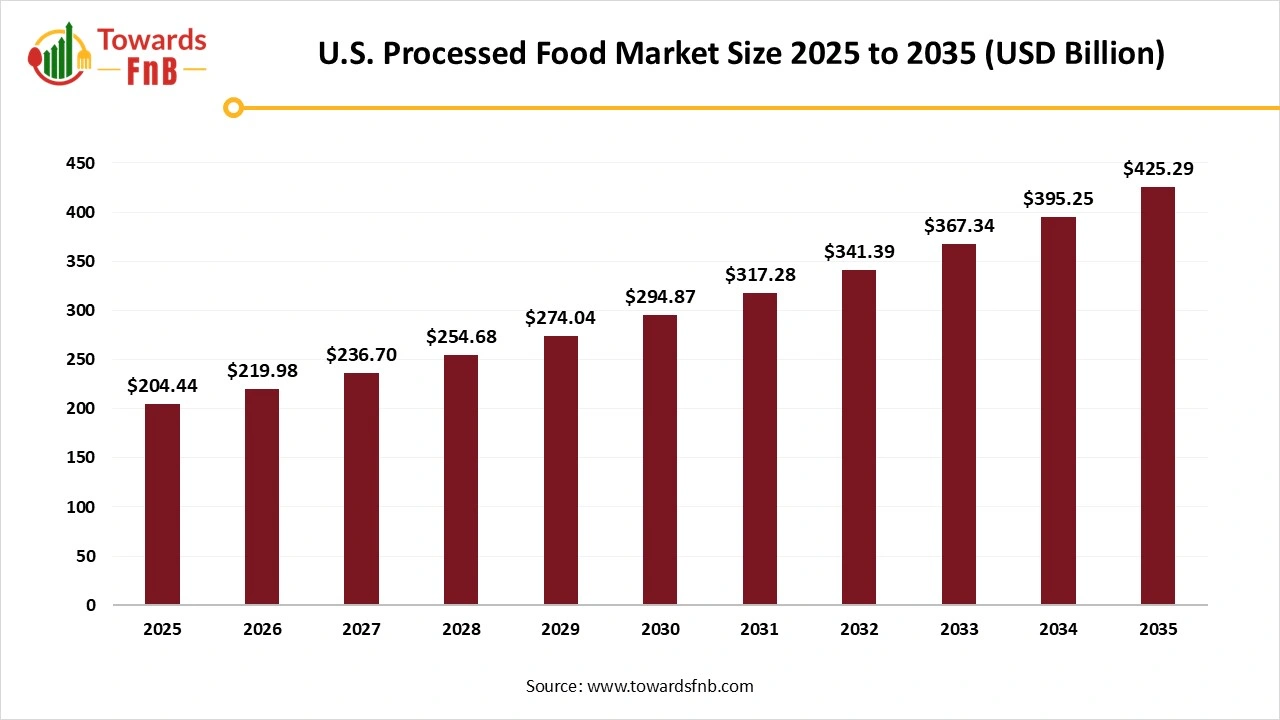
The U.S. processed food market was valued at USD 190.00 billion in 2024 and is projected to experience steady growth, reaching USD 204.44 billion in 2025. By 2034, the market is expected to nearly double, reaching approximately USD 395.25 billion, with a compound annual growth rate (CAGR) of 7.6% from 2025 to 2034. This growth is driven by the increasing demand for convenient, ready-to-eat foods, as well as rising health awareness among consumers.
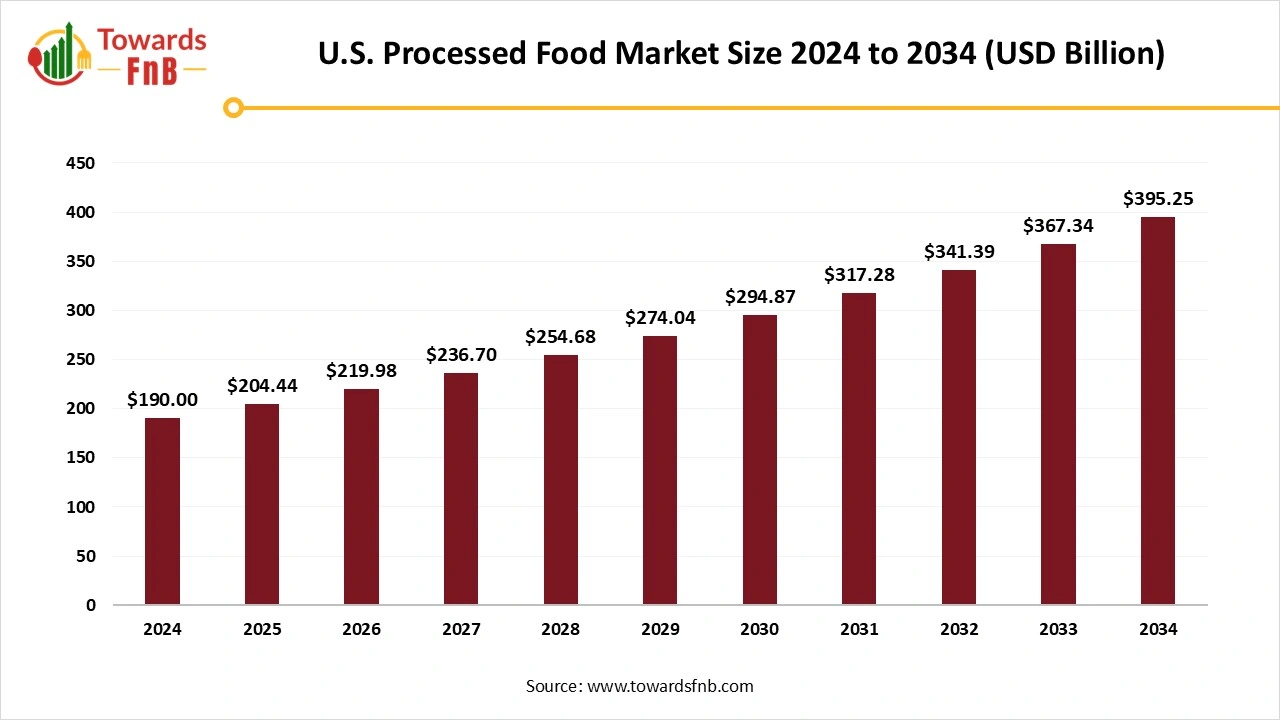
The U.S. processed food market is expected to experience steady growth, driven by the increasing demand for convenient and ready-to-eat foods, as well as rising health awareness among consumers. The market is projected to expand significantly over the coming years, with a steady upward trajectory fueled by these consumer trends.
North America Processed Food Market Trends
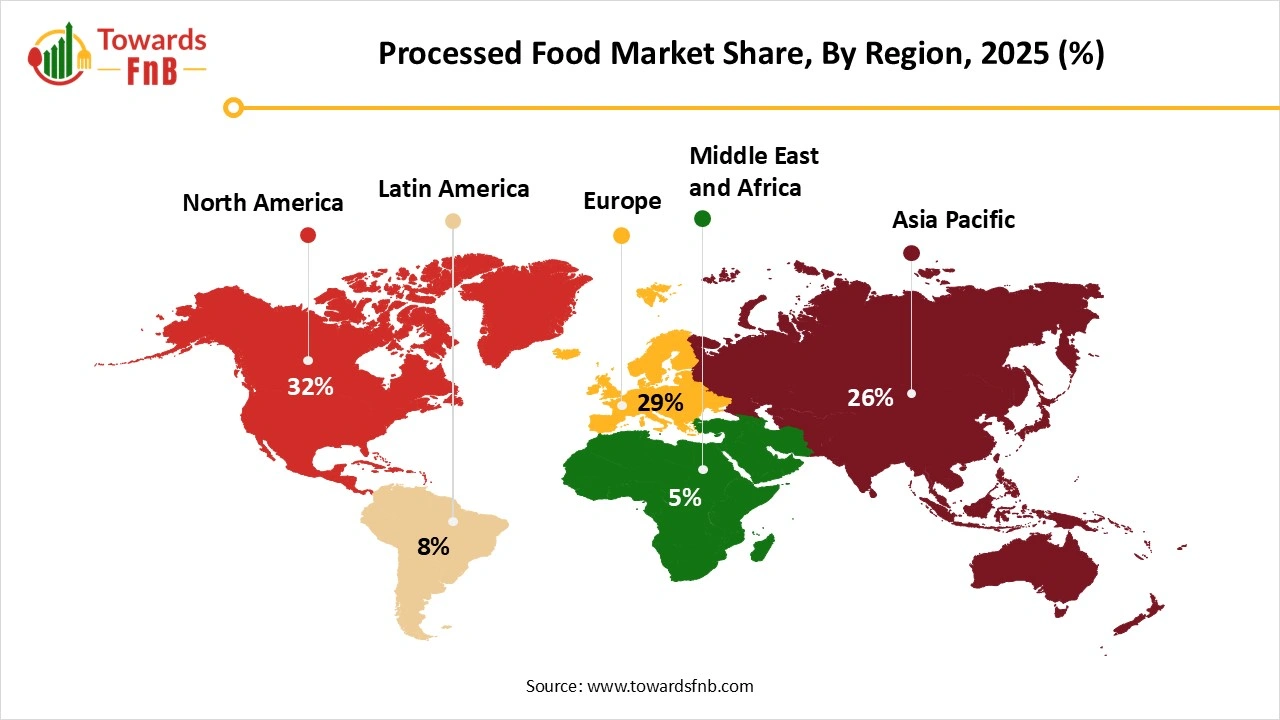
North America dominated the market share in 2024. The growth of the market is owing to the focus on new product advancemnts and development, rising innovation in processed food, increasing demand for ready-to-eat products, snacks, frozen meals, and others, and increasing consumption of convenience and packaged foods. In the region, with over 50% of daily calories eaten being sourced, the consumption of processed foods is high. The consumers' preference towards processed foods is very high, due to industrialization, urbanization, and the growing population.
North America Processed Food Market Size 2025 to 2035
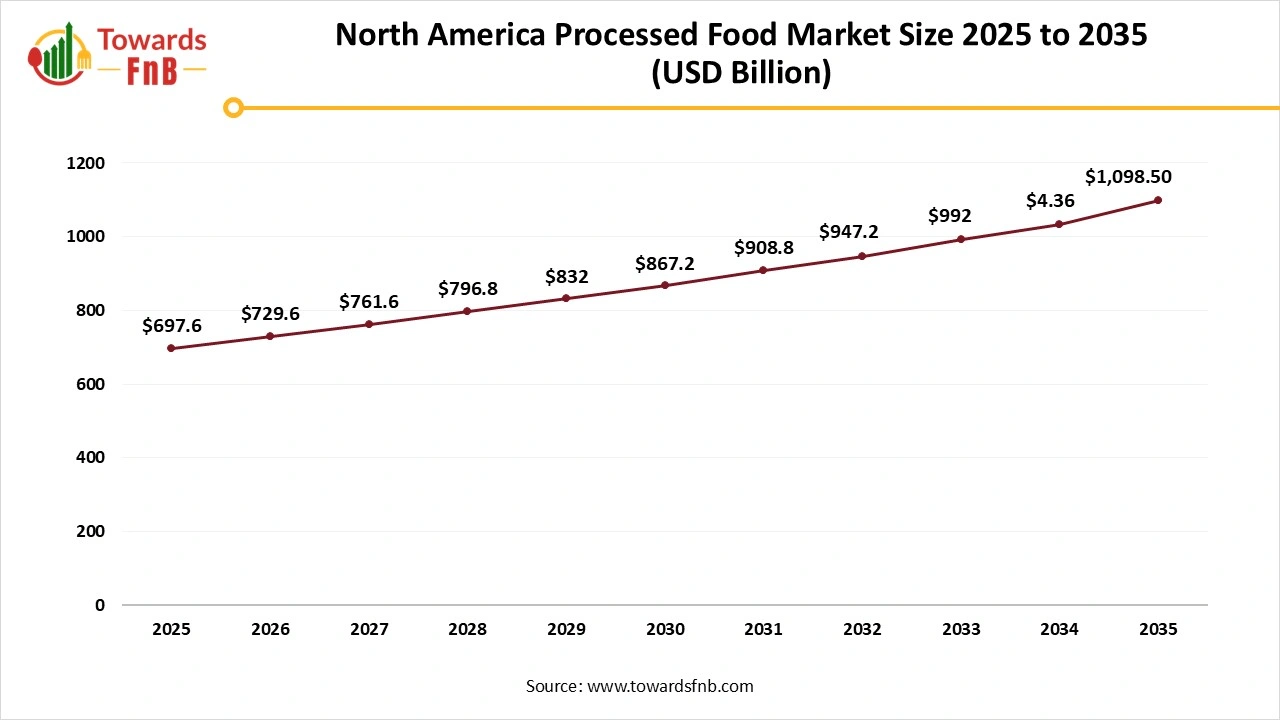
The North America processed food market size was calculated at USD 497.6 billion in 2025 with projections indicating a rise from USD 729.6 billion in 2026 to approximately USD 1,098.50 billion by 2035, expanding at a CAGR of 4.65% throughout the forecast period from 2026 to 2035.
How U.S. Dominated the Processed Food Market in 2024?
The U.S. dominated the market share due to the increasing changing lifestyles, increasing demand for snacks and packaged foods, rising demand for frozen food, and increasing working women's workforce. In the U.S. 73% of the food is currently the top-ranked country and highly dominated by ultra-processed foods. On a daily basis, the population in the U.S. consumes over half of its calories from ultra-processed food sources. Most of the people eating at least one pre-made or packaged food with every meal in the U.S.
How Big is the U.S Processed Food Market?
The U.S processed food market size estimated at USD 523.2 billion in 2025 and is predicted to increase from USD 547.2 billion in 2026 to nearly reaching USD 829.37 billion by 2035, growing at a CAGR of 4.71% during the forecast period from 2026 to 2035.
Asia Pacific Processed Food Market Trends
Asia Pacific is expected to grow fastest during the forecast period. The market growth in the region is driven by factors such as increasing consumer preference towards convenient processed food options, increasing busy lifestyles, growing middle class population, and increasing demand for ultra-processed food products, snacks, and ready-to-cook foods. China, India, Japan, and South Korea are the fastest growing countries in the region.
India is expected to grow fastest during the forecast period. The market is experiencing rapid growth in the country due to factors such as increasing growth of modern retail formats, increasing disposable incomes, and rapid urbanization. The Indian food processing market plays an important role in the economic growth of India. The market for processed foods is further influenced by an increasing number of restaurants, e-commerce retailers, and brand-oriented importers.
Europe Processed Food Market Trends
The processed food market in the European region is growing as this region is being classified by a “convenience-health “scenario in which there is an urge for ready-to-eat solutions that stays high despite developing user expectations towards ultra-processed foods.
Additionally, there is a huge demand for processed fruits, nuts, and vegetables which are displaying the primary signs of an update after certain years to reduce the amount of inflation. European manufacturig is not effective to align with the urge which makes possibilities for the suppliers from growing countries.
Germany Processed Food Market Trends
The German government has named a “National Reduction and Invention Method” that actively encourages producers to a lower sugar, salt and fat too in processed foods, which is specifically for yout-focussed products. Additionally, Germany stays as the third biggest global importer of agricultural products that excessively relies on an foreign supplier for tropical fruits, nuts and processed ingredients to align with domestic demand.
Middle East and Africa Processed Food Market Trends
The processed food market in the Middle East &Africa (MEA) region is growing quickly as it is totally dependent on an industry-actual calculation procedure that tracks a supply demand balance, financial reporting and machine installation too. Its growth is being driven by growing demand for packaged and processed foods, which are developing the funding in urbanisation, automation and moving the dietary designs that needs effective and hygienic processing system.
How did the Secondary Processed Food Segment Dominated the Processed Food Market in 2024?
The secondary processed food segment dominated the market share in 2024. The segment growth in the market is driven by increasing consumption of processed foods in both developing and developed countries, increasing busy lifestyles, growing urbanization, and increasing affordability and convenience of processed foods. The secondary processed food deals with ready-to-eat foods, canned vegetables, and baked products
The Ultra-Processed Foods Segment is Expected to Grow Fastest During the Forecast Period.
The segment growth in the market is driven by increasing consumer preference towards quick and instant food options, the rise of retail chains and supermarkets, and growing urbanization. The ultra-processed foods include instant noodles, snacks, and other foods.
Why did the Freezing Segment Dominated the Processed Food Market Share in 2024?
The freezing segment dominated the processed food market in 2024. The segment growth in the market is attributed to the increasing demand for healthy and convenient options, increasing demand for nutritious and long-lasting options, and increasing consumption of ready-to-cook meals, vegetables, and frozen fruits. In addition, segment growth is also experiencing rapid growth due to various benefits such as availability & freshness, time-saving convenience, economic choice, sealed freshness, longer frozen food storage life, less food waste, optimal nutrition, consistent high-quality, unbeatable value, and more.
The Extrusion Segment is Expected to Grow Fastest During the Forecast Period.
The segment growth in the market is propelled by increasing consumer preference towards convenient and novel food choices, increasing consumption of extruded breakfast and snack cereals, increasing demand for innovative snacks, and increasing snack production to produce puffed snacks, pasta, and cereals.
What Factors Helped to Dominate the Grains & Cereals Segment in the Processed Food Market in 2024?
The grains & cereals segment dominated the processed food market in 2024. The segment growth in the market is driven by the increasing consumption of staple foods such as pasta, rice, and bread. The grains and cereals have various health benefits such as high in nutrients and fiber, reducing the risk of heart disease, reduced risk of stroke, reduced risk of obesity, lower risk of type 2 diabetes, supporting healthy digestion, reducing chronic inflammation, and reducing the risk of premature death, which further drives the segment growth.
The Meat and Poultry Segment is Expected to Grow Fastest During the Forecast Period.
The segment growth in the market is attributed to the increasing consumer preference towards protein-rich and convenient food options, increasing consumption of processed meat, including pre-cooked poultry, nuggets, and sausages, and increasing disposable incomes.
Al Islami Foods
By Type
By Technology
By Product
By Region







Principal Consultant
Vidyesh Swar, Senior Research Analyst at Towards Food & Beverages, specializes in market research, focusing on supply-demand evaluation, pricing analysis, alternative proteins, plant-based foods, and sustainable food technologies within the industry.
Learn more about Vidyesh Swar
Reviewed By
Aditi Shivarkar, with 14+ years in Food and Beverages market research, specializes in food, beverage, and eco-friendly packaging. She ensures accurate, actionable insights, driving Towards FnB's excellence in industry trends and sustainability.
Learn more about Aditi ShivarkarApril 2026
April 2026
April 2026
April 2026

Processed Food Market


 +1 804-441-9344
 Download Sample
 Schedule a Meeting