April 2026



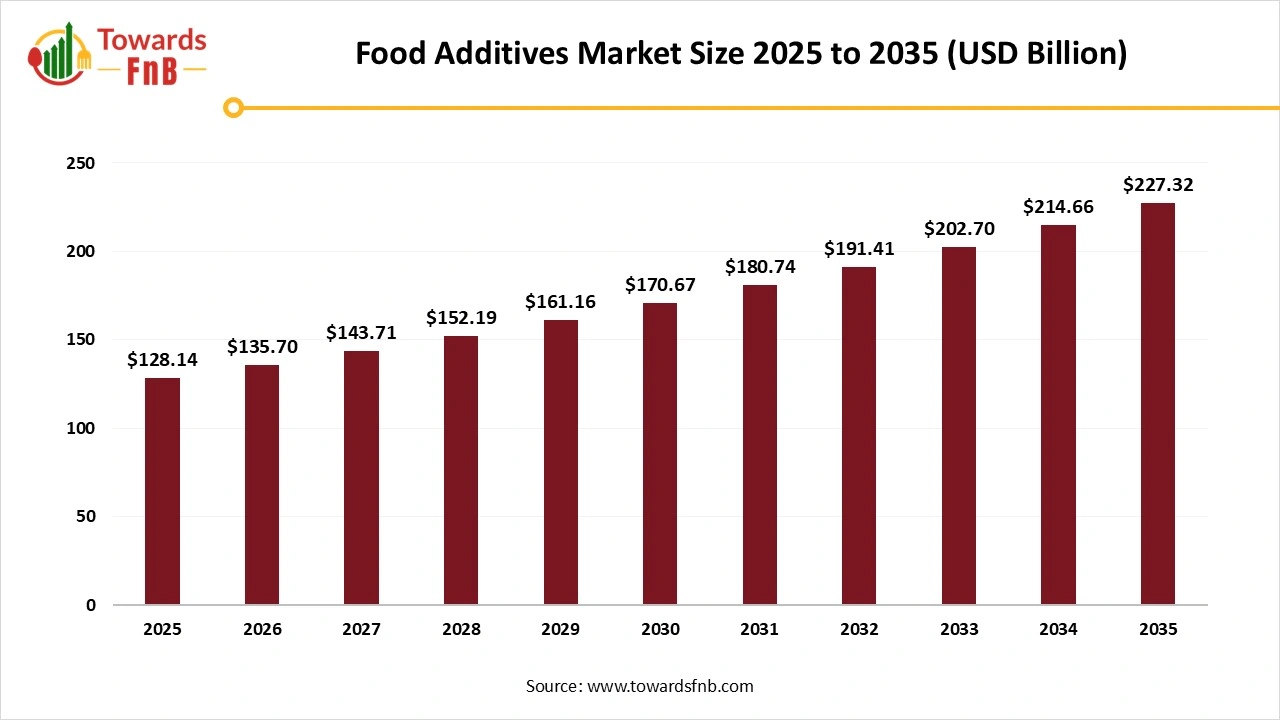
The global food additives market size was valued at USD 128.14 billion in 2025 with projections indicating a rise from USD 135.70 billion in 2026 to reach approximately USD 227.32 billion by 2035, expanding at a CAGR of 5.9% throughout the forecast period from 2026 to 2035. The swift progress in food processing that allows for the development of new additives to enhance food quality, flavor, and safety is driving market expansion.
| Study Coverage | Details |
| Growth Rate from 2026 to 2035 | CAGR of 5.9% |
| Market Size in 2026 | USD 135.70 Billion |
| Market Size in 2027 | USD 143.71 Billion |
| Market Size by 2035 | USD 227.32 Billion |
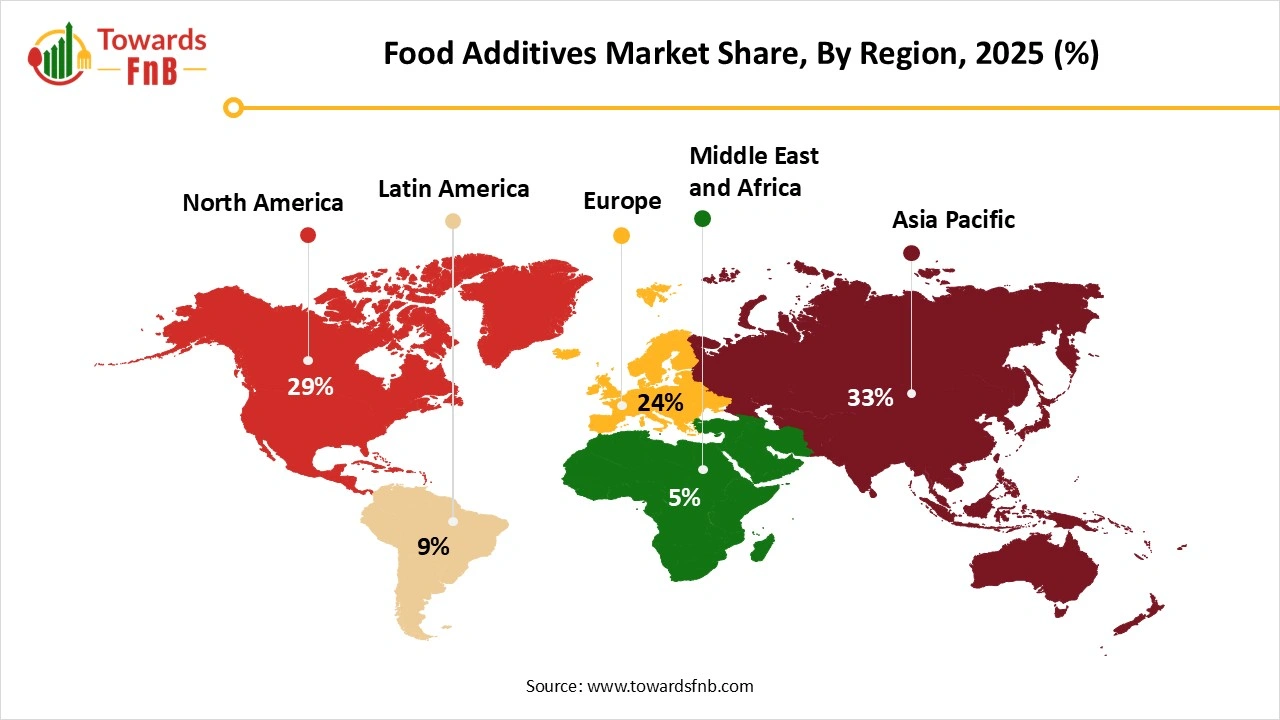
| Largest Market | Asia Pacific |
| Base Year | 2025 |
| Forecast Period | 2026 to 2035 |
| Regions Covered | North America, Europe, Asia-Pacific, Latin America, and Middle East & Africa |
Food additives have become essential components in the food and beverage sector. This is due to their ability to extend the shelf life of food items while significantly improving their freshness, taste, and texture. To ensure the safety of processed food during its journey from the industrial kitchen to warehouses, retail stores, and finally to consumers, food additives are incorporated. Since ancient times, certain food additives have been utilized to maintain food preservation. The global consumption of packaged food items and drinks is increasing. This is anticipated to aid the rising need for additives utilized in the processing of different packaged goods and drinks is further accelerate the growth of the market.
Increase in demand for packaged and convenience foods after the pandemic period, rising food expenses, propelled by higher per capita incomes and an expanding female workforce in developing areas are elevating the demand for processed food, thereby intensifying the use of food additives. Fast urban growth and increasing disposable incomes in developing countries are altering food choices, resulting in a higher demand for convenience and processed foods. These products frequently depend on food additives to enhance flavor, improve texture, and prolong shelf life. The growing food and beverage sector in these areas is additionally boosting the need for food additives market.
| Date | Regulatory Framework | Initiatives |
| July 2025 | The Food and Drug Administration (FDA) |
Granted a novel color additive petition for using color gardenia blue in various foods, at a level which is consistent with good manufacturing practices. (Source: U.S. Food & Drug) |
| May 2025 | FAO |
Conducted a scientific literature review to assess the way certain food additives can affect the gut microbiome and human health. The review showcases the way of exploring microbiome data to improve chemical food safety risk assessments. (Source: FAO) |
| April 2025 | The U.S. Department of Health and Human Services and the FDA |
Launched a series of novel measures to phase out petroleum-based synthetic dyes from the U.S. food supply. The series includes FDA-guaranteed three novel color additive petitions to expand the palette of available colors from natural sources, demonstrating that manufacturers to use additives safely in food. (Source: U.S. Food &Drug) |
| March 2025 | China National Center for Food Safety Risk Assessment (CFSA) |
Issued novel eight food additives for public comment, including two new food additives and two new food nutrition enhancers, two food processing aids, one food additive with expanded scope, and one food additive with supplemented quality specification. (Source: cirs-group) |
Nutritional additives are utilized to replace nutrients that were lost or diminished during manufacturing, to enhance or enrich specific foods to address dietary deficiencies, or to incorporate nutrients into food alternatives.
The application of metallic nanoparticles for their antimicrobial properties and advanced methods such as nanoencapsulation have created fresh opportunities for creating new food ingredients. The investigation of unconventional cell disruption methods for obtaining promising food additives and nutraceuticals from microalgae, as well as employing encapsulated natural compounds as antimicrobials in food packaging advancing the sector.
Numerous studies indicate that artificial colourings, benzoate preservatives, non-caloric sweeteners, emulsifiers, and their breakdown products may negatively impact health by elevating the risks of mental health issues, attention deficit hyperactivity disorder, cardiovascular diseases, metabolic syndrome, and possible carcinogenic effects. Rising awareness among consumers regarding health impact of food additives restraining the growth of the market.
Raw Material Procurement
Processing
Asia Pacific Dominated Market in 2025
The rise in the urbanization, increasing net incomes, and shifting lifestyles all drive market expansion. In addition, the growing consumer awareness regarding food quality, the extension of shelf-life, and the wish for enhanced flavors all drive the need for additives. Nations like China and India play a major role in this expansion, supported by governmental actions aimed at upgrading the food sector and aligning with international standards. This strong growth path positions the Asia pacific region as a significant market for food additives.
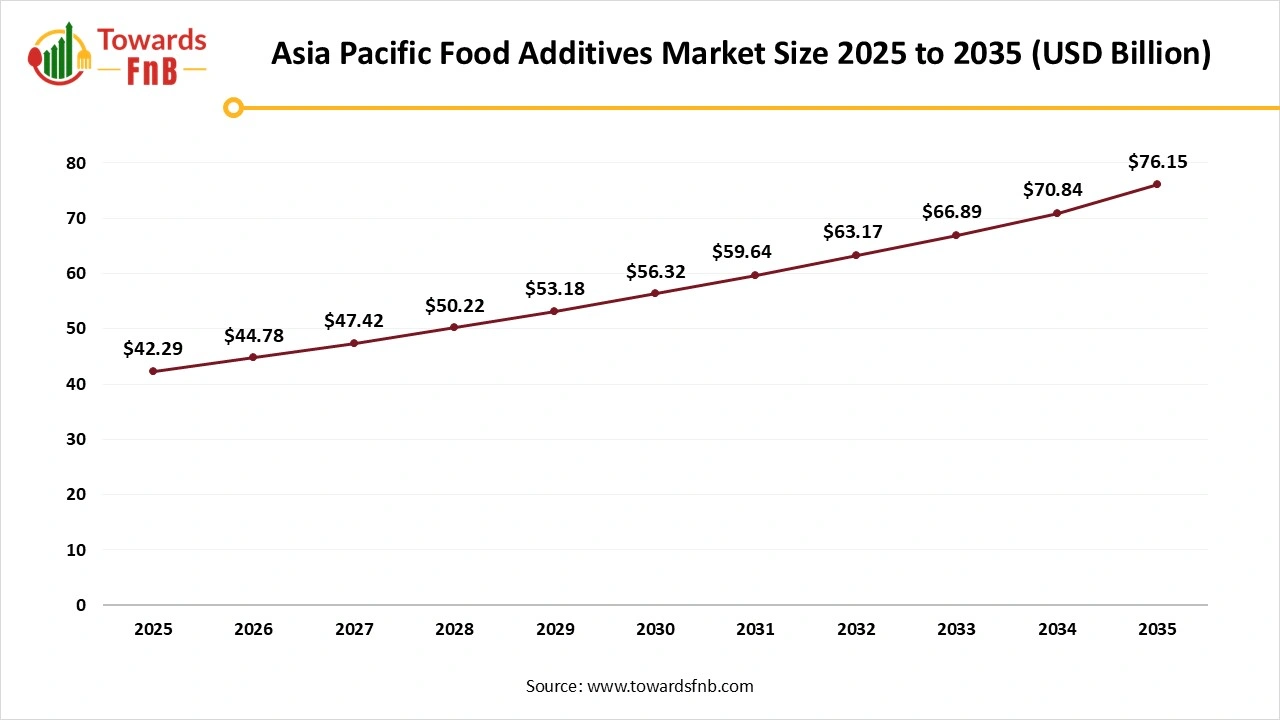
Asia Pacific Food Additives Market Size 2025 to 2035
The Asia Pacific food additives market size was calculated at USD 42.29 billion in 2025 with projections indicating a rise from USD 44.78 billion in 2026 to reach approximately USD 76.15 billion by 2035, expanding at a CAGR of 6.06% throughout the forecast period from 2026 to 2035.
Rise of market of food additive in India is related to growing demand for tropical flavors in non-alcoholic drinks, including sodas, juices, and flavored waters. With an increasing awareness of health and food safety among consumers in India, there has been a notable surge in the demand for natural food additives. The increasing demand for processed foods in India has become a key driver boosting the food additives market.
North America is Expected Fastest Growth in the Market During the Forecast Period
Rising demand for packaged, frozen and ready to eat food, busy lifestyle and need of convenience foods driving the market. The popularity of specialty food ingredients is strong because of the greater technological and functional advantages they provide regarding the superior quality, safety, cost-effectiveness, nutrition, and taste of processed food items.
The food additives market in the United States plays a crucial role in the food industry by enhancing the quality, safety, and attractiveness of different food items. In the United States, producers of food additives must comply with strict government regulations established by the Food and Drug Administration. The FDA regulates the safety and appropriate use of food additives, making sure they are safe for consumers. Retail as well as convenience food is crucial in promoting the expansion of the food additives market in the United States.
Europe Food Additives Market Trends
Europe's food additives market is significant and growing, valued in the billions. This growth is driven by the demand for processed and convenience foods, cleaner labels, and health trends. Europe has a large food and beverage industry that relies on natural additives for various applications. Consumers are increasingly seeking healthier and more sustainable food ingredients, moving away from artificial options. Stricter EU legislation is also contributing to this shift, creating an interesting market for export companies that produce natural sweeteners, emulsifiers, and natural colors, among others.
The German food additives market is set to undergo a dynamic transformation, driven by changing consumer preferences for clean-label, functional, and fortified foods. Innovations in natural preservatives, flavor enhancers, and texturizing agents are enabling manufacturers to offer high-quality, safe, and sustainable products. This adoption is further accelerated by regulatory support, growing health consciousness, and the evolution of a digital ecosystem that enhances production and supply chain solutions.
Middle East and Africa Food Additives Market Trends
In the Middle East and Africa (MEA), the food additives market has experienced significant growth in recent years due to factors like population growth, urbanization, and changing dietary habits. This market is broad and encompasses various nations with different levels of economic development and consumer preferences. The MEA food additive industry is vibrant and diverse, with cultural diversity playing a key role in shaping the region's culinary tastes, ingredients, and flavor profiles.
In the UAE, the food additives market is expanding rapidly alongside the growth of the country's food industry. Food additives are substances added to products to enhance their flavor, appearance, texture, or shelf life. In the UAE, the market is primarily driven by the rising consumer demand for processed and convenience foods. The nation’s multicultural population has resulted in diverse food consumption patterns, influencing the demand for various types of food additives.
Latin America Food Additives Market Trends
Latin America has also seen steady growth in its food additives market in recent years, fueled by evolving consumer preferences and an increasing demand for processed foods. This market has been shaped by a combination of long-term drivers, short-term influences, and emerging opportunities. A significant long-term driver is the growing demand for processed and convenience foods. As urbanization continues to rise, busy lifestyles lead consumers to seek products that are quick to prepare, have extended shelf lives, and maintain nutritional value.
In Brazil, the demand for processed and convenience foods, driven by fast-paced lifestyles and rapid urbanization, is expected to stimulate growth in the food additives market during the forecast period. As cities expand and the middle class grows, there is a greater inclination towards quick and ready-to-eat meals, which in turn fuels the need for food additives to ensure product quality and shelf life. Additionally, regulatory agencies in Brazil are implementing stringent guidelines for food safety, pushing companies to use approved and effective additives in their products. Government initiatives aimed at fortifying staple foods with essential nutrients further contribute to the growth of this market.
The Dietary Fibers Held the Largest Share in the Food Additives Market in 2025
Dietary fibers like cellulose, which have a low capacity for water absorption, are primarily utilized to enhance fiber content in baked goods such as tortillas and bread. Increased intake of bread and bread-derived items is anticipated to boost the need for dietary fibers in baked goods. Individuals with Irritable bowel syndrome IBS are often recommended to raise and alter their dietary fiber intake. Similarly, this is expected to boost the need for dietary fiber among individuals experiencing IBS worldwide.
The Colors Segment Expecting a Significant Growth in the Food Additives Market During the Forecast Period
Food coloring serves as an additional method that companies utilize to distinguish their products in a competitive food and beverage market where visual appeal can influence sales. The globalization of food trends necessitates genuine and diverse culinary coloring. Furthermore, the transition from synthetic to natural coloring sourced from fruits, vegetables, and spices is an emerging trend in the food colors industry.
The Natural Segment Dominated the Food Additives Market in 2025
Rising health awareness and shift towards organic products driving the market. Shoppers are increasingly mindful of their health and are examining product labels closely. The quest for transparency and trust in food items has resulted in an increasing inclination towards natural additives, seen as safer and more genuine.
The Synthetic Additives Segment is Expecting a Notable Growth in the Food Additives Market During the Forecast Period
The process of producing synthetic food flavors is regarded as environmentally friendly and sustainable since it requires fewer resources to create double the quantity of ingredients. These features, along with the availability of safe, dependable, and organic synthetic fragrances and flavors will drive market consumption.
Food Additives Market Size By Source, 2024 to 2034 (USD Billion)
| Source | 2024 | 2025 | 2026 | 2027 | 2028 | 2029 | 2030 | 2031 | 2032 | 2033 | 2034 |
| Natural | 109.64 | 117.85 | 123.60 | 130.82 | 138.97 | 134.29 | 156.14 | 163.15 | 162.22 | 153.71 | 188.44 |
| Synthetic | 11.36 | 10.29 | 12.10 | 12.89 | 13.21 | 26.87 | 14.53 | 17.59 | 29.18 | 48.98 | 26.22 |
The Dry Segment Dominated in the Food Additives Market in 2025
Factors such as easy handling, storage and transport and are cost effective than liquid additives, boosting the growth. The increasing usage of the dry food additives for the efficient and long-lasting preservation of food that boosts the growth of the segment.
The Liquid Segment is Anticipated Significant Growth in the Food Additives Market During Predictive Timeframe
In items such as drinks, condiments, and marinades, liquid additives blend effortlessly, improving sensory qualities and providing uniform distribution. The move towards unique and novel flavor combinations in liquid formulations, such as drinks and sauces, drives the demand for liquid additives.
Food Additives Market Size By Form, 2024 to 2034 (USD Billion)
| Form | 2024 | 2025 | 2026 | 2027 | 2028 | 2029 | 2030 | 2031 | 2032 | 2033 | 2034 |
| Dry | 78.00 | 82.05 | 90.43 | 92.34 | 106.42 | 112.45 | 96.37 | 114.25 | 127.17 | 127.22 | 176.73 |
| Liquid | 43.00 | 46.09 | 45.27 | 51.36 | 45.77 | 48.71 | 74.30 | 66.49 | 64.24 | 75.48 | 37.93 |
The Food Segment Led the Food Additives Market in 2025
Rising market of various food sectors like dairy and bakery products, snack food and nutritional supplements driving the market of food additives. Further rising demand of ready to eat and frozen food increasing the market growth.
The Beverage Segment is Expected to Grow Significantly in the Projection Period
The beverage industry is expected to experience moderate growth as consumer preferences shift towards ready-to-drink options, especially in developing and emerging markets. Moreover, an increase in per capita alcoholic beverage consumption and a preference among consumers for premium products are likely to fuel market expansion and rising the demand for additives.
The Thickening Segment Dominated the Food Additives Market in 2025
This expansion is mainly fuelled by the rising demand for convenience and processed foods, as shoppers look for items that provide improved texture and stability. The use of plant-derived thickeners indicates a move towards healthier, more sustainable choices in food manufacturing.
The Stabilizing Segment is Expected to at Highest Rate Throughout the Forecast Period
Increase in the use of natural ingredients in food drives demand for natural stabilizers. innovations in food stabilizers, expanded adoption of clean-label stabilizers, a significant trend surge in veganism and interest in alternative dairy products elevates demand for vegan-friendly food stabilizers.
By Type
By Source
By Form
By Application
By Functionality (Qualitative)
By Region





Principal Consultant
Vidyesh Swar, Senior Research Analyst at Towards Food & Beverages, specializes in market research, focusing on supply-demand evaluation, pricing analysis, alternative proteins, plant-based foods, and sustainable food technologies within the industry.
Learn more about Vidyesh Swar
Reviewed By
Aditi Shivarkar, with 14+ years in Food and Beverages market research, specializes in food, beverage, and eco-friendly packaging. She ensures accurate, actionable insights, driving Towards FnB's excellence in industry trends and sustainability.
Learn more about Aditi ShivarkarApril 2026
April 2026
April 2026
April 2026

Food Additives Market


 +1 804-441-9344
 Download Sample
 Schedule a Meeting