


April 2026



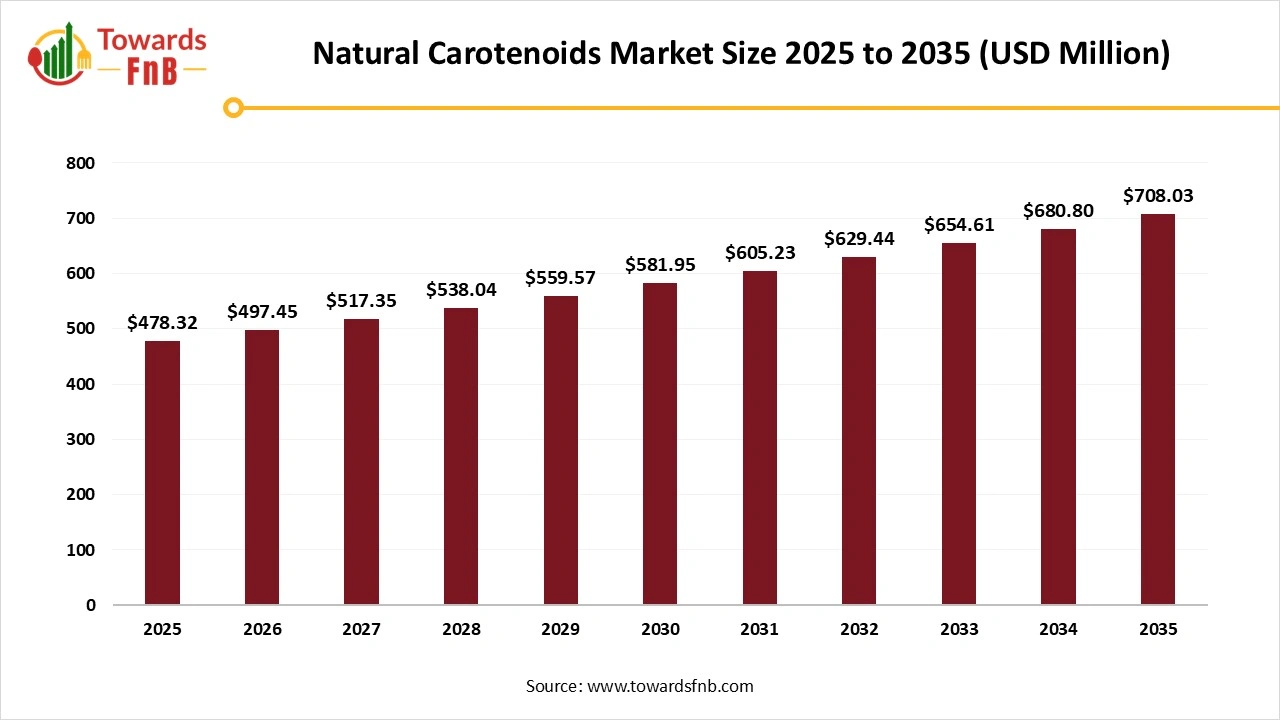
The global natural carotenoids market size reached at USD 478.32 million in 2025 and is predicted to increase from USD 497.45 million in 2026 to an estimated USD 708.03 million by 2035, growing at a CAGR of 4% during the forecast period from 2026 to 2035. The growth of the market is driven by the increasing demand for nutrient-rich and natural ingredients.
| Study Coverage | Details |
| Growth Rate from 2026 to 2035 | CAGR of 4% |
| Market Size in 2026 | USD 497.45 Million |
| Market Size in 2027 | USD 517.35 Million |
| Market Size by 2035 | USD 708.03 Million |
| Largest Market | Asia Pacific |
| Base Year | 2025 |
| Forecast Period | 2026 to 2035 |
| Regions Covered | North America, Europe, Asia-Pacific, Latin America, and Middle East & Africa |
The natural carotenoids market refers to the global industry focused on the production and application of naturally derived carotenoids pigments produced by plants, algae, bacteria, and fungi, including beta-carotene, astaxanthin, lutein, zeaxanthin, lycopene, and canthaxanthin. Natural carotenoids are valued for their antioxidant properties, health benefits, and coloring capabilities. They are widely used in food and beverages, dietary supplements, pharmaceuticals, cosmetics, and animal feed.
The market growth is also driven by rising consumer preference for natural colorants, health & wellness trends, aging populations, and regulatory restrictions on synthetic carotenoids, demand for natural ingredients, rising health consciousness, growing livestock and aquaculture sectors and increasing focus on strategic partnerships, sustainability and innovation.
The rise of technological advancements in the natural carotenoids industry focus on optimized biosynthesis for cost-effective and sustainable production, enhanced delivery and stability via encapsulation such as 3D printing, liposomes and microencapsulation, and greener extraction such as enzymatic, ultrasound and supercritical fluid for higher purity, further driving applications in food, beverages and nutraceuticals. Microwave-assisted and ultrasound extraction also enhance efficiency, reduce solvent use and accelerate extraction, are further expected to revolutionize the growth of the market in the coming years.
Raw Material Procurement
Packaging and Branding
Waste Management and Recycling
| Country | Regulatory Body | Key Regulations | Focus Areas | Notable Notes |
| India | Food Safety and Standards Authority of India (FSSAI) | Food Safety and Standards (Packaging and Safety Regulations) and Licensing and Registration of Food Businesses) | Major focus areas in the natural carotenoids market focuses on nutraceuticals, cosmetics, personal care and food and beverages industries and health-conscious, plant-based and clean-label food products | The market is growing industry by expansion into diverse applications, increasing demand for organic and sustainable products, focus on nutritional benefits and premiumization and regulatory support. |
Why is Asia Pacific Dominating the Natural Carotenoids Market?
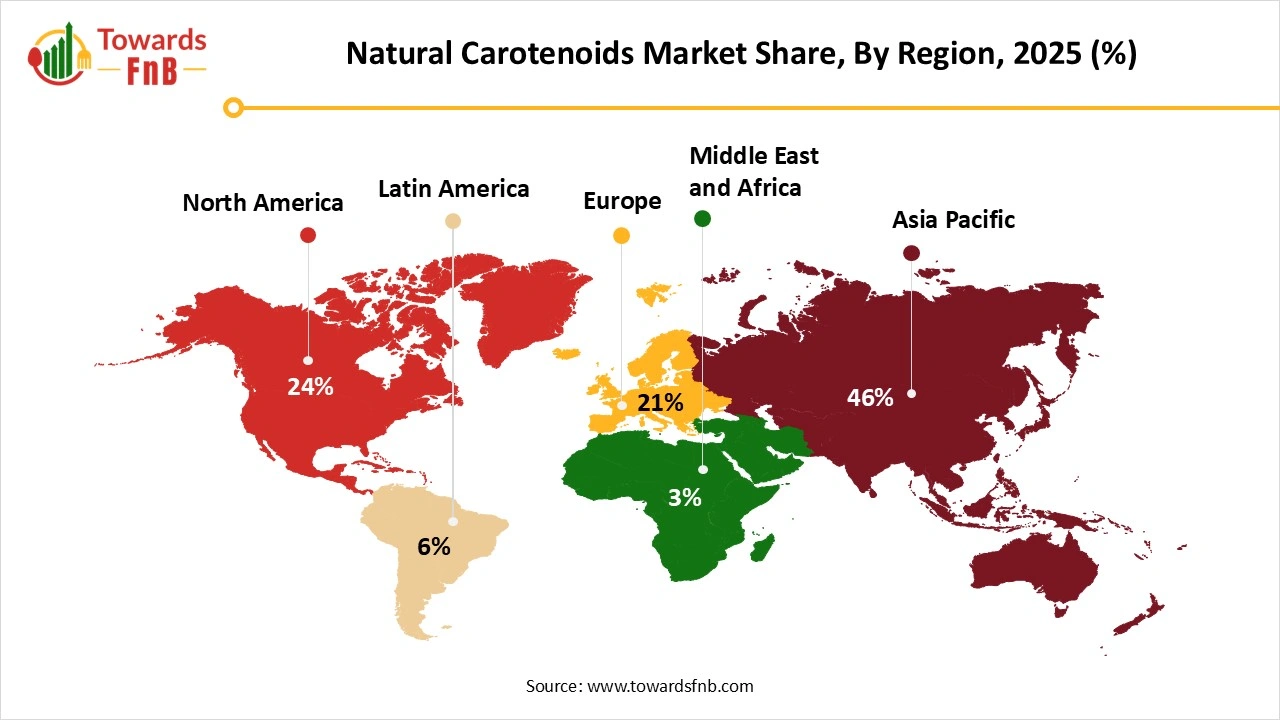
Asia Pacific dominated the global market with approximately 46% of revenue in 2025. The market growth in the region is driven by the increasing disposable incomes, rapid urbanization, growing aquaculture and food and beverage industries and rising health consciousness. Consumers in the region rapidly seek natural ingredients for preventive health, driving demand for functional foods and dietary supplements. Rapid expansion in functional foods and food processing further drives the need for natural additives. China, India, Japan and South Korea are dominating countries driving the market growth.
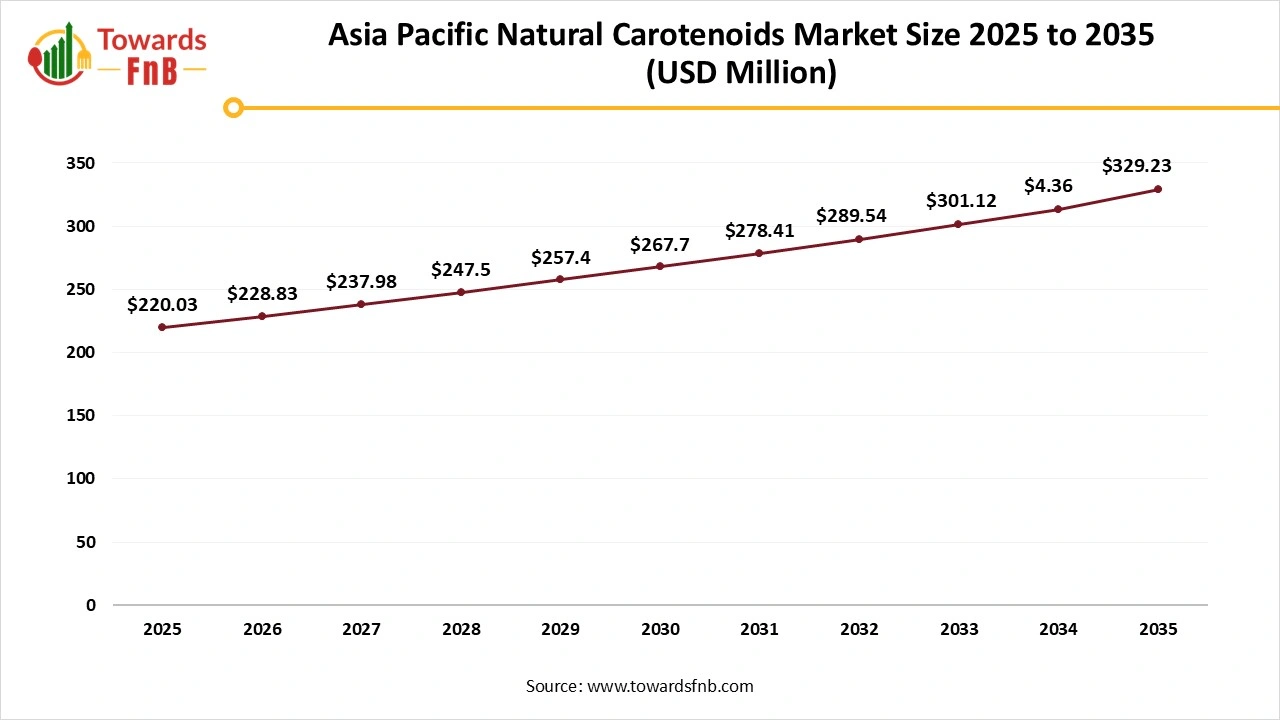
Asia Pacific Natural Carotenoids Market Size 2025 to 2035
The Asia Pacific natural carotenoids market size was calculated at USD 220.03 billion in 2025 with projections indicating a rise from USD 228.83 billion in 2026 to approximately USD 329.23 billion by 2035, expanding at a CAGR of 4.11% throughout the forecast period from 2026 to 2035.
India Natural Carotenoids Market Trends
India dominated the natural carotenoids industry. The market is witnessing rapid growth, driven by growing applications in animal feed, food and nutraceuticals, demand for clean label products, rising health awareness, and strong plant-based trends. Various consumers are shifting towards preventive healthcare, driving demand for natural antioxidants. Major companies in India such as Vidya Herbs, Shreedha Phyto Extracts and Zeus Hygia offer natural carotenoids.
North America is expected to grow fastest during the forecast period. The natural carotenoids market is witnessing rapid growth, driven by the increasing demand for natura colors in animal feed, supplements and food, health benefits such as immune support, vision and antioxidant and rising consumer demand for clean labels. Key drivers include aquaculture, nutraceuticals and fortified foods, with major players focusing on R&D for astaxanthin, lycopene, lutein and natural extraction. In addition, prevalence of chronic diseases, preference for natural colors and demand for natural ingredients, further drives the market growth in the region.
The U.S. Natural Carotenoids Market Trends
The U.S. is expected to grow fastest during the forecast period. The market growth in the U.S. is attributed to the increasing need for natural food colorants, health benefits such as antioxidants and eye health and increasing consumer demand for clean labels, with major applications in animal feed, food and beverage and supplements. Various major players in the U.S. are focusing on natural products and innovations.
Why Does Europe Driving the Natural Carotenoids Market?
Europe is expected to grow at a notable rate during the forecast period. The market growth in the region is driven by the supportive government policies and regulations, increasing demand for natural products in supplements and food, increasing consumer awareness of health-consciousness, focus on new product development and sustainability and high demand for quality animal products. The U.K., France and Germany are notable countries driving the market growth.
Germany Natural Carotenoids Market Trends
The natural carotenoids market is growing and robust growth, driven by the strong consumer demand for natural ingredients, clean labels, wellness and health in animal feed, supplements and food and beverages particularly fortified drinks and juices, with major growth expected in natural-sourced lutein, astaxanthin, and beta-carotene. With major players focusing on sustainable sourcing and innovation, the market favors non-GMO and natural products in the Europe.
How does Middle East and Africa Driving the Market Growth in 2025?
The market in the Middle East and Africa is witnessing rapid growth, attributed to the expansion in cosmetic sectors, nutraceuticals, food, and beverage. Increasing health consciousness and increasing demand for plant-based and clean-label products. Manufacturers are reformulating products to meet consumer expectations and standards for natural ingredients, which further increase the demand for natural carotenoids in the region.
South Africa Natural Carotenoids Market Trends
The market growth in the country is driven by factors such as the increasing trend towards functional food, increasing consumer awareness towards health and wellness, government supportive regulations and increasing demand for natural and clean-label products in animal feed, nutraceuticals and food and beverages. With natural carotenoids segments growing rapidly, the market sees major B2C sales via wellness shops, online channels, and supermarkets, further increase the demand for natural carotenoids in South Africa.
Why does South America is Driving the Natural Carotenoids Market
The market growth in the region is growing rapidly in South America, driven by the demand for plant-based and functional foods and increasing shift towards sustainable products, with Brazil and Mexico as major share countries, increasing demand for clean-label food and supplements and increasing demand for local rich food sources include diverse fruits and palm oil for extraction. Mexico and Brazil are the major countries boosting the market growth in South America.
Brazil Natural Carotenoids Market Trends
The natural carotenoids industry in Brazil is witnessing rapid growth, driven by the growing food and beverage and food service industry, growing e-commerce platforms, consumer preference towards functional ingredients and sustainability, demand for natural food colorants, increasing clean-label trends in cosmetics, nutraceuticals, feed, food and beverage and rising innovations in encapsulation and extraction promoting wider adoption and improve stability and bioavailability.
Natural Carotenoids Market Share, By Type, 2025 (%)
| Segments | Shares (%) |
| Beta-Carotene | 35% |
| Astaxanthin | 20% |
| Lutein | 15% |
| Lycopene | 12% |
| Zeaxanthin | 6% |
| Canthaxanthin | 4% |
| Others (Capsanthin, Fucoxanthin, etc.) | 8% |
Why is Beta-Carotene Segment Dominating the Natural Carotenoids Market
The beta-carotene segment dominated the global market with approximately 35% of revenue in 2025. Beta-carotene dominates due to high demand in food colors and supplements, increasing prevalence of degenerative diseases, rising health awareness, increasing demand for natural sources, vision-supporting, immune-boosting, potent antioxidant benefits and demand in feed, cosmetics, supplements and food and beverages. Consumers are continuously preferring natural beta-carotene from sources such as sweet potatoes, carrots and algae, further driving the innovation in market growth and extraction methods.
The Others (Capsanthin, Fucoxanthin, etc.) Segment Expected to Grow Fastest During the Forecast Period.
Specialty carotenoids like fucoxanthin and capsanthin hold a major value in the market due to their well-researched, diverse and unique health benefits across typical antioxidant activity, further serving to the increasing consumer demand for functional and natural ingredients in the pharmaceutical, cosmetic and nutraceutical industries.
Natural Carotenoids Market Share, By Source, 2025 (%)
| Segments | Shares (%) |
| Algae / Microalgae | 40% |
| Fruits & Vegetables | 20% |
| Fungi & Yeast | 13% |
| Animal-derived | 10% |
| Plant Extracts / Flowers & Seeds | 17% |
How Does the Algae/Microalgae Segment Dominating the Natural Carotenoids Market?
The algae/microalgae segment dominated the market with approximately 40% of revenue in 2025. Algae/ microalgae plays an important role in the natural carotenoids industry, catering as sustainable and primary “cell factories” for high-value pigments such as beta-carotene and astaxanthin. Microalgae are the major commercial source for high-demand and specific natural carotenoids. In addition, increasing focus on scalability and sustainability, diverse product portfolio, rising technological advancements into optimizing cultivation techniques and rising health consciousness, further drives the segment growth.
The Plant Extracts/Flowers & Seeds Segment is Expected to Grow Fastest During the Forecast Period.
The segment growth in the natural carotenoids market is driven by the increasing demand for clean-label and natural ingredients across various industries, increasing consumer health consciousness, focus on immune function, demand for natural alternatives such as plant-derived carotenoids, focus on preventive healthcare, growing aging population, growing food and beverages industry, technological advancements in extraction technologies, regulatory support for natural ingredients and sustainable and abundant sourcing.
Natural Carotenoids Market Share, By Application, 2025 (%)
| Segments | Shares (%) |
| Food & Beverages | 42% |
| Dietary Supplements & Nutraceuticals | 20% |
| Pharmaceuticals | 10% |
| Cosmetics & Personal Care | 5% |
| Animal Feed & Aquaculture | 8% |
| Functional Foods & Beverages | 15% |
What Factors Help Food and Beverage Segment to Grow in 2025?
The food and beverage segment dominated the market with approximately 42% of revenue in 2025. Food and beverages play an important role in the global market, driven by consumer demand for health benefits and natural colors, utilizing carotenoids for appealing hues in snacks, dairy and juices, supporting the increasing functional foods trend and boosting nutritional value as vitamin A precursors and antioxidants. In food and beverages, natural carotenoids provide natural and vibrant colors to drinks and foods and make products such as confectionery, cheese, margarine, smoothie and juices more appealing to consumers looking for natural ingredients.
The Functional Food and Beverages Segment is Expected to Grow Fastest During the Forecast Period.
The segment growth in the natural carotenoids market is driven by factors such as increasing shift towards natural and clean-label ingredients, new product development in fortified foods and plant-based drinks, enhanced bioavailability, enhanced dual functionality, demand for functional foods, rising health consciousness, preference for natural additives and health benefits such as reducing risk of chronic diseases, immune function, supporting eye health and act as a antioxidants.
AstaReal AB
Prodalim
By Type
By Source
By Application
By Region




Principal Consultant
Vidyesh Swar, Senior Research Analyst at Towards Food & Beverages, specializes in market research, focusing on supply-demand evaluation, pricing analysis, alternative proteins, plant-based foods, and sustainable food technologies within the industry.
Learn more about Vidyesh Swar
Reviewed By
Aditi Shivarkar, with 14+ years in Food and Beverages market research, specializes in food, beverage, and eco-friendly packaging. She ensures accurate, actionable insights, driving Towards FnB's excellence in industry trends and sustainability.
Learn more about Aditi ShivarkarApril 2026
April 2026
April 2026
April 2026

Natural Carotenoids Market


 +1 804-441-9344
 Download Sample
 Schedule a Meeting