April 2026



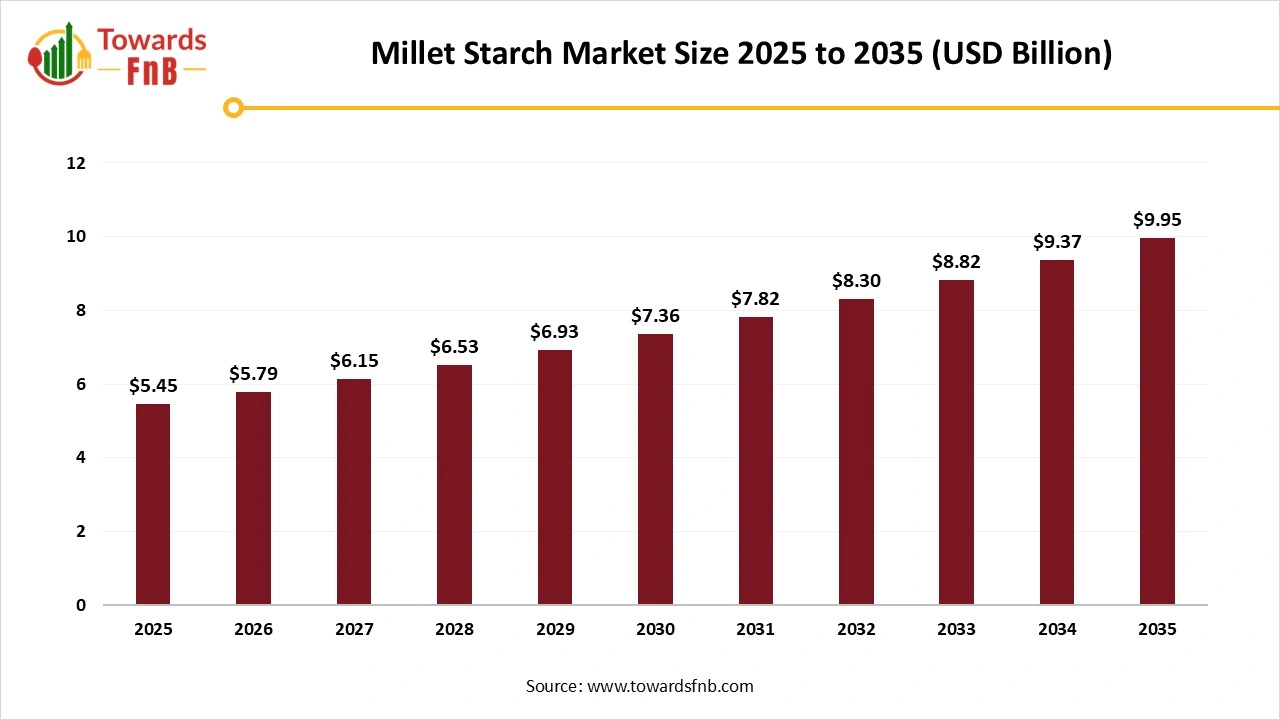
The global millet starch market size estimated at USD 5.45 billion in 2025 and is predicted to increase from USD 5.79 billion in 2026 to nearly reaching USD 9.95 billion by 2035, growing at a CAGR of 6.2% during the forecast period from 2026 to 2035. Growing demand for the healthy and sustainable ingredient across various industries is driving the market.
| Study Coverage | Details |
| Growth Rate from 2026 to 2035 | CAGR of 6.2% |
| Market Size in 2026 | USD 5.79 Billion |
| Market Size in 2027 | USD 6.15 Billion |
| Market Size by 2035 | USD 9.95 Billion |
| Largest Market | Europe |
| Base Year | 2025 |
| Forecast Period | 2026 to 2035 |
| Regions Covered | North America, Europe, Asia-Pacific, Latin America, and Middle East & Africa |
The millet starch market is the global industry that extracts, processes, and commercializes starch from various millet grains, including pearl millet, finger millet, and foxtail millet. Millet starch is a valuable functional component with viscosity, gelling, binding, and stabilizing qualities used in food, industrial, pharmaceutical, animal feed, and personal care applications. The industry's expansion is fueled by health-conscious consumers (e.g., gluten-free products), expanding food processing operations, and a need for sustainable starch supplies.
Raw Material Procurement
Processing of Millet Starch
Distribution of Millet Starch
Why did the Europe Region Dominate the Millet Starch Market in 2025?
Europe dominated the market in 2025, influenced by a combination of increased consumer demand for convenience foods, heightened awareness of health-conscious choices, and the versatile applications of starch across various industries. The demand for millet starch in Europe is on the rise, driven by the pursuit of gluten-free, nutritious, and sustainable alternatives to conventional starches such as corn and wheat. This growth is particularly evident in health-focused food products and bio-based industries. The European starch industry, comprising 70 production facilities across 18 EU member states, manufactures 9.8 million tons of starch and starch derivatives, along with over 5 million tons of proteins and fibers annually.
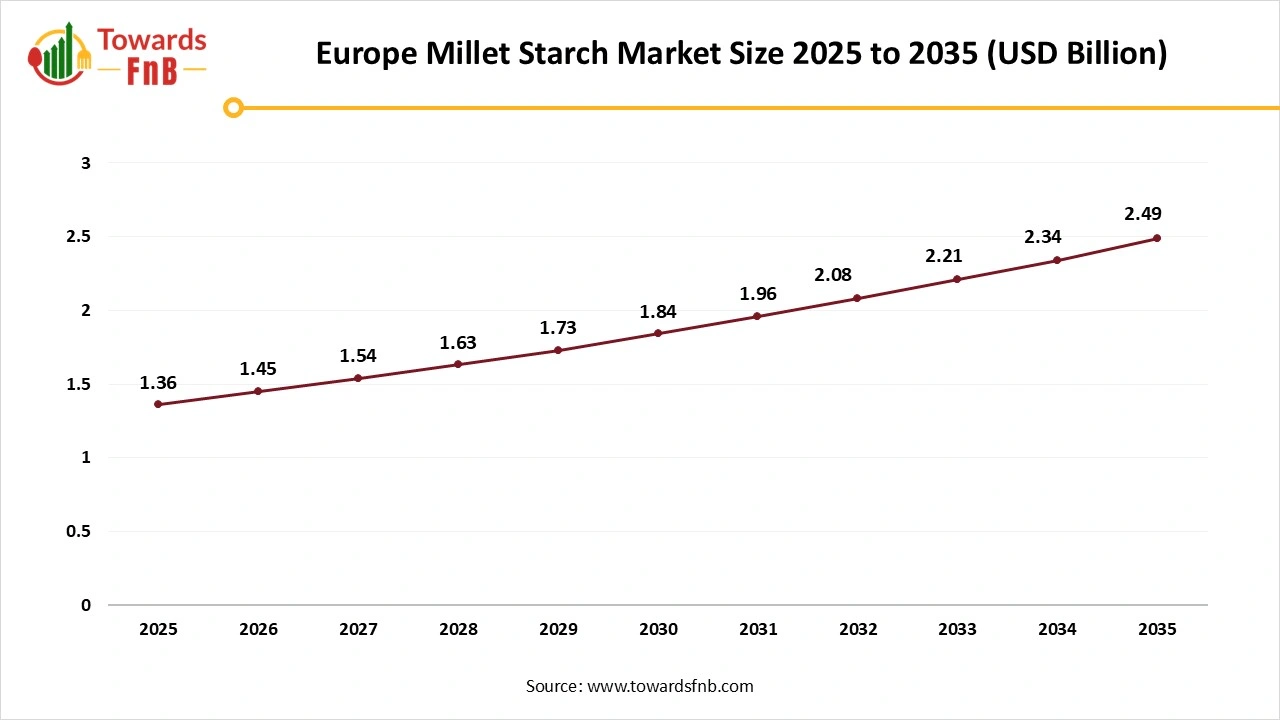
The Europe millet starch market size reached at USD 1.36 billion in 2025 and is anticipated to increase from USD 1.45 billion in 2026 to an estimated USD 2.49 billion by 2035, witnessing a CAGR of 6.2% during the forecast period from 2026 to 2035.
UK Millet Starch Market Analysis
In the United Kingdom, the market is witnessing consistent growth, propelled by increasing consumer awareness regarding the health benefits of millet flour, particularly its gluten-free properties and high nutritional value. The market expansion is mainly attributed to the rising demand for alternative starch options among health-conscious consumers, especially individuals with gluten intolerance or celiac disease. Additionally, the growing trend toward vegan and plant-based diets has further heightened the appeal of millet starch as a versatile ingredient in diverse culinary applications.
Which is the Fastest-Growing Region in the Millet Starch Market?
Asia Pacific expects fastest growth during the forecast period. The market in the Asia Pacific region is undergoing substantial transformations, driven by escalating consumer demand for health-focused and gluten-free alternatives. The inclination towards plant-based diets and gluten-free offerings serves as a primary growth catalyst, enhancing demand across the region. Concurrently, advancements in organic farming techniques and processing innovations are improving yield quality and reducing costs, thereby increasing the accessibility of millet starch.
India Millet Starch Market Investment
In India, the millet starch market is experiencing notable growth, primarily fueled by heightened awareness of the health benefits associated with millets, diversification of millet-based products, and increased incorporation of millets into urban diets. India is the largest global producer of millets, accounting for 38.4% of world production. The country has witnessed a 31.96% increase in millet production over the past five years, rising from 10,235,830 metric tons in 2019 to 13,507,041 metric tons in 2023. To promote the use of millets in food products and foster value addition, the Government of India has initiated the Production Linked Incentive Scheme for Millet-based Products (PLISMBP) for the fiscal years 2022-2023 to 2026-2027, with an expenditure of ₹800 crore. Such growing investment significantly expands the market during the forecast period.

What are the Factors Driving the Millet Starch Market in North America?
The North America millet starch market is being driven by several factors. Millet starch is increasingly employed as a thickening agent in the formulation of various food products, including soups, sauces, salad dressings, custards, creamy spreads, and an array of canned goods. The market is propelled by a growing consumer demand for gluten-free, health-oriented, plant-based foods, alongside trends favoring veganism and innovations in functional ingredients. Additionally, the utilization of alternative starches is supported by advanced food standards and FDA regulations, which foster technological advancements and optimization of processing techniques.
U.S. Millet Starch Market Analysis
The expansion of the United States market is primarily driven by heightened consumer awareness regarding health and nutrition. Millets are esteemed for their high fiber, protein, and antioxidant content, rendering them particularly appealing to health-conscious individuals. Furthermore, the increasing incidence of gluten intolerance and celiac disease has augmented the demand for gluten-free grains, such as millets, owing to their versatility in various food products, including baked goods, snacks, and nutritional supplements, thereby serving as a nutritious alternative to conventional starches with enhanced functional properties like gelation.
Growing Millet Starch Market in the Middle East and Africa
In the Middle East and Africa, the market for millet starch is predominantly influenced by the escalating demand from the food and beverage sector, where starches function as thickeners, stabilizers, and fillers. The rising population coupled with urbanization contributes to an increase in the consumption of processed foods, thereby propelling market growth. Additionally, the expanding pharmaceutical and cosmetics industries employ starch derivatives for diverse applications, further augmenting demand.
UAE Millet Starch Market Examination
The growth of the UAE millet starch market is chiefly driven by the growing demand for processed foods and beverages in which starch serves as a fundamental ingredient. The region's food processing industry is expanding, and an increasing consumer consciousness regarding healthy and convenient food options further supports market growth. Moreover, government initiatives aimed at diversifying the economy beyond oil dependence encourage investments in agriculture and the food sector, which indirectly bolster starch production. Researchers within the UAE are actively investigating efficient and eco-friendly methodologies, such as ultrasound-assisted extraction, to achieve high yields and purity in finger millet starch, thereby enhancing its quality for food applications.
South America Millet Starch Market Potential
In the South American market, consumer demand for processed and convenience food serves as a primary growth driver, with starch being a crucial ingredient. The rising awareness of health and the shift toward plant-based and gluten-free products also enhance the demand for natural starches sourced from millets. Furthermore, the burgeoning foodservice industry and increasing urbanization contribute to elevated consumption rates.
Brazil Millet Starch Market Analysis
Brazil's millet starch market is developing, leveraging the substantial starch industry predominantly based on corn and cassava, while millet starch presents unique gluten-free and nutritional advantages, catering to the expanding health and food sectors. The Ministry of Agriculture has broadened subsidies for millet under its climate-resilient cropping program, making it more attractive for resource-limited farmers. Additionally, the mounting global demand for gluten-free grains positions millet as a viable substitute in health-oriented food manufacturing.
Millet Starch Market Share, By Source, 2025 (%)
| Segments | Shares (%) |
| Pearl Millet | 30% |
| Finger Millet | 14% |
| Foxtail Millet | 12% |
| Proso Millet | 8% |
| Barnyard Millet | 13% |
| Kodo Millet | 7% |
| Little Millet | 6% |
Why did the Pearl Millet Segment Dominate the Millet Starch Market In 2025?
The pearl millet segment led the millet starch market by 2025, attributed to its higher starch yields and favorable processing characteristics compared to traditional cereal starches. Its extensive cultivation, exceptional drought resistance, high starch and protein content, and nutritional benefits, including iron and fiber, along with supportive government initiatives and its applicability across various food products such as flatbreads and porridges, facilitate ongoing demand for its starch.
The Finger Millet Segment is Anticipated to Experience a Fastest Growth During the Forecast Period.
Renowned for its resilience to harsh climatic conditions, finger millet flourishes in semi-arid and rainfed regions, establishing itself as a critical food security crop in developing economies. The starch derived from finger millet possesses significant potential for the development of starch-based edible films and coatings for food items. Its gluten-free nature makes it an excellent alternative for individuals diagnosed with celiac disease or gluten intolerance.
Millet Starch Market Share, By Application, 2025 (%)
| Segments | Shares (%) |
| Food & Beverages | 58% |
| Industrial | 12% |
| Pharmaceuticals | 10% |
| Animal Feed | 6% |
| Personal Care & Cosmetics | 14% |
Which Application Segment Dominated the Millet Starch Market in 2025?
The food and beverages segment held the dominating share of the millet starch market in 2025. Millet starch is suitable for numerous uses: baking flours, thickeners, gluten-free pasta, snacks, infant foods, and fermented drinks. Millets are adaptable grains used in a wide range of food and drink items. The distinct nutritional composition and gluten-free characteristics of millets render them ideal for various food uses. The potential uses of millet starch in food product development are largely determined by its functional characteristics, including swelling, solubility, thermal behavior, gelatinization, viscosity, rheological properties, digestibility, and texture.
The Industrial Segment is Seen to Grow at a Fastest Rate During the Predicted Timeframe.
The starch obtained from millet demonstrates distinct physicochemical characteristics, such as elevated amylose level, small granule size, and excellent gel-forming capacity. These characteristics render it appropriate for multiple industrial uses. Additionally, millet starch exhibits potential in the textile sector as a sizing agent and for creating biodegradable films. It is increasingly utilized in non-food industries such as paper, textiles, adhesives, and biodegradable packaging because of its characteristics.
Millet Starch Market Share, By Functionality, 2025 (%)
| Segments | Shares (%) |
| Thickening Agent | 40% |
| Binding Agent | 15% |
| Gelling Agent | 12% |
| Stabilizer | 8% |
| Film-forming Agent | 5% |
How did the Thickening Agent Segment Dominate the Millet Starch Market in 2025?
The thickening agent segment dominated the market with the largest share in 2025. Its granules take up water and expand greatly when heated, creating viscous gels that combine liquids, enhancing foods such as soups, gravies, and custards by making them thicker and creamier, particularly beneficial in gluten-free products due to its inherent properties and excellent water retention capability. Its porous design enables it to effectively attach water molecules via hydrogen bonds, swelling considerably and increasing in thickness.
The Film Forming Segment is Expected to Grow at the Fastest Rate in the Market During the Forecast Period.
Millet starches have phenolics and antioxidants that can be incorporated into the film, improving food safety and extending shelf life. Biodegradable films made from starch are gaining popularity because starch is an eco-friendly resource that can replace synthetic materials in packaging. Starch offers numerous advantageous properties, including excellent film-forming abilities, abundant availability, and low cost, which can help decrease the use of synthetic polymers. The development of biodegradable films using millet starches signifies a novel path for the starch industry.
Which Form of the Millet Starch Dominated the Millet Starch Market in 2025?
The native millet starch segment held the largest share of the market in 2025. Native starch is the unrefined, natural form of starch obtained from different plant sources, including corn, wheat, potatoes, or tapioca. It is obtained from these sources and maintains its inherent qualities without any chemical or physical alterations. The growing consumer awareness about the advantages of natural and unaltered ingredients in food items has resulted in a heightened preference for native starch compared to modified starches, bolstering market expansion.
The Modified Millet Starch Segment is Seen to Expand at the Highest Rate Throughout the Forecast Period.
Modified millet starch exhibits better quality than native starch for various uses. The techniques applied to modify the starch change its properties and various attributes for broader use in food products. Modified starch is an important and beneficial ingredient used in the production of ready-to-eat food items. The market is expected to grow substantially due to increasing consumer interest in processed foods in the upcoming years.
Nestle
National Institute of Technology (NIT)
By Source
By Application
By Functionality
By Form
By Region




Principal Consultant
Vidyesh Swar, Senior Research Analyst at Towards Food & Beverages, specializes in market research, focusing on supply-demand evaluation, pricing analysis, alternative proteins, plant-based foods, and sustainable food technologies within the industry.
Learn more about Vidyesh Swar
Reviewed By
Aditi Shivarkar, with 14+ years in Food and Beverages market research, specializes in food, beverage, and eco-friendly packaging. She ensures accurate, actionable insights, driving Towards FnB's excellence in industry trends and sustainability.
Learn more about Aditi ShivarkarApril 2026
April 2026
April 2026
April 2026

Millet Starch Market


 +1 804-441-9344
 Download Sample
 Schedule a Meeting