April 2026



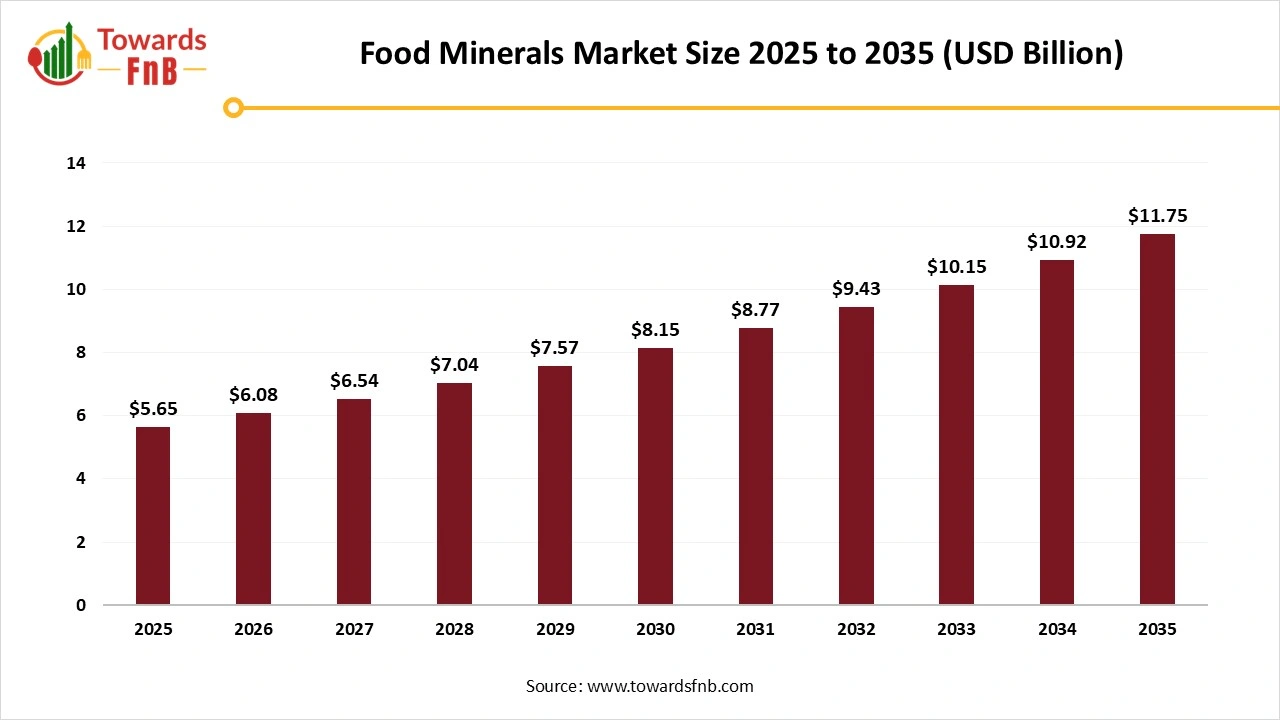
The global food minerals market size estimated at USD 5.65 billion in 2025 and is predicted to increase from USD 6.08 billion in 2026 to reach nearly USD 11.75 billion by 2035, with a CAGR of 7.6% during the forecast period from 2026 to 2035. The growing immune dysfunction and the increasing demand for fortified foods drive market growth.
| Study Coverage | Details |
| Growth Rate from 2026 to 2035 | CAGR of 7.6% |
| Market Size in 2026 | USD 6.08 Billion |
| Market Size in 2027 | USD 6.54 Billion |
| Market Size by 2035 | USD 11.75 Billion |
| Largest Market | Asia Pacific |
| Base Year | 2025 |
| Forecast Period | 2026 to 2035 |
| Regions Covered | North America, Europe, Asia-Pacific, Latin America, and Middle East & Africa |
Food minerals are essential components present in food that the body requires for proper functioning. The two types of food minerals are trace minerals and macrominerals. The applications of food minerals are fluid balance, oxygen transport, maintaining strong bones, energy metabolism, electrolyte balance, and immune system regulation. The various sources of food minerals are meat, nuts, seafood, fruits, eggs, whole grains, and others. The common minerals like magnesium, iron, calcium, zinc, potassium, phosphorus, and copper are obtained from food sources.
The food minerals market growth is driven by growing wellness trends, increased functional food consumption, accelerated mineral supplement consumption, focus on personalised nutrition, rising nutritional deficiency in public, robust livestock industry growth, increased spending on nutritious food, and advancement in nutrient delivery.
The food minerals market is experiencing key technological shifts due to growing demand for enhancing nutrient stability and bioavailability. Several innovations like precision biotechnology, IoT, smart fortification, and nanotechnology easily track mineral intake and improve absorption. The key innovation is the AI incorporation that tracks daily intake of minerals and develops tailored solutions.
AI optimizes water usage and offers a higher quality of raw materials. AI easily identifies contaminants in minerals and develops personalised mineral supplements. AI optimizes the texture of essential minerals and develops organic alternatives for synthetic formulations. AI detects mineral concentration in food and beverages and identifies quality deviations. Overall, AI is a major factor that drives innovations in the food minerals industry.
Raw Material Procurement
Processing and Preservation
Quality Testing and Certifications
| Minerals | Application Area | Diseases Caused | Common Food Sources |
| Potassium | Health Supplements | Constipation Arrhythmias |
Potatoes White Beans Bananas |
| Magnesium | Sports nutrition Functional Foods |
Palpitations Migraines Type 2 Diabetes |
Seeds Peanuts Soy Products |
| Iron | Staple Foods Fortification Nutraceuticals |
Anemia Pica Immune System Dysfunction |
Poultry Legumes Dried Fruits Seafood |
| Iodine | Animal Feed Supplement Food Fortification |
Hyperthyroidism Infertility Goiter |
Dairy Products Eggs Seaweed Baked Goods |
| Calcium | Beverage Fortification Meat Processing |
Osteoporosis Hypocalcemia Dental Problems |
Fortified Foods Fish Nuts |
Why Asia Pacific Dominates the Food Minerals Market?
Asia Pacific dominated the food minerals market with approximately 44% share in 2025. The growing nutritional deficiencies among consumers and the high spending on health-oriented food increase demand for food minerals. The increased consumption of fortified food products and the large-scale food manufacturing industry increases the adoption of food minerals. The strict government initiatives for food safety and expanding the livestock sector require food minerals, driving the overall market growth.
Asia Pacific Food Minerals Market Size 2025 to 2035
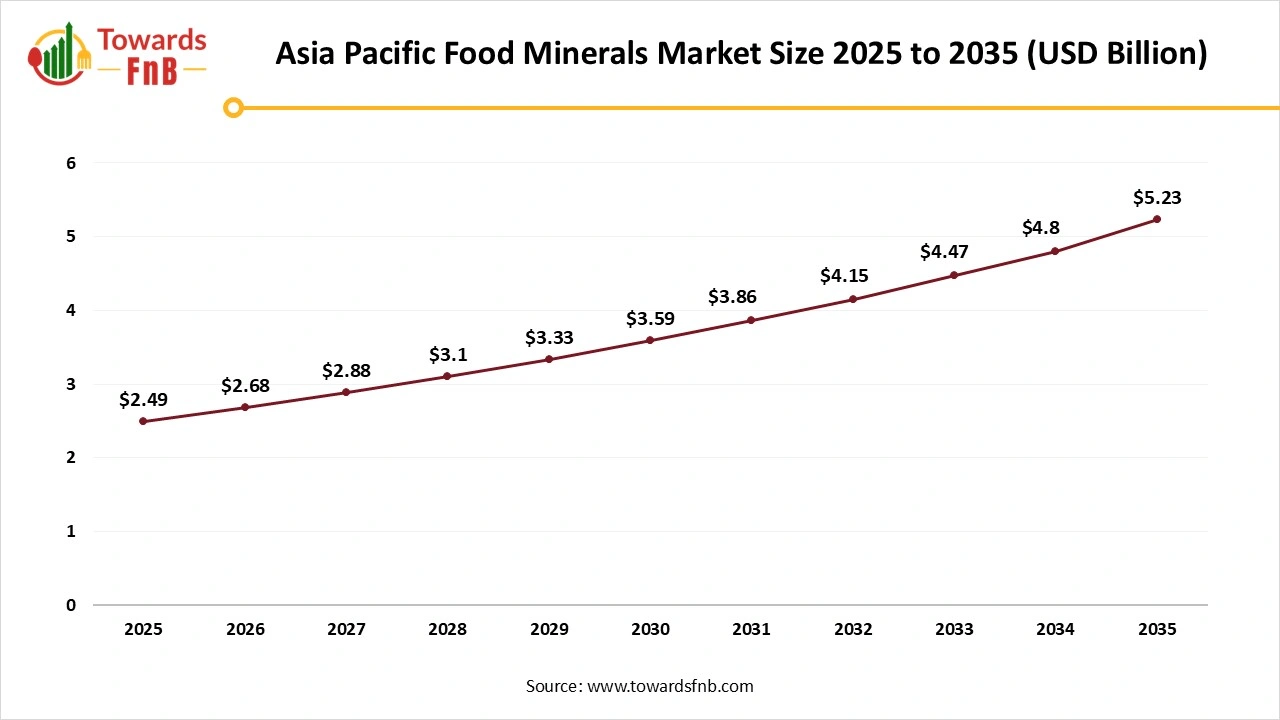
The Asia Pacific food minerals market size was calculated at USD 2.49 billion in 2025 with projections indicating a rise from USD 2.68 billion in 2026 to approximately USD 5.23 billion by 2035, expanding at a CAGR of 7.7% throughout the forecast period from 2026 to 2035.
Nutrition at Scale: India’s Boom in Food Minerals Production
India is rapidly expanding in the market. The growing consumption of mineral supplements and the strong dairy production base increase demand for food minerals. The increasing lifestyle-related deficiencies and the well developed food processing industry increase demand for food minerals. The high availability of raw ingredients and a strong livestock population increase the production of food minerals, supporting the market growth.
North America Food Minerals Market Trends
North America is experiencing the fastest growth in the market during the forecast period. The growing rate of obesity and the increased popularity of dietary supplements increase demand for food minerals. Consumer preference for convenient foods and the presence of advanced food processing infrastructure increase the adoption of food minerals. The push for personalized nutrition and the rising fortified foods expansion increases demand for food minerals, driving the overall market growth.
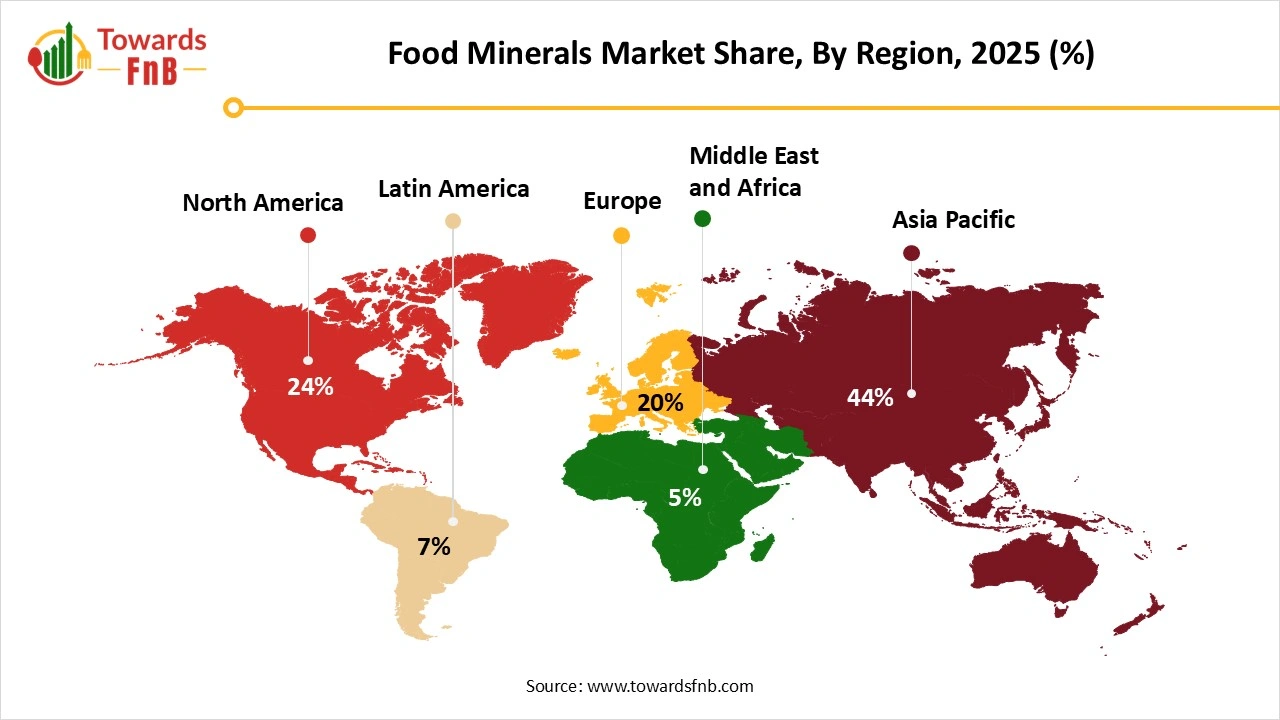
Rise of Food Minerals in the United States
The United States is a key contributor to the market. The strong focus on preventive nutrition and the growing age-related issues increase demand for food minerals. The trending fortified beverages and the strong presence of the poultry industry increases adoption of food minerals. The growing healthcare costs and the increased consumption of fortified dairy increase demand for food minerals, supporting the overall market growth.
Food Minerals Market Share, By Type, 2025 (%)
| Segments | Shares (%) |
| Calcium | 32% |
| Magnesium | 15% |
| Zinc | 10% |
| Iron | 20% |
| Others (Iodine, Copper, Potassium, etc.) | 23% |
Why Calcium Segment Dominates the Food Minerals Market?
The calcium segment dominated the food minerals market with approximately 32% share in 2025. The strong focus on bone health and the increasing need for enhancing the texture of food products increase demand for calcium. The growing prevalence of osteoporosis and the increased consumption of plant-based products increase the adoption of food minerals. The high bioavailability and cost-effectiveness of calcium drive the market growth.
The Iron Segment is the Fastest-Growing in the Market During the Forecast Period.
The growing rate of anemia and the strong focus on treating malnutrition increases adoption of iron. The high preference for immune-boosting nutrients and the focus on infant growth increases adoption of iron. The increasing iron deficiency among women and the government mandate for food fortification increases adoption of iron, supporting the overall market growth.
Food Minerals Market Share, By Form, 2025 (%)
| Segments | Shares (%) |
| Powder | 58% |
| Liquid | 30% |
| Others (Capsules/Tablets) | 12% |
How did the Powder Segment hold the Largest Share in the Food Minerals Market?
The powder segment held the largest revenue share of approximately 58% in the market in 2025. The increased manufacturing of bakery items and the consumer preference for on-the-go nutrition increase demand for powder. The rapid growth in the fitness community and the high rate of micronutrient deficiency among consumers increases adoption of powder. The cost-effectiveness, superior stability, convenience, and longer shelf life of powder form drive the overall market growth.
The Liquid Segment is Experiencing the Fastest Growth in the Market During the Forecast Period.
The consumer shift towards easy-to-consume products and the increased production of liquid mineral supplements increase demand for the liquid form. The increasing need for chronic disease management requires a liquid form for the development of liquid supplements. The high palatability, superior bioavailability, easy integration, and superior absorption of the liquid form support the overall market growth.
Food Minerals Market Share, By Application, 2025 (%)
| Segments | Shares (%) |
| Nutraceuticals & Dietary Supplements | 42% |
| Food & Beverages (Fortified Foods) | 30% |
| Pharmaceuticals | 15% |
| Infant Nutrition | 13% |
Which Application Dominated the Food Minerals Market?
The nutraceuticals & dietary supplements segment dominated the food minerals market with approximately 42% share in 2025. The consumer approach for preventing illness and the increasing prevalence of lifestyle-related conditions increase demand for nutraceuticals. The shift towards portable nutrition and the high spending on premium health products increases the adoption of dietary supplements, which require food minerals. The increased consumption of supplements in pregnant women and focus on overall wellness drive the market growth.
The Food & Beverages Segment is the Fastest-Growing in the Market During the Forecast Period.
The surging popularity of fortified foods and the high preference for mineral-infused beverages increase demand for food minerals. The heightened consumption of vegan diets and the popularity of energy drinks increases adoption of food minerals. The increased nutrition consciousness among consumers and the increasing awareness of natural food products increase demand for food minerals, supporting the overall market growth.
Food Minerals Market Share, By Source, 2025 (%)
| Segments | Shares (%) |
| Mineral Mines | 65% |
| Plant & Animal Based | 20% |
| Marine-sourced | 15% |
How did the Mineral Mines Segment hold the Largest Share in the Food Minerals Market?
The mineral mines segment held the largest revenue share of approximately 65% in the market in 2025. The growing malnutrition and the expanding food processing base increase demand for mineral mines. The increased awareness of health concerns and extended food fortification increases the adoption of mineral mines. The cost-efficiency, high purity, and formulation stability in mineral mines drive the market growth.
The Plant & Animal-Based Segment is Experiencing the Fastest Growth in the Market During the Forecast Period.
The high preference for lowering environmental concerns and the increased consumption of lower-cholesterol food increase demand for plant-based food minerals. The robust expansion of animal feed and increasing awareness of bone health increases adoption of animal-based food minerals. The consumer shift towards ethically produced food and the increasing number of vegetarians support the overall market growth.
Vegan Minerals
Cadila Pharmaceuticals
Medley
By Type
By Form
By Application
By Source
By Region




Principal Consultant
Vidyesh Swar, Senior Research Analyst at Towards Food & Beverages, specializes in market research, focusing on supply-demand evaluation, pricing analysis, alternative proteins, plant-based foods, and sustainable food technologies within the industry.
Learn more about Vidyesh Swar
Reviewed By
Aditi Shivarkar, with 14+ years in Food and Beverages market research, specializes in food, beverage, and eco-friendly packaging. She ensures accurate, actionable insights, driving Towards FnB's excellence in industry trends and sustainability.
Learn more about Aditi ShivarkarApril 2026
April 2026
April 2026
April 2026

Food Minerals Market


 +1 804-441-9344
 Download Sample
 Schedule a Meeting