


April 2026



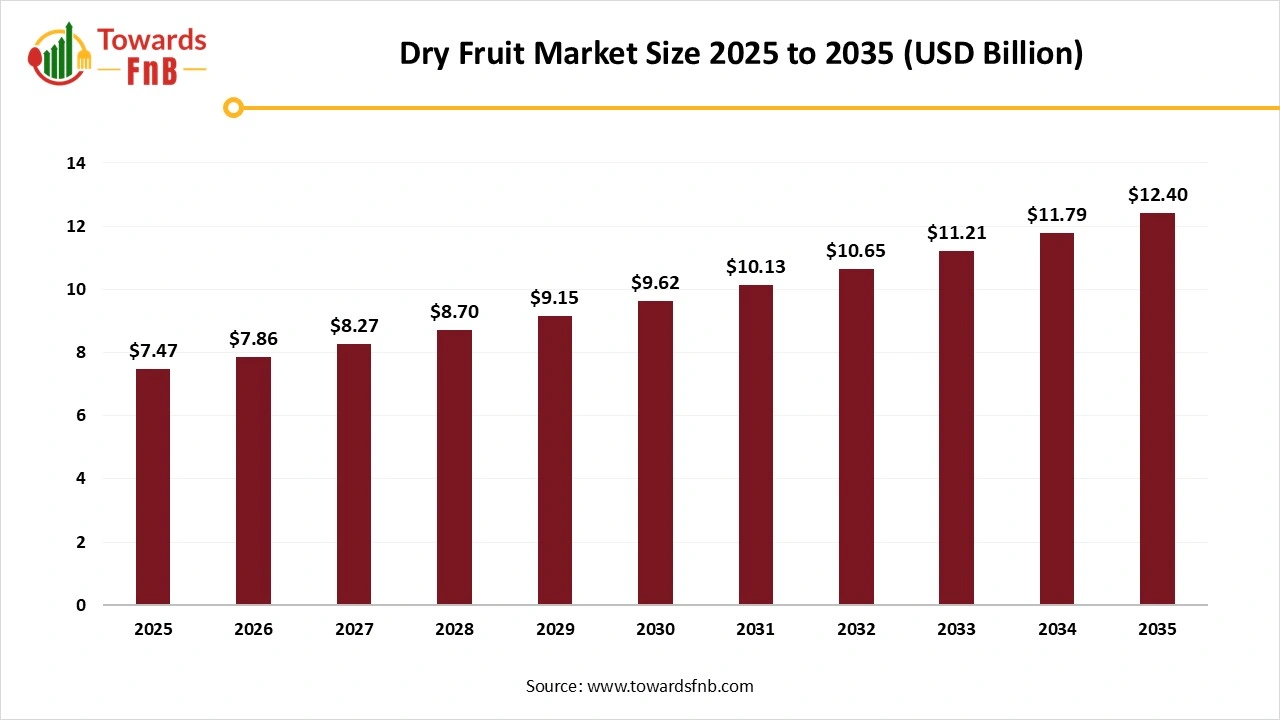
The global dry fruit market size reached at USD 7.47 billion in 2025 and is expected to grow steadily from USD 7.86 billion in 2026 to reach nearly USD 12.40 billion by 2035, expanding at a CAGR of 5.2% during the forecast period from 2026 to 2035. The increase in demand for the nutrient-dense packaged foods and huge amount of utilization of dry fruits in various food items or sectors such as bakery, dairy, snack, and confectionery industries driving the growth of the market.
| Study Coverage | Details |
| Growth Rate from 2026 to 2035 | CAGR of 5.2% |
| Market Size in 2026 | USD 7.86 Billion |
| Market Size in 2027 | USD 8.27 Billion |
| Market Size by 2035 | USD 12.40 Billion |
| Largest Market | Europe |
| Base Year | 2025 |
| Forecast Period | 2026 to 2035 |
| Regions Covered | North America, Europe, Asia-Pacific, Latin America, and Middle East & Africa |
Dried fruit is basically a fruit from which the water content is being completely removed and then dried through soaking in the sun before cooking or eating on its own. The drying process can be completed either by a natural process by the sun or by an industrial procedure such as a dehydrator or freeze drying. The overall rise in consumption of dried fruit started long before in the 21st century, which is divided basically into two types, such as conventional dried fruits and organic dried fruits. Raisins, dates, prunes, figs, apricots, peaches, apples, and pears are categorized under conventional dried fruits, and cranberries, blueberries, cherries, strawberries, and mango are called organic dried fruits.
The main reason behind the revenue generation of the dry fruit market is due to growing consumer awareness of health benefits, which is linked with dry fruit consumption, growing disposable income, and rising demand for conventional food. Dry fruits such as almonds, cashews, and walnuts are counted as healthy snacks that are rich in nutrients.
Another reason is that healthier consumption habits are driving the demand for dry fruits, as consumers are opting for more nutritionally based wholesome foods, which include walnuts and cashews that are rich in protein, minerals, and vitamins too. The augmentation of digital retail and e-commerce platforms has spearheaded the way towards the easy accessibility of dry fruits among urban and rural areas both simultaneously. Online e-commerce platforms such as Amazon and Flipkart have contributed a large number to the distribution of dry fruits over a period of time.
The increasing importance of dry fruits in culinary sector. There are every chef and home cook is explicitly adding them in savory dishes to desserts, imparting a depth of flavor and upgrading the dining experience. There are numerous culinary dishes where dry fruits are used, such as Ultimate Fruity Granola, Candied Fruit Cookies, Bacon Date Bread, Fruitcake Christmas Cookie, Caramelized Onion and Fig Pizza, and there are endless possibilities, which add exoticism and sophistication to various dishes. There has also been an acceleration in snacking time among urban consumers, especially in between their busy schedules, in which they like to prefer healthy snacks that emerging as the driving opportunity in the market growth.
The increased cost of dry fruits like cashews, almonds, pistachios, raisins to more exotic ones like such as dried berries, dried apricots, pecans and dried prunes are limiting the adoption of the product and fluctuating quality of dry fruits due to the changing climate condition restraint the growth of the market.
Raw Material Procurement
Packaging and Branding
Waste Management and Recycling
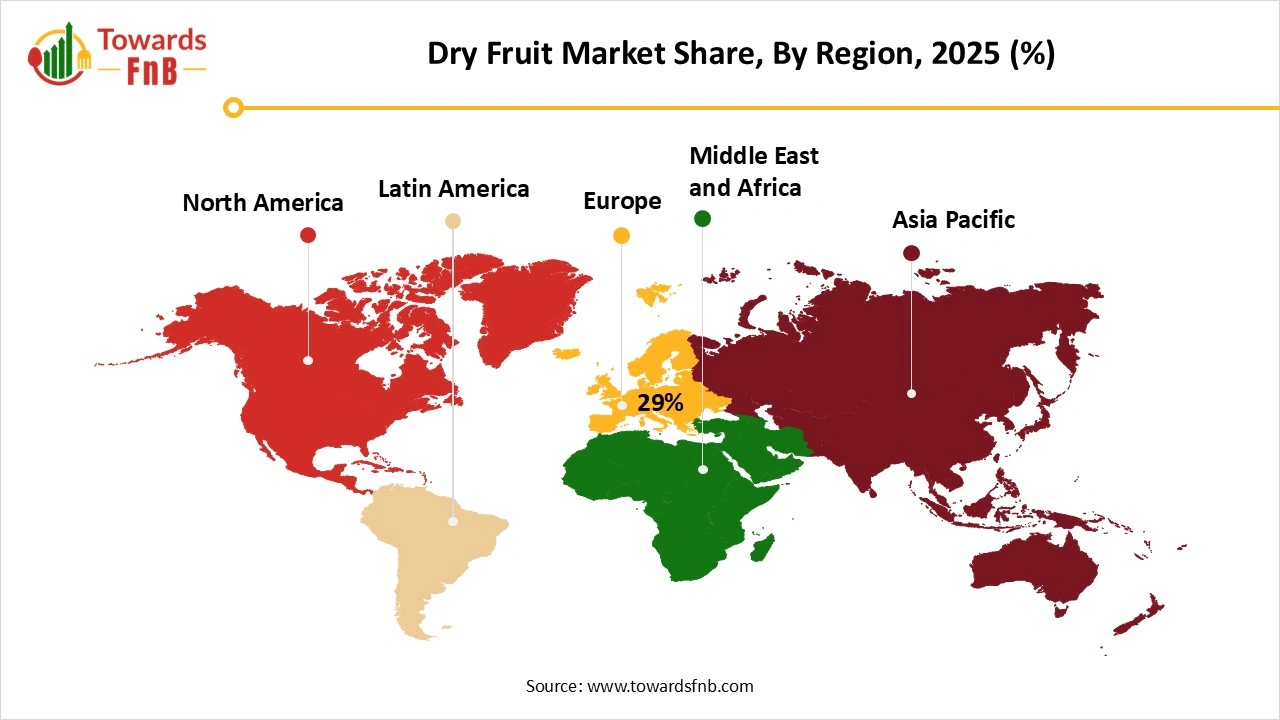
Europe Dominated the Dry Fruit Market in 2025
This robust growth is due to consumer preference for healthy, convenient, and long-lasting snacking options. Among European region, there are different variations such as Spain, Italy, and Greece are leading consumers and manufacturers of dried fruits. Many key drivers and trends are moving towards the growth of the market in Europe due to health benefits such as high fiber, vitamin, and antioxidant content, which has boosted consumption of dry fruits, and the expanding bakery industry is contributing in the growth of the market.
Europe Dry Fruit Market Size 2025 to 2035
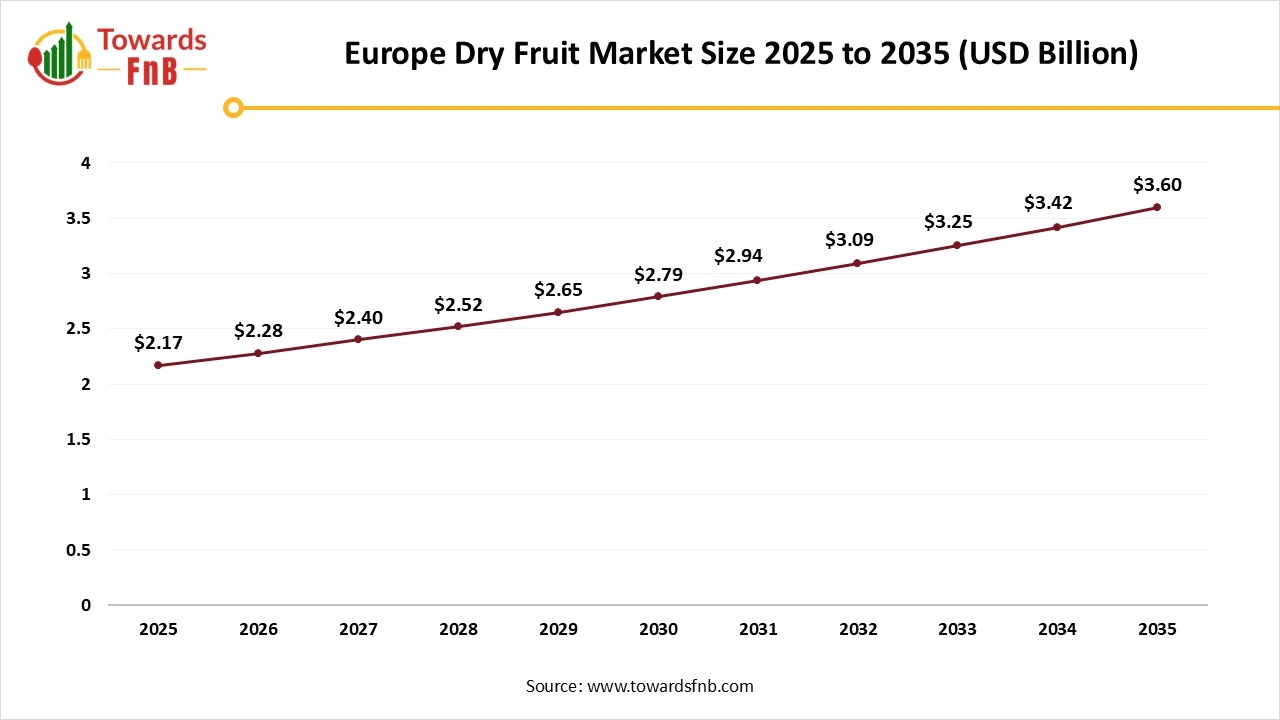
The Europe dry fruit market size calculated at USD 2.17 billion in 2025 and is expected to grow from USD 2.28 billion in 2026 to reach nearly USD 3.60 billion by 2035, expanding at a CAGR of 5.2% during the forecast period from 2026 to 2035.
Germany Dry Fruit Market Trends
Germany’s dry-fruit market is expanding steadily as consumers increasingly embrace healthy snacking and ethical consumption. Demand for organic, clean-label, plant-based and sustainably sourced nuts and dried fruits especially almonds, walnuts, hazelnuts, raisins and exotic varieties is rising. Growth is further driven by convenience-oriented lifestyles, with more ready-to-eat mixes, snack bars, and baking ingredients.
Asia Pacific Expecting the Fastest Growth in the Dry Fruit Market During the Forecast Period
Rising disposable income of middle-class people in growing economies will lead the growth of the market in the regional countries. There are number of dry fruits dealers are available with the number of qualities in dry fruits and the rise in consumption of the dried fruit market in gifting during festivals and other Asian countries has led to the growth of the dried fruit market.
India Dry Fruit Market Trends
India’s dry-fruit market is booming with growth fueled by rising health awareness, growing disposable incomes and easy access through e-commerce. Consumption of almonds, cashews, pistachios, raisins and walnuts is increasing steadily as people choose dry fruits for nutritious snacking, festive gifting, and everyday cooking.
Why is North America Driving the Dry Fruit Market?
North America expects notable growth during forecast period. The market growth in the region is driven by factors such as high consumer spending, increasing popularity of plant-based diets, and increasing health-conscious consumers. The U.S. and Canada are the major countries driving the market growth.
The U.S. Dry Fruit Market Trends
The global market in the U.S. is driven by the increasing consumer trend towards nutritional and healthy snacks, increasing consumer preference towards sustainably produced and organic options, and increasing consumer shift towards plant-based diets.
Middle East and Africa Revolutionizing the Dry Fruit Market
The market growth in the region is driven by factors such as the increasing demand for versatility and nutritional snacks in modern and traditional snacks, increasing health consciousness and increasing string local demand and production for raisins, dates and other dried fruits.
South Africa Dry Fruit Market Trends
The market growth in the country is attributed to the increasing consumer preference for organic products and berries, increasing strong domestic consumption, especially raisins, and increasing demand for specialty and organic products.
Why is Latin America Fueling the Dry Fruit Market in 2025?
The Latin America plant-based protein industry is driven by the rising new product introductions, demand for convenience, increasing disposable incomes, and increasing consumer health consciousness. Brazil and Mexico are the major countries driving the market growth.
Mexico Dry Fruit Market Trends
The dry fruit industry in Mexico is witnessing major growth, driven by the increasing demand for confectionery, bakery and healthy snacks, increasing consumer demand for natural, convenient and healthy snacks, increasing focus on nutritious food and higher purchasing power.
Dry Fruit Market Share, By Type, 2025 (%)
| Segments | Shares (%) |
| Dried Grapes | 34% |
| Table Dates | 18% |
| Dried Apricots | 14% |
| Prunes | 13% |
| Dried Cranberries | 12% |
| Dried Figs | 9%) |
The Dried Grapes Segment Dominated the Dry Fruit Market in 2025
The growth of the segment is attributed to the rise in functional food and superfoods, which has led to increased demand for dried grapes, which are rich in antioxidants and nutrients too which drives the major cause for the market growth. Whereas table dates segment expects a significant growth in the market during the forecast period. The table dates have emerged as a natural sweetener, a nutritious snack, and a healthy option in alternative to processed and artificial sugar, which are more prevalently found in smoothie, chocolate bars, and desserts.
Dry Fruit Market Share, By Application, 2025 (%)
| Segments | Shares (%) |
| Bakery | 36% |
| Confectioneries | 21% |
| Breakfast Cereal | 17% |
| Snacks | 16% |
| Others | 10% |
The Bakery Segment Dominated the Dry Fruit Market in 2025
The growth of the segment is attributed to the extensive use of dry fruits in baked goods such as cakes, muffins, and breads to increase the flavor and nutritional value of the product. While the snacks segment expects the fastest growth in the market during the forecast period. The growth of the segment is due to the rising popularity of healthy snacking to maintain health and wellness. There are several dry fruit snack brands available in the market, such as Nutraj, Ministry of Nuts, Solimo, Farmley, Happilo, True Elements, Urban Platter, Tulsi, etc.
By Type
By Application
By Region





Principal Consultant
Vidyesh Swar, Senior Research Analyst at Towards Food & Beverages, specializes in market research, focusing on supply-demand evaluation, pricing analysis, alternative proteins, plant-based foods, and sustainable food technologies within the industry.
Learn more about Vidyesh Swar
Reviewed By
Aditi Shivarkar, with 14+ years in Food and Beverages market research, specializes in food, beverage, and eco-friendly packaging. She ensures accurate, actionable insights, driving Towards FnB's excellence in industry trends and sustainability.
Learn more about Aditi ShivarkarApril 2026
April 2026
April 2026
April 2026

Dry Fruit Market


 +1 804-441-9344
 Download Sample
 Schedule a Meeting