
Whole Milk Powder Market Size to Climb USD 19.90 Billion in 2025

Whole Milk Powder Market Size, Growth, and Trends 2025 to 2034

The global whole milk powder market size is expected to grow from USD 19.90 billion in 2025 to USD 26.42 billion by 2034, at a CAGR of 3.2% over the forecast period from 2025 to 2034. This market growth is underpinned by rising demand for dairy-based convenience products milk powder’s long shelf life, ease of storage/transport, and nutritional value (protein, fat, vitamins) make it a preferred ingredient for manufacturers and consumers alike, especially in regions with limited cold-chain infrastructure.

Last Updated: 01 December 2025 Category: Food & Beverages Ingredients Insight Code: 5938 Format: PDF / PPT / Excel

Whole Milk Powder Market Size, Share and Growth Analysis

The global whole milk powder market size reached at USD 19.28 billion in 2024 and is anticipated to increase from USD 19.90 billion in 2025 to an estimated USD 26.42 billion by 2034, witnessing a CAGR of 3.2% during the forecast period from 2025 to 2034. The market is driven by the increasing consumer demand for bakery, dairy, and convenience foods.
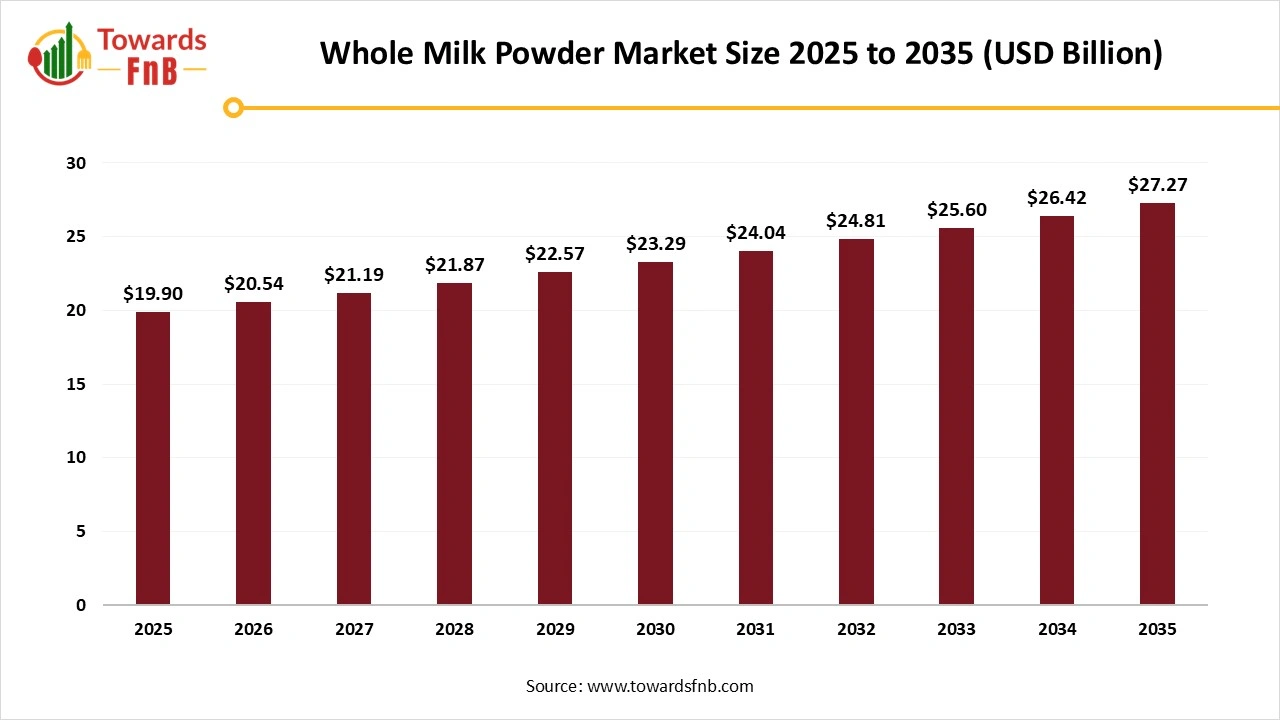
Whole Milk Powder Market Size 2025 to 2034

Key Highlights

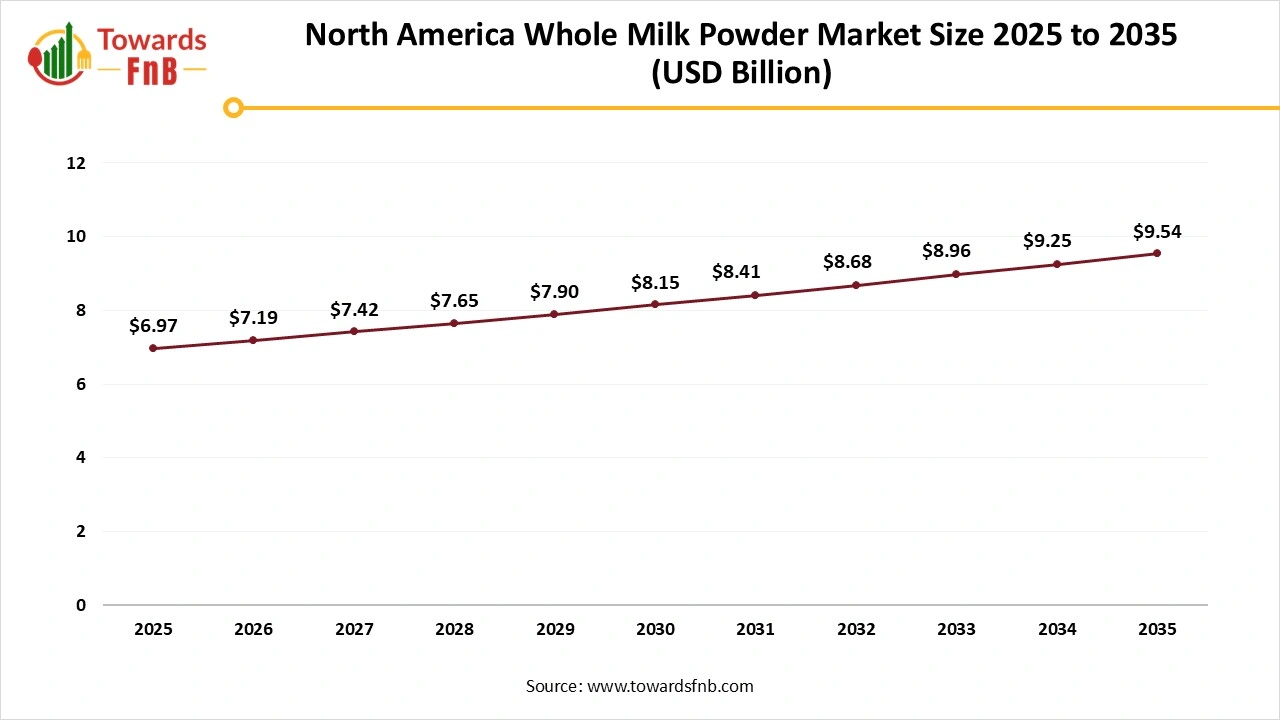
  • By region, North America dominated the global whole milk powder market revenue in 2024.
  • By region, Asia Pacific is expected to grow fastest during the forecast period.
  • By region, Europe is expected to grow at a notable rate during the forecast period.
  • By end use, the dairy segment held a major market revenue in 2024.
  • By end use, the bakery segment is projected to grow at a CAGR between 2025 and 2034.

Industry Coverage

Study Coverage Details
Growth Rate from 2025 to 2034 CAGR of 3.2%
Market Size in 2025 USD 19.90 Billion
Market Size in 2026 USD 20.53 Billion
Market Size by 2034 USD 26.42 Billion
Largest Market North America
Base Year 2024
Forecast Period 2025 to 2034
Regions Covered North America, Europe, Asia-Pacific, Latin America, and Middle East & Africa

What Factors Help to Revolutionize the Whole Milk Powder Market in 2024?

The whole milk powder is created by removing the water from full-fat and fresh milk via spray-drying procedure. It offers the creamy, rich taste and nutritional benefits of milk in a shelf-stable and dry form, making it versatile for use in beverages, confectionery, baking, and many other food products. 

The whole milk powder market is also driven by the growing food and beverage industry, growing global population, increasing demand for dairy products, increasing rapid consumption of milk across the globe, growing e-commerce platforms, rising technological advancements, increasing per capita incomes in developing nations, and expansion of confectionery and bakery industries. In addition, increasing demand for long-lasting and convenient food products and increasing demand for medical foods and nutritional supplements are further expected to drive the market during the forecast period.

Whole Milk Powder Market Outlook

  • Industry Growth Overview: Between 2025 and 2034, the whole milk powder industry is expected to see rapid growth due to the increasing demand for convenience food, increasing popularity of unique nutritional benefits, rising innovations in food processing technologies, increasing focus on health and nutrition, and increasing versatility in food manufacturing and longer shelf life. In addition, the whole milk powder market growth is also driven by the increasing demand for huge range of food products such as beverages, desserts, confectionery and bakery, increasing consumer awareness of health and nutrition and expansion beverage industry, especially in Asia-Pacific, Europe and Middle East and Africa.
  • Increasing consumer preference towards sustainability: The preference towards sustainability in whole milk powder industry is driven by environmental impact, waste reduction and ethical sourcing. Major trends such as improving innovations in processing and packaging and water efficiency to reduce carbon emissions and waste, manufacturers adopting greener practices such as utilizing renewable energy and increasing consumer demand for sustainably produced products. In addition, this shift is creating a more ethically conscious and sustainable industry ecosystem and changing how products are sourced and developed. These shifts are expected to increase the consumer preference towards sustainability in the global market.
  • Startup Ecosystem: Startup ecosystems preferences in the global whole milk powder market is driven by the increasing consumer preference towards sustainability, increasing consumer demand for confectionery, dairy products and beverages and supply chain digitization due to rising urbanization and rapid industrialization. The rise of health awareness, increasing demand for milk and milk related food products, rising technological integration across the value chain and increasing development in production of milk powder of advanced technologies such as IoT and AI in the supply chain, which further expected to drive the market growth.

Technological Shift to Revolutionize the Whole Milk Powder

The rise of technological advancements in the whole milk powder industry includes customization and fortification to cater to specific dietary needs such as sports nutrition and infant formula, AI integration and automation to increase consistency and efficiency, and improvements in spray drying techniques for better nutritional solubility and retention. These innovations result in greater market competitiveness, reduced production costs, and higher quality products. In addition, automation in manufacturing enhances efficiency and consistency, while the integration of machine learning and AI is being explored for personalized nutrition, demand forecasting and predictive maintenance, which is further expected to revolutionize the growth of the whole milk powder market in the coming years.

Trade Analysis of Whole Milk Powder Market: Import & Export Statistics

  • India: India exported 1,638 shipments of Milk Powder, according to India Export data. Most of the milk powder exports from India go to the United Arab Emirates, Sri Lanka and Bangladesh. These exports were made by 345 exporters to 516 buyers in India. 
  • The U.S.: The U.S. leads the Milk Powder exports with 113,344 shipments across the globe, followed by New Zealand with 13,183 shipments. 
  • China: China exported 1,552 shipments of Milk Powder, according to China Export data. These exports are contributed by 556 China exporters to 594 buyers. Most of the milk powder exports from China go to the Uganda, Ghana and United States. 

Value Chain Analysis of Whole Milk Powder Market

Raw Material Procurement

  • The raw material procurement for whole milk powder industry includes sourcing fresh liquid milk, which is transported and chilled to processing plant for quantity and quality control. Procurement strategies focus on supply of premium milk, with modern diaries using advanced technologies such as automated systems and bulk milk coolers.

Packaging and Branding

  • Branding and Packaging for global whole milk powder market focuses on creating packaging which may ensures stable, safe and fresh shelf life by protecting product from contamination, light and moisture.

Waste Management and Recycling

  • The waste management and recycling in the industry for the whole milk powder industry focus heavily on valorizing by-product into valuable resources, treating highly organic wastewater and reducing product loss during production.

Whole Milk Powder Industry Regulatory Landscape: Global Regulations

Country Regulatory Body Key Regulations Focus Areas Notable Notes
India Food Safety and Standards Authority of India (FSSAI) Food Safety and Standards (Packaging and Safety Regulations) and Licensing and Registration of Food Businesses) The whole milk powder market focus areas include applications on food and beverage sector especially infant formula, confectionery and bakery. It also focuses on increasing demand and developing product trends such as fortified and organic variants. Whole milk powder is highly utilized in the natural and protein-rich milk powder for their capacity to enhance the efficiency, consistency and quality of high-quality beverages, to enhance consumer immune system and health and wellness.

Whole Milk Powder Market Regional Insights

How is North America Dominating the Whole Milk Powder Market Revenue in 2024?

North America dominated the market revenue in 2024. The market growth in the region is driven by factors such as the increasing demand for ready-to-eat and ready-to-cook foods, increasing presence of strong sports nutrition culture, increasing demand for longer shelf life, affordability and convenience due to busy lifestyles, increasing demand from the confectionery and bakery sectors, increasing demand for indulgent and dairy rich products, increasing demand for milk and milk products, consumer awareness of nutrition and increasing consumer focus towards sustainability. 

The U.S. Whole Milk Powder Market Trends

The U.S. dominated the whole milk powder industry in 2024, driven by increasing popularity of high-protein and functional food, increasing consumer health awareness, rapid urbanization, changing and busy lifestyles, increasing demand in sectors such as confectionery, bakery and infant formula, and rising advancements in dairy technology and processing. In addition, due to the increasing invest and regulatory support in food technology, the U.S is one of the major countries in the food and beverage processing industry in the region.

Asia Pacific Expects the Fastest Growth During the Forecast Period. 

The market growth in the region is driven by factors such as the increasing consumer busy and changing lifestyles, convenience, increasing demand for ready-to-eat food options, increasing demand for processed food and convenience, growing rapid urbanization, growing working population, increasing disposable and increasing disposable incomes and changing modern lifestyles. 

India Whole Milk Powder Market Trends

The whole milk powder industry in India is growing due to increasing shifts in food consumption patterns, health awareness and demand from rising incomes. Major drivers such as the expansion of the organized retail sector, increasing higher per capita dairy consumption and growing rapid population. Major players such as Amul are investing significantly in capacity to increase the demand for whole milk powder. In addition, the market is also growing significantly due to increasing health awareness and shifting food patterns. Government in India are supporting investments in dairy infrastructure, further contributing the market growth in India.
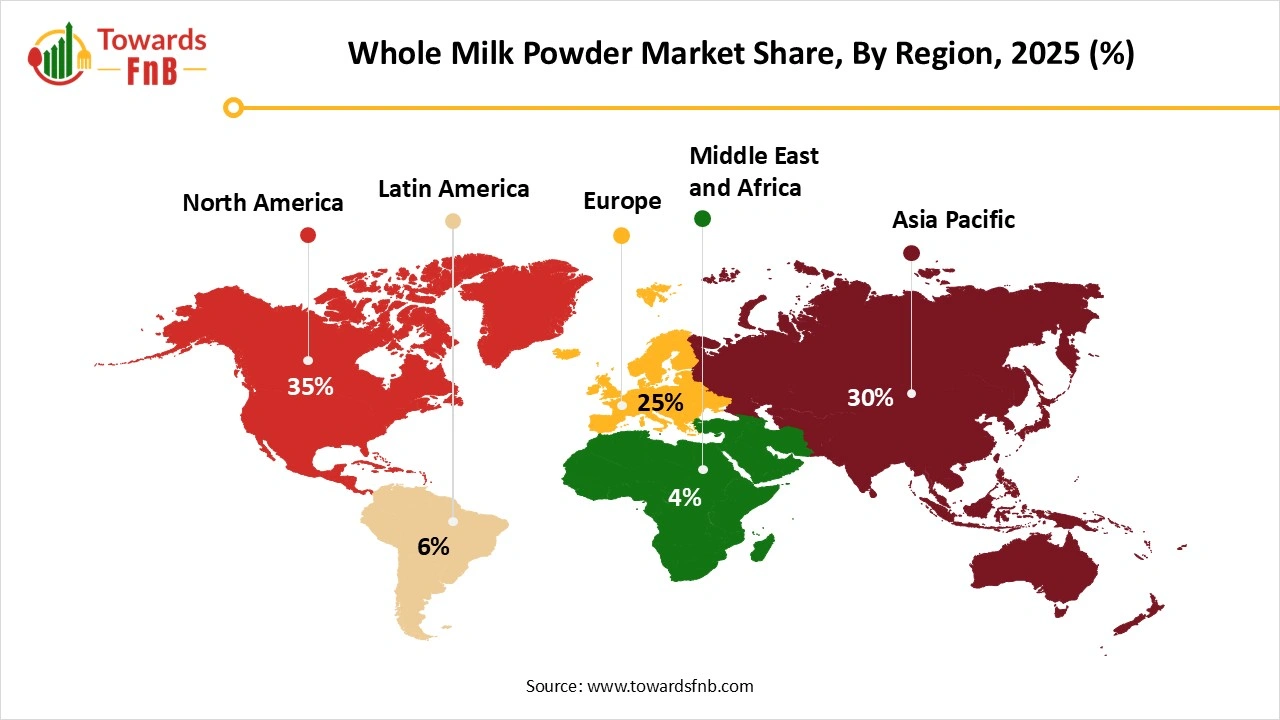
Europe is Expected to Grow at a Notable Rate During the Forecast Period. 

The market growth in the region is attributed to the factors such as the growing food and beverage industry, increasing government regulatory frameworks, rising technological advancements in production to improve shelf life and quality, expansion of food retail industry, increasing consumer focus on clean-label beverages and increasing versatility of milk powder in products such as baked products and infant formula. Germany, UK, and France are the major countries in the Europe.

Germany Whole Milk Powder Market Trends

The market growth in the country is attributed to the factors such as increasing affordability, strong organic food and beverage market, as it the major dairy producer. The market growth in Germany is also driven by the increasing demand for products in nutritional foods, confectionery, bakery and infant formulas, increasing demand for bakery and convenient food and beverages, increasing demand for nutrient-rich products and rapid urbanization. 

Middle East and Africa are Transforming the Whole Milk Powder Market in 2024

The market growth in the region is witnessing rapid growth, driven by increasing demand for nutritious food, changing food and beverage preferences, and growing urbanization and population. Market growth is also attributed to increasing disposable incomes, increasing demand for nutritious food products, expansion of functional food and beverage service sectors, and increasing sophisticated consumer base. South Africa, UAE, Saudi Arabia and Kuwait are the major countries driving the market growth. 

South Africa Whole Milk Powder Market Trends

The whole milk powder industry in South Africa is driven by the growing expansion of food and beverage industry, increasing consumer preference towards nutrient-dense and convenient food products and increasing consumer health awareness. Major drivers such as the increasing use in various applications such as baked goods and infant formula and expansion of the dairy industry, which further drive market growth in the country.

Latin America Whole Milk Powder Market Trends

The whole milk powder industry is the largest in countries and driven by increasing consumer awareness of its nutritional benefits, increasing disposable incomes, increasing use in various food products such as confectionery and baked products and increasing convenience of milk powder, especially in Brazil and Argentina, which are the major countries in the cold press juices industry. Brazil, Mexico and Argentina are the major countries in the region.

Mexico Whole Milk Powder Market Trends

The whole milk powder industry in Mexico is witnessing rapid growth due to the increasing disposable incomes, increasing consumer changing lifestyles, growing e-commerce platforms and desire for home cooking and growing rapid urbanization. Major growth factors such as the increasing consumer preference for nutritional food products and increasing use in industrial applications such as confectionery and bakery are further expected to drive the market growth in Mexico.

Segmental Insights

End Use Insights

Why is Dairy Segment Dominating the Whole Milk Powder Market?

The dairy segment dominated the global market revenue in 2024. The segment growth in the global market is driven by factors such as rising rapid population across the globe, increasing long shelf-life and convenience of whole milk powder, increasing demand for dairy products, growing food and beverage industry, increasing consumer awareness towards health and wellness and increasing versatility and convenience. In addition, dairy processing is necessary for providing benefits such as preservation of excess supply, lower storage costs and lower storage costs and extended shelf life. The increasing consumer trend towards the consumption of dairy snacks, smoothies and ready-to-eat meals. The dairy industry continues as the major end-use segment in the market, with a strong dairy market across the globe, especially in developing countries, which further expected to drive the market growth during the forecast period.

The Bakery Segment is Expected to Grow Fastest During the Forecast Period. 

The segment growth in the global market is driven by factors such as the increasing ability to enhance moisture, browning and flavor retention in baked products such as cookies, pastries and bread, increasing consumer preference towards convenient food options and high-quality ingredients, increasing consumer demand for bakery ingredients in baked sweets and goods, increasing consumer awareness towards health and wellness, increasing demand for convenient food options such as pastries and bread and processed snacks and increasing changing and busy lifestyles.

The infant formula segment is expected to grow at a notable rate during the forecast period. Infant formula plays an important role in the whole milk powder industry as it is a highly formulated substitute for human breast. It is a high-value segment using specialized ingredients such as prebiotics and protein isolates, driven by specific nutritional needs for infant growth. To address the critical requirements of infants, infant formula’s production includes specific nutrient additions and advanced processing, further drives the demand for infant formula in the market.

Recent Developments in the Whole Milk Powder Market

Bobbie

  • Launch: In April 2025, Bobbie announced the launch of its fourth infant formula. Bobbie Organic Whole Milk infant formula offers reliability, safety and quality. (Source: businesswire)

Inyange

  • Launch: In October 2025, Inyange Industries launched its instant whole milk powder and marked a significant step forward in empowering farmers and strengthening the country’s dairy value chain. (Source: The New Times)

Top Vendors in Whole Milk Powder Market & Their Offerings

Fonterra Co-operative Group Limited

Corporate Information

  • Fonterra is a multinational dairy co-operative based on New Zealand. 
  • It is owned by thousands of New Zealand dairy farmers. 
  • The company is the worldwide largest exporter of dairy products. 
  • Fonterra supplies dairy ingredients (including whole milk powder), butter, cheese and other dairy products globally under various brands through its manufacturing and export network.

History and Background

  • The roots of Fonterra trace back to New Zealand’s historic dairy cooperatives and early dairy exports in the 1800s and 1900s. 
  • In 2001, Fonterra was formally established through a merger of the two largest dairy co-operatives New Zealand Dairy Group and Kiwi Co-operative Dairies along with the New Zealand Dairy Board (which had handled export marketing) under the umbrella of the Dairy Industry Restructuring Act 2001. 

Key Developments and Strategic Initiatives

  • In May 2024, Fonterra announced a strategic shift: it plans to deepen focus on its high-value dairy
  • Ingredients and Foodservice businesses moving away from being primarily a consumer-goods company worldwide. 
  • As part of this strategy review, Fonterra is exploring full or partial divestment of its global consumer business, including some business units under the brand umbrella.

Mergers & Acquisitions

  • The foundational “merger” in 2001 was itself a consolidation of multiple major dairy cooperatives and the national dairy board forming today’s Fonterra. 
  • More recently (2024 onward), Fonterra reorganized its consumer-facing business in New Zealand and Australia: its domestic consumer brands business (previously separate) was merged under a new unit called Fonterra Oceania effective 1 May 2024 to better integrate trans-Tasman operations.

Partnerships & Collaborations

  • Early in its history, soon after formation, Fonterra entered strategic export alliances and partnerships to expand global reach and market access. 
  • On the technology and innovation front, Fonterra has adopted a collaboration-driven model: it launched an open incubator platform internally called Fonterra Ventures Co-Lab (established in 2017), to partner with small businesses, larger corporations and individuals aiming to develop new dairy-related technologies, services and business models.

Product Launches / Innovations

  • They developed a quickly-manufactured mozzarella (IQF mozzarella) using a patented process enabling production from milk in a day rather than traditional two-to-three month processes.

Key Technology Focus Areas

  • Their product innovation also includes “complex milk lipids” used in maternal, infant, and adult nutrition products, targeted for gut health, cognitive benefits, joint/muscle support, etc. 
  • On the IT/digital side: as noted, migration to cloud infrastructure (Azure), data-driven operations, potentially improving supply-chain visibility, demand forecasting, production planning, and global coordination. 

R&D Organisation & Investment

  • Their R&D Centre has developed technologies like milk “finger-printing”, enabling traceability and authenticity of milk a valuable feature for quality control and differentiation. 

SWOT Analysis

Strengths

  • Very large scale world’s largest dairy exporter; global footprint across 140+ countries. 
  • Co-operative structure owned by thousands of farmers ensures stable supply and alignment with primary producers. 
  • Strong R&D and innovation capabilities (milk fingerprinting, fast-processing mozzarella, specialized lipids) ability to produce value-added dairy ingredients beyond basic milk powder.

Weaknesses

  • As a co-op reliant on many individual farmers, vulnerable to fluctuations in raw-milk supply, weather/climate, agricultural conditions, and regulatory changes.
  • Heavy focus on commodity-style dairy ingredients (milk powder, butter, etc.) commodity markets are prone to volatile global prices, exchange-rate risks, and margin pressures.

Opportunities

  • Growing global demand for dairy ingredients, nutrition-based milk powders (infant formula, health-oriented dairy products), specialty dairy high-value segments where Fonterra’s R&D and scale matter.
  • Further expansion of food-service and B2B ingredients business catering to global food manufacturers, bakeries, dairy-based food producers.

Threats

  • Global dairy commodity price volatility, currency fluctuations, and trade barriers can impact profitability.
  • Increasing competition from other global dairy companies / co-ops / local producers, especially in value-added dairy ingredients and powder markets.
  • Supply-side risks: climate change, farming-cost pressures, raw-milk supply shortages, regulatory changes related to agriculture or environment.

Recent News & Strategic Updates

  • In May 2024, Fonterra announced a “step-change in strategic direction.” The co-op said it will deepen its position as a leading provider of high-value dairy ingredients (Ingredients + Foodservice), and explore divestment of its global consumer business and associated units like Fonterra Oceania and Fonterra Sri Lanka. 
  • As part of that structural change: from 1 May 2024, the former separate businesses in New Zealand (consumer brands) and Australia were merged under the new Fonterra Oceania, to streamline operations across the two markets. 

Top Companies Lists

  • Nestlé S.A: Nestlé holds a leading position in the consumer-facing whole milk powder market, as the world's largest food and beverage company. Its significance lies in its strong brand reputation and extensive supply chain across the globe.
  • Lactalis Group: Lactalis is the major B2B supplier of whole milk powder through its Lactalis Ingredients division and largest dairy company across the globe.
  • Agri-Dairy Products, Inc.
  • All American Foods
  • Amul (GCMMF)
  • Arla Foods amba
  • Chicago Dairy Corporation
  • Dairy Farmers of America, Inc.
  • Fonterra Co-Operative Group Limited
  • Lactalis Ingredients
  • Vinamilk
  • Westland Milk Products
  • Z Natural Foods

Segments Covered in the Report

By End Use Insights

  • Dairy
  • Infant Formula
  • Bakery
  • Confectionery
  • Others

By Region

  • North America
  • Europe
  • Asia Pacific
  • MEA
  • Latin America
Share With : linkedin twitter facebook
  • Report Covered: [Revenue + Volume]
  • Historical Year: 2021-2023
  • Base Year: 2024
  • Estimated Years: 2025-2034

Meet the Team

Vidyesh Swar, Senior Research Analyst at Towards Food & Beverages, specializes in market research, focusing on supply-demand evaluation, pricing analysis, alternative proteins, plant-based foods, and sustainable food technologies within the industry.

Learn more about Vidyesh Swar

Aditi Shivarkar, with 14+ years in Food and Beverages market research, specializes in food, beverage, and eco-friendly packaging. She ensures accurate, actionable insights, driving Towards FnB's excellence in industry trends and sustainability.

Learn more about Aditi Shivarkar

Related Insights

FAQ's

The whole milk powder market stands at USD 19.90B in 2025 and is projected to reach USD 26.42B by 2034 at a 3.2% CAGR, driven by rising demand for convenience foods, nutritional products, and bakery/dairy applications.

Key trends include the surge in convenience foods, clean-label and nutritional formulations, sustainability-driven packaging innovations, and rapid adoption of digitalized supply chains.

The dairy segment dominates, while bakery and infant formula segments show exceptional growth due to improved texture, nutrition, and product versatility.

AI-enabled demand forecasting, automation in spray-drying, nutrient preservation technologies, and smart supply-chain monitoring are reducing costs and improving quality consistency.

Regulations from bodies like FSSAI, FDA, EFSA, and Codex focus on food safety, nutritional standards, infant formula compliance, and labeling requiring manufacturers to invest in quality, traceability, and compliance systems.

Investors favor companies implementing renewable energy, water-efficient processing, recyclable packaging, by-product valorization, and responsible sourcing due to rising ESG expectations.

Companies like Fonterra, Nestlé, Lactalis win through global supply networks, advanced R&D, ingredient innovation, and strong B2B relationships, enabling resilience against price volatility.

Risks include dairy supply volatility, climate-driven raw milk fluctuations, commodity price swings, trade restrictions, and stringent infant formula regulations.