April 2026



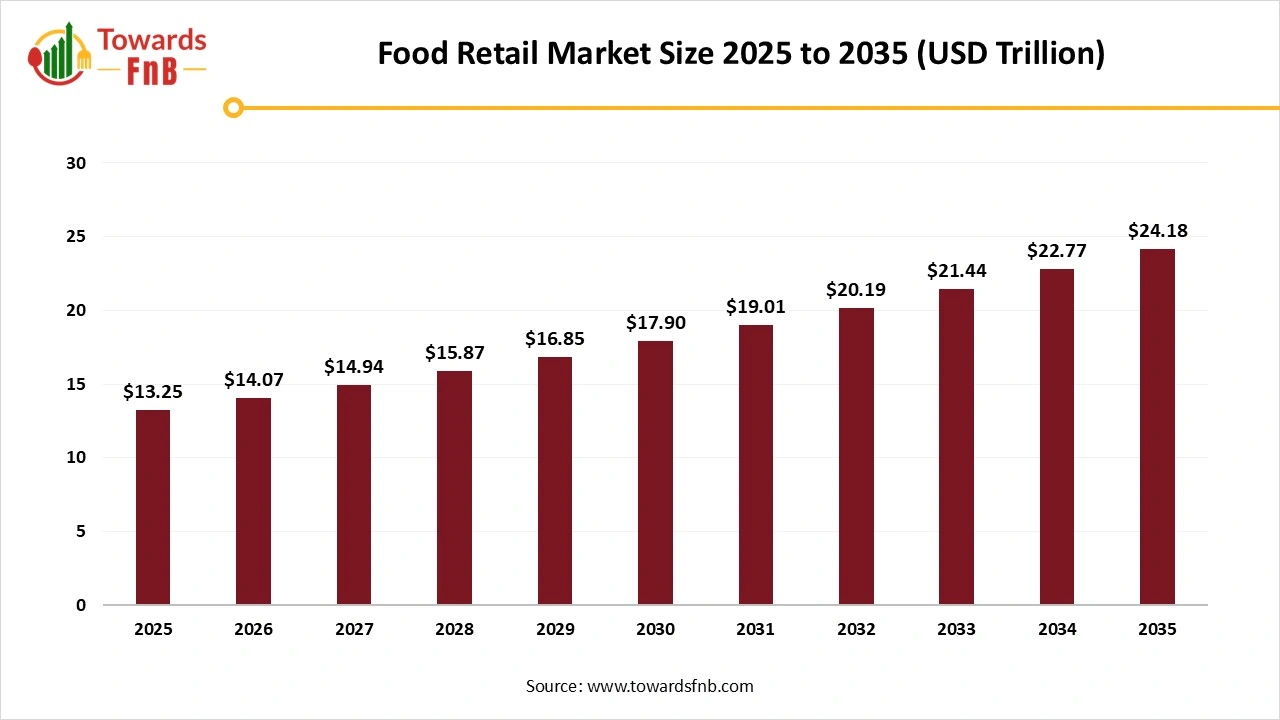
The global food retail market size reached at USD 13.25 trillion in 2025 and is anticipated to increase from USD 14.07 trillion in 2026 to an estimated USD 24.18 trillion by 2035, witnessing a CAGR of 6.2% during the forecast period from 2026 to 2035. The rise in convenience-oriented shopping and the huge spending on higher-quality food drive market growth.
| Study Coverage | Details |
| Growth Rate from 2026 to 2035 | CAGR of 6.2% |
| Market Size in 2026 | USD 14.07 Trillion |
| Market Size in 2027 | USD 14.94 Trillion |
| Market Size by 2035 | USD 24.18 Trillion |
| Largest Market | North America |
| Base Year | 2025 |
| Forecast Period | 2026 to 2035 |
| Regions Covered | North America, Europe, Asia-Pacific, Latin America, and Middle East & Africa |
Food retail is a type of business that sells beverages and food items directly to consumers. They include distribution channels like hypermarkets, warehouse clubs, farmers markets, supermarkets, and many other stores. Food retail has a diverse range of products like vegetables, dairy products, chilled items, deli, freshly baked goods, frozen pizza, desserts, staples, breakfast foods, spices, soft drinks, juices, and many others. They offer benefits like improved food access, safe food products, consumer convenience, easy access to nutritious food, and value-added services. The examples of food retailers are Kroger, 7-Eleven, Bakeries, and Walmart.
The food retail market growth is driven by increased spending on branded food products, the rise of online grocery shopping, the popularity of ready-to-eat items, the expansion of wholesale clubs, the high availability of quick commerce, growing sustainability awareness, heavy spending on pre-packaged food, and improved inventory management.
The food retail market is experiencing key technological shifts driven by demand for streamlining supply chains, creating seamless experiences, and enhancing personalization. The technological innovations like robotics, autonomous checkout, blockchain, machine learning, and IoT sensors lower food waste and enhances shopping experience. The AI integration is a key shift in the food retail industry, which optimizes inventory and supports personalization.
AI easily tracks shipments of food and analyzes customer behaviour. AI predicts delays of products and easily generates shopping lists. AI improves the margin of the product and creates a new product line. AI analyzes local trends and provides customized promotions. AI improves the checkout process and optimizes store layouts. AI identifies fraudulent activity and automatically adjusts pricing. Overall, AI provides an efficient shopping experience to consumers.
Raw Material Procurement
Quality Testing and Certification
Waste Management and Recycling
| Food Retailers | Type | Private Label Brands |
| Walmart | Hypermarkets | Freshness Guaranteed Marketside Great Value |
| 7-Eleven | Convenience Stores | Seven Premium 7-Select 7-Select Fusion Energy & Rehydrate |
| Amazon Fresh | Online Retail | Amazon Saver Vedaka Amazon Grocery Aplenty |
| Aldi & Lidl | Discount & Limited Assortment Stores | liveGfree Earth Grown Friendly Farms Barissimo Simply Nature |
| Kroger & Publix | Conventional Supermarkets | Simple Truth Organic Smart Way Heritage Farm Publix Deli Kroger Brand Publix Premier |
| Trader Joe’s | Discount Stores | Bibigo Alvarado Street Bakery Wallaby SoyVay |
Why North America is Dominating the Food Retail Market?
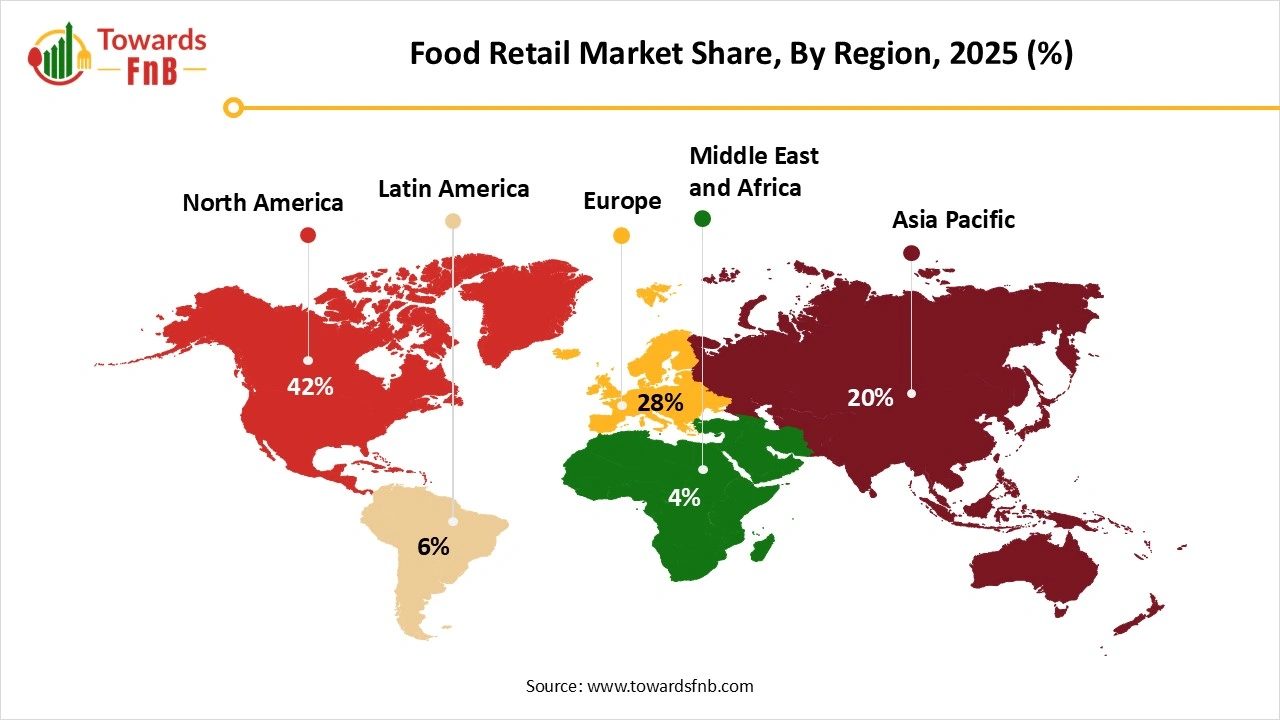
North America dominated the food retail market with approximately 42% share in 2025. The well-developed hypermarkets and the transition to ready-to-eat meals increase demand for food retail. The robust growth in e-commerce and the increased purchasing of premium food products help market expansion. The presence of large-scale convenience stores and the presence of companies like Costco Wholesale, Albertsons Companies, Publix Super Markets, Walmart, The Kroger Co, & Sams Club drives the market growth.
North America Food Retail Market Size 2025 to 2035
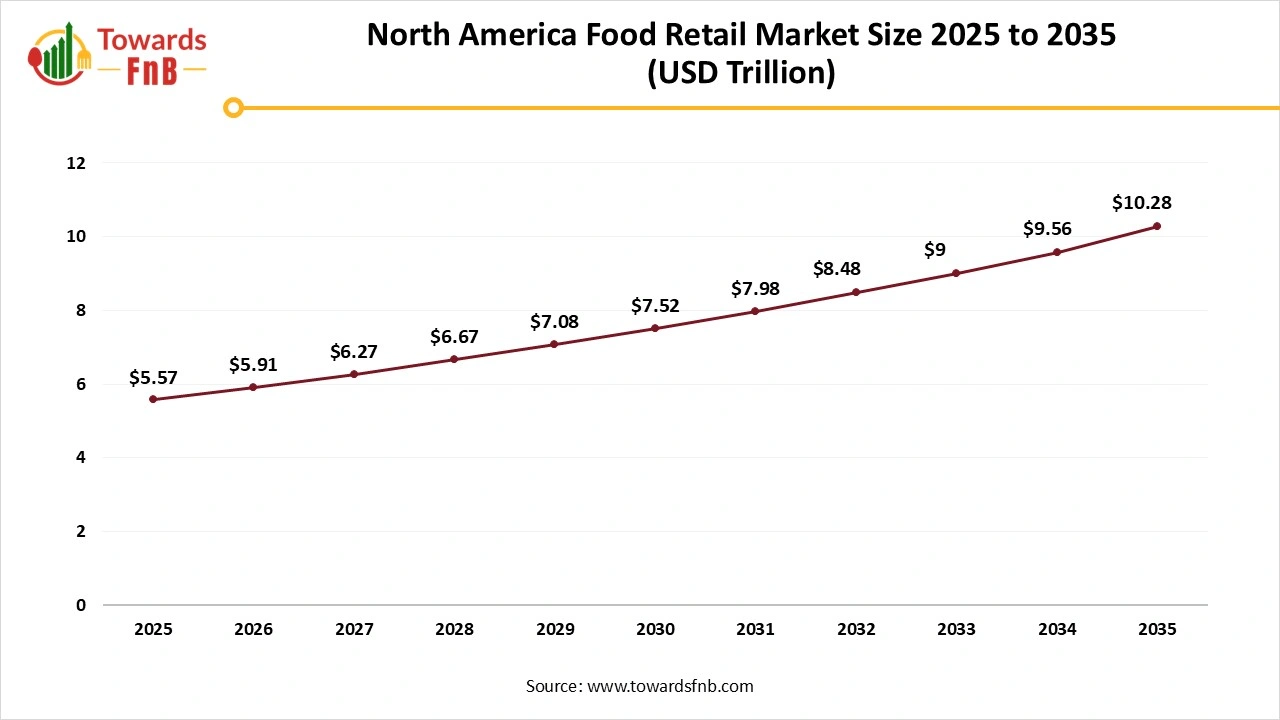
The North America food retail market size was calculated at USD 5.57 billion in 2025 with projections indicating a rise from USD 5.91 billion in 2026 to approximately USD 10.28 billion by 2035, expanding at a CAGR of 6.32% throughout the forecast period from 2026 to 2035.
The United States Powerful Contribution to Food Retail
The United States is a key contributor to the market. The rise in expenditure on organic food items and the high demand for ready-to-eat meals increase the adoption of food retail. The robust growth in online retail shopping and the massive presence of grocery stores help market expansion. The major players like Costco Wholesale Corporation, Publix Super Markets, Walmart, and Albertsons Companies support the overall market growth.
How Big is the U.S. Food Retail Market?
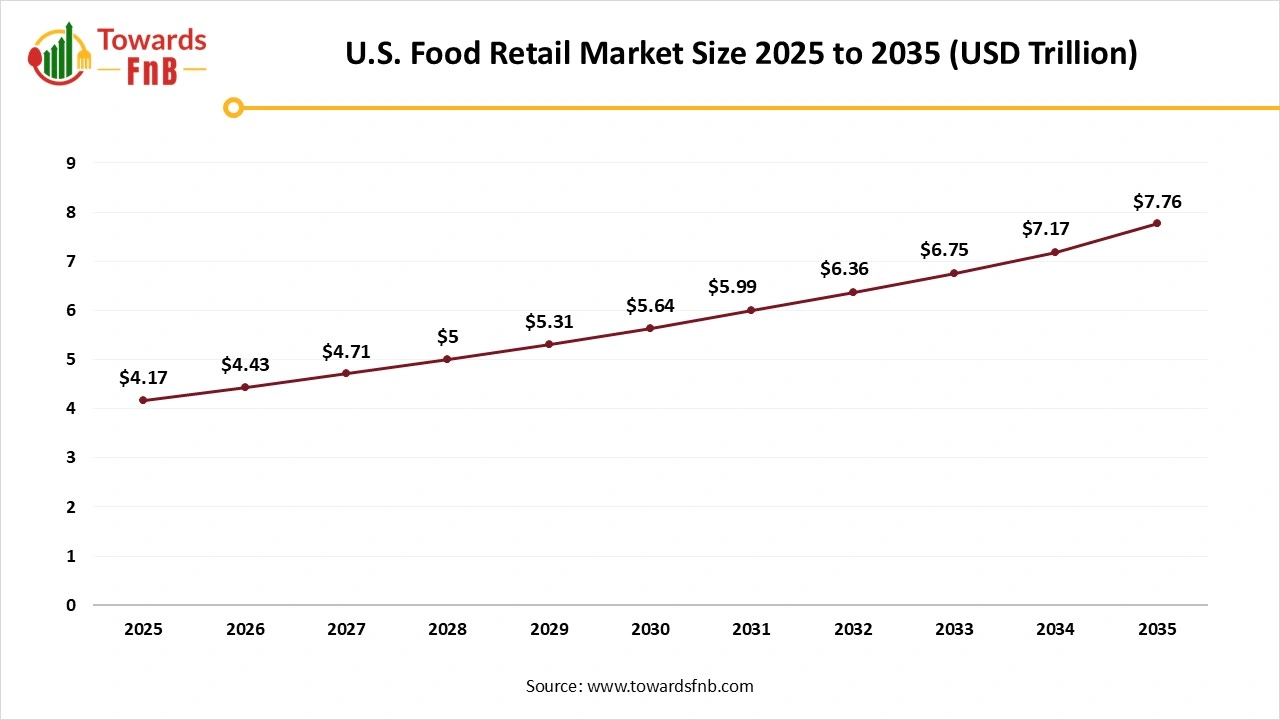
The U.S. food retail market size estimated at USD 4.17 billion in 2025 and is predicted to increase from USD 4.43 billion in 2026 to nearly reaching USD 7.76 billion by 2035, growing at a CAGR of 6.41% during the forecast period from 2026 to 2035.
Asia Pacific Food Retail Market Trends
Asia Pacific is experiencing the fastest growth in the market during the forecast period. The increased purchasing of higher-quality foods and the consumer interest in functional food increase demand for food retail. The huge investment in cold chain storage and the high need for ready-to-eat products increase the adoption of food retail. The government investment in food processing and the growing organizations like Lawson, Costco, & 7-Eleven drive the overall market growth.
India's Growing Expansion in Food Retail
India is rapidly growing in the market. The growing number of working women and the government support for the food processing sector increase the adoption of food retail. The huge purchasing of value-added food items and the high preference for packaged food increase demand for food retail. The growing expansion of hypermarkets and the shift towards food ordering support the overall market growth.
Food Retail Market Share, By Channel, 2025 (%)
| Segments | Shares (%) |
| Supermarkets & Hypermarkets | 50% |
| Online Grocery | 20% |
| Convenience Stores | 17% |
| Discounters & Others | 13% |
Why Supermarkets & Hypermarkets Segment Dominates the Food Retail Market?
The supermarkets & hypermarkets segment dominated the market in 2025. The increased purchasing of private-label products and the strong focus on saving consumer time increase the adoption of supermarkets. The strong focus on providing a better shopping experience to consumers increases demand for hypermarkets. The operational efficiency, convenience, easy accessibility, product variety, and competitive pricing of supermarkets & hypermarkets drive the market growth.
The Online Grocery Segment is the Fastest-Growing in the Market During the Forecast Period
The consumer focuses on avoiding crowded stores, and the growing accessibility of online payment modes increases demand for online grocery shopping. The availability of personalised recommendations and subscription benefits in online grocery helps market expansion. The wide assortment, ultimate convenience, improved logistics, personalization, and time-saving capabilities of online grocery support the overall market growth.
Food Retail Market Share, By Product Category, 2025 (%)
| Segments | Shares (%) |
| Packaged Food | 60% |
| Fresh Produce (Fruits/Veg) | 17% |
| Beverages | 10% |
| Others (Household/Tobacco) | 13% |
How did the Packaged Food Segment hold the Largest Share of the Food Retail Market?
The packaged food segment held the largest revenue share of 45% in the market in 2025. The urban consumers' busy schedules and the strong focus on ensuring food safety increase the consumption of packaged food. The high preference for branded flavors and the growing nutritional awareness increase demand for packaged food. The convenience, consistent quality, customization availability, increased hygiene, and the extended shelf life of packaged food drive the overall market growth.
The Fresh Produce Segment is Experiencing the Fastest Growth in the Market During the Forecast Period
The consumer preference for nutrient-dense food and the expansion of online delivery apps increase demand for fresh produce. The increased consumption of exotic vegetables and the increased pre-packaged produce increases demand for fresh produce. The sustainability consciousness and the transition towards plant-based eating increase demand for fresh produce, supporting the overall market growth.
Food Retail Market Share, By Consumer Profile, 2025 (%)
| Segments | Shares (%) |
| Value-Oriented | 60% |
| Health & Wellness Focused | 25% |
| Premium/Luxury Seekers | 15% |
Which Consumer Profile Segment Dominated the Food Retail Market?
The value-oriented segment dominated the food retail market with 52% share in 2025. The shift towards smart shopping and the strong focus on purchasing lifestyle products increases demand for food retail. The strong presence of private-label products and the robust growth in discount chains increase the adoption of food retail. The increased buying of budget-friendly food options and the higher need for one-stop shopping drive the market growth.
The Health & Wellness Focused Segment is the Fastest-Growing in the Market During the Forecast Period
The focus on managing chronic diseases and the heavy awareness of nutrition increases demand for health-focused food products. The growth of food as medicine and the preferability of minimally processed food increases the adoption of food retail. The strong focus on personal health supports the overall market growth.
Naver and Kurly
Amazon
Emart24
By Channel
By Product Category
By Consumer Profile
By Region





Principal Consultant
Vidyesh Swar, Senior Research Analyst at Towards Food & Beverages, specializes in market research, focusing on supply-demand evaluation, pricing analysis, alternative proteins, plant-based foods, and sustainable food technologies within the industry.
Learn more about Vidyesh Swar
Reviewed By
Aditi Shivarkar, with 14+ years in Food and Beverages market research, specializes in food, beverage, and eco-friendly packaging. She ensures accurate, actionable insights, driving Towards FnB's excellence in industry trends and sustainability.
Learn more about Aditi ShivarkarApril 2026
April 2026
April 2026
April 2026

Food Retail Market


 +1 804-441-9344
 Download Sample
 Schedule a Meeting