February 2026



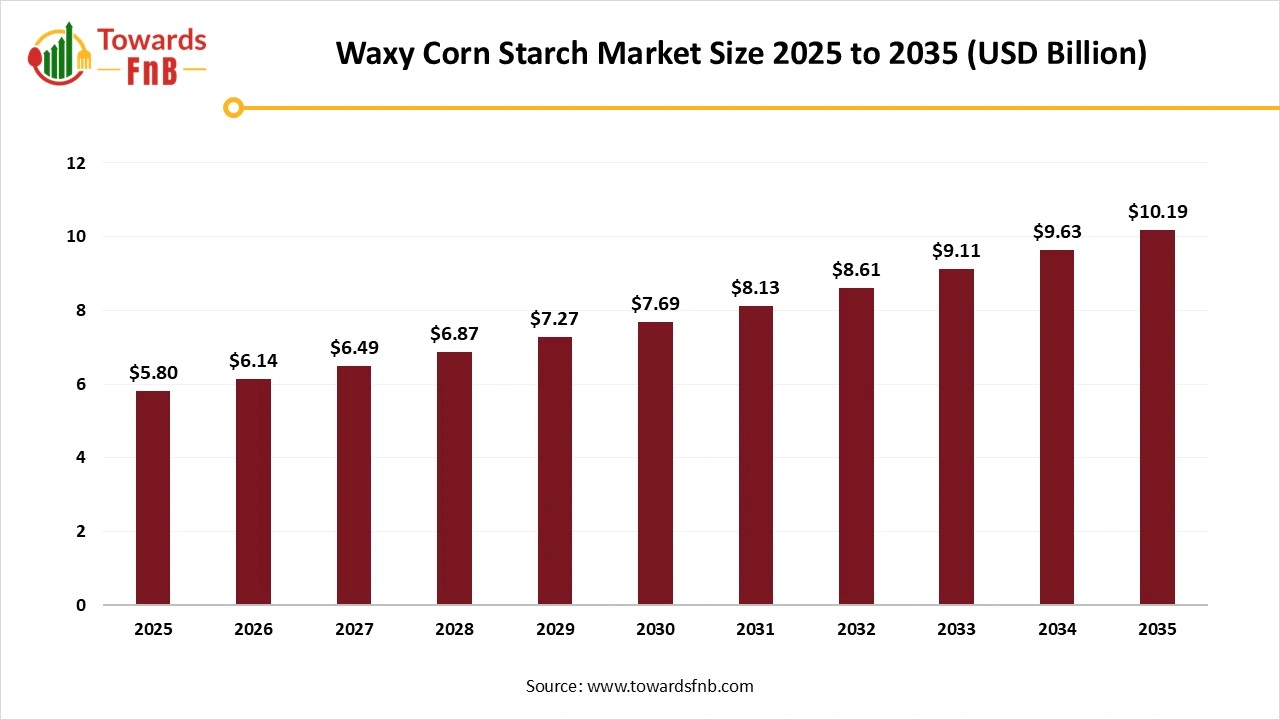
The global waxy corn starch market size estimated at USD 5.80 billion in 2025 and is predicted to increase from USD 6.14 billion in 2026 to reach nearly USD 10.19 billion by 2035, growing at a CAGR of 5.8% during the forecast period from 2026 to 2035. This growth is due to the expanding food, pharmaceutical and industrial sectors.
| Study Coverage | Details |
| Growth Rate from 2026 to 2035 | CAGR of 5.8% |
| Market Size in 2026 | USD 6.14 Billion |
| Market Size in 2027 | USD 6.49 Billion |
| Market Size by 2035 | USD 10.19 Billion |
| Largest Market | North America |
| Base Year | 2025 |
| Forecast Period | 2026 to 2035 |
| Regions Covered | North America, Europe, Asia-Pacific, Latin America, and Middle East & Africa |
The growing demand for convenience and processed food is boosting the waxy corn starch market. Waxy corn starch is notable for its high amylopectin content, which can reach up to 99%. This characteristic enhances its paste stability, clarity, and texture Fand is therefore widely used in food products. Natural waxy corn starch has significant application potential due to its advantageous properties, including high peak viscosity, high swelling power, anti-aging effects, high transparency, and easy digestibility. Beyond the food industry, waxy corn starch is utilized in papermaking to improve surface strength and printing quality, as well as in textiles.
| Market Driver | (~) % Impact on CAGR Forecast | Geographic Relevance | Impact Timeline |
| Growing demand for clean label & natural ingredients in food | +3.0% to +4.0% | North America & Europe with strong clean label trends; rising in Asia Pacific | Medium to Long term (2025–2035) |
| Expanding processed and convenience food sectors | +2.5% to +3.5% | Global, especially in North America, Europe & APAC | Medium (2025–2032) |
| High functionality (stability, viscosity, clarity) | +2.0% to +3.0% | Global, across food, paper, textile, and pharmaceutical applications | Medium (2025–2030) |
| Retail & e commerce distribution expansion | +1.5% to +2.5% | North America & Europe lead; rising Asia Pacific urban distribution | Short to Medium term (2025–2030) |
| Market Restraint | (~) % Impact on CAGR Forecast | Geographic Relevance | Impact Timeline |
| Raw material price volatility (corn feedstock) | ~ 2.0% to 3.0% | Global, particularly in regions dependent on commodity imports | Short term (2025–2028) |
| Limited cultivation acreage for waxy corn | ~ 1.5% to 2.5% | North America & Europe where supply chains are constrained by limited waxy corn production | Medium term (2025–2032) |
| Competition from alternative starch sources | ~ 1.0% to 1.8% | Global, especially in markets with cheaper tapioca/potato starch offerings | Medium term (2025–2030) |
| Regulatory hurdles for food additive approvals | ~ 1.0% to 1.5% | North America & Europe with strict additive and labeling standards | Long term (2025–2035) |
Advances in technology are enabling companies to produce high-quality corn starch products more efficiently. The implementation of automation, robotics, and AI is enhancing the accuracy and speed of production processes. Moreover, new processing techniques are facilitating the production of specialty starches with unique functional properties. Whether through the clean-label appeal of physical modification, the targeted functionality of chemical modification, or the precision achieved via enzymatic conversion, these methods give rise to products that are essential across numerous sectors.
Raw Material Procurement
Processing
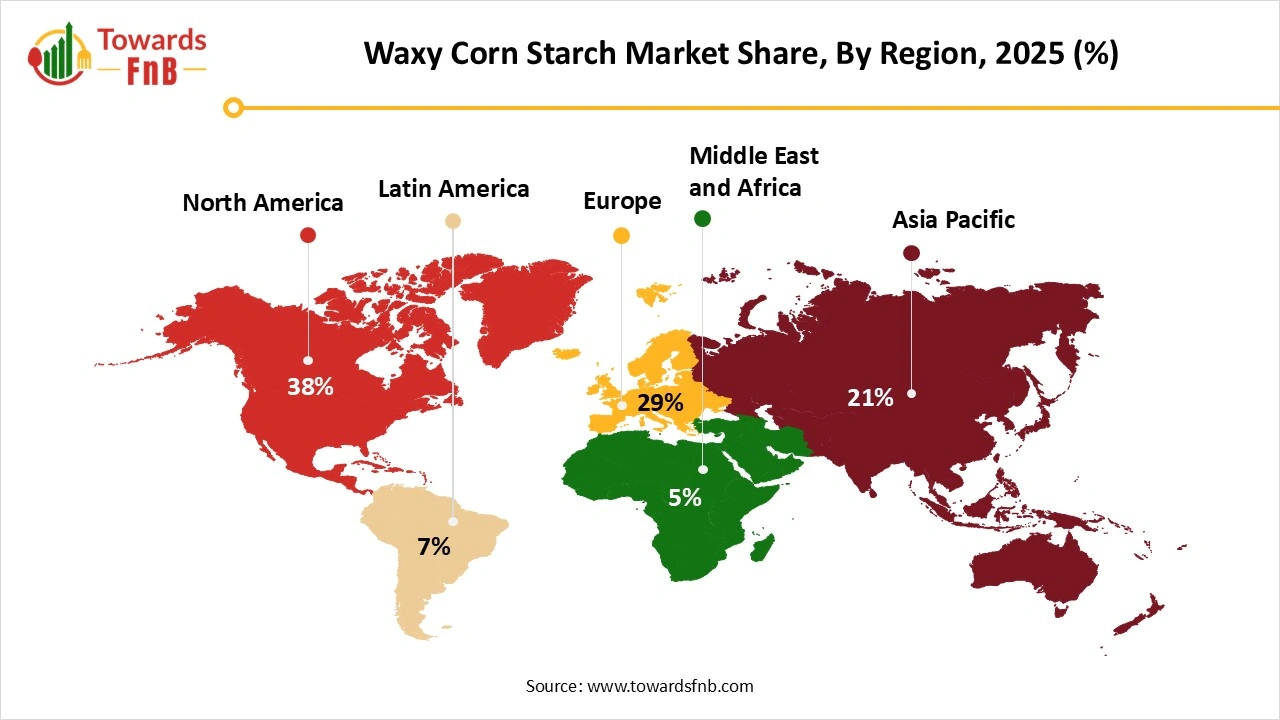
North America Held a Dominant Position in the Market with a Share of 38% in 2025
The growing demand for convenient foods and ready-to-cook products, which require maize starch as a food additive, is anticipated to drive market growth. In recent years, the need for gluten free food has surged, largely due to health-conscious and gluten-intolerant consumers, particularly in the U.S. and Canada. This shift in eating habits has spurred increased production of gluten-free products from alternative sources like maize. In addition to the food industry, the demand for waxy corn starch is expected to rise due to its use in sectors such as adhesives, pharmaceuticals, nutraceuticals, and paper and pulp production.
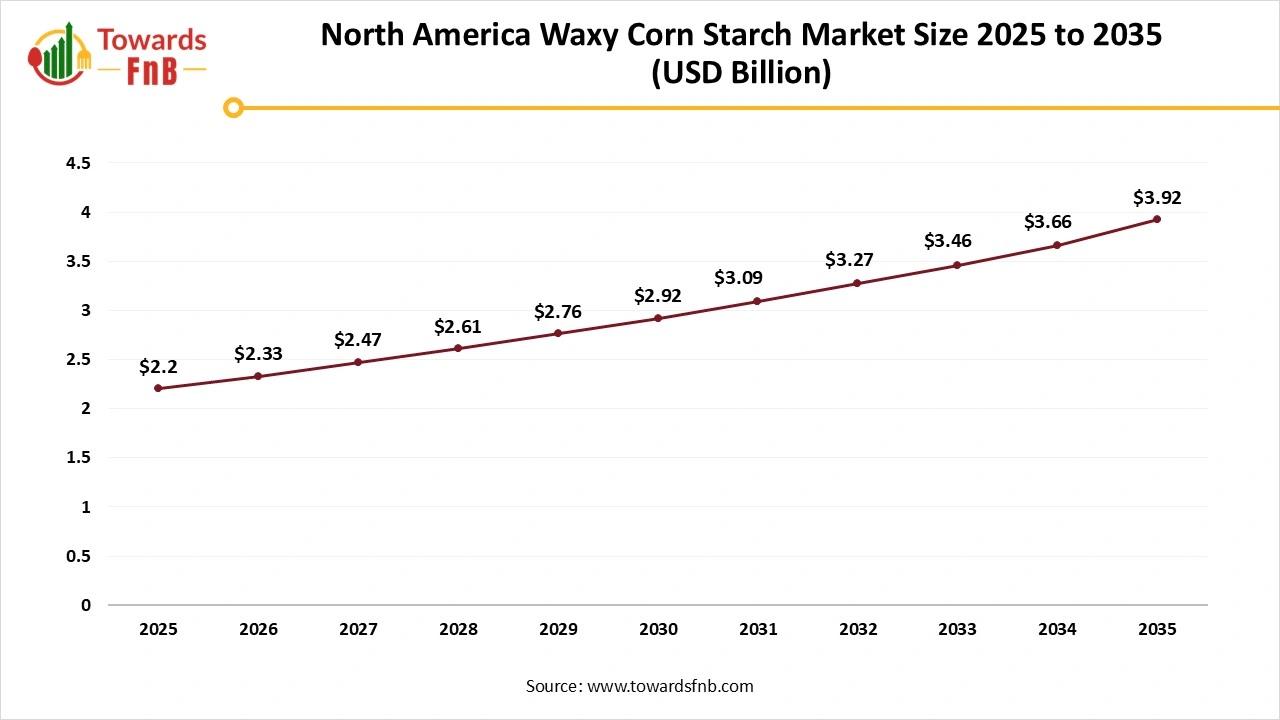
North America Waxy Corn Starch Market Size 2025 to 2035
The North America waxy corn starch market size was calculated at USD 2.2 billion in 2025 with projections indicating a rise from USD 2.33 billion in 2026 to approximately USD 3.92 billion by 2035, expanding at a CAGR of 5.95% throughout the forecast period from 2026 to 2035.
United States Waxy Corn Starch Market Trends
In the United States, waxy corn starch has become the preferred base starch for many food applications. It is also used in pharmaceuticals as a binder or disintegrant due to its rapid hydration properties. To meet the needs of farmers, feed manufacturers, food processors, and industrial users, Ingredion Inc. has launched new organic native starches in the United States and Canada under the brand Purity Bio 201 organic native corn starch. Technological advancements in the production process of waxy corn starch are enhancing its functionality and application potential, making it a favored choice across various industries.
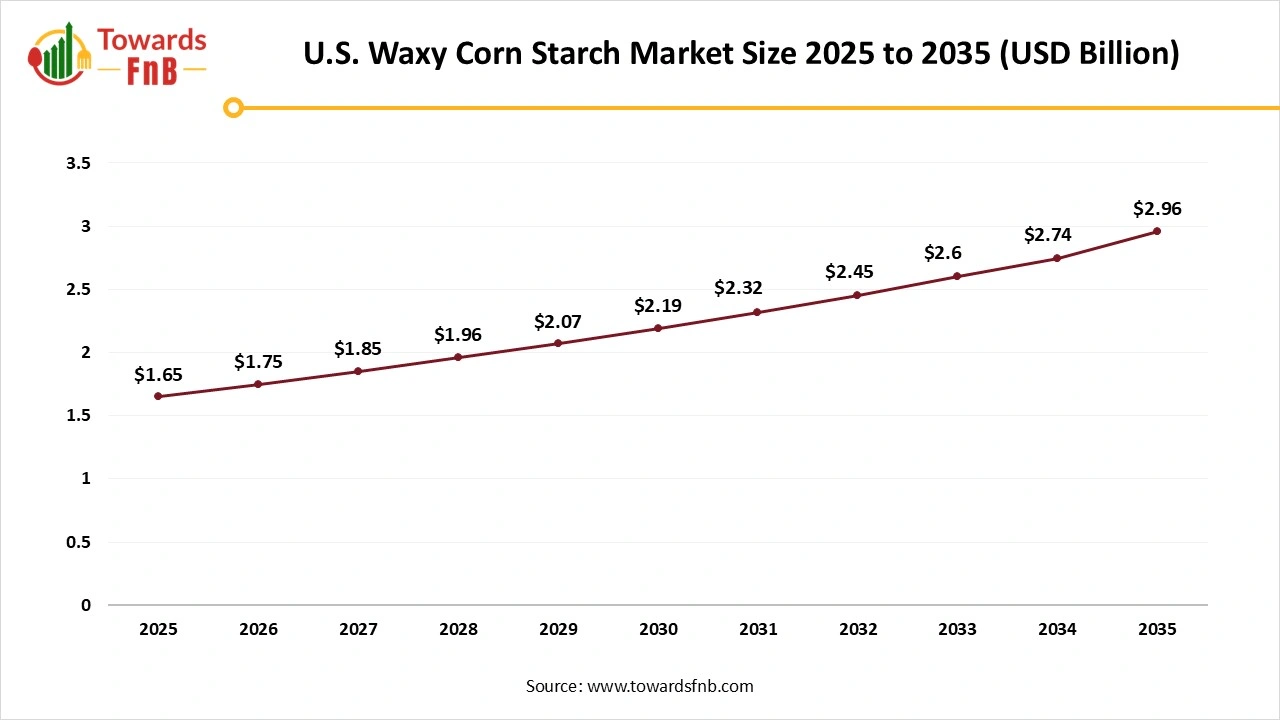
How Big is the U.S. Waxy Corn Starch Market?
The U.S. waxy corn starch market size estimated at USD 1.65 billion in 2025 and is predicted to increase from USD 1.75 billion in 2026 to nearly reaching USD 2.96 billion by 2035, growing at a CAGR of 6.02% during the forecast period from 2026 to 2035.
Asia Pacific Waxy Corn Starch Market Trends
Asia Pacific expects fastest growth during the forecast period, driven by expanding agricultural capacities and rising consumer demand for clean-label, plant-based ingredients. Farmers in Thailand and Southeast Asia have been cultivating waxy corn as a cash crop alongside rice. Waxy corn has been improved and cultivated in East and Southeast Asia for over a century. Additionally, a growing urban population in developing Asian economies is increasing the demand for ready-to-eat meals, further boosting the need for stabilizers.
India Waxy Corn Starch Market Trends
In India, the focus on sustainable energy has led to a significant rise in corn-based ethanol production, which is positively impacting the market. The primary demand for starches comes from industries such as textiles, paper, construction, and pharmaceuticals. While the use of starch derivatives in the food industry is on the rise. India benefits from an ample supply of maize and other raw materials necessary for processing and production. Major players like HL Agro, a bulk corn starch producer and supplier, are helping the industry gradually align with international standards.
Europe Waxy Corn Starch Market Trends
The European waxy corn starch market is characterized by steady growth, driven by the expanding food processing industry, an increasing demand for biodegradable and sustainable ingredients, and ongoing technological innovations. Countries such as Germany, the UK, and France are leading this growth, largely due to government regulations and sustainability initiatives. Additionally, the rising application of waxy corn starches in industrial sectors like paper and textiles is creating further growth opportunities.
Germany Waxy Corn Starch Market Trends
The waxy corn starch market is undergoing a transformation in Germany, fueled by heightened health consciousness and a growing demand for natural, transparent ingredients. The market in Germany is also steadily growing, driven by increasing demand from various end-use industries such as food and beverages, pharmaceuticals, and textiles. This shift indicates a dynamic landscape where clean-label starches, valued for their minimal processing and lack of artificial additives, are becoming more popular among consumers seeking healthier alternatives across diverse food and beverage segments.
Why did the Native Waxy Starch Dominate the Waxy Corn Starch Market in 2025?
The native waxy starch segment led the waxy corn starch market with a share of 58% in 2025. Native starch provides a cost-effective alternative to other food additives, making it an appealing choice for manufacturers. It is most suitable for products that are prepared fresh and used without prolonged storage. Native starches, offered in a purified but unmodified form, vary in their functionality in baked goods and snacks. In snacks, native starches contribute various properties depending on the base material. Furthermore, native starch is often sourced from locally grown crops like corn, wheat, or potatoes, making it a viable option for local food manufacturers.
The Modified Waxy Starch Segment is Projected to Grow the Fastest During the Forecast Period
As these starches offer improved stability, enhanced thickening, and precise texture control. Modified food starch is widely used in sauces, dressings, baked goods, and frozen meals, delivering consistent and reliable results that enhance product quality and shelf life. Due to its low amylose content, waxy maize starch offers high stability and is also extensively used in adhesives, textiles, and paper production, where it improves structural integrity and surface properties.
How did the Conventional Segment Dominate the Waxy Corn Starch Market in 2025?
The conventional segment held the dominant share of 74% in the waxy corn starch market in 2025, driven by its widespread availability, cost-effectiveness, and extensive use across food, pharmaceutical, and industrial applications. Manufacturers prefer conventional starch for mass production due to its reliable supply chain and established processing methods.
The Organic Segment is Expected to Grow at the Fastest Rate During the Forecast Period
As it is increasingly adopted in plant-based food, gluten-free products, and ready-to-eat meals, key drivers in the clean-label movement. Advances in enzymatic processing and precision fermentation are enhancing the yield and purity of organic waxy corn starch. Buyers are prioritizing suppliers that implement traceable, eco-friendly farming practices and hold low carbon footprint certifications.
Which Application Segment Dominated the Waxy Corn Starch Market in 2025?
The food & beverage segment dominated the market with a share of 62% in 2025. In the food sector, waxy corn starch is valued for its transparency, stability, and smoothness. Waxy cornstarch offers better water retention, higher viscosity, and improved stability. It has been utilized to enhance confectionery textures, thicken soups, and serve as an antistaling agent in baking. It exhibits strong resistance to degradation during mechanical processing, which is essential for production. Waxy maize can serve as a thickening or stabilizing agent in drinks like smoothie and dairy products.
The Pharmaceuticals Segment is Expected to Expand at a Significant Rate in the Projected Period
Its biocompatibility and stability render it ideal for formulations that allow controlled release. Pharmaceutical firms indicate enhanced process efficiency and product stability through waxy corn starch, leading to lower manufacturing expenses. Its hypoallergenic properties also render it appropriate for sensitive patient populations, broadening its application in health supplements and medical equipment.
Al Ghurair Foods
Cargill
By Type
By Nature
By Application
By Region





Principal Consultant
Vidyesh Swar, Senior Research Analyst at Towards Food & Beverages, specializes in market research, focusing on supply-demand evaluation, pricing analysis, alternative proteins, plant-based foods, and sustainable food technologies within the industry.
Learn more about Vidyesh Swar
Reviewed By
Aditi Shivarkar, with 14+ years in Food and Beverages market research, specializes in food, beverage, and eco-friendly packaging. She ensures accurate, actionable insights, driving Towards FnB's excellence in industry trends and sustainability.
Learn more about Aditi ShivarkarFebruary 2026
March 2026
March 2026
March 2026

Waxy Corn Starch Market


 +1 804-441-9344
 Download Sample
 Schedule a Meeting