April 2026



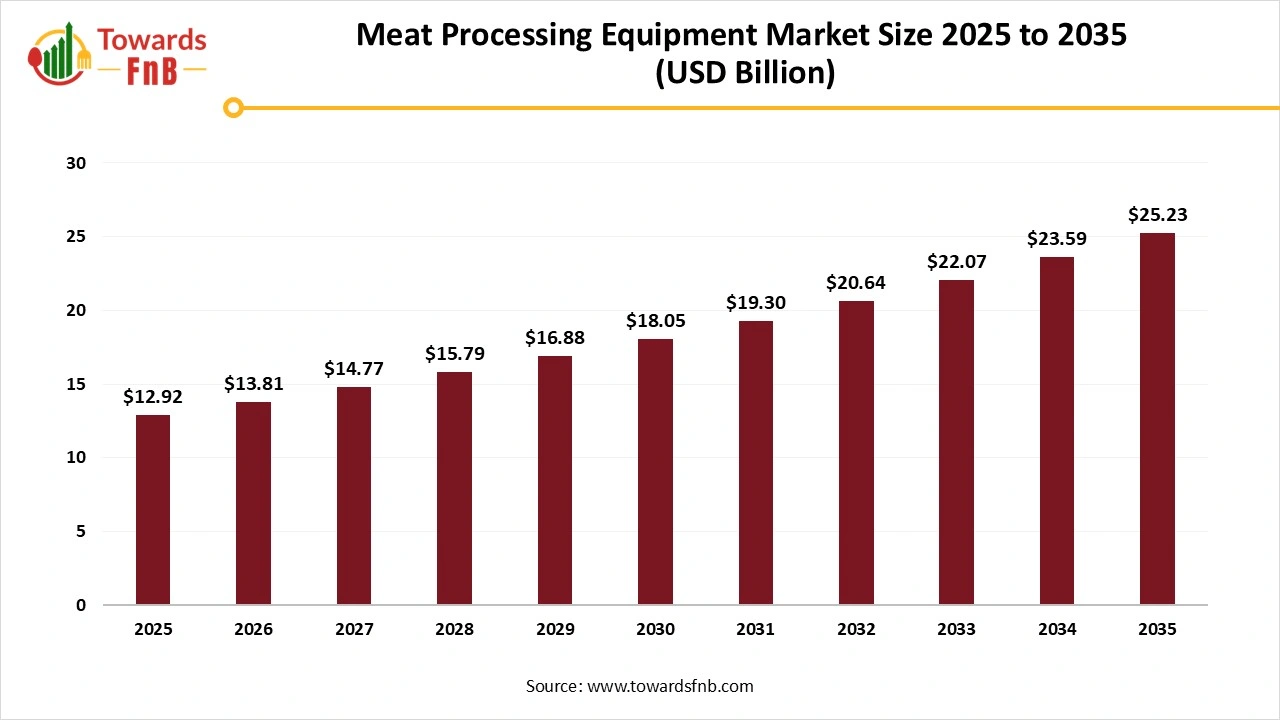
The global meat processing equipment market size estimated at USD 12.92 billion in 2025 and is predicted to increase from USD 13.81 billion in 2026 to nearly reaching USD 25.23 billion by 2035, growing at a CAGR of 6.92% during the forecast period from 2026 to 2035. The high processed meat consumption rate and the robustly growing restaurant chains drive market growth.
| Study Coverage | Details |
| Growth Rate from 2026 to 2035 | CAGR of 6.92% |
| Market Size in 2026 | USD 13.81 Billion |
| Market Size in 2027 | USD 14.77 Billion |
| Market Size by 2035 | USD 25.23 Billion |
| Largest Market | North America |
| Base Year | 2025 |
| Forecast Period | 2026 to 2035 |
| Regions Covered | North America, Europe, Asia-Pacific, Latin America, and Middle East & Africa |
Meat processing equipment is a tool designed for tasks such as grinding, tenderizing, cutting, packaging, and mixing meat products. They have features like hygienic construction, precision cutting, safety, high automation, and productivity optimization. They offer benefits like enhanced hygiene, consistency, higher yield, extended shelf life, increased productivity, reduced waste, and enhanced safety. The diverse equipment includes bowl cutters, slicers, tenderizers, battering, grinders, mixers, sausage stuffers, forming machines, packaging machines, choppers, and injectors.
The meat processing equipment industry is growing due to the popularity of processed meat, the rise in integration of smart technologies, the growth in restaurant chains, higher demand for pork processing, stricter hygiene regulations, growing meat consumption, increased use of automated equipment, and the growing investment in the facilities of meat processing.
The meat processing industry undergoes key technological innovations driven by demand for lowering labor dependency and the need for real-time tracking. Technological shifts like robotic automation, predictive maintenance, sustainable equipment design, intelligent vision systems, advanced packaging, and IoT are driven by demand for enhancing yield, optimizing maintenance, and enhancing product safety. Artificial intelligence (AI) is a key transformation in the market.
AI supports smart cutting of meat and lowers the product wastage. AI predicts mechanical failures and automates the grading procedure. AI lowers reliance on labor and supports digital tracking. It maximizes the yield of meat and enables automatic sorting. It also minimizes the consumption of energy and lowers the risk of worker injury. AI manufactures diverse raw meat products and minimizes the operational cost. Overall, AI is widely used in quality control, deboning, grading, packaging, and cutting applications in the meat industry.
Raw Material Procurement
Quality Testing and Certifications
Packaging and Branding
How Did North America Dominate the Meat Processing Equipment Market?
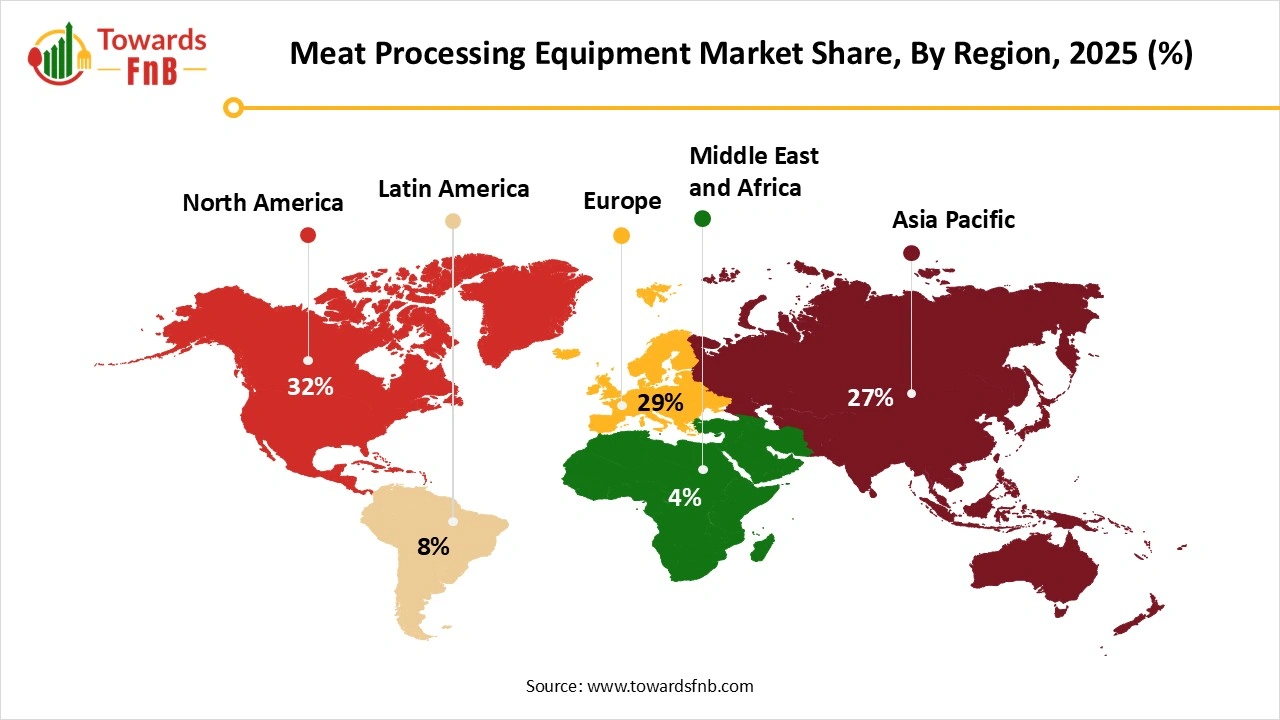
North America dominated the market with 32% share in 2025. The growing labor shortages and the popularity of meat snacks increase demand for meat processing equipment. Increased investment in meat supply chains and the trending premium meat increase the adoption of meat processing equipment. The popularity of deli meats and the increased upgradation of facilities increases demand for meat processing equipment. The trending low-fat meat products drive the market growth.
North America Meat Processing Equipment Market Size and Growth 2025 to 2035
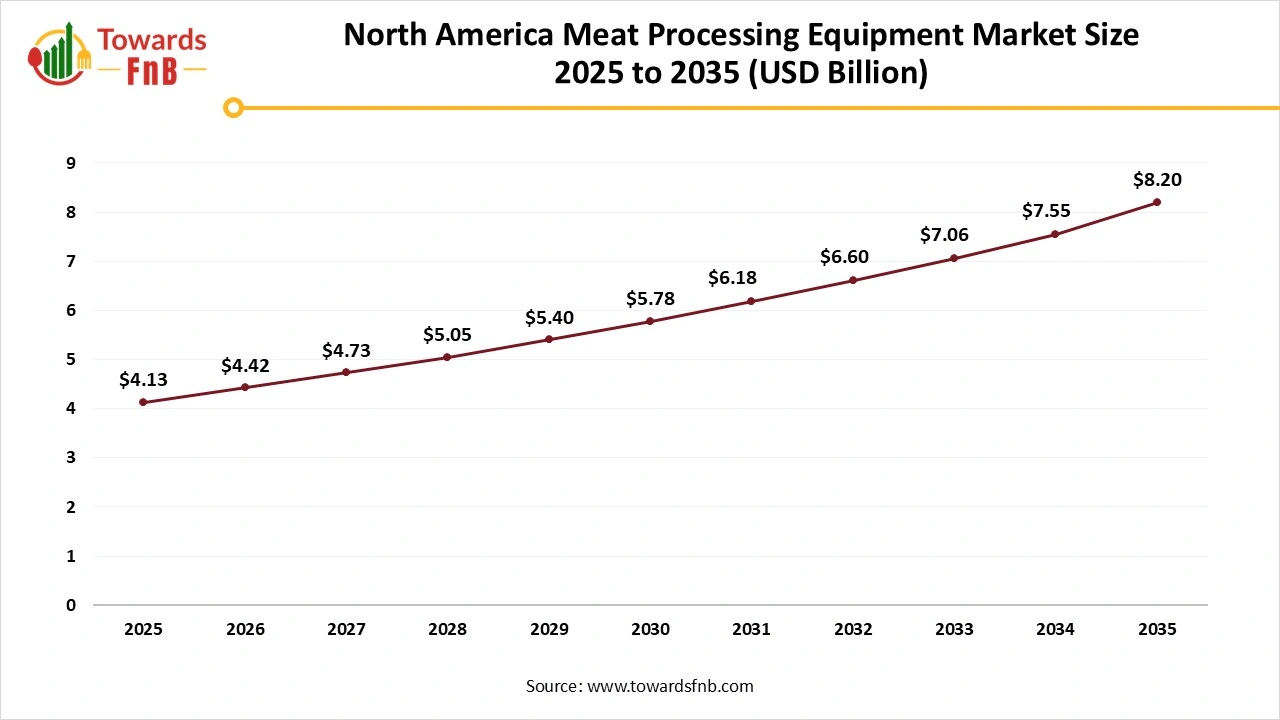
The North America meat processing equipment market size was valued at USD 4.13 billion in 2025 and is predicted to increase from USD 4.42 billion in 2026 to nearly reaching USD 8.20 billion by 2035, growing at a CAGR of 7.1% during the forecast period from 2026 to 2035.
United States Contribution to Meat Processing Equipment Market
The U.S. is a key contributor to the market. The focus on enhancing worker safety and the government's backing for improving meat supply chains increases demand for meat processing equipment. The popularity of organic meat and stringent safety regulations increases the adoption of meat processing equipment. The huge investment in poultry processing and the development of new processing plants support market growth.
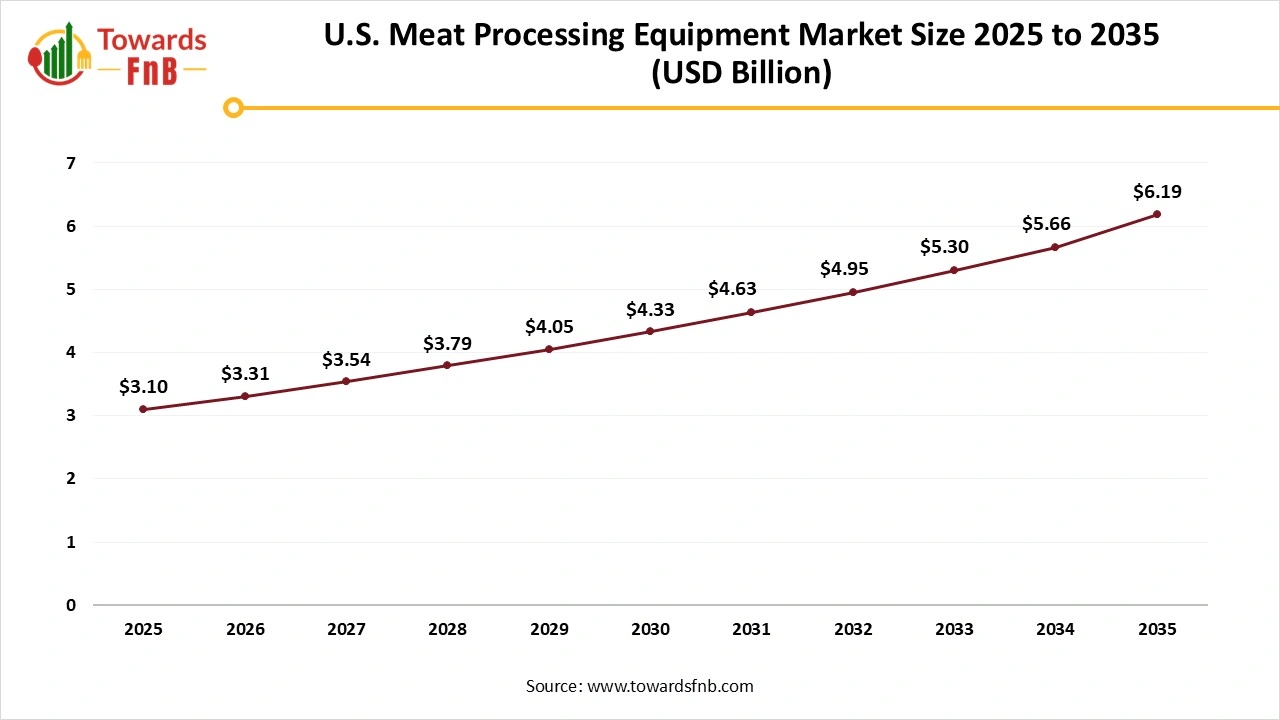
U.S. Meat Processing Equipment Market Size and Growth 2025 to 2035
The U.S. meat processing equipment market size was calculated at USD 3.10 billion in 2025 and is predicted to increase from USD 3.31 billion in 2026 to nearly reaching USD 6.19 billion by 2035, growing at a CAGR of 7.1% during the forecast period from 2026 to 2035.
How is Asia-Pacific Growing in the Meat Processing Equipment Market?
Asia-Pacific held 27% share in 2025. The increased consumption of processed meat due to busy schedules and the expanding organized retail sector increases demand for meat processing equipment. The growing pork processing plants and the awareness of protein-rich foods increase the adoption of meat processing equipment. The expansion of industrial-scale poultry and the popularity of ready-to-cook meat increase the adoption of meat processing equipment.
Crafting the Cut: India’s Role in Meat Processing Equipment
India is a robust contributor to the market. The increased popularity of processed meat among the middle class and the huge export of buffalo meat increase demand for meat processing equipment. The growth in cold chains and the increased integration of robotic tools in meat processing help with expansion. The increased use of medium-sized processors and the high-efficiency machinery support the market growth.
Will Europe Grow in the Meat Processing Equipment Market?
Europe is growing at a notable CAGR in the market. The rising demand for packaged meat items and the focus on energy-efficient technology increase the adoption of meat processing equipment. High-volume meat demand and the tradition of meat consumption increase the adoption of meat processing equipment. The presence of EFSA food safety guidelines and the heavy investment in automated processing boost the overall growth of the market.
Advanced Processing: Germany’s Rise in Meat Processing
Germany is rapidly expanding in the market. The growing demand for ethically sourced meat and the increased poultry consumption increase demand for meat processing equipment. Sustainability trends in the meat industry and the availability of high-speed machines increase the adoption of meat processing equipment. The high-tech meat manufacturing infrastructure supports the overall market growth.
The cutting equipment segment dominated the market with a 22% market share in 2025, because it plays a crucial part in guaranteeing accuracy, consistent positioning, and rapid processing throughout meat options. Adoption is being driven by the growing need in large-scale facilities for automated slicing and portion control. Robotic cutters and AI-enabled blades are examples of cutting-edge technologies that are increasing productivity and decreasing waste. Manufacturers are also being forced to use stainless steel, easily cleaned, cutting systems due to strict hygiene regulations. All of these elements work together to reinforce its hegemony in industrial meat processing.
The filling & stuffing equipment segment holds a 7.1% CAGR in 2025 because of the growing demand for ready-to-cook foods and processed meat products like sausages. Convenience-driven consumption habits and increased urbanization are driving this trend. Automated filling systems are being used by manufacturers to decrease reliance on labor and increase consistency. Product quality is being improved by advancements in portion control and vacuum stuffing technology. Growth is also being aided by the packaged food and quick service restaurant sectors' expansion.
The grinding equipment segment held a 18% market share in 2025 because it is crucial to the production of ground and minced meat products. Its adoption is still being driven by the high demand for meatball burgers and processed meat formulas. Product quality is being improved by technological developments that allow for consistent grinding and texture control. Large processors are adopting high-capacity, energy-efficient grinders because it is a fundamental stage in many meat processing applications; the segment is stable.
The beef segment dominated the market with a 30% market share in 2025 because it is widely consumed and a major ingredient in processed meat products worldwide. Equipment use is being driven by the high demand for beef-based products like steaks, burgers, and prepared meals; this dominance is largely due to developed markets with well-established meat processing industries. Furthermore, yield and efficiency in beef processing are being improved by technological developments. Consumption of premium meat products and export demand also contribute to the segment’s expansion.
The poultry segment holds a 7.2% CAGR in 2025 because consumers are becoming more interested in lean and reasonably priced protein sources. Demand is shifting toward low-fat meat options like chicken as people become more conscious of their health. Supply growth is further supported by poultry farming cost effectiveness and shorter production cycles. In poultry processing lines, automation is increasing productivity and lowering the risk of contamination. Demand is rising due to the growth of fast food restaurants and ready-to-eat chicken products.
The pork segment accounted for a 27% market share in 2025 because it is highly consumed in areas like Asia Pacific and Europe. Equipment use is being driven by the demand for processed pork products like ham, bacon, and sausages. Product innovation is aided by cutting-edge curing and preservation technologies. Demand is sustained by established supply chains and cultural dietary preferences. The development of value-added products continues to benefit the market.
The raw processed meat segment dominated the market with 40% market share in 2025 because fresh meat products with minimal processing are in high demand. Particularly in emerging markets, consumers prefer fresh meat for home cooking; for this segment, meat processors mainly depend on equipment for cutting, grindings, and deboning. Reduced processing complexity and cost benefit the segment. Supermarkets and retail meat chains are growing, which boosts demand even more.
The pre-cooked & ready-to-eat meat segment held a 35% market share in 2025 because urban consumers' demand for convenience foods is growing. Adoption is being driven by busy lifestyles and an increase in dual-income households. Innovations in packaging and advanced processing techniques like thermal processing are extending shelf life. Additionally, manufacturers are being forced to use standardized pre-cooked solutions by food safety regulations. Demand is further increased by the expansion of frozen food distribution networks and e-commerce.
The cured & fermented meat segment held a 25% market share in 2025 because traditional and high-quality meat products are in high demand. Popular products in developed markets include cured ham and salami. Taste texture and shelf stability are being enhanced by advanced fermentation technologies. Growing consumer interest in specialty and artisanal foods is bolstering expansion. Another factor driving growth is the demand for high-end cured goods from exports.
The fully automated equipment segment segment held a 45% market share in 2025 and is expected to maintain its leadership position in the coming years because of the requirement for high productivity, reliability, and lower labor costs. To manage large production volumes, large-scale processors are investing in automation. Predictive maintenance and real-time monitoring are being improved by the integration of robotics, IoT, and AI. Automation also guarantees adherence to strict food safety laws. Adoption is further accelerated by labor shortages in developed areas.
The semi-automation equipment segment holds relevance, especially among mid-sized processors balancing cost and efficiency. Compared to conventional setups, these technologies offer flexibility while requiring less manual intervention. Semi-automated systems are preferred by SMEs since they demand less initiative investment. They also make it possible to gradually move toward complete automation. In developing and price-sensitive regions, the category is still significant.
The industrial meat processing plant segment dominated the market with a 50% market share in 2025, driven by their extensive activities and high equipment requirements for effective continuous processing. These facilities need sophisticated machinery. Industrial plant expansion is being driven by rising meat consumption worldwide. Their position is further strengthened by investments in automation and adherence to food safety regulations. Economies of scale are also advantageous for large processors.
The SME segment held a 6.8% CAGR in 2025, driven by more local and regional meat processors entering the market. Small-scale processing facilities are being encouraged by government support and funding programs in emerging economies. To increase productivity, SMEs are implementing semi-automated and reasonably priced technology. This market is supported by rising demand for regional and personalized meat products. Additionally, digital channels are assisting SMEs in reaching a wider audience.
The food service sector, including restaurants and catering services, contributes significantly to equipment demand. Growth is being driven by an increase in the amount of processed and ready-to-eat meat consumed in quick-service restaurants and hotels. For internal processing, compact and effective equipment solutions are preferred for the growth of service restaurants and hotels. For internal processing, compact and effective equipment solutions are preferred. The growth of international food chains is increasing demand even more. Adoption of equipment is also aided by a greater emphasis on food quality and hygiene.
The direct sales (OEM) segment dominated the market with a 55% market share in 2025 because manufacturers and big processors have solid relationships. OEM channels offer technical assistance, after-sales services, and tailored solutions. This market is further strengthened by large purchases made by businesses' clients. Additionally, direct sales guarantee improved equipment dependability and pricing. For high-value machinery transactions, manufacturers favor this channel.
The online sales segment holds a 15% share in 2025 because of growing digitalization and procurement ease. Online platforms are preferred by SMEs and small processors of price and product comparison. A variety of equipment options are accessible through e-commerce channels. Growth is being supported by digital payment systems and enhanced logistics. Adoption is accelerating due to the shift in consumer behavior toward digital purchases.
Distribution & dealers play a crucial role in reaching regional and local markets. They offer end users services such as installation, maintenance, and training. This channel is especially crucial in developing nations with dispersed markets. Dealers assist in bridging the gap between small-scale buyers and manufacturers. Their localized presence guarantees quicker customer service and assistance.
SBAG
GEA
Starrett
TVI
By Equipment Type
By Meat Type
By Application
By Automation Level
By End User
By Distribution Channel
By Region





Principal Consultant
Vidyesh Swar, Senior Research Analyst at Towards Food & Beverages, specializes in market research, focusing on supply-demand evaluation, pricing analysis, alternative proteins, plant-based foods, and sustainable food technologies within the industry.
Learn more about Vidyesh Swar
Reviewed By
Aditi Shivarkar, with 14+ years in Food and Beverages market research, specializes in food, beverage, and eco-friendly packaging. She ensures accurate, actionable insights, driving Towards FnB's excellence in industry trends and sustainability.
Learn more about Aditi ShivarkarApril 2026
February 2026
February 2026
February 2026

Meat Processing Equipment Market


 +1 804-441-9344
 Download Sample
 Schedule a Meeting