April 2026



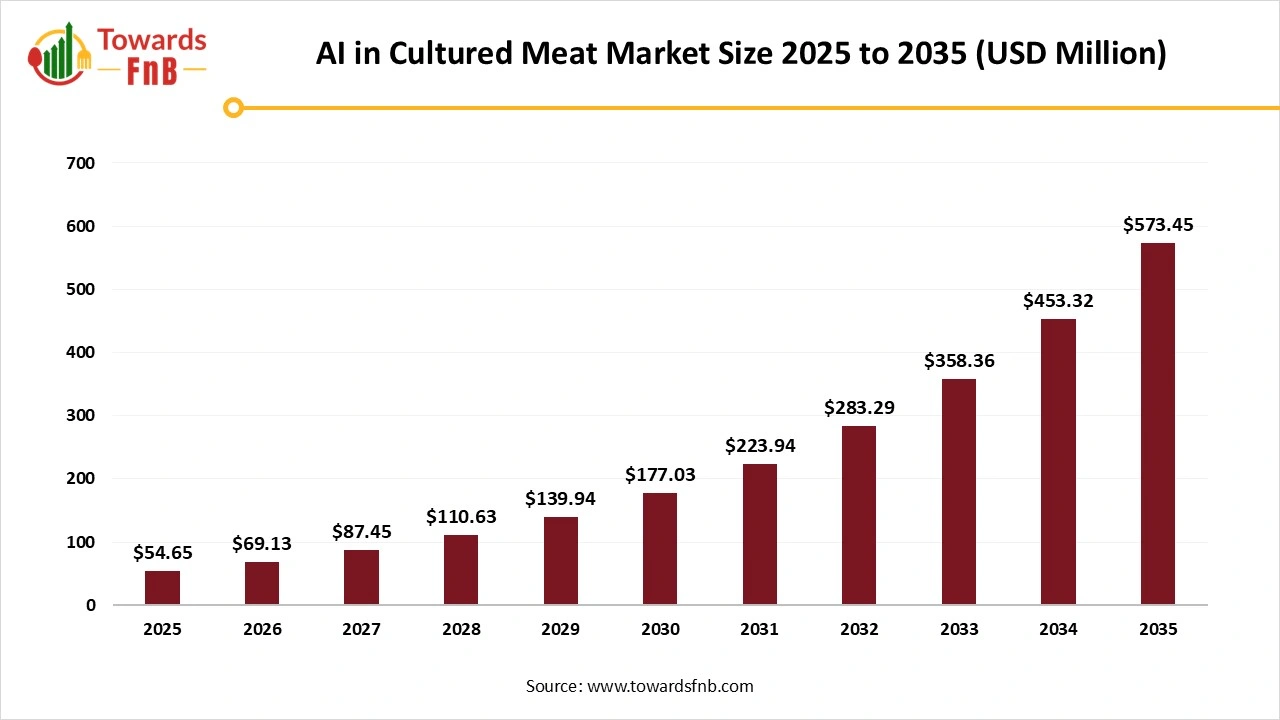
The global AI in cultured meat market size reached at USD 54.65 million in 2025 and is anticipated to increase from USD 69.13 million in 2026 to an estimated USD 573.45 million by 2035, witnessing a CAGR of 26.5% during the forecast period from 2026 to 2035. Rising global demand for sustainable and ethical meat alternatives and the need to reduce the high costs of production expanding the market.
| Study Coverage | Details |
| Growth Rate from 2026 to 2035 | CAGR of 26.5% |
| Market Size in 2026 | USD 69.13 Million |
| Market Size in 2027 | USD 87.45 Million |
| Market Size by 2035 | USD 573.45 Million |
| Largest Market | North America |
| Base Year | 2025 |
| Forecast Period | 2026 to 2035 |
| Regions Covered | North America, Europe, Asia-Pacific, Latin America, and Middle East & Africa |
The AI in cultured meat market refers to the integration of artificial intelligence technologies in the production, optimization, and commercialization of lab-grown/cultivated meat. AI is applied across bioprocess optimization, cell line development, nutrient/media formulation, bioreactor monitoring, and supply chain scaling, enabling cost reduction, product quality improvement, and faster market adoption.
Technological transformation in AI within the cultured meat industry AI-powered systems utilize machine learning to evaluate large datasets for quicker cell line optimization and media development, while immediate sensor data integrated with IoT and robotics automates and enhances both upstream and downstream production processes. AI aids in developing intricate scaffolds to produce structured, 3D-bioprinted meat items that better resemble the texture and look of traditional meat.
Raw Materials Procurement
Retail Sales and Marketing
Waste Management and Recycling
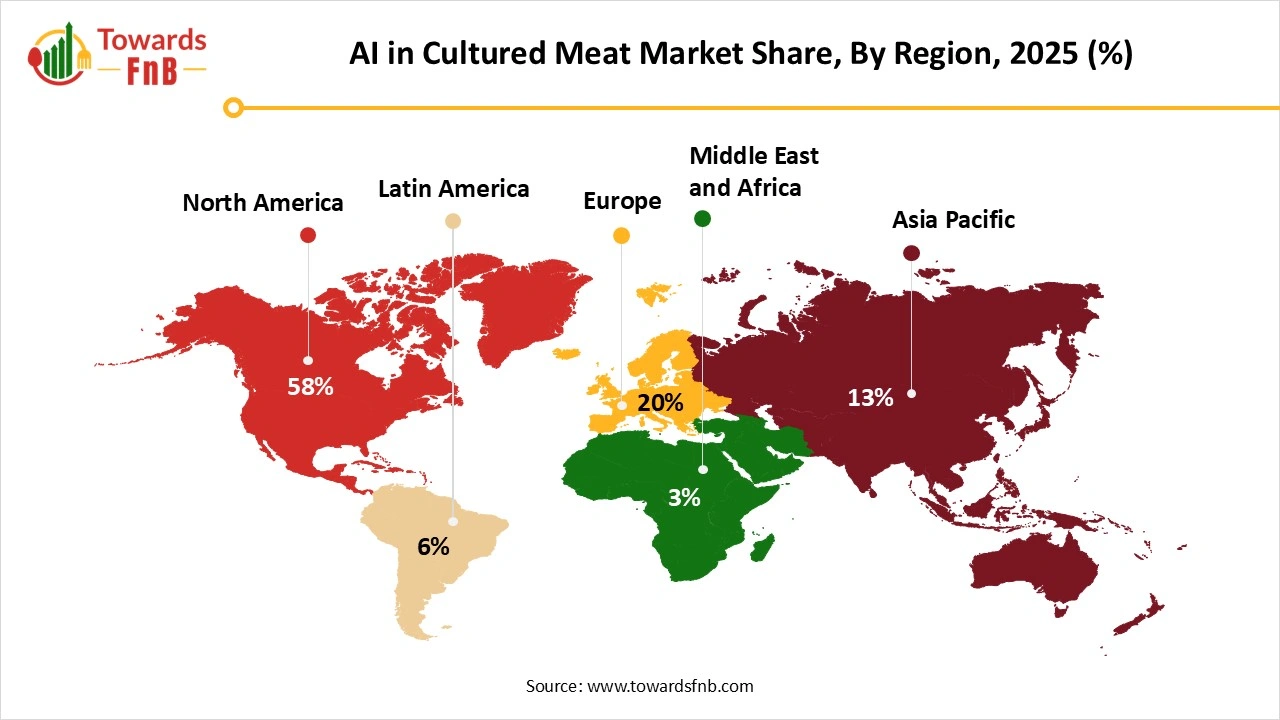
North America Dominated the AI in Cultured Meat Market in 2025
Because of the significant research and development and measurable consumer interest in the sustainability of food alternatives. The advancement of technology in the area, along with support from both public and private sectors, speeds up the progress and acceptance of cultured meat products. AI and ML algorithms examine large datasets to pinpoint and create the best, high-yielding cell lines for production at a commercial scale. This significantly decreases the time and resources usually needed for this procedure. For example, US-based Orbillion Bio employs AI and ML for extensive screening of different cell lines, such as Wagyu beef.
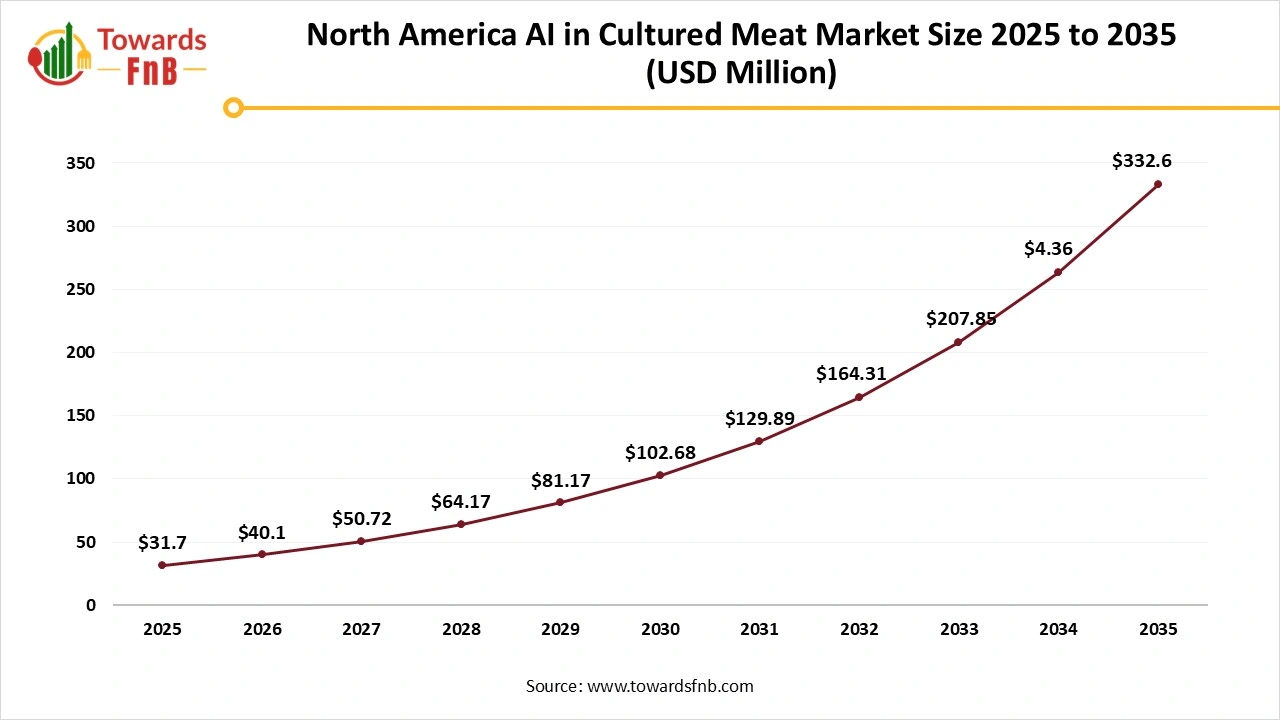
The North America AI in cultured meat market size was calculated at USD 31.7 million in 2025 with projections indicating a rise from USD 40.1 million in 2026 to approximately USD 332.6 million by 2035, expanding at a CAGR of 26.5% throughout the forecast period from 2026 to 2035.
U.S. AI in Cultured Meat Market Trends
In the United States cultured meat market, artificial intelligence (AI) is playing an increasingly important role by helping to overcome some of the biggest scientific and commercial barriers in producing lab-grown meat. AI technologies especially machine learning, deep learning, computer vision, and predictive analytics are being used to optimize bioprocesses such as cell line development, nutrient media formulation, scaffold and tissue design, and real-time monitoring of growth conditions to improve yield, consistency, texture, flavor and cost-efficiency of cultured meat production.
How Big is the U.S. AI in Cultured Meat Market?
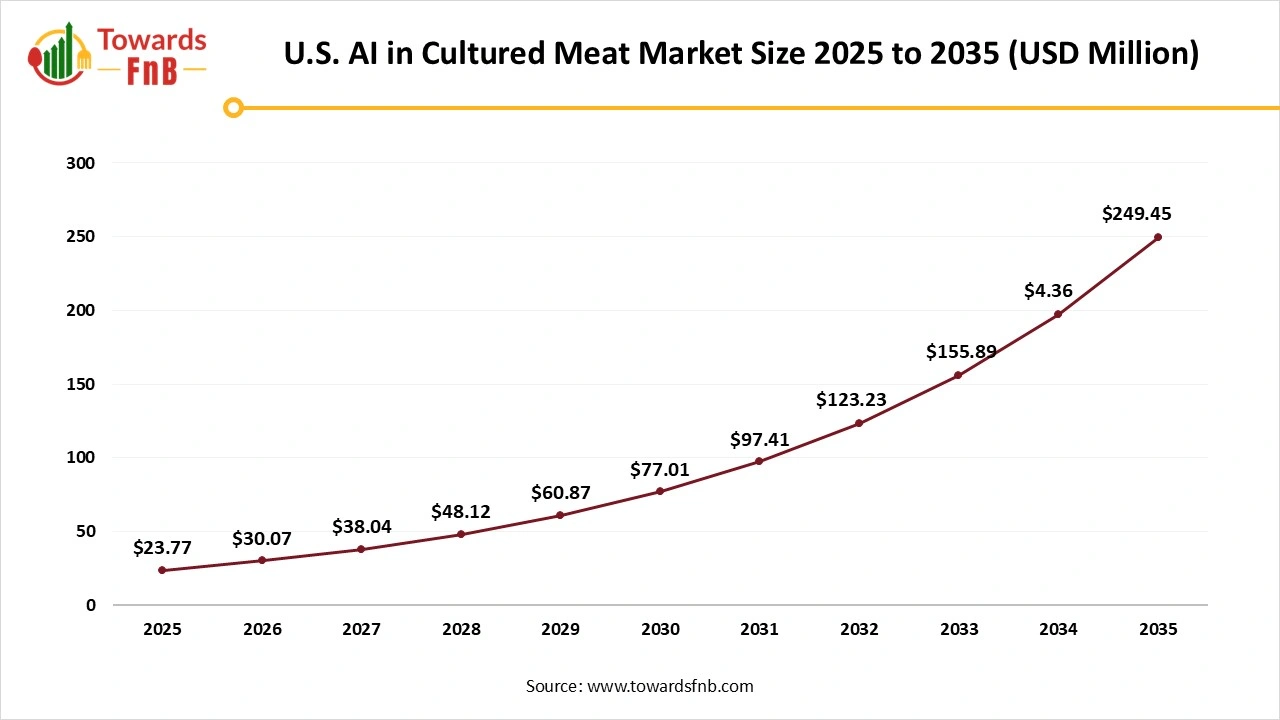
The U.S. AI in cultured meat market size estimated at USD 23.77 million in 2025 and is predicted to increase from USD 30.07 million in 2026 to nearly reaching USD 249.45 million by 2035, growing at a CAGR of 26.5% during the forecast period from 2026 to 2035.
Asia Pacific Expects the Fastest Growth During the Forecast Period
The area's significant and increasing population, along with urban growth and higher disposable incomes, has resulted in a spike in protein demand. Cultured meat provides an eco-friendly alternative to satisfy this need, alleviating the pressure on conventional animal agriculture. AI is being utilized to address the main issues of cost and scalability in cultured meat production. The Asia-Pacific area has emerged as a center for technological innovations, especially in AI and biotechnology. This knowledge is being utilized in the cultured meat industry. China is making substantial investments in cultured meat research and development to tackle food security challenges and lessen the ecological effects of its large meat industry.
India AI in Cultured Meat Market Trends
In India’s cultured meat market, AI is still emerging but has begun to influence the nascent industry by supporting technology-driven startups and research initiatives focused on sustainable protein alternatives. Indian companies like Biokraft Foods and ClearMeat are pioneering cultivated meat technologies, such as 3D bioprinting and advanced cell culture methods, to produce lab-grown chicken and other meat products without traditional animal slaughter, reflecting a broader move toward biotech innovations in food systems.
In Europe’s cultured meat market, artificial intelligence (AI) is beginning to play a role within a region that combines strong scientific research with complex regulatory challenges. European countries such as the Netherlands, Germany, Spain and the UK are hubs of cellular agriculture innovation, with companies and research institutions developing technologies for cell lines, scaffolds and bioprocessing that could benefit from AI-driven optimisation and automation, even though detailed AI adoption data is still emerging.
Germany AI in Cultured Meat Market Trends
In Germany’s AI in cultured meat market, AI applications are still at an early stage but are increasingly seen as a key tool to improve research, development and production efficiency especially within the broader field of cellular agriculture and food technology innovation. German research institutions like the Technical University of Munich and other universities are exploring advanced modelling and biological optimisation techniques that could involve AI to predict optimal conditions for cell growth, nutrient diffusion and scaffold design, linking mathematical models with machine-learning approaches to enhance cultured tissue development.
Middle East & Africa Expects the Substantial Growth in the Market
The overall cultured meat market in the Middle East & Africa is expanding from a small base, driven by food security concerns, high meat import dependence, and growing investment in sustainable food technologies, with countries like the UAE, Saudi Arabia, South Africa, Egypt and Nigeria projected to see significant market growth in the coming decade. While specific AI applications in cultured meat production in this region are not widely documented yet, global market reports include the Middle East and Africa as a segment in AI in cultured meat forecasts, indicating anticipated adoption of AI technologies such as machine learning for process optimization, bioreactor control and quality monitoring as companies scale.
UAE AI in Cultured Meat Market Trends
In the United Arab Emirates (UAE), AI’s influence on the cultured meat sector is indirect but poised to grow as part of the broader push toward high-tech food innovation and sustainable protein production. The UAE particularly. Abu Dhabi is actively developing a regulatory framework for novel foods such as cultured meat and other advanced protein technologies, aiming to streamline approvals and attract investment in biotechnology and food tech innovations.
In South America, the AI in cultured meat sector is still at an early and emerging stage, with the region showing growing interest in alternative proteins but relatively limited documented use of AI specifically in cultured meat production so far. Countries like Brazil and Argentina are pioneering cultured meat research and prototype development. Brazil’s Embrapa has been developing lab-grown chicken products as part of broader innovation efforts in alternative proteins, and there is growing exploration of policies to support novel food technologies.
Brazil AI in Cultured Meat Market Trends
In Brazil’s cultured meat market, AI’s role is still emerging and not yet widely documented, but the country is becoming a significant centre for cellular agriculture research and development that could increasingly integrate AI-driven tools. Brazil’s national agricultural research corporation Embrapa and several universities are pioneering lab-based production of cultured chicken and other alternative proteins, advancing tissue engineering and bioreactor experimentation to create meat analogues under controlled conditions.
AI in Cultured Meat Market Share, By Application, 2025 (%)
| Segments | Shares (%) |
| Cell Line Development & Optimization | 19% |
| Culture Media Formulation | 30% |
| Bioprocess Monitoring & Control | 10% |
| Quality Assurance & Safety Testing | 10% |
| Product Design & Texture Simulation | 15% |
| Supply Chain & Commercialization | 15% |
Which Application Segment Dominated the AI In Cultured Meat Market in 2025?
Culture media formulation segment led the AI in cultured meat market in 2025, since it tackles the most significant obstacle in the industry: the excessively high expense of cell growth media. Artificial intelligence is crucial for addressing the intricate, multi-dimensional challenge of developing cost-effective, animal-free, and efficient media that can be produced at an industrial scale. Predictive analytics powered by AI can significantly reduce the research and development time for new media formulations. Machine learning models examine extensive datasets from previous experiments to forecast the ideal mix of nutrients and growth factors for particular cell lines.
Bioprocess Monitoring & Control Segment is Observed to Grow at the Fastest Rate During the Forecast Period.
Because it is crucial for increasing production, maintaining consistent quality, and enhancing efficiency by utilizing AI to oversee the complex cellular growth environment. Sensors powered by AI and automation allow for instantaneous modifications to essential bioprocess parameters, enhancing cell growth, nutrient supply, and waste elimination, which are crucial for realizing economical and large-scale production of cultured meat.
Which Technology Segment Held the Largest Share of the AI In Cultured Meat Market in 2025?
Machine learning segment held the dominating share of the AI in cultured meat market in 2025. Due to its exceptional capabilities to address the core biological and engineering issues necessary for extensive, economical manufacturing. ML examines intricate omics datasets (genomics, proteomics) to determine the best cell lines and create specific, animal-free growth media. This removes the requirement for costly, variable animal-sourced serum and speeds up the creation of effective, sustainable formulations. Computer vision, a type of machine learning, is utilized for automated quality assessment by examining images of food items.
Digital Twins Segment is Seen to Grow at a Notable Rate During the Predicted Timeframe.
Digital twins can replicate the impact of various nutrients and growth factors to identify the most effective and cost-efficient cell culture media combinations. Businesses can utilize a digital twin to simulate and optimize factors such as temperature, pH, and oxygen concentrations to enhance cell production and reduce resource consumption. Through the simulation of the complete bioprocess, from sourcing cells to harvesting, digital twins recognize and eliminate bottlenecks to enhance manufacturing efficiency and minimize waste.
AI in Cultured Meat Market Share, By End User, 2025 (%)
| Segments | Shares (%) |
| Cultured Meat Startups | 40% |
| Food & Beverage Companies | 25% |
| Biotechnology & Life Science Firms | 15% |
| Academic & Research Institutes | 10% |
| Government & Regulatory Bodies | 10% |
Which End User Segment Dominated the AI In Cultured Meat Market in 2025?
Cultured meat startups segment dominated the market with the largest share in 2025, due to their flexibility, capacity to promote innovation, and emphasis on advancing core technologies that utilize AI for improved efficiency. AI is utilized in the cultured meat sector to improve its production, effectiveness, quality, and scalability. AI and machine learning are vital instruments for enhancing growth media, simplifying bioprocesses, elevating quality control, identifying contamination, and lowering manufacturing expenses, all of which are vital for ensuring lab-grown meat is a practical and sustainable substitute for conventional meat.
Food & Beverage Companies Segment is Expected to Grow at the Fastest Rate in the Market During the Forecast Period.
The food and beverages sector is fueled by a rising worldwide need for sustainable, ethical, and nutritious food options. AI in this area directly tackles these issues by promoting the broad commercialization of cultured meat. AI aids in regulating the makeup and framework of lab-grown meat by accurately blending ingredients and enhancing cell development, enabling the production of functional food and tailored dietary items.
Why did the Poultry Segment Dominate the AI in Cultured Meat Market?
Poultry segment held the largest share of the market in 2025, because of the increased worldwide demand for chicken and its less complex cellular structure, which allows for more efficient growth in laboratory environments. The extensive utilization of chicken items in fast food establishments, such as nuggets and burgers, has led producers to create novel cultivated substitutes to satisfy upcoming demand. The current affordability of poultry meat also affects the expansion of the cultivated poultry market. An increasing number of startups and established businesses are putting money into cellular agriculture technology and exploring the creation of cultivated poultry products.
Seafood Segment is Observed to Grow at the Fastest Rate During the Forecast Period.
Attributed to AI's exceptional capability to mimic the intricate environmental conditions required for marine organisms. In contrast to cultured beef or chicken, numerous aquatic species necessitate very specific and meticulously regulated environments, a difficulty that AI can handle with remarkable accuracy. Fish cells typically exhibit superior resilience and stability, managing changes in oxygen and pH levels more effectively than mammalian cells.
AI in Cultured Meat Market Share, By End User, 2025 (%)
| Segments | Shares (%) |
| On-Premises AI Solutions | 30% |
| Cloud-Based AI Platforms | 50% |
| Hybrid AI Systems | 20% |
Which Deployment Model Dominated AI in Cultured Meat Market in 2025?
Cloud-based AI platforms segment dominated the market in 2025, due to their scalability, cost-effectiveness, and flexibility, which are crucial for the fast-evolving production technologies. AI in the cloud enables startups to develop digital twins of biological systems to conduct virtual experiments and enhance processes without the costs and time associated with traditional laboratory work. Cloud platforms provide robust AI technologies to small and medium-sized enterprises (SMEs) and startups that lack the funding for expensive upfront investments in on-premise infrastructure.
Hybrid AI Systems Segment is Seen to Grow at a Notable Rate During the Predicted Timeframe.
Rather than concentrating on one problem, hybrid AI combines various technologies to develop a smart factory capable of controlling all production phases with little human involvement. Hybrid AI enables accurate bio-printing and scaffolding to mimic the texture of traditional meat, tackling a crucial obstacle for consumer acceptance. Hybrid AI integrates various AI technologies to develop more thorough and efficient solutions for these intricate issues.
By Application
By Technology
By End-User
By Meat Type
By Deployment Model
By Region





Principal Consultant
Vidyesh Swar, Senior Research Analyst at Towards Food & Beverages, specializes in market research, focusing on supply-demand evaluation, pricing analysis, alternative proteins, plant-based foods, and sustainable food technologies within the industry.
Learn more about Vidyesh Swar
Reviewed By
Aditi Shivarkar, with 14+ years in Food and Beverages market research, specializes in food, beverage, and eco-friendly packaging. She ensures accurate, actionable insights, driving Towards FnB's excellence in industry trends and sustainability.
Learn more about Aditi ShivarkarApril 2026
April 2026
April 2026
April 2026

AI in Cultured Meat Market


 +1 804-441-9344
 Download Sample
 Schedule a Meeting