April 2026



The global beef market size was calculated at USD 579.16 billion in 2025 and is forecast to rise from USD 604.06 billion in 2026 to approximately USD 882.35 billion by 2035, with a CAGR of 4.3% during the forecast period from 2026 to 2035. Increasing demand for the high-quality protein for health management majorly contributing for the market growth.

| Study Coverage | Details |
| Growth Rate from 2026 to 2035 | CAGR of 4.3% |
| Market Size in 2026 | USD 604.06 Billion |
| Market Size in 2027 | USD 630.04 Billion |
| Market Size by 2035 | USD 882.35 Billion |
| Largest Market | Asia Pacific |
| Base Year | 2025 |
| Forecast Period | 2026 to 2035 |
| Regions Covered | North America, Europe, Asia-Pacific, Latin America, and Middle East & Africa |
Beef is obtained from the completely grown and developed cattle; beef market encompasses of supply and production of beef. Customers from Generation X and Millennials are contributing the market by demanding for easy and instant protein. Hectic schedules and health consciousness and fitness of consumers look for the instant and protein-loaded option. Suitable beef-derived products such as beef jerky or protein bar, ready to eat meals completing the need of protein conveniently. This demand for easy and suited protein sources is the significant driving factor for the market expansion. Rapid urbanization and development in developing countries, increased net income, rising population rising the demand of protein for complete nutrition. Expansion food sector, increasing number of restaurants and café, rising demand for quick foods, collectively, all these factors are contributing to the growth of beef production and market.
Beef producers employ targeted production methods to address environmental and weather-related issues. These methods encompass a range of management approaches, distinct production systems, and technologies aimed at improving beef production. Lately, the livestock sector has started incorporating advanced technological tools into production workflows to enhance resource management. This technology, referred to as precision livestock farming, encompasses sensors, big data analytics, blockchain technology, and robotics. Precision agriculture instruments like GPS-guided machinery and data analytics enhance cattle farming methods. Blockchain technology enhances traceability, guaranteeing food safety, benefiting the beef market expansion.
Consumers preference for the plant based vegan food due to environmental concern and animal welfare hindering the demand for beef. Because of the shrinkage of beef heard, ongoing drought, increased producer input costs, supply chain problems, declining the supply of the beef from manufacturers and leads to the increased product cost. Recently, fertilizer, vaccines, and cattle identification products, also affected by the disruption of supply chain.
Production
Processing of beef
Distribution & Sales
Asia Pacific Segment Held the Dominating Share of the Beef Market in 2025
In recent years, the region went through swift industrialization and urbanization, because of that net income of the population increased substantially. This resulted in augmented need for protein-loaded, high-standard, and nutritious meat products. Advancements in beef supply chain networks contributing to the expansion of the market Asia Pacific region. The producers have saw significant influx of funding in novel agriculture methods, with producers choosing advanced breeding methods and automated feeding systems. These technological developments in beef industries boosting the market.
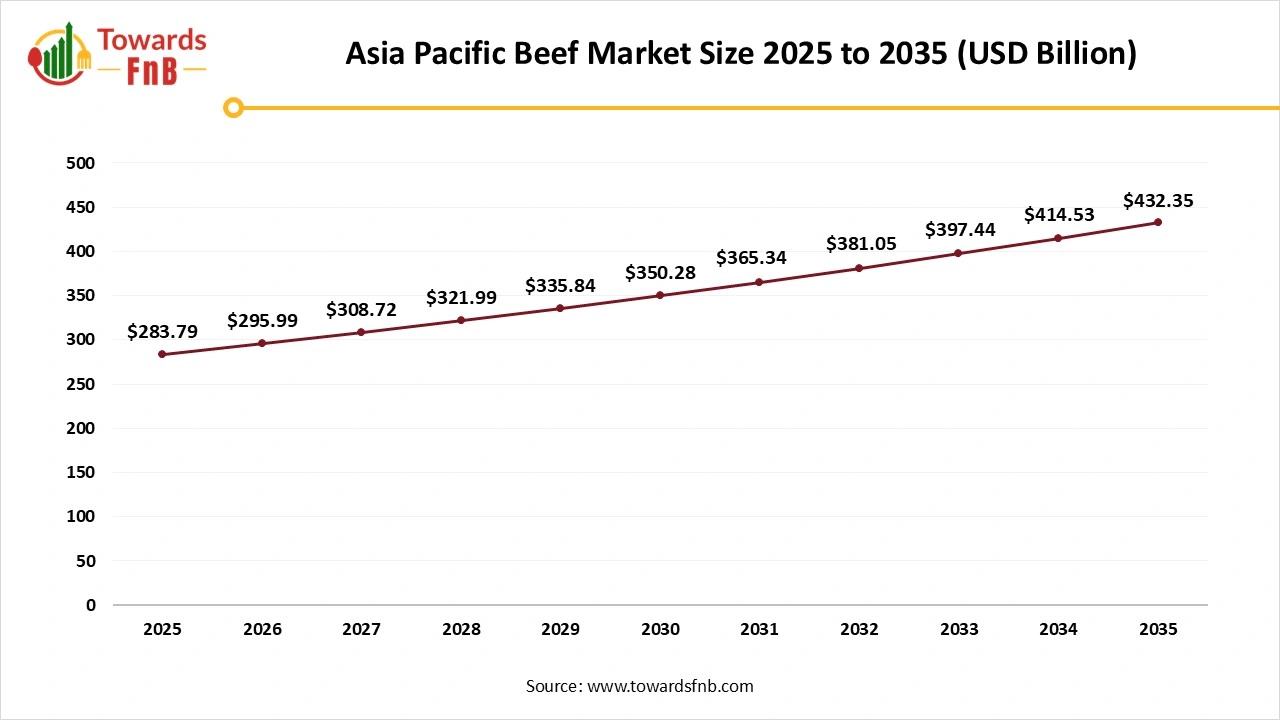
The Asia Pacific beef market size was calculated at USD 283.79 billion in 2025 and is forecast to rise from USD 295.99 billion in 2026 to approximately USD 432.35 billion by 2035, with a CAGR of 4.3% during the forecast period from 2026 to 2035.
Indian Beef Market Trends
India is the second-largest country, leading the regional market, driven by its large domestic livestock population, robust government support policies, and growing demand for beef as a cost-effective protein source across a health-conscious consumer base.
According to the United States Department of Agriculture (USDA) prediction, India is expected to increase its beef, specifically carabeef production and export in 2025, driven by the Indian government's policy support, spurring domestic and global demands. In 2025, the number of bovine cattle, Bos taurus and Bos indicus, and Asian domestic water buffalo, Bubalus bubalis, was 307.5 million in India. (Source: The New Indian Express)
Emerging Beef Market of China
Third largest beef producer globally is China and is the biggest producer in Asia. Beef cattle production is the conventional activity of the China and is the vital component for the economical development. China’s market growth is attributed to the rapid urbanization and development, consumers preference for western foods and import of beef. The recent data from 2023 found that about of 1.8 million tonnes of fresh and frozen beef was imported from China. There was 6% rise in comparison with the year 2022.
North America Beef Market is Observed to Grow at the Fastest Rate During the Forecast Period
Beef production in North America, especially in the Canada and United, is distinguished by three main constituents including cow-calf, stocker, and feedlot operations. There is increasing attentiveness among beef producers, customers, and other beef supply chain shareholder in attaining considerable sustainability within the industry fostering the market. Additionally, development in technology for beef production, distribution and supply leveraging the market.
U.S. Tariff's Impact on the Beef Market
The US 2026 beef import to 4.95 billion lb in August was revised by the US Department of Agriculture, down 6.1 year over year and 7.5% from its July estimation for US tariffs. The estimation for 2025 beef imports by the USDA was at 5.274 billion lb, decares 103 million lb (1.9%) from its July estimation for MY 2025, but 639 million lb (13.8%) from MY 2024, according to the USDA data. (Source: S&P Global)
Leveraging Beef Market of United States
Beef market of the United States is expanding, which is attributed to the increased demand of protein, convenient and ready to eat food, increased working population, and expanding food sector. Furthermore, various initiative and subsidies provided by the welfare of the livestock commodities boosting the market. From 2018 to 2023, the U.S. Department of Agriculture distributed $12.1 billion in total assistance to the leading 10,000 agricultural producers, recognized as those receiving the most federal financial aid, managing livestock feeding operations across the U.S. During this period, dairy, hogs, and beef cattle were the three main categories receiving livestock feeding assistance. The USDA projected an increase in beef production to 4.64 million metric tons (MMT) in 2024, up from 4.57 MMT, and forecasts exports to rise to 1.64 MMT, an increase from 1.56 MMT in 2023.
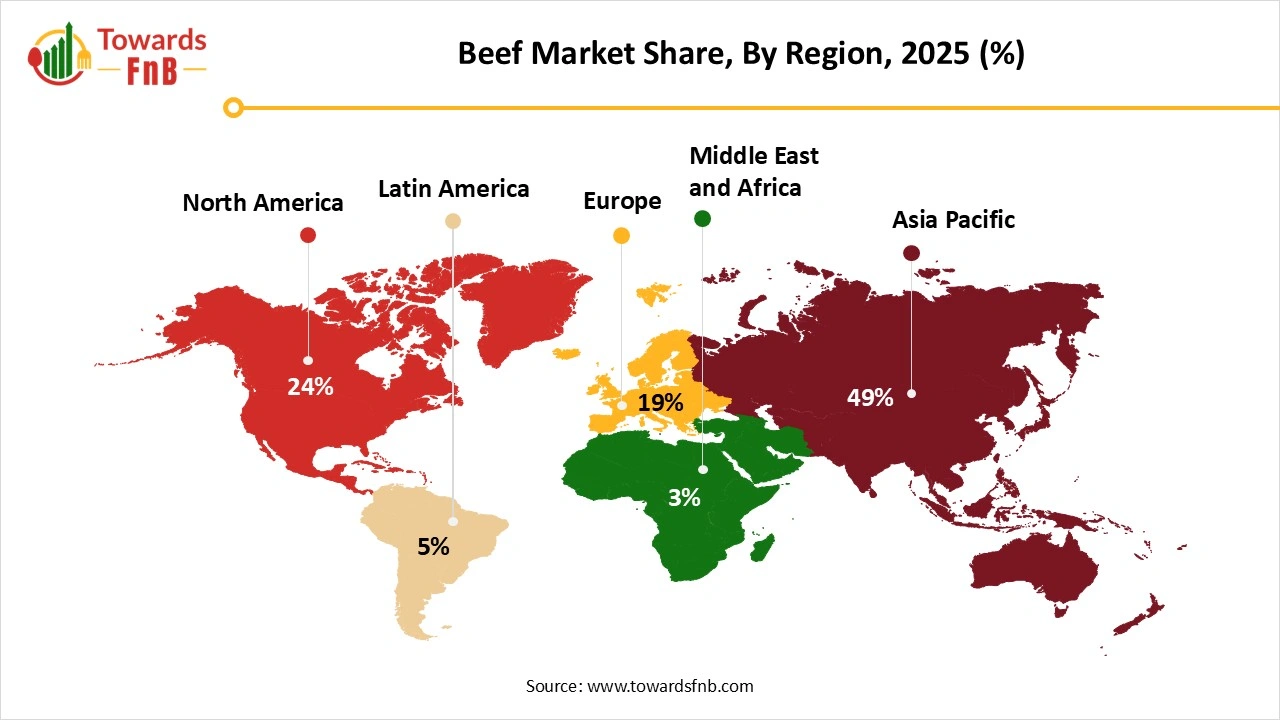
The European beef market presents considerable growth opportunities driven by several factors. Shifting consumer preferences towards high-quality, organic, and sustainably sourced beef products are propelling market expansion, as consumers increasingly demand transparency and traceability in their food choices. Furthermore, the growing awareness of the health benefits associated with protein-rich diets is enhancing demand for beef products, which are renowned for their rich nutrient content, including protein, iron, and vitamins.
In Germany, the beef market is experiencing growth fueled by consumer demand for premium, organic, and sustainably sourced beef, as well as ethical and environmental concerns. The nation’s strong culinary tradition for quality meat is supported by technological advancements in traceability and efficient supply chains. Nevertheless, the market faces challenges from plant-based alternatives and prevailing health trends. Rising disposable incomes and the expansion of e-commerce are also contributing to the demand for high-quality, convenient beef products, while local farming practices and governmental support promote organic growth.
The beef market in the Middle East and Africa (MEA) is expanding due to increasing disposable incomes, population growth, urbanization, and Western dietary influences, resulting in heightened demand for protein-rich foods and premium cuts, such as Wagyu beef. Key growth drivers include a flourishing tourism and hospitality sector that requires a diverse range of beef options, a growing demand for convenience in processed and frozen foods, and technological advancements in production that collectively enhance consumption across the region.
In the United Arab Emirates (UAE), the beef market is significantly influenced by a growing expatriate population, an increasing demand for premium meat products, and a rising consumer interest in protein-rich diets. The expansion of contemporary retail and foodservice industries, which offer a variety of international and halal-certified beef options, further supports market growth.
The South American beef market is currently experiencing steady growth, propelled by robust domestic demand, cultural significance, rising income levels, and enhanced export opportunities. Beef is an integral dietary staple, with high consumption rates observed in countries such as Brazil and Argentina. This growth is further stimulated by increased incomes and urbanization that lead to a demand for convenient processed products. South America is positioned as a major global beef supplier, expected to control 50% of the world's beef trade within the next five years, owing to its competitiveness and abundant cattle supply.
In Brazil, the beef market is anticipated to undergo rapid growth, primarily driven by record-breaking exports projected for 2025 and 2026. This growth is characterized by significant revenue increases, particularly in exports to China, despite facing global challenges such as tariffs imposed by the United States. Brazil's emerging position as a crucial global supplier amid worldwide shortages is further supported by rising consumer interest in premium cuts, including brisket, and niche segments such as organic and halal-certified beef.
Beef Market Share, By Cut, 2025 (%)
| Segments | Shares (%) |
| Brisket | 23% |
| Shank | 10% |
| Loin | 37% |
| Others | 30% |
Loin Cut Segment Dominated the Beef Market With the Largest Share in 2025
Loin beef portions are derived from the region below the spine. The Loin begins at the hip and consists of the Sirloin, Short Loin, and Tenderloin. Loin beef sections are some of the most flavorful, tender, and juicy. The way consumers perceive beef products is strongly tied to their preferences for certain palatability traits, with tenderness, juiciness, and flavor collectively impacting overall enjoyment.
The Brisket Segment is Seen to Grow at a Notable Rate During the Predicted Timeframe
Brisket is a piece of meat taken from the breast or lower chest of beef or veal. Brisket is not a costly cut. It is, nevertheless, a nutritious one. As brisket has a high amount of connective tissue, it indicates that it is rich in collagen, the body's most prevalent protein. Collagen is essential for maintaining healthy joints and maintaining skin elasticity. Brisket meat contains high amounts of oleic acid. This aids in reducing harmful cholesterol while increasing the levels of the beneficial type. Brisket is loaded with protein. These benefits of brisket boosting the market.
Beef Market Share, By Slaughter Method, 2025 (%)
| Segments | Shares (%) |
| Kosher | 30% |
| Halal | 60% |
| Others | 10% |
Halal Beef Segment Held the Largest Share of the Beef Market in 2025
With the growth of the Muslim community, the need for halal food items, particularly beef, also rises. The focus on humane and ethical treatment of animals is on the rise, and the halal slaughter method, designed to reduce animal suffering, is becoming more acknowledged and accepted. The food market is progressively seeking higher quality, natural, and eco-friendly meat products, which are viewed as healthier than traditional options. Alongside various other alternatives to traditional meat, halal meat is appealing to consumers globally, regardless of their faith. Hence, halal meat and meat products are becoming more accessible in supermarkets and fast-food chains. Like organic meat, halal meat is derived from grass-fed livestock that are not given antibiotics or growth hormones; furthermore, the slaughtering process is more compassionate towards the animals. In general, halal meat production is anticipated to offer superior nutritional value compared to traditional meat, thus delivering considerable health advantages.
Kosher Beef Segment Expected to Grow at the Fastest Rate in the Market During the Forecast Period
For religious reasons, Orthodox Jews exclusively buy meat that has kosher certification. Therefore, the kosher beef market, is important as it caters specifically to this portion of the population. The quality of Kosher products is celebrated globally for being healthy and sustainable, closely linked to the production methods, particularly the slaughtering process, as well as the sanitary and strict conditions in which animals are raised. Ideas like health and sustainability have a significant impact on consumers food selections; in fact, many individuals are attracted to authentic, healthy items like Kosher meat, even if they don't practice Judaism.
Performance Food Group
McDonald’s, and Syngenta North America
Impossible Foods
By Cut
By Slaughter Method
By Region





Principal Consultant
Vidyesh Swar, Senior Research Analyst at Towards Food & Beverages, specializes in market research, focusing on supply-demand evaluation, pricing analysis, alternative proteins, plant-based foods, and sustainable food technologies within the industry.
Learn more about Vidyesh Swar
Reviewed By
Aditi Shivarkar, with 14+ years in Food and Beverages market research, specializes in food, beverage, and eco-friendly packaging. She ensures accurate, actionable insights, driving Towards FnB's excellence in industry trends and sustainability.
Learn more about Aditi ShivarkarApril 2026
April 2026
April 2026
April 2026

Beef Market


 +1 804-441-9344
 Download Sample
 Schedule a Meeting