April 2026



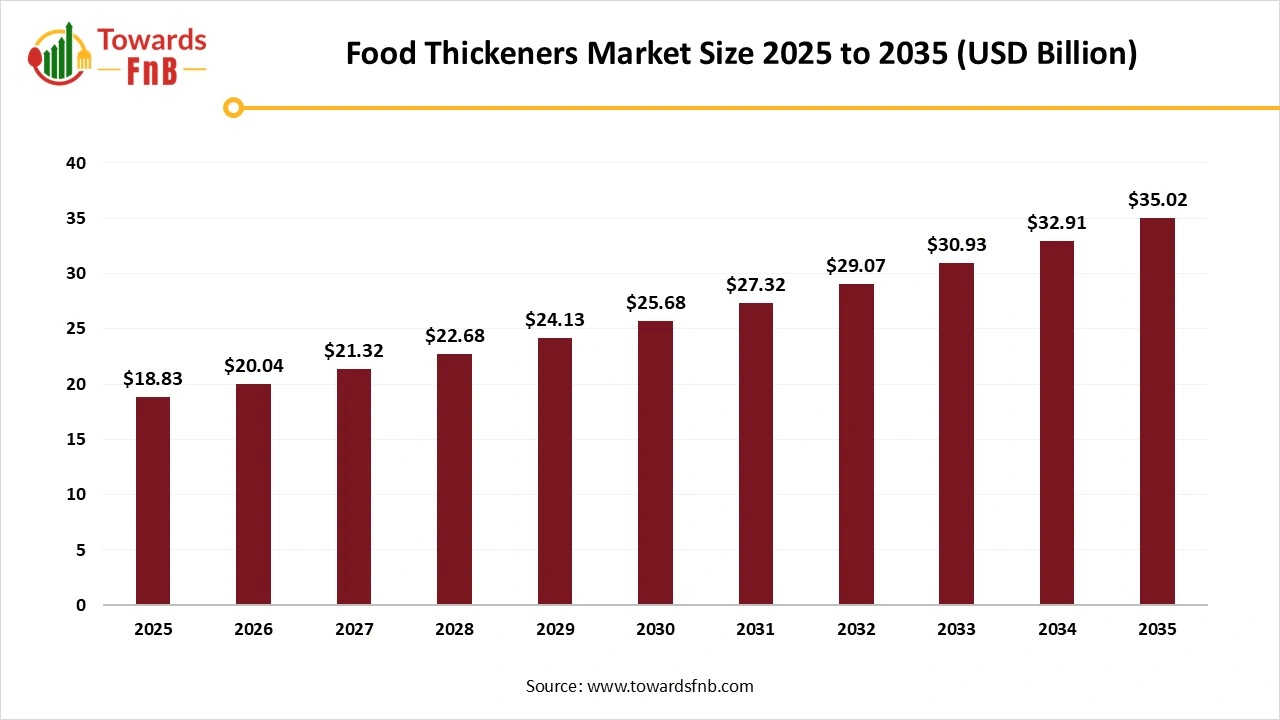
The global food thickeners market size was valued at USD 18.83 billion in 2025 and is expected to grow steadily from USD 20.04 billion in 2026 to reach nearly USD 35.02 billion by 2035, with a CAGR of 6.4% during the forecast period from 2026 to 2035. The market is growing due to rising demand for convenience foods, clean-label ingredients, and texture-enhanced products in processed and functional foods.
| Study Coverage | Details |
| Growth Rate from 2026 to 2035 | CAGR of 6.4% |
| Market Size in 2026 | USD 20.04 Billion |
| Market Size in 2027 | USD 21.32 Billion |
| Market Size by 2035 | USD 35.02 Billion |
| Largest Market | North America |
| Base Year | 2025 |
| Forecast Period | 2026 to 2035 |
| Regions Covered | North America, Europe, Asia-Pacific, Latin America, and Middle East & Africa |
Food thickeners are ingredients used to increase the thickness, stability, and texture of food and beverages without altering their flavor. The food thickeners market is growing due to increasing demand for processed and convenience food, rising consumption of bakery and dairy products, and growing awareness of texture and mouthfeel in foods. Additionally, the shift toward clean-label, plant-based, and gluten-free ingredients, along with expanding applications in sauces, soups, beverages, and infant nutrition, is further driving market growth globally.
Technological advancements in food thickeners include the development of enzyme-modified starches, multifunctional hydrocolloids, and improved extraction techniques that enhance stability, heat resistance, and texture. Innovations also focus on clean-label formulations, reduced usage levels, and better performance in low-fat, sugar-reduced, and plant-based food products.
World Bakery Products Export Trends (USA billions)
| Year | Exported Value |
| 2020 | 38.05 |
| 2021 | 44.37 |
| 2022 | 49.03 |
| 2023 | 56.7 |
| 2024 | 54.4 |
World Bakery Products Import Trends (USA billions) (Source: mofpi)
| Year | Imported Value |
| 2020 | 38.77 |
| 2021 | 44.4 |
| 2022 | 49.92 |
| 2023 | 56.9 |
| 2024 | 56.1 |
Raw Material Procurement (Farms, Fisheries, etc.)
Processing and Preservation
Packaging and Branding
What Made the North America Region Dominant in the Food Thickeners Market?
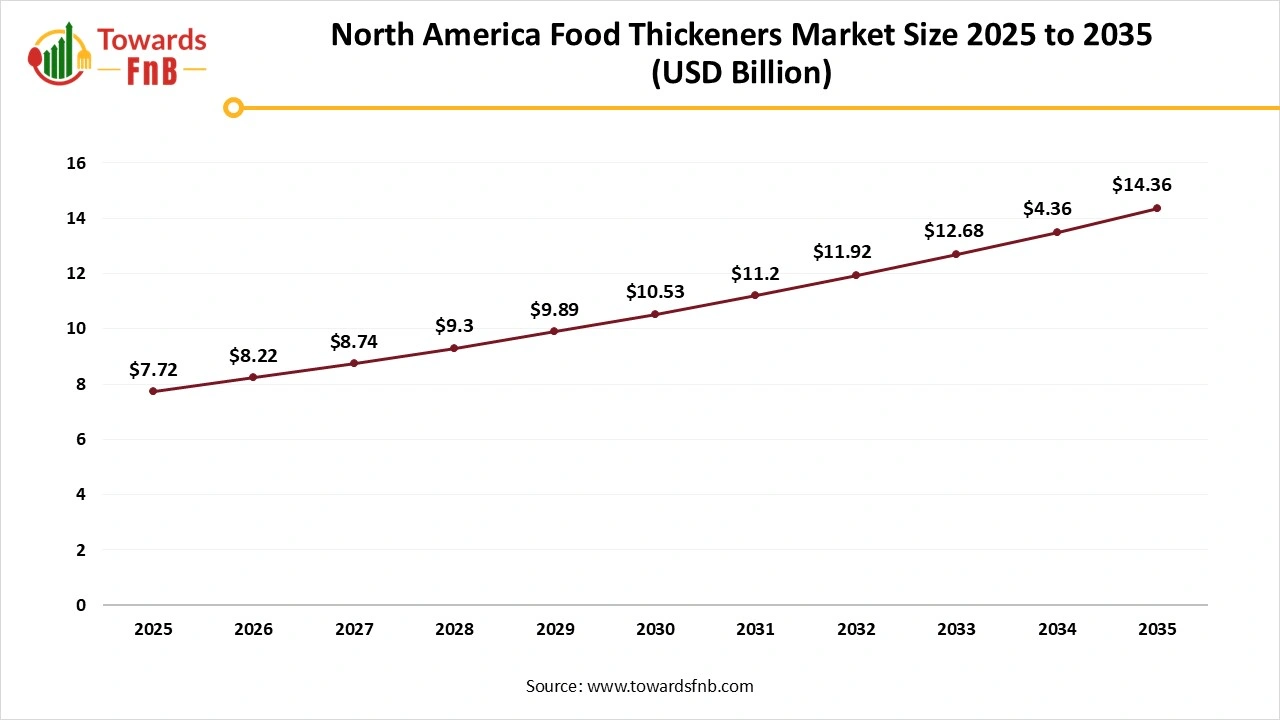
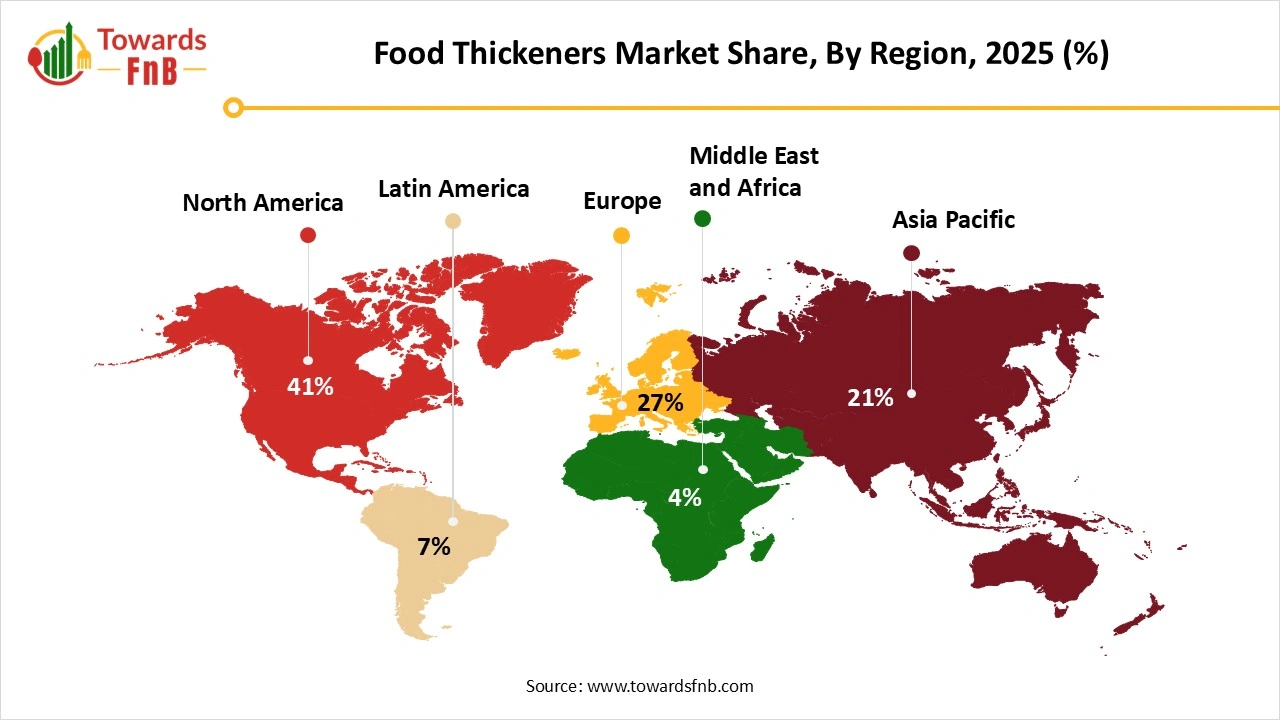
North America dominated the global market in 2025 due to its well-established food processing industry and high consumption of processed, convenience, and ready-to-drink products. Strong demand for clean-label, functional, and protein-enriched foods, along with advanced manufacturing capabilities and the presence of major ingredient suppliers, supported widespread adoption of food thickeners across beverages, sauces, dairy, and bakery applications in the region.
The North America food thickeners market size reached at USD 7.72 billion in 2025 and is anticipated to increase from USD 8.22 billion in 2026 to an estimated USD 34.36 billion by 2035, witnessing a CAGR of 6.4% during the forecast period from 2026 to 2035.
Innovation-Driven Demand Shaping the U.S. Food Thickeners Market
The U.S. market is expanding due to the rapid growth of foodservice chains and home meal replacements, increasing use of thickeners in specialty nutrition and medical foods, and rising demand for texture control in low-sugar and low-fat formulations. Additionally, advancements in ingredient technology and strong investment in product customization for diverse consumer preferences are accelerating market growth across the U.S.
How Big is the U.S. Food Thickeners Market?
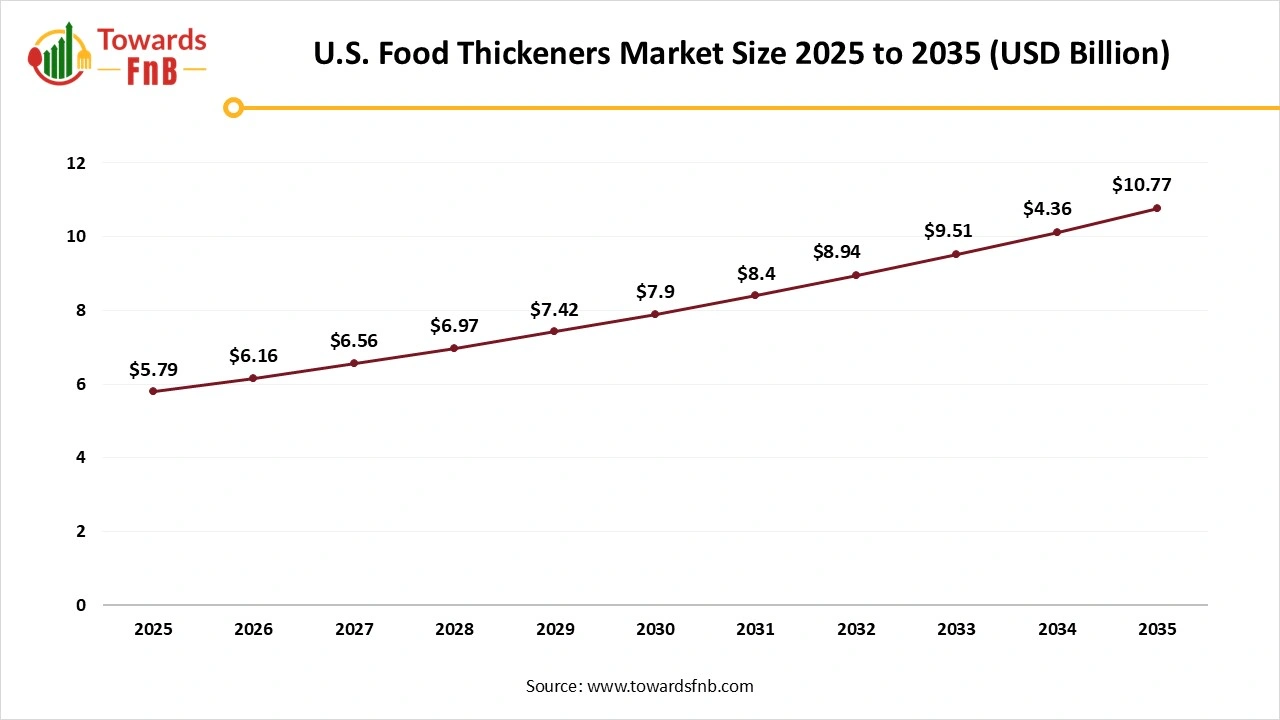
The U.S. food thickeners market size was calculated at USD 5.79 billion in 2025 with projections indicating a rise from USD 6.16 billion in 2026 to approximately USD 10.77 billion by 2035, expanding at a CAGR of 6.4% throughout the forecast period from 2026 to 2035.
A High-Growth Hub Powered by Changing Diets and Rapid Urbanization
Asia Pacific is anticipated to grow at the fastest CAGR during the forecast period due to rapid urbanization, rising disposable incomes, and changing dietary habits. Increasing consumption of processed food, ready-to-drink beverages, and convenience meals, along with the expansion of food manufacturing capacities and local ingredient production, is driving demand. Additionally, growing awareness of texture, quality, and shelf life in packaged food is accelerating market growth across the region.
Rising Appetite for Texture in India’s Expanding Packaged Food Sector
The India food thickeners market is growing due to the rapid expansion of the packaged food and beverage sector, increasing demand for ready-to-cook sauces, dairy products, and beverages, and rising adoption of clean-label and plant-based ingredients. Additionally, growth in food processing infrastructure, quick service restaurants, and regional cuisine commercialization, along with higher consumer awareness of texture and product consistency, is supporting steady market expansion across the country.
Clean-label Leadership Fueling Europe’s Food Thickeners Expansion
The Europe food thickeners market is growing significantly due to strong demand for clean-label, organic, and sustainably sourced ingredients across food and beverage products. Strict food quality regulations encourage the use of natural texture-enhancing agents. In addition, rising consumption of bakery, dairy alternatives, sauces, and functional food, along with advanced food processing technologies and innovation by regional manufacturers, is supporting steady market growth across Europe.
Precision, Quality, and Consistency Driving Germany’s Market Growth
The Germany market is growing as food manufacturers focus on improving texture, stability, and shelf life in packaged foods. Rising preferences for natural, vegan, and clean label ingredients s boosting demand for plant-based thickeners. Additionally, increased consumption of ready to eat meals, strong domestic food processing capabilities, and continuous product innovation are contributing to sustained market expansion.
Shelf-Life Solutions Gaining Momentum Across MEA Markets
The Middle East and Africa food thickeners market is increasing due to growing consumption of packaged foods, sauces, and beverages driven by urbanization and changing lifestyles. Expansion of the hospitality and food service sectors, rising demand for longer shelf-life products in hot climates, and increasing investment in local food processing and imports of specialty ingredients are supporting steady market growth across the region.
Vision 2030: Accelerating Demand For Advanced Food Ingredients
The Saudi Arabia food thickeners market is expanding due to rising demand for processed and convenience foods, supported by a growing urban population and busy lifestyles. Increased investments in domestic food manufacturing under Vision 2030, expanding foodservice and hospitality sectors, and higher consumption of sauces, beverages, and dairy products are boosting the use of food thickeners to enhance texture, stability, and shelf life.
Export-Focused Food Manufacturing Boosting Regional Growth
The South America food thickeners market is growing as regional producers increasingly use thickeners to improve product consistency and export quality. Expanding private-label food production, rising use of thickeners in bakery, confectionery, and dairy formulations, and ongoing investments in processing efficiency and shelf-life enhancement are further supporting market expansion across South American countries.
Agriculture Strength Supporting Brazil’s Rising Use of Food Thickeners
The Brazil food thickeners market is increasing due to the rising production of processed foods, beverages, and dairy products for both domestic consumption and exports. Growing demand for cost-efficient formulation solutions, increased use of thickeners in sauces, confectionery, and bakery applications, and Brazil’s strong agricultural base supporting starch and gum production are contributing to steady market growth across the country.
Food Thickeners Market Share, By Type, 2025 (%)
| Segments | Shares (%) |
| Protein | 25% |
| Starch | 15% |
| Hydrocolloids | 33% |
| Gelatin | 5% |
| Xanthan Gum | 6% |
| Agar | 4% |
| Pectin | 7% |
| Others | 5% |
Why did the Hydrocolloids Segment Dominate in the Food Thickeners Market in 2025?
The hydrocolloids segment dominated the market in 2025, due to its versatility, excellent water-binding properties, and ability to enhance texture and stability across a wide range of products, including sauces, dairy, bakery, and beverages. Additionally, growing consumer demand for clean-label, plant-based, and low-calorie ingredients further boosted hydrocolloids' adoption, making them a preferred choice for manufacturers aiming to improve mouthfeel, shelf life, and overall product quality.
The Protein Segment is Projected to Grow at the Highest CAGR Between 2026 and 2035.
Due to increasing consumer demand for high-protein, functional, and health-focused products such as beverages, snacks, and dairy alternatives. Rising awareness of muscle health, weight management, and plant-based nutrition, coupled with innovations in protein extraction and formulation, is driving adoption, positioning protein-based thickeners as a key growth area in the food industry.
Food Thickeners Market Share, By Source Type, 2025 (%)
| Segments | Shares (%) |
| Animal | 30% |
| Plant | 60% |
| Microbial | 10% |
What made the Plant Segment Dominant in the Food Thickeners Market in 2025?
The plant-based segment held the largest market share in 2025, due to the growing preference for natural, clean-label, and sustainable ingredients. Derived from sources like corn, guar, locust bean, and seaweed, plant-based thickeners offer excellent texture, stability, and versatility across processed foods, beverages, and dairy products. Additionally, increasing consumer demand for vegan and health-conscious products further strengthened the dominance of plant-derived thickeners in the market.
The Animal Segment is Expected to Grow at a Significant CAGR Between 2026 and 2035.
Due to rising demand for gelatin and other protein-rich thickeners in confectionery, dairy, and pharmaceutical applications. Increased consumer focus on high-protein, functional, and specialty foods, along with the expanding use of animal-derived thickeners for stability, gelling, and texture enhancement, is driving market growth in this segment globally.
Food Thickeners Market Share, By Application, 2025 (%)
| Segments | Shares (%) |
| Bakery | 15% |
| Confectionery | 12% |
| Sauces & Dips | 20% |
| Beverages | 30% |
| Convenience & Processed Food | 15% |
| Others | 8% |
How will the Beverages Segment dominate the Food Thickeners Market in 2025?
The beverages segment dominated the market with the largest revenue share, due to the high demand for ready-to-drink, smoothie, dairy alternatives, and functional beverages. Thickeners improve texture, mouthfeel, stability, and shelf life in these products. Additionally, the growing trends are health-focused, protein-enriched, and plant-based beverages has further driven the adoption of thickeners, making the beverages sector a key revenue contributor in the market.
The Sauce & Dips Segment is Expected to Grow at a Significant CAGR During the Forecast Period.
Due to rising consumer demand for convenient, ready-to-use, and flavorful condiments. Food thickeners enhance texture, consistency, stability, and shelf life in these products. Additionally, the increasing popularity of ethnic cuisines, fast food, and clean-label sauces is driving the adoption of thickeners, making sauces and dips a key growth segment in the market.
By Type
By Source
By Application
By Region





Principal Consultant
Vidyesh Swar, Senior Research Analyst at Towards Food & Beverages, specializes in market research, focusing on supply-demand evaluation, pricing analysis, alternative proteins, plant-based foods, and sustainable food technologies within the industry.
Learn more about Vidyesh Swar
Reviewed By
Aditi Shivarkar, with 14+ years in Food and Beverages market research, specializes in food, beverage, and eco-friendly packaging. She ensures accurate, actionable insights, driving Towards FnB's excellence in industry trends and sustainability.
Learn more about Aditi ShivarkarApril 2026
April 2026
April 2026
April 2026

Food Thickeners Market


 +1 804-441-9344
 Download Sample
 Schedule a Meeting