April 2026



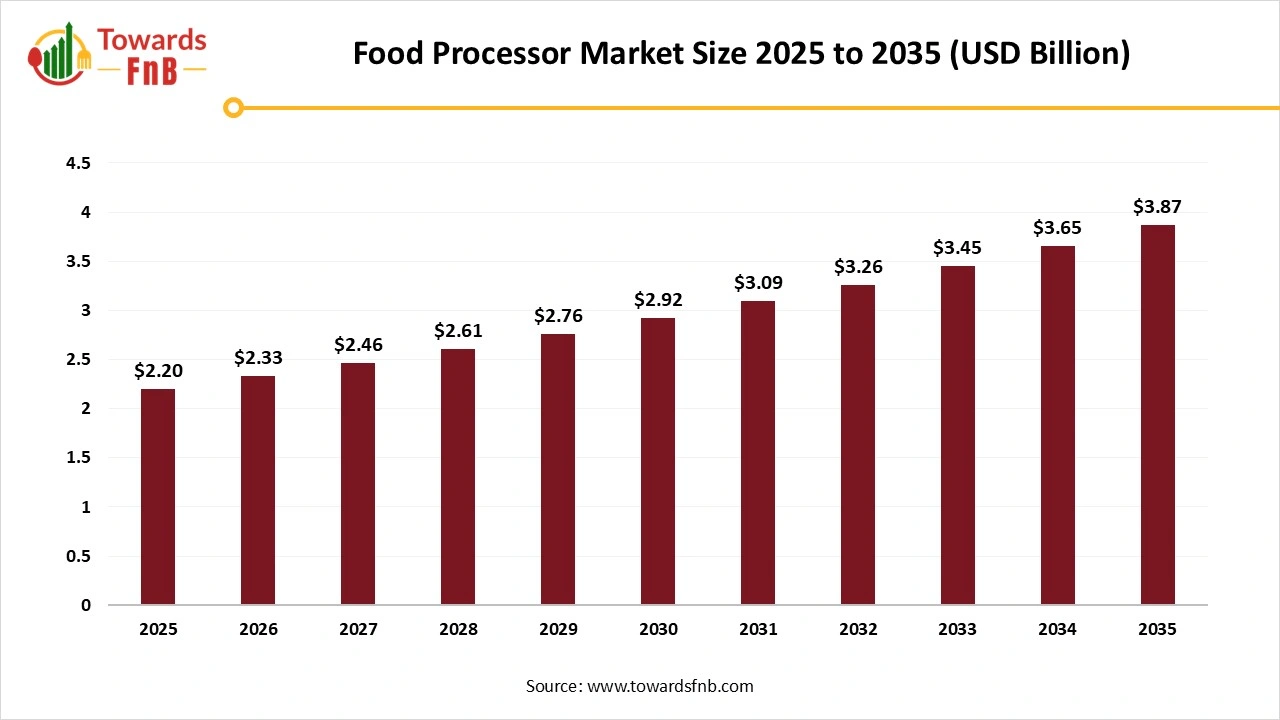
The global food processor market size estimated at USD 2.20 billion in 2025 and is predicted to increase from USD 2.33 billion in 2026 to nearly reaching USD 3.87 billion by 2035, growing at a CAGR of 5.8% during the forecast period from 2026 to 2035. Growing demand for convenience and quick meal solutions, coupled with technological advancements driving the market.
| Study Coverage | Details |
| Growth Rate from 2026 to 2035 | CAGR of 5.8% |
| Market Size in 2026 | USD 2.33 Billion |
| Market Size in 2027 | USD 2.46 Billion |
| Market Size by 2035 | USD 3.87 Billion |
| Largest Market | North America |
| Base Year | 2025 |
| Forecast Period | 2026 to 2035 |
| Regions Covered | North America, Europe, Asia-Pacific, Latin America, and Middle East & Africa |
The food processor market covers electrically powered kitchen appliances designed to perform multiple food preparation tasks such as chopping, slicing, shredding, grinding, blending, kneading, and pureeing. These appliances integrate motors, interchangeable blades, and bowls to reduce manual effort and improve consistency, speed, and hygiene in food preparation. Demand is driven by urban lifestyles, rising home cooking, growing adoption of smart kitchen appliances, and expanding food service establishments across residential and commercial settings.
Recent breakthroughs in food processor technology have genuinely transformed cooking experiences. Improved blade systems, robust motors, intelligent technology, and compact designs have advanced these appliances, rendering them adaptable, efficient, and easy to use. Thanks to these innovative technologies, food processors have become an essential appliance in every contemporary kitchen, making meal prep easier and enabling users to explore their culinary creativity. AI technology can be utilized in the control systems of food processors to attain more accurate and smarter ingredient handling. By using machine learning algorithms, food processors can automatically recognize various ingredients such as vegetables, meat, and fish, and can autonomously modify cutting, grinding, and stirring and other processing methods to meet the user's cooking needs.
Raw Material Sourcing
Production & Manufacturing
Distribution
What Made the North America Region Dominant in the Food Processor Market?
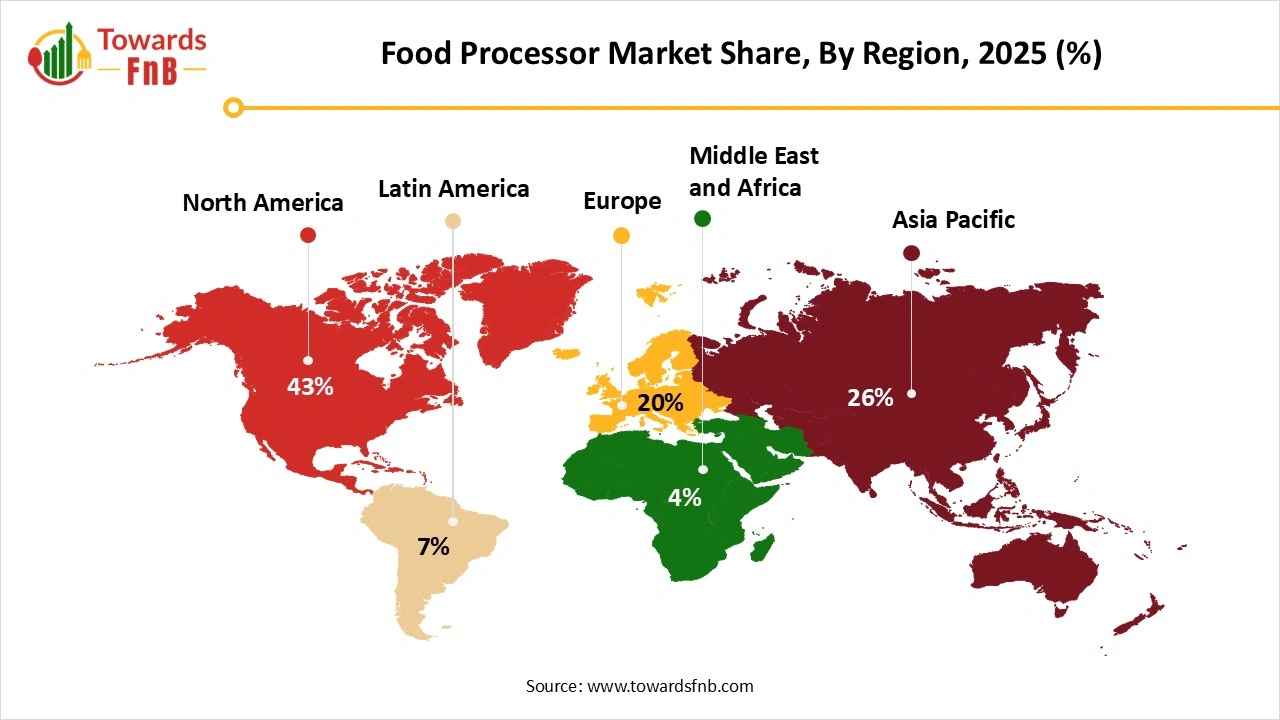
North America dominated the market with 43.4% share in 2025. The expansion of the North America food processor Market can be linked to several reasons. The market growth is primarily driven by the rising consumer demand for efficient kitchen appliances, heightened health awareness, and the increasing trend of home cooking. Multifunctional food processors provide convenience, effectiveness, and adaptability, attracting consumers looking for devices that can perform multiple roles. As shoppers aim to prepare gourmet dishes and drinks at home, versatile food processors are turning into essential kitchen appliances in North American homes.
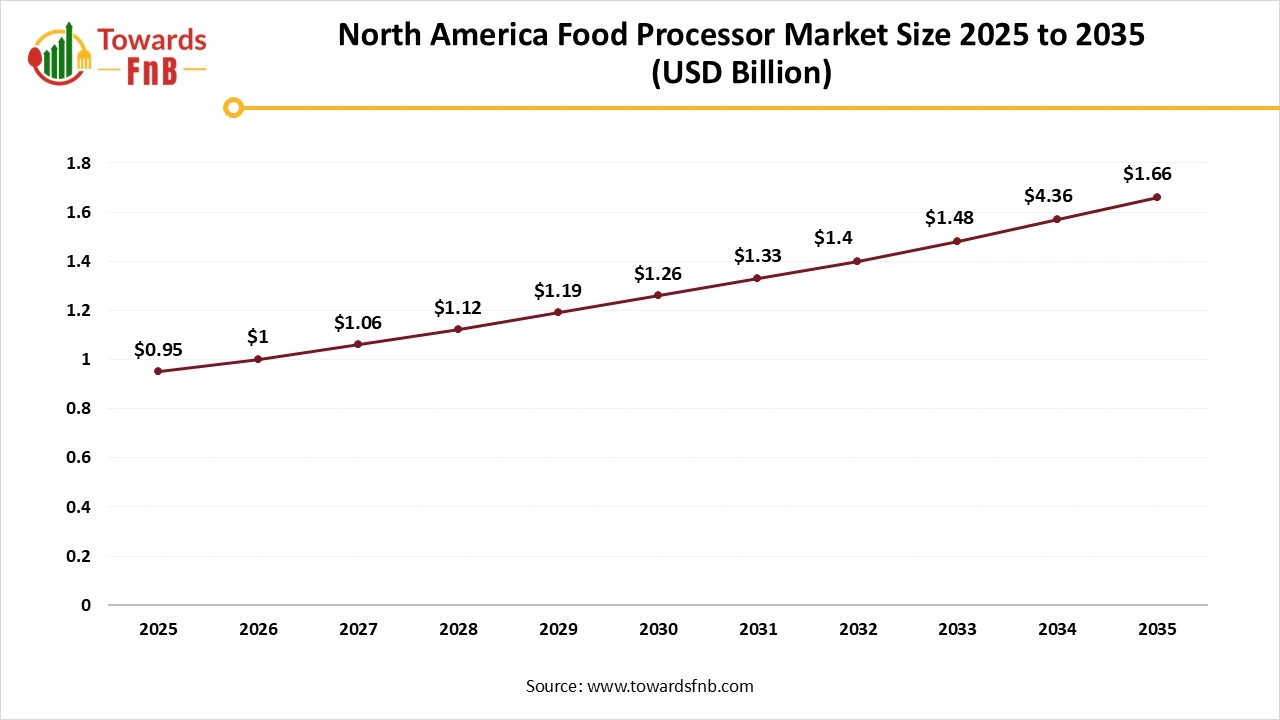
The North America food processor market size was calculated at USD 0.95 billion in 2025 with projections indicating a rise from USD 1 billion in 2026 to approximately USD 1.66 billion by 2035, expanding at a CAGR of 5.8% throughout the forecast period from 2026 to 2035.
U.S. Food Processor Market Expansion
The food processor industry in the United States is greatly impacted by the increasing health and wellness movements among consumers. As people become more aware of their health, there is a growing inclination towards homemade dishes instead of processed items. The demand for convenience-oriented kitchen appliances in the market is seeing a significant increase. With consumers living more hectic lives, the demand for efficient cooking solutions is becoming essential. Food processors provide various functions, enabling users to quickly chop, slice, and puree ingredients. Advancements like smart technology incorporation, better motor performance, and superior blade designs are enhancing the attractiveness of food processors to consumers.
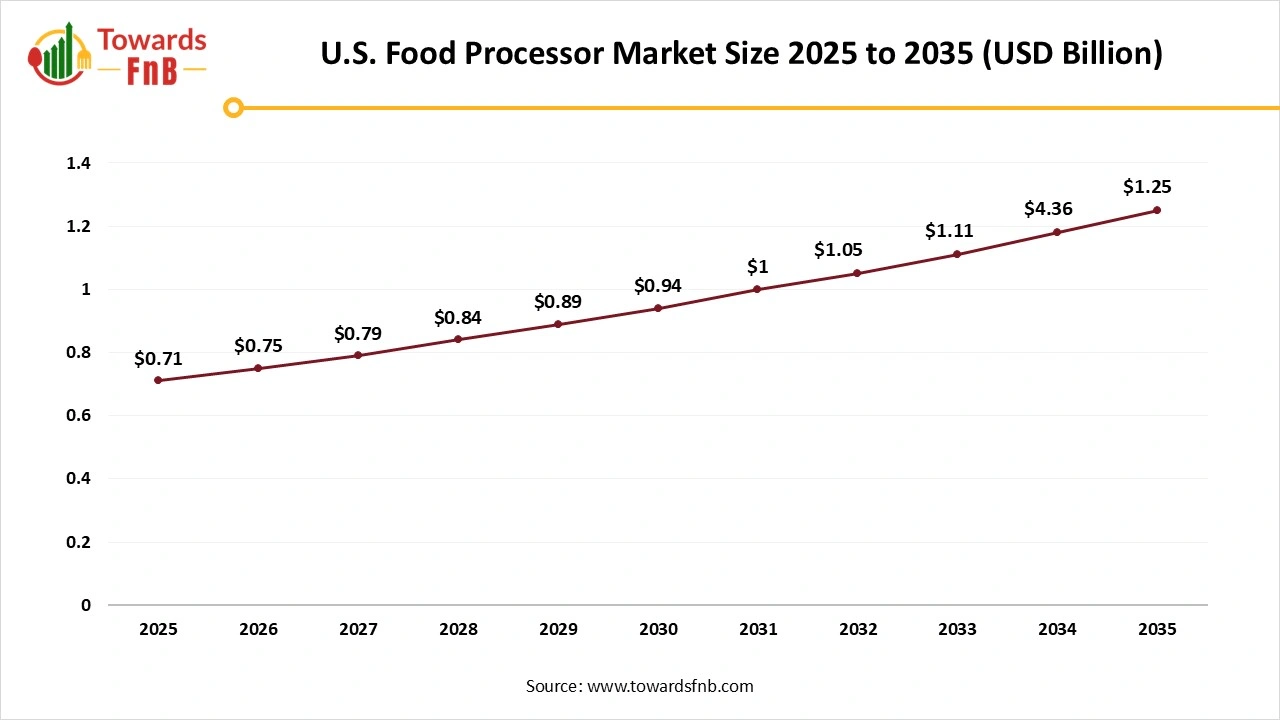
The U.S. food processor market size reached at USD 0.71 billion in 2025 and is anticipated to increase from USD 0.75 billion in 2026 to an estimated USD 1.25 billion by 2035, witnessing a CAGR of 5.8% during the forecast period from 2026 to 2035.
Which is the Fastest-Growing Region in the Food Processor Market?
Asia Pacific expects fastest growth during the forecast period. The market in the Asia Pacific region is mainly propelled by swift urbanization, increasing disposable incomes, and evolving consumer habits that prefer convenience food. The rising demand for packaged and processed food, along with an expanding middle class, drives market growth. Improvements in processing technologies improve product quality and longevity, drawing in additional consumers. Furthermore, the growing retail infrastructure and e-commerce platforms in the region enable broader distribution channels. Government efforts to enhance food safety regulations and invest in food processing facilities also foster growth.
China Food Processor Market Analysis
The swift urban growth in China is a key factor influencing the market. With more people moving to cities, the need for processed food items rises considerably. Rising disposable incomes and evolving lifestyles drive the need for convenience appliances. China ranks among the leading global producers of both industrial and consumer goods. Surpassing all other economies globally, China is the fastest-expanding market for the consumption of goods and services. China ranks among the top exporters of food processors globally, characterized by a robust manufacturing sector and competitive pricing.
What Are the Factors Driving the Food Processor Market in Europe?
The food processor market in Europe has seen notable expansion lately, fueled by rising consumer interest in multifunctional kitchen tools that consolidate various roles into one appliance. As lifestyles grow more hectic and food preferences change, shoppers look for convenient and compact options to effortlessly create a range of meals. The market displays technological progress, unique product traits, and an increasing consciousness of nutritious eating practices. Additionally, the growing retail environment, encompassing e-commerce sites, has enabled wider access to a variety of products throughout the area.
Germany Food Processor Market Trends
The major factors driving the expansion of the market in Germany are heightened awareness about food quality, rising disposable incomes among individuals, and an increasing embrace of contemporary food production techniques. Rising demand for sustainable food and sustainable food components will further drive the expansion of the market in Germany. Demand for automated, time-saving kitchen appliances is fueled by hectic lifestyles and workforce shortages in the food sector. Sustainable materials and energy-saving machines are becoming more significant to consumers in Germany.
The Middle East and Africa Food Processor Market Growth
Several key factors are driving the expansion of the market in the Middle East and Africa. This expansion is fueled by heightened urbanization, increasing disposable incomes, and a growing inclination for convenient kitchen gadgets among middle-class families. The growing popularity of healthy eating and cooking at home has driven market demand, as shoppers look for appliances that help them prepare various nutritious meals quickly. Moreover, cultural diversity and different culinary practices require adaptable food processors that can manage various food types, prompting manufacturers to innovate and tailor their products
Saudi Arabia Food Processor Market Study
The market for food processors in Saudi Arabian households presents an attractive growth opportunity for brands that provide innovative, localized, and high-quality solutions. Saudi Arabia offers a strategic chance because of its growing urban population, higher disposable incomes, and a cultural transition toward contemporary food habits. Consumers in the region are progressively embracing Western lifestyles, characterized by a desire for convenient, multifunctional kitchen solutions that address the needs of health-aware and busy households.
South America Food Processor Market Potential
The expansion of the South America market is mainly fueled by rising urbanization and evolving lifestyles, prompting consumers to look for convenient and time-efficient cooking options. Increasing disposable incomes allow more families to purchase contemporary kitchen appliances. Moreover, an increasing consciousness of nutritious eating practices motivates consumers to make fresh dishes at home, elevating the need for multifunctional food processors. Opportunities for investment in the kitchen food processor market in South America are significant, fueled by increasing demand for creative and multifunctional devices. Businesses can concentrate on creating budget-friendly, energy-efficient designs suited to local customer needs.
Brazil Food Processor Market Analysis
Brazil's food processor industry is witnessing robust growth, fueled by rising demand for convenient and processed foods, alongside substantial investments from key companies such as BRF and an increase in imports of specialized equipment. The prevalence of smart food processors is greatest in metropolitan areas like São Paulo, Rio de Janeiro, and Brasília, where shoppers show early acceptance of connected, AI-driven kitchen devices. These markets gain from increased disposable income and digital proficiency.
Food Processor Market Share, By Product Type, 2025 (%)
| Segments | Shares (%) |
| Standard Food Processors | 56.5% |
| Large-capacity/Professional Food Processors | 23.0% |
| Mini Food Processors | 20.5% |
Why did the Mini Food Processor Segment Dominate the Food Processor Market in 2025?
The standard food processors segment led the food processor market by holding a share of 56.5%. As the provide unmatched versatility like chopping, slicing, pureeing, cater to the increasing consumer demand for convenience and meal preparation, and offer a cost-effective, all-in-one solution for busy consumers looking to save time and lower kitchen clutter, all while technology keeps improving performance and usability.
The Large Capacity or Professional Food Processor Segment is Observed to Grow at the Fastest CAGR During the Forecast Period.
propelled by increasing demand from large-scale food manufacturing and catering industries focusing on efficiency and consistent volume. Growth in plant-based food production and specialty ingredient management is driving the need for tailored, high-precision food processors. Incorporating intelligent technologies like IoT-based monitoring and AI-fueled process optimization offers a revolutionary chance to boost productivity and minimize downtime.
Food Processor Market Share, By Function/Operation Mode, 2025 (%)
| Segments | Shares (%) |
| Chopping & Slicing | 43.4% |
| Grinding & Shredding | 22% |
| Blending & Pureeing | 20% |
| Kneading & Dough Mixing | 14.6% |
How did the Chopping & Slicing Segment Dominate the Food Processor Market in 2025?
The chopping & slicing segment held the dominating market share of 43.4% in 2025. With more consumers shifting away from processed, pre-packaged foods, many are choosing to cook fresh meals in their own kitchens. Food choppers are essential in this transition, simplifying the addition of fresh fruits, vegetables, and herbs to daily dishes. This focus on nutritious eating resonates deeply with younger people and families, who see food choppers as essential for preparing salads, smoothies, salsas, and many other fresh meals.
The Kneading & Dough Mixing Segment is Projected to Expand at a Significant CAGR Throughout the Anticipated Period.
Key factors fueling growth encompass heightened consumer desire for quality baked items, advancements in mixing technology, and the growing trend of automation in food preparation. Food processors utilize strong motors and unique blades to guarantee consistent mixing and adequate gluten formation on every occasion.
Which End User Segment Dominated the Food Processor Market in 2025?
The residential segment dominated the food processor market with the largest share of 72.4% in 2025. Busy professionals are increasingly opting for convenient, automated, and intelligent home and kitchen devices that can reduce their time and effort. The home food processors are versatile and quick. These food processors function efficiently and greatly help simplify the cooking process, even when preparing meals for a large group. With the rapid pace of urbanization and increasingly hectic lifestyles, families are looking for creative options that simplify meal prep while maintaining quality and diversity.
The Commercial Segment is Anticipated to Expand at the Highest CAGR in the Market Throughout the Forecast Period.
Owing to the increasing popularity of dining out and the expanding quantity of food service businesses worldwide. With increasingly hectic consumer lifestyles, the demand for convenient, ready-to-eat, and fast-service foods has risen, boosting the need for effective food processing machinery. Commercial food processors are essential for minimizing preparation time and improving operational efficiency in commercial kitchens, leading to increased usage
Which Price Range Segment Held the Largest Share of the Food Processor Market in 2025?
The mid-range segment held the largest market share of 52.7% in 2025. Mid-range products attract consumers looking for a compromise between the cost-effectiveness of low-end models and the superior features, longevity, and brand prestige of high-end brands. Mid-range food processors frequently include numerous desirable features, like various attachments and different processing methods, without the expensive cost of high-end models.
The Premium Segment is Seen to Expand at the Quickest Pace Throughout the Forecast Period.
High-end models incorporate cutting-edge technology like strong motors, robust blades, smart connectivity like app control, AI-driven recipes, touch displays, and automated systems. Buyers are ready to spend more on appliances that provide enhanced performance, flexibility, and longevity.
Cuckoo
Guy Fieri’s Flavortown Cookware
By Product Type
By Function / Operation Mode
By End-user
By Region





Principal Consultant
Vidyesh Swar, Senior Research Analyst at Towards Food & Beverages, specializes in market research, focusing on supply-demand evaluation, pricing analysis, alternative proteins, plant-based foods, and sustainable food technologies within the industry.
Learn more about Vidyesh Swar
Reviewed By
Aditi Shivarkar, with 14+ years in Food and Beverages market research, specializes in food, beverage, and eco-friendly packaging. She ensures accurate, actionable insights, driving Towards FnB's excellence in industry trends and sustainability.
Learn more about Aditi ShivarkarApril 2026
April 2026
April 2026
April 2026

Food Processor Market


 +1 804-441-9344
 Download Sample
 Schedule a Meeting