April 2026



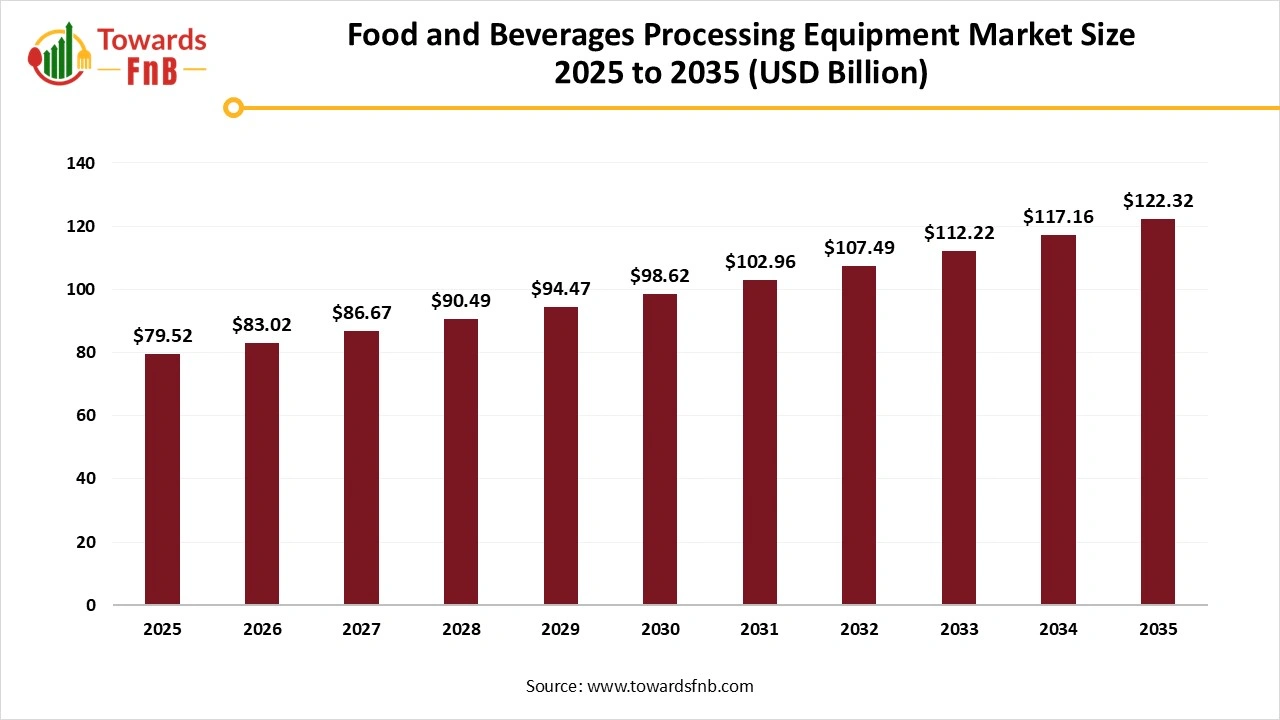
The global food and beverage processing equipment market size reached at USD 79.52 billion in 2025 and is anticipated to increase from USD 83.02 billion in 2026 to an estimated USD 122.32 billion by 2035, witnessing a CAGR of 4.4% during the forecast period from 2026 to 2035. Growing demand for processed food and beverages and advancement in processing technology are driving the market.
| Study Coverage | Details |
| Growth Rate from 2026 to 2035 | CAGR of 4.4% |
| Market Size in 2026 | USD 83.02 Billion |
| Market Size in 2027 | USD 86.67 Billion |
| Market Size by 2035 | USD 122.32 Billion |
| Largest Market | Asia Pacific |
| Base Year | 2025 |
| Forecast Period | 2026 to 2035 |
| Regions Covered | North America, Europe, Asia-Pacific, Latin America, and Middle East & Africa |
The food and beverage processing equipment market involves machinery for transforming raw ingredients into consumer-ready products, covering everything from baking & dairy to meat & beverages, driven by rising demand for processed food, convenience, and safety. The growing demand for packaged food and beverages because of changing lifestyles and busy schedules of consumers is driving significant investments in food and beverage processing equipment. The market is witnessing trends like increasing automation and the development of technologically advanced equipment.
The food processing sector is undergoing a technological transformation with the implementation of state-of-the-art machinery that optimizes production processes and guarantees superior food quality along with increased efficiency. Contemporary intelligent food packaging technology is one of the most significant innovations. The integration of artificial intelligence food sorting technology with machine learning and computer vision algorithms enables producers to enhance their manufacturing processes and reduce operational waste. The advancement of 3D food printing technology makes the future of food processing increasingly sophisticated.
Raw Material Sourcing
Production And Manufacturing
Distribution
What Made the Asia Pacific the Dominant Region in the Food and Beverage Processing Equipment Market?
Asia Pacific dominated the market in 2025. The market for food and beverage processing equipment in the Asia Pacific region is witnessing significant growth fueled by population growth, urban development, and increasing disposable incomes. Nations such as China, India, Japan, and South Korea lead this expansion. The appetite for processed foods, particularly in developing countries, is increasing as consumer choices trend towards convenience and meal options that require no preparation. The government's emphasis on food safety laws has compelled local producers to embrace cutting-edge processing technologies.
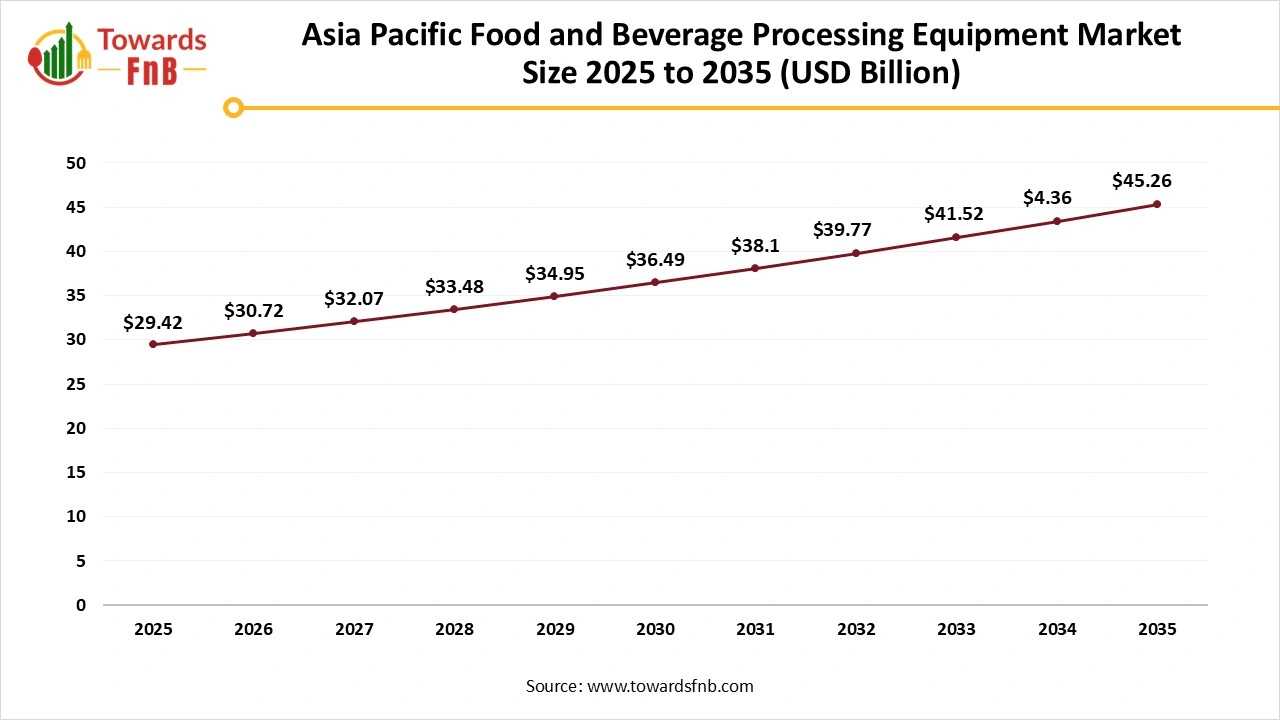
The Asia Pacific food and beverage processing equipment market size was calculated at USD 29.42 billion in 2025 with projections indicating a rise from USD 30.72 billion in 2026 to approximately USD 45.26 billion by 2035, expanding at a CAGR of 4.4% throughout the forecast period from 2026 to 2035.
India Food and Beverage Processing Equipment Market Analysis
The increasing demand for packaged food products is driving the growth of India's food and beverage processing equipment market. India ranks among the biggest producers of milk, fruit and vegetables, wheat, rice, spices, and more. Total agricultural exports amounted to Rs. 4.2 lakh crore in fiscal 2025, and imports were at Rs. 3.1 lakh crore. The proportion of processed food exports in agri-food exports rose significantly from 13.7% in 2014-15 to 23.4% in 2023-24. India's food & beverage processing equipment market is witnessing significant expansion, fueled by substantial agricultural production, increasing consumer interest in processed/packaged foods, governmental programs such as 'Make in India,' and urban development.
North America Food and Beverage Processing Equipment Market Expansion
North America expects the fastest growth in the market during the forecast period, fueled by rising consumer demand for processed products, technological innovations, and strict regulatory requirements. The growth path of the market is driven by increasing health awareness among consumers, the growth of convenient food categories, and the implementation of Industry 4.0 technologies. As the food processing industry advances quickly, manufacturers of equipment are consistently developing new solutions to address changing market demands.
U.S. Food and Beverage Processing Equipment Market Analysis
The U.S. market shows strong growth propelled by sectors like dairy, beverages, and processed foods, while automation and smart technology are at the forefront of tech adoption. The growing need for scalable, high-efficiency processing solutions highlights the transition to Industry 4.0 integrations. A key factor propelling the U.S. food and beverage processing equipment market is the rising demand for packaged and processed foods. Prepared meals, frozen items, snacks, and canned goods are becoming increasingly popular, particularly among younger and employed individuals.

Europe: A Notably Growing Region in the Food and Beverage Processing Equipment Market
The European food and beverage processing equipment market is witnessing significant changes, driven by strict EU food safety standards and strong government incentives encouraging sustainable industrial improvements. A significant portion of the European economy is derived from the food and beverage sector, with countries like Italy, Germany, and the U.K. contributing importantly to the region's economic growth. The expansion of the market is anticipated to be enhanced by the steady advancements in the food processing industry, progress in processing technology, and ongoing growth in the need for processed foods.
Germany Food and Beverage Processing Equipment Market Analysis
Germany’s prominence in food engineering and rigorous food safety regulations from entities such as the Federal Ministry of Food and Agriculture are crucial market drivers. With the tightening of energy efficiency regulations, equipment manufacturers are swiftly embracing environmentally friendly options to fulfill EU sustainability goals.
The Middle East and Africa Food and Beverage Processing Equipment Market Growth
The market in the Middle East and Africa is seeing strong growth, largely due to the rising need for processed and packaged foods, spurred by urbanization and higher disposable incomes. Consumers in this area are moving towards convenient and ready-to-eat food items, which requires advanced processing machinery to improve production efficiency and product quality.
UAE Food and Beverage Processing Equipment Market Analysis
The factors influencing the market in the United Arab Emirates are the rising health issues and eating habits of consumers. The government and various food organizations are encouraging food processing equipment manufacturers to make investments in the nation. Expanding investment in food processing technology and machinery will enhance the market share. Additionally, rising demand for processed foods requires manufacturers to enhance their focus on boosting productivity, thereby significantly raising the need for food processing machinery.
South America Food and Beverage Processing Equipment Market Expansion
The market share for food and beverage processing equipment in South America is mainly influenced by the expanding processed food industry, rising infrastructure investments and technological progress, as well as government efforts to modernize food production. Investments by the government in modernizing agriculture and improving food processing infrastructure are greatly driving the growth of the market in South America
The Brazil food and beverage processing equipment market size is experiencing growth due to the high processed foods and beverages. Swift urbanization along with growing middle class in Brazil have fostered the demand for processed foods, thereby raising the demand for modern equipment for food and beverage processing. This market expansion is predominantly fueled by the rising consumption of carbonated soft drinks, flavored sparkling water, and energy drinks, all of which need sophisticated processing equipment.
Food and Beverage Processing Equipment Market Share, By Type, 2025 (%)
| Segments | Shares (%) |
| Pre-processing | 60% |
| Processing | 40% |
Why did the Pre-Processing Segment Dominate the Food and Beverage Processing Equipment Market in 2025?
The pre-processing segment led the market in 2025, because of strict hygiene standards imposed by various industries and a rising inclination toward waste minimization and raw material optimization. Automation is also growing in pre-processing jobs, such as peeling, washing and sorting to decrease human error and offer consistency. The modern equipment used for pre-processing is in demand with increased consumer demand for ready-to-cook and clean-label foods.
The Processing Segment is Observed to Grow at the Fastest Rate During the Forecast Period.
Processing equipment serves as the foundation of the food and beverage sector, including machines that convert raw materials into end products. This section is defined by its diverse functions, such as blending, cooking, and fermentation. With manufacturers putting greater emphasis on efficiency and automation, the need for cutting-edge processing technologies is continuously growing.
Food and Beverage Processing Equipment Market Share, By Application, 2025 (%)
| Segments | Shares (%) |
| Solid | 65% |
| Liquid | 25% |
| Semi-solid | 10% |
Which Application Segment Dominated the Food and Beverage Processing Equipment Market in 2025?
The bakery and confectionery segment held the dominating share of the market in 2025. The rising need for bakery goods globally is significantly influencing the growth of the worldwide bakery processing equipment market. With the global population rising significantly, the need for foods like bread and cookies is anticipated to grow swiftly. Moreover, increasing demand for specialty and health-focused bakery items (gluten-free, organic, high-protein) is driving investments in specialized and adaptable equipment that can accommodate various recipes.
The Non-Alcoholic Drinks Segment is Expected to Expand at a Significant Pace Over the Forecast Period.
This growth path is supported by various factors, such as rising demand for non-alcoholic drinks, improvements in processing technology, and an enhanced emphasis on sustainability in the beverage sector. Consumer choices are changing in favor of healthier alternatives, leading to an increased demand for fruit juice, flavored waters, and plant-derived drinks. The overall expansion of the food and beverage industry, particularly in developing economies, is fueling the demand for enhanced processing machinery.
Which End Product Form Segment Held the Largest Share of the Food and Beverage Processing Equipment Market in 2025?
The solid segment held the largest share of the market in 2025. To create a reliable solid product, it is essential to manage these items with ease. Packing the final product is very simple, unlike with liquid or semisolid products. The transport and storage of solid food items is much simpler than that of semisolid or liquid items. The likelihood of harm and pollution has risen
The Liquid Segment is Expected to Grow at the Fastest Rate in the Market During the Forecast Period.
In liquid manufacturing, multiple physical and chemical procedures are performed utilizing different tools like crushing and pressing machinery, tanks and fermenters, temperature regulation devices, filtration systems, and more. The rising demand for organic, functional, and health-oriented beverages influences equipment choices, emphasizing adaptable, hygienic, and versatile processing systems.
Food and Beverage Processing Equipment Market Share, By Mode of Operation, 2025 (%)
| Segments | Shares (%) |
| Semi-automatic | 30% |
| Automatic | 70% |
How did the Automatic Segment Dominate the Food and Beverage Processing Equipment Market in 2025?
The automatic segment dominated the market in 2025. These sectors need automation to address increasing consumer demand, maintain uniformity in product quality, and adhere to strict food safety regulations. The move toward convenience food and ready-to-eat meals has sped up the use of automated systems, particularly in urban areas where quick lifestyles prevail. Moreover, the expansion of frozen and processed meat industries is affecting equipment requirements.
The Semi-Automatic Segment is Steadily Expanding Throughout the Forecast Period.
Due to advantages like affordability, limited capital requirements, and lower energy consumption. This pricing structure has historically rendered these systems attractive to small and medium-sized enterprises (SMEs) aiming to expand operations without the burden of large initial investments.
Tetra Pak
By Type
By Application
By End Product form
By Mode of Operation
By Region




Principal Consultant
Vidyesh Swar, Senior Research Analyst at Towards Food & Beverages, specializes in market research, focusing on supply-demand evaluation, pricing analysis, alternative proteins, plant-based foods, and sustainable food technologies within the industry.
Learn more about Vidyesh Swar
Reviewed By
Aditi Shivarkar, with 14+ years in Food and Beverages market research, specializes in food, beverage, and eco-friendly packaging. She ensures accurate, actionable insights, driving Towards FnB's excellence in industry trends and sustainability.
Learn more about Aditi ShivarkarApril 2026
April 2026
April 2026
April 2026

Food and Beverage Processing Equipment Market

 +1 804-441-9344
 Download Sample
 Schedule a Meeting