April 2026



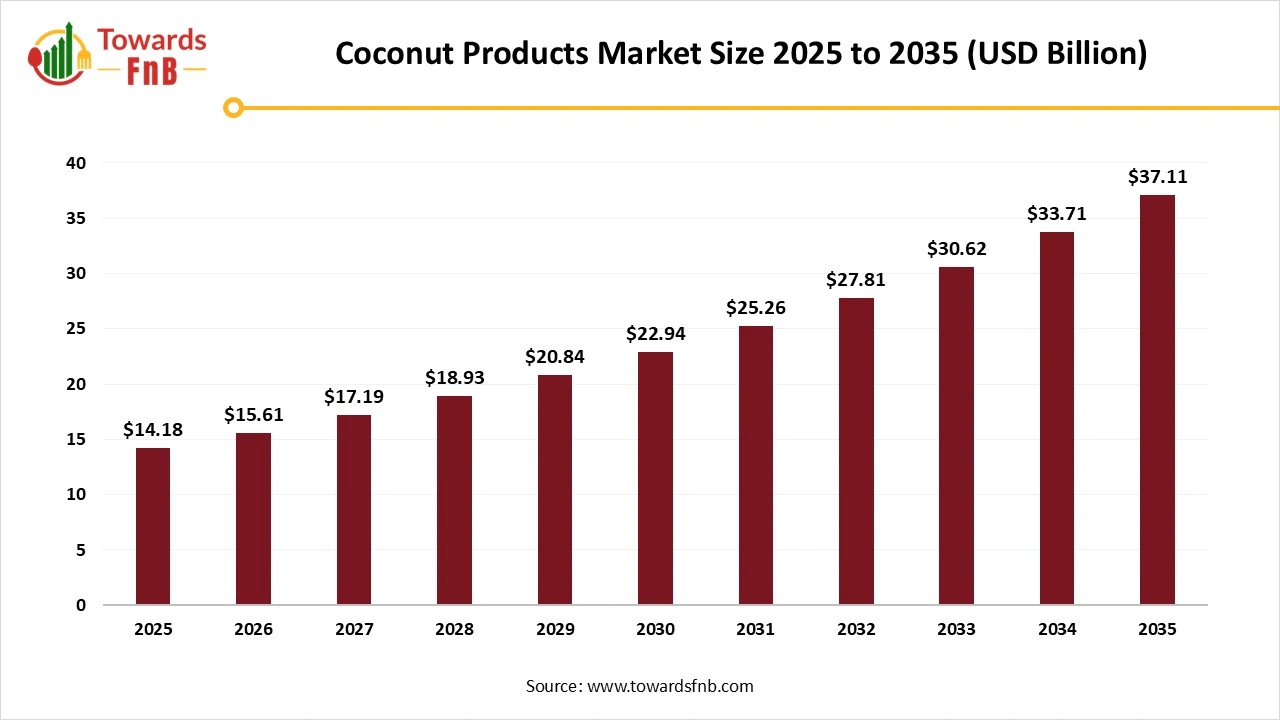
The global coconut products market size reached at USD 14.18 billion in 2025 and is anticipated to grow from USD 15.61 billion in 2026 to an estimated USD 37.11 billion by 2035, witnessing a CAGR of 10.1% during the forecast period from 2026 to 2035. Heightened awareness regarding the advantages of coconuts, along with the rising demand for coconut-derived items in prominent developed nations, is anticipated to boost the demand for the coconut product market.
| Study Coverage | Details |
| Growth Rate from 2026 and 2035 | CAGR of 10.1% |
| Market Size in 2026 | USD 15.61 Billion |
| Market Size in 2027 | USD 17.19 Billion |
| Market Size by 2035 | USD 37.11 Billion |
| Largest Market | Asia Pacific |
| Base Year | 2025 |
| Forecast Period | 2026 and 2035 |
| Regions Covered | North America, Europe, Asia-Pacific, Latin America, and Middle East & Africa |
Coconut is a major cash crop in tropical regions seen a significant increase in demand, fuelled by a rising awareness of the health advantages and diverse uses of coconut-derived products. This trend is transforming markets worldwide, offering challenges and opportunities for producers and vendors. Due to the rising demand for coconut products and the creative solutions arising to tackle industry challenges, the coconut products market is set for considerable growth. Global coconut farming spans 12.3 million hectares, yielding 61.4 million metric tons of coconut fruit each year.
Coconut provides edible products like coconut water, virgin coconut oil, copra which is dried coconut, and coconut milk, in addition to husk and activated charcoal. Currently, they are all in great demand in the global markets. Worldwide producers of food and beverages, as well as cosmetic items, are allocating resources to research and development to fully leverage the advantages of coconuts to improve their product lineup. Sustainability has emerged as a critical issue in the coconut products sector. Businesses are embracing sustainable practices and responsible sourcing techniques. Widely embraced in various areas, this trend impacts buying choices.
| Market Driver | (~) % Impact on CAGR Forecast | Geographic Relevance | Impact Timeline |
| Rising health & wellness awareness | +3.5% to +4.5% | Global, with strong engagement in Asia Pacific and Europe | Medium to Long term (2025–2035) |
| Broadening application across food, cosmetics & nutraceuticals | +2.5% to +3.5% | Global, highest uptake in North America & Europe | Medium (2025–2032) |
| Plant based & clean label trend adoption | +2.0% to +3.0% | Global, especially in North America & Europe | Short to Medium term (2025–2030) |
| Retail & e commerce penetration expansion | +1.5% to +2.5% | North America & Europe lead; urban Asia Pacific catching up | Short to Medium term (2025–2030) |
| Market Restraint | (~) % Impact on CAGR Forecast | Geographic Relevance | Impact Timeline |
| Raw material price volatility & supply challenges | ~ 2.5% to 3.5% | Global, especially in Asia Pacific producer markets where weather and yield affect supply | Short term (2025–2028) |
| High pricing vs traditional alternatives | ~ 1.8% to 2.5% | Price sensitive regions like Latin America and parts of Asia Pacific | Medium term (2025–2032) |
| Perceived quality & product differentiation issues | ~ 1.0% to 1.8% | Europe and North America where consumer expectations vary by segment | Medium term (2025–2030) |
| Regulatory and standards barriers in export markets | ~ 1.0% to 1.5% | Complex import/regulation environments in North America and EU | Long term (2025–2035) |
The use of novel technologies and research approaches like metabolomics, proteomics, genomics as well as transcriptomics on coconut fruit is producing intriguing data that will aid in enhancing the management and marketing of this important crop. The incorporation of AI, automation, and intelligent technologies is generating new possibilities. Moreover, enhanced manufacturing methods and material innovations are facilitating affordable production, promoting wider acceptance.
The coconut products sector involves a complicated supply chain. Coconuts mainly thrive in tropical areas, which frequently encounter issues like weather variations and natural calamities. These elements can disturb the supply chain, resulting in erratic product availability and price variations which contribute in the limitation of the coconut products market expansion.
Raw Material Procurement
Packaging and Branding
Waste Management and Recycling
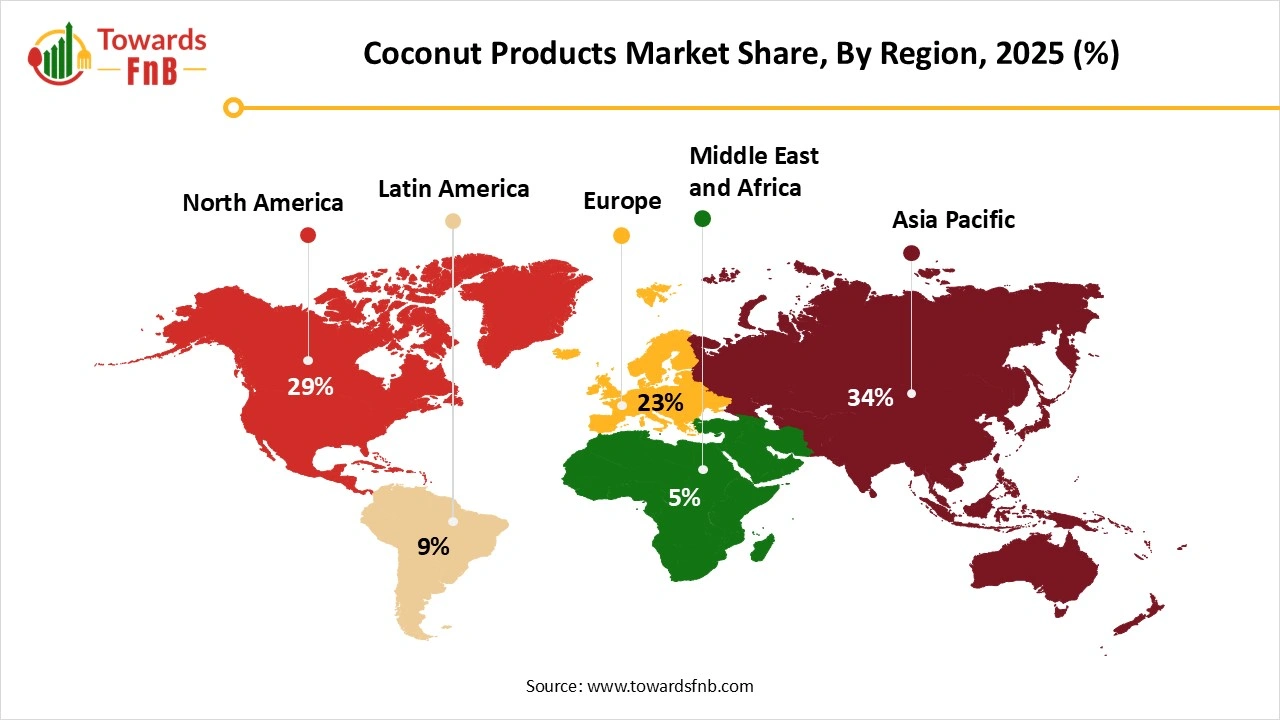
Asia Pacific Dominated the Coconut Products Market in 2025
Coconut has been a staple in traditional Asian cooking for a long time. It is a widely used cooking and enhancing the flavor of various dishes in numerous Asia pacific countries. It’s easier accessibility and lower cost in comparison to its organic counterpart have boosted demand. Yet, the strong trend of clean label products among informed consumers is increasing the demand for organic coconut items.
Asia Pacific Coconut Products Market Size 2025 to 2035
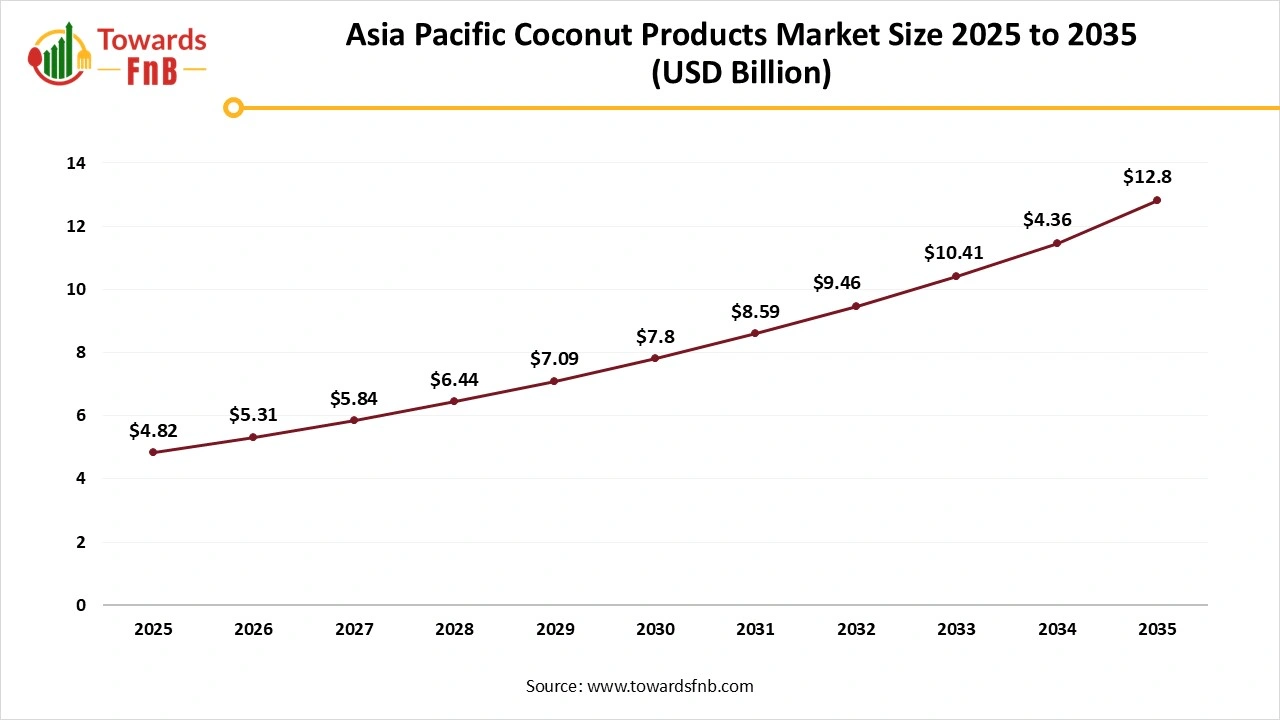
The Asia Pacific coconut products market size was calculated at USD 4.82 billion in 2025 and is anticipated to grow from USD 5.31 billion in 2026 to an estimated USD 12.80 billion by 2035, witnessing a CAGR of 10.26% during the forecast period from 2026 to 2035.
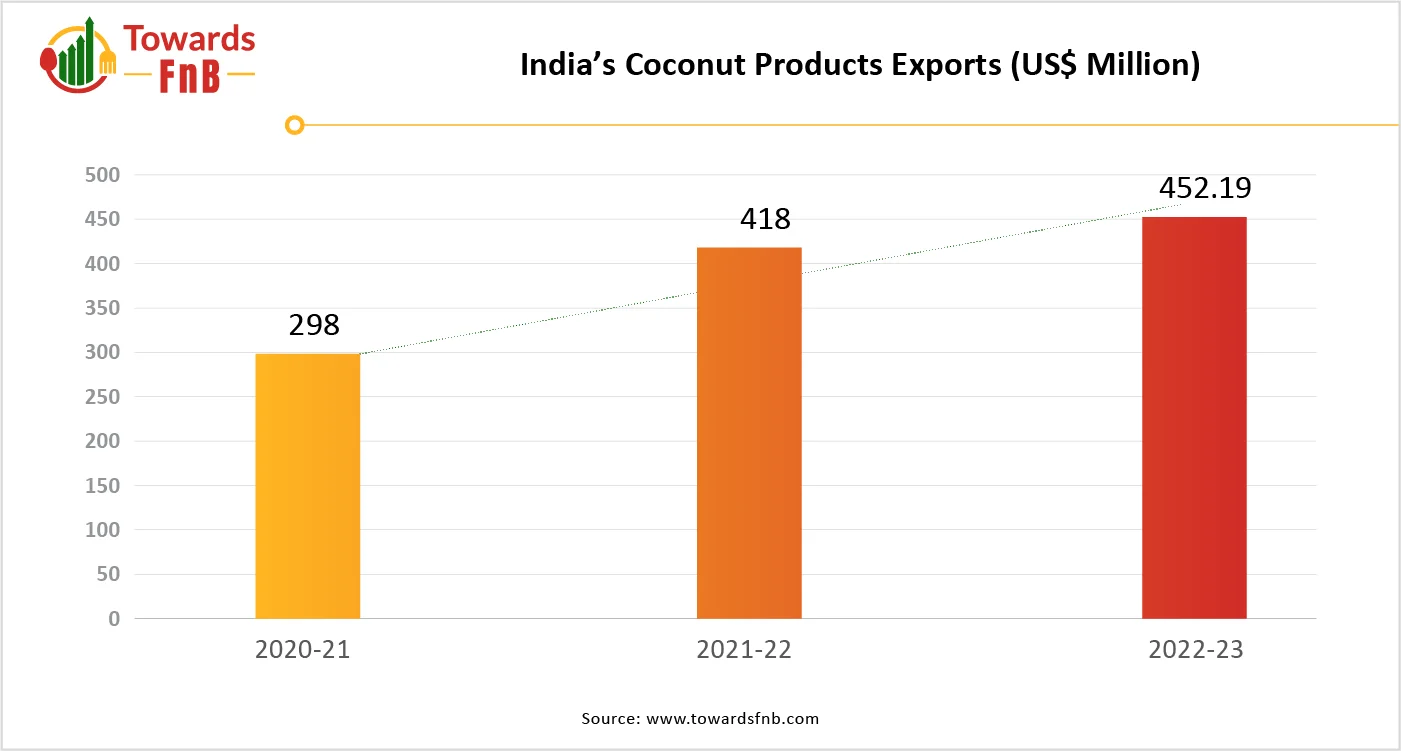
Coconut productivity of India rises globally. India's productivity surpasses that of Indonesia and the Philippines, and it is nearly equivalent to that of Sri Lanka. Under the guidance of the Ministry of Agriculture and Farmers Welfare, the Coconut Board of India has launched several initiatives to enhance the coconut sector in the nation. Several initiatives involve the production and distribution of high-quality planting materials, increasing the cultivated area, technology demonstration and enhancement, replanting and revitalization, assisting exporters in engaging with international events, providing training for marketing export-specific products, and expanding the global market for coconut products by creating opportunities, among others. Additional programs like the Coconut Palm Insurance Mission and Kera Suraksha Insurance Scheme aim to safeguard farmers from natural disasters and financial losses.
Europe region is expected to witness the significant growth in the coconut products market during the forecast period. The market for coconuts in Europe is expanding. Health, convenience, and innovation lead to increased consumption of both fresh mature and young coconuts. Opportunities are varied, encompassing both types of fresh coconut and established markets like the United Kingdom and Italy, along with emerging markets such as France and Spain.
The UK is a major player in the regional market, contributing to growth due to the country's largest coconut milk industry. the growing consumer demand for various flavor-based and healthy food options is driving this segment’s growth. The well-established and popular ethnic cuisines of the UK are driving the traction of the coconut products in both the culinary and health sectors of the country.
Germany is a significant player in the regional market, growth driven by countries' robust import of coconut products, including coconut oil and desiccated coconut. The robust industrial infrastructure, strong manufacturing capabilities, and focus on technological advancements are driving the German coconut products market.
North America Coconut Products Market Trends
North America is expected to grow at a notable rate during the forecast period. The market growth in the region is driven by the rising popularity of natural and plant-based food alternatives, increasing consumer health awareness, demand for vegan and plant-based diets, increasing versatility in applications, ethical sourcing and sustainability and increasing demand for longer shelf life and convenient products. Germany, France and the U.K. are the notable countries in the region.
Middle East and Africa Coconut Products Market Trends
The market growth in the Middle East and Africa is witnessing rapid growth, driven by the demand for sustainable and nutritional wellness solutions, increasing disposable incomes, increasing government initiatives to supports, demand for flexitarian and vegan diets, rise of technological advancements such as genetic testing, wearable tech and AI, growing middle class population and increasing demand from confectionery and bakery industries .
Latin Africa Coconut Products Market Trends
The coconut products market in Latin America is driven by the demand for natural ingredients, rapid urbanization, and health trends. In addition, demand for organic and natural options, increasing consumer awareness of coconut health benefits, changing lifestyles and shift towards clean labels and plant-based diets, further drives the market growth.
Brazil is the leading company in the market due to their growing demand for vegan and veganism, large populations, rapid urbanization, increasing health awareness, demand for functional food and beverages and rising investment and favorable climate in sustainable production to offer more accurate dietary recommendations.
The Coconut Oil Dominated the Coconut Products Market in 2025
Coconut oil is said to help lessen effects from various illnesses, including cardiovascular issues like abnormal blood sugar levels and conditions like kidney bladder infections. The existence of monolaurin and antioxidants can offer unique benefits from a broader public health perspective. These advantages of the coconut oil attracting the consumers and increasing the market. Coconut oil is being increasingly utilized for transportation and electricity generation in Pacific nations due to its reduced local expense. Additional advantages comprise the backing of regional agro-industries and a reduction in emissions. The use of biofuel made from coconut oil in various nations offers significant prospects for market participants.
The Coconut Water Segment is Projected to Grow at Faster Rate Throughout the Projection Period
The coconut water market is primarily driven by growing consumer preference for health-focused and natural drinks, supported by rising awareness of its nutritional value and hydration advantages. Innovations in packaging and product enhancements, including fortified or flavored varieties, attract a wider audience. These elements together contribute to the growth of the coconut water market size throughout worldwide areas.
The Cosmetic Segment Led the Coconut Products Market in 2025
The growth is due to moisturizing and skin friendly properties of coconut. Cosmetics based on coconut are developed with coconut oil, milk, and other derivatives recognized for their nourishing and hydrating benefits, which makes them flavored selections in skincare and haircare items. The expansion of this market can be related to multiple factors such as increasing awareness of the detrimental impacts of synthetic substances in beauty products.
Food and Beverage Segment is Expected Fastest Growth in the Coconut Products Market During the Forecast Period
The growth of market is fueled by increasing trends in coconut milk beverages, innovative product launches, and environmental issues. As a result of consumer demand, bottled RTD Coconut water beverages are becoming popular in developed countries such as the United States. The increasing demand for ready-to-drink coconut-based drinks, culinary uses, and non-dairy dessert recipes has prompted producers to expand their product offerings. The growing demand of natural products is fueling advancements in product development.
By Product
By Application
By Region






Principal Consultant
Vidyesh Swar, Senior Research Analyst at Towards Food & Beverages, specializes in market research, focusing on supply-demand evaluation, pricing analysis, alternative proteins, plant-based foods, and sustainable food technologies within the industry.
Learn more about Vidyesh Swar
Reviewed By
Aditi Shivarkar, with 14+ years in Food and Beverages market research, specializes in food, beverage, and eco-friendly packaging. She ensures accurate, actionable insights, driving Towards FnB's excellence in industry trends and sustainability.
Learn more about Aditi ShivarkarApril 2026
April 2026
April 2026
April 2026

Coconut Products Market


 +1 804-441-9344
 Download Sample
 Schedule a Meeting