
April 2026



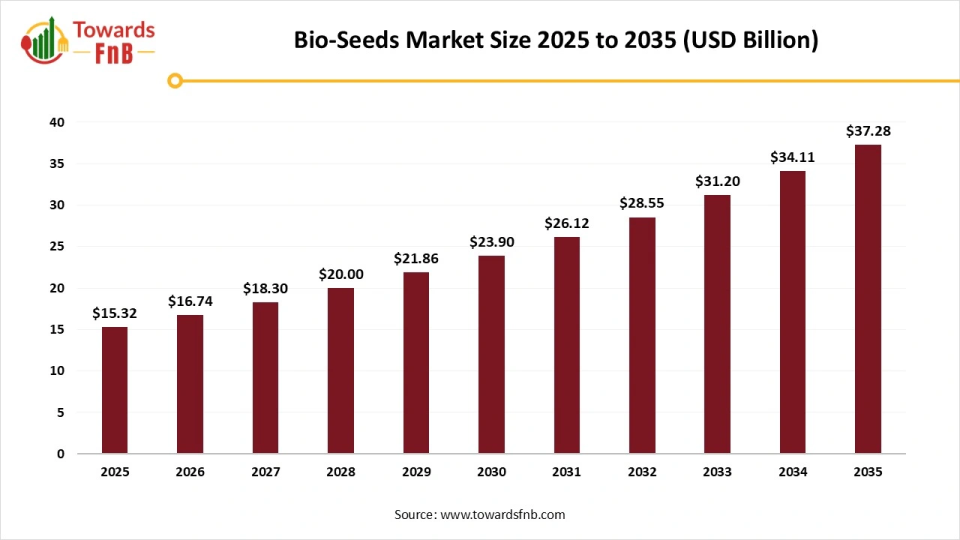
The global bio-seeds market size reached at USD 15.32 billion in 2025 and is anticipated to increase from USD 16.74 billion in 2026 to an estimated USD 37.28 billion by 2035, witnessing a CAGR of 9.3% during the forecast period from 2026 to 2035. The growing demand for high-quality organic food and the increasing global population drive market growth.
| Study Coverage | Details |
| Growth Rate from 2026 to 2035 | CAGR of 9.3% |
| Market Size in 2026 | USD 16.74 Billion |
| Market Size in 2027 | USD 18.30 Billion |
| Market Size by 2035 | USD 37.28 Billion |
| Largest Market | North America |
| Base Year | 2025 |
| Forecast Period | 2026 to 2035 |
| Regions Covered | North America, Europe, Asia-Pacific, Latin America, and Middle East & Africa |
Bio-seeds are a type of seed produced using technologies like advanced breeding, genetic engineering, and others. They possess characteristics like pest resistance, advanced genetic development, high quality, environmental resilience, wide adaptability, and long shelf life. The types of bioseeds are hybrid, GM seeds, and non-GM bio-seeds. They offer benefits like disease resistance, short crop duration, high yield output, consistent performance, and higher income for farmers. Bio-seeds enhance sowing efficiency and lower dependency on chemicals.
The bio-seeds market growth is driven by demand for healthy food, shift to environmentally friendly agriculture practices, increased genetic engineering adoption, declining farmland, popularity of microbial seed treatments, rising renewable energy production, and the increased adoption of bio-engineered seeds.
The bio-seeds market is experiencing key technological shifts driven by demand for biological enhancements, advanced coatings, sustainability, and precision breeding. The technological innovations like digital transformation, blockchain traceability, advanced seed coatings, IoT devices, and machine learning lower chemical reliance, improve plantability, and enhance crop performance. The AI integration enables monitoring environmental conditions and supports precision agriculture.
AI easily analyzes desirable traits in crop genomes and automatically sorts diverse grades of seeds. AI manufactures new varieties of seeds and identifies disorders in seeds. AI monitors the performance of the seed under various conditions and easily analyzes genomic data. AI understands the germination potential and detects seed-borne fungi. AI predicts the condition of the soil and enhances the performance of seed coating. Additionally, companies like Syngenta, Cropin, Bayer, and Seed-X use AI for diverse agricultural purposes.
Raw Material Procurement
Processing and Preservation
Quality Testing and Certifications
Why North America Dominates the Bio-Seeds Market?
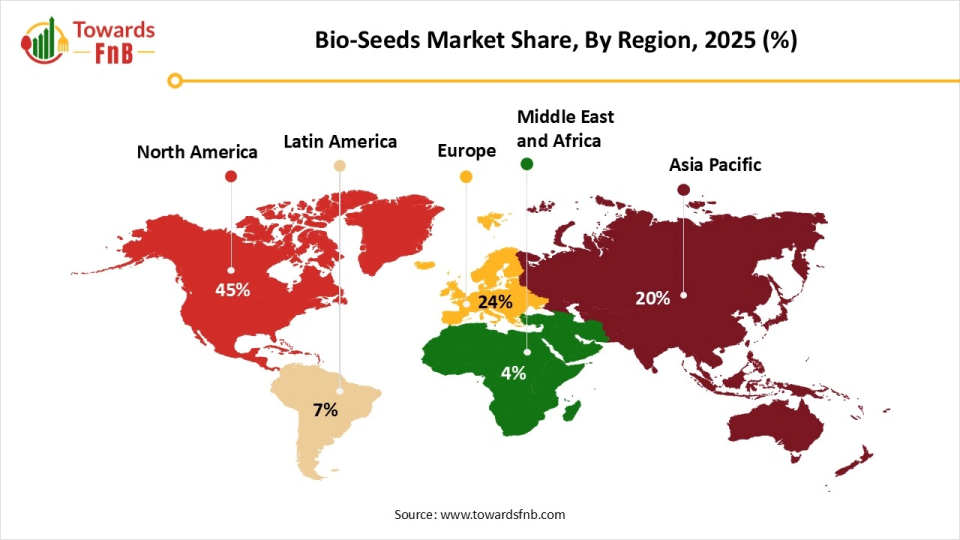
North America dominated the bio-seeds market in 2025. The well-established agricultural biotechnology infrastructure and the robust growth in GM crops increase demand for bio-seeds. The transition to residue-free products and the strong presence of genetic engineering increase the adoption of bio-seeds. The strong focus on herbicide tolerance and the higher demand for climate-resilient seeds create a higher demand for bio-seeds, driving the overall market growth.
Powering Agriculture: Rise of Bio-Seeds in the United States
The United States is at the forefront of the market due to the increased production of GM seeds. The strong presence of large-scale farming activities and the availability of crop subsidies increase demand for bio-seeds. The shift to sustainable seed treatments and the strong government backing for biotechnology increases demand for bio-seeds. The rise of gene editing and the increased investment in seed technology support the overall market growth.
Asia Pacific Bio-Seeds Market Trends
Asia Pacific is experiencing the fastest growth in the market during the forecast period. The government focuses on ensuring food security, and the rise of organic farming increases demand for bio-seeds. The popularity of hybrid seeds and the transition to biologicals help market expansion. The decline of agricultural arable land and the focus on managing stress-prone soils increase demand for bio-seeds. The growth in nutrient-rich vegetables supports the overall market growth.
Cultivating Science: Bio-Seeds Transformation in India
India is rapidly growing in the market due to the growing demand for biofortified crops. The shift away from chemical fertilizers and the rising biotech innovation increases demand for bio-seeds. The strong focus on addressing malnutrition and the increased production of climate-resilient varieties increases demand for bio-seeds. The increased awareness of pest-resistant seeds and the popularity of agricultural biotechnology support the market growth.
Bio-Seeds Market Share, By Crop Type, 2025 (%)
| Segments | Shares (%) |
| Corn | 40% |
| Soybean | 25% |
| Canola | 15% |
| Wheat | 12% |
| Rice | 8% |
Why Corn Segment Dominates the Bio-Seeds Market?
The corn segment dominated the bio-seeds market in 2025. The increased development of ethanol and the heavy investment in corn research have increased the production of corn. The renewable energy targets and the move towards bio-seed technology increase demand for corn. The increased use of corn in industries like processed food and the growing adoption rate of genetically modified corn drive the market growth.
The soybean segment is the fastest-growing in the market during the forecast period
The rising manufacturing of biodiesel and the higher demand for livestock feed increase demand for soybean seeds. The increased popularity of soy-based products and consumer awareness about the super legume have increased the adoption of soybean seeds. The nitrogen fixation, herbicide tolerance, sustainability, and excellent nutritional value of soybean seeds support the overall market growth.
Bio-Seeds Market Share, By Trait, 2025 (%)
| Segments | Shares (%) |
| Herbicide Resistance | 45% |
| Insect Resistance | 25% |
| Disease Resistance | 15% |
| Drought Tolerance | 10% |
| Nutrient Efficiency | 5% |
How did the Herbicide Resistance Segment hold the Largest Share in the Bio-Seeds Market?
The herbicide resistance segment held the largest revenue share in the bio-seeds market in 2025. The strong focus on weed management and the surging production of higher crop yields increases demand for herbicide-resistant bio seeds. The popularity of no-till farming and large-scale agricultural practices boosts expansion. The unmatched efficiency, economic efficiency, and operational simplicity of herbicide resistance drive the market growth.
The insect resistance segment is experiencing the fastest growth in the market during the forecast period
The growth in the plantation of maize and the focus on high genetic plasticity increase demand for insect resistance. The changing rainfall patterns and the inadequate crop rotation create a higher demand for insect resistance. The metabolic resistance, rapid evolution of pests, and target-site mutations in insect resistance support the overall market growth.
Bio-Seeds Market Share, By End Use, 2025 (%)
| Segments | Shares (%) |
| Agriculture | 80% |
| Biofuels | 10% |
| Pharmaceuticals | 6% |
| Cosmetics | 4% |
Which End Use Dominated the Bio-Seeds Market?
The agriculture segment dominated the bio-seeds market in 2025. The robust growth in chemical-free food and the strong focus on better germination increase demand for bio-seeds. The increased production of higher-quality oilseeds and the rising cultivation of oilseeds increase the adoption of bio-seeds. The focus on boosting agricultural productivity and the massive production scale of soybeans drives the market growth.
The biofuels segment is the fastest-growing in the market during the forecast period
The government mandates for biofuel blending, and the surge in the creation of ethanol increases demand for bio-seeds. The increased development of cleaner fuel alternatives and the strong energy security focus increase the adoption of bio-seeds. The growth in the production of waste-to-energy and the shift towards agriculture-based energy support the market growth.
How did the Hybrid Seeds Segment hold the Largest Share in the Bio-Seeds Market?
The hybrid seeds segment held the largest revenue share in the bio-seeds market in 2025. The strong focus on combating environmental stressors and the increased prevalence of local diseases in crops increases demand for hybrid seeds. The growth of mechanized farming and the need to minimize crop loss create a huge demand for hybrid seeds. The commercial benefits, improved productivity, superior performance, and environmental adaptation of hybrid seeds drive the market growth.
The genetically modified seeds segment is experiencing the fastest growth in the market during the forecast period
The presence of limited arable land and the strong focus on increasing farm profits increase demand for genetically modified seeds. The changing climate conditions and the higher demand for drought-tolerant varieties increases adoption of genetically modified seeds. The higher profitability, low operational cost, weed control, and increased stability of genetically modified seeds support the overall market growth.
Jigawa State Government
Bayer
Upstream Biotechnology and Bene Seeds
By Crop Type
By Trait
By End Use
By Seed Form
By Region



Principal Consultant
Vidyesh Swar, Senior Research Analyst at Towards Food & Beverages, specializes in market research, focusing on supply-demand evaluation, pricing analysis, alternative proteins, plant-based foods, and sustainable food technologies within the industry.
Learn more about Vidyesh Swar
Reviewed By
Aditi Shivarkar, with 14+ years in Food and Beverages market research, specializes in food, beverage, and eco-friendly packaging. She ensures accurate, actionable insights, driving Towards FnB's excellence in industry trends and sustainability.
Learn more about Aditi ShivarkarApril 2026
April 2026
April 2026
April 2026

Bio-Seeds Market


 +1 804-441-9344
 Download Sample
 Schedule a Meeting