April 2026



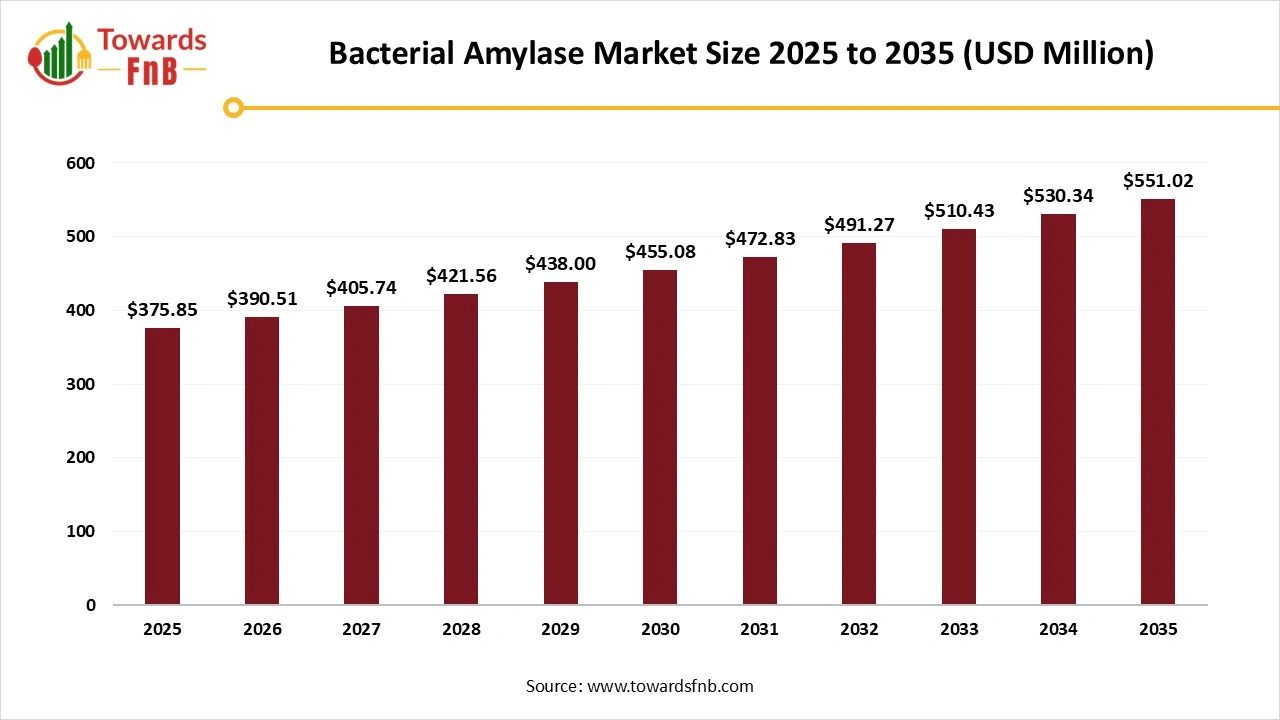
The global bacterial amylase market size estimated at USD 375.85 million in 2025 and is anticipated to increase from USD 390.51 million in 2026 to nearly reaching USD 551.02 million by 2035, witnessing a CAGR of 3.9% during the forecast period from 2026 to 2035. The expanding industrial sectors, such as food & beverages, pharmaceuticals, textiles, and animal feed, are driving the market.
| Study Coverage | Details |
| Growth Rate from 2026 to 2035 | CAGR of 3.9% |
| Market Size in 2026 | USD 390.51 Million |
| Market Size in 2027 | USD 405.74 Million |
| Market Size by 2035 | USD 551.02 Million |
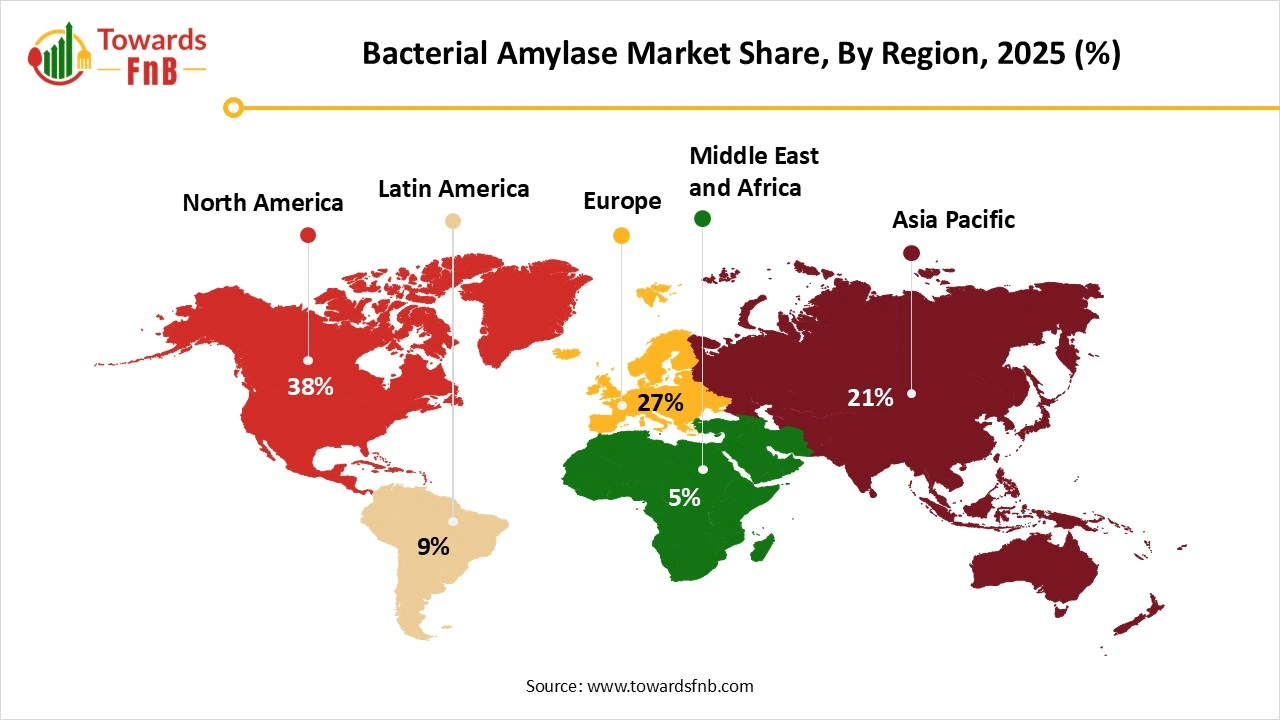
| Largest Market | North America |
| Base Year | 2025 |
| Forecast Period | 2026 to 2035 |
| Regions Covered | North America, Europe, Asia-Pacific, Latin America, and Middle East & Africa |
Bacterial amylases are important biocatalysts widely applied across various industrial sectors, including the food industry. Their rising demand parallels the rising global need for food, underscoring the importance of cost-effective and sustainable production methods. Amylases are one of the main enzymes used in various industrial sectors. Ongoing biotechnological innovations are driving the development of genetically engineered amylases with improved efficiency.
| Market Driver | (~) % Impact on CAGR Forecast | Geographic Relevance | Impact Timeline |
| Expanding demand across key industrial sectors (food & beverage, textiles, biofuels) | +3.0% to +4.0% | North America & Europe lead; Asia Pacific fastest growing | Medium to Long term (2025–2035) |
| Rising processed food production & enzyme use in baking/brewing | +2.5% to +3.5% | North America & Europe (largest markets); growing in APAC | Medium (2025–2030) |
| Technological innovations in enzyme engineering | +2.0% to +3.0% | Global biotech hubs driving investment (US, EU, China) | Short to Medium term (2025–2030) |
| Growing preference for sustainable & clean label bioprocessing | +1.5% to +2.5% | Global, especially Europe & North America | Short to Medium term (2025–2030) |
| Market Restraint | (~) % Impact on CAGR Forecast | Geographic Relevance | Impact Timeline |
| Price sensitivity & cost pressures in industrial supply chains | ~ 2.0% to 3.0% | Asia Pacific & Latin America (price competitive markets) | Short term (2025–2028) |
| Supply chain & raw material volatility (culture media, fermentables) | ~ 1.5% to 2.5% | Global, particularly regions dependent on imports (Europe & APAC) | Medium term (2025–2032) |
| Regulatory complexities & enzyme safety standards | ~ 1.0% to 1.8% | North America & Europe (stringent biotech standards) | Medium term (2025–2030) |
| Limited awareness in niche industrial segments | ~ 1.0% to 1.5% | Emerging markets where enzyme use is still nascent | Long term (2025–2035) |
The market is also witnessing significant innovations in enzyme production and application. Advances in biotechnology are leading to the development of more efficient and sustainable amylase variants, which can enhance performance in various industrial processes. CRISPR/Cas9 technology presents a promising method for increasing amylase production. Companies are increasingly implementing Artificial Intelligence in their bacterial amylase processes, along with other digitalization methods, to manage procurement, processing, and distribution effectively.
R&D
Raw Material Procurement
Processing
Why did North America Dominate the Bacterial Amylase Market in 2025?
North America dominated the bacterial amylase market in 2025. This expansion is driven by rising demand across multiple industries such as food and beverages, pharmaceuticals, biofuels, textiles, and animal feed. A significant factor contributing to this growth is the increasing consumption of processed and convenience foods, where bacterial amylase enhances texture, flavor, and shelf-life stability. Additionally, in the biofuel sector, bacterial amylase aids in converting starch into fermentable sugars, boosting ethanol production and aligning with renewable energy goals.
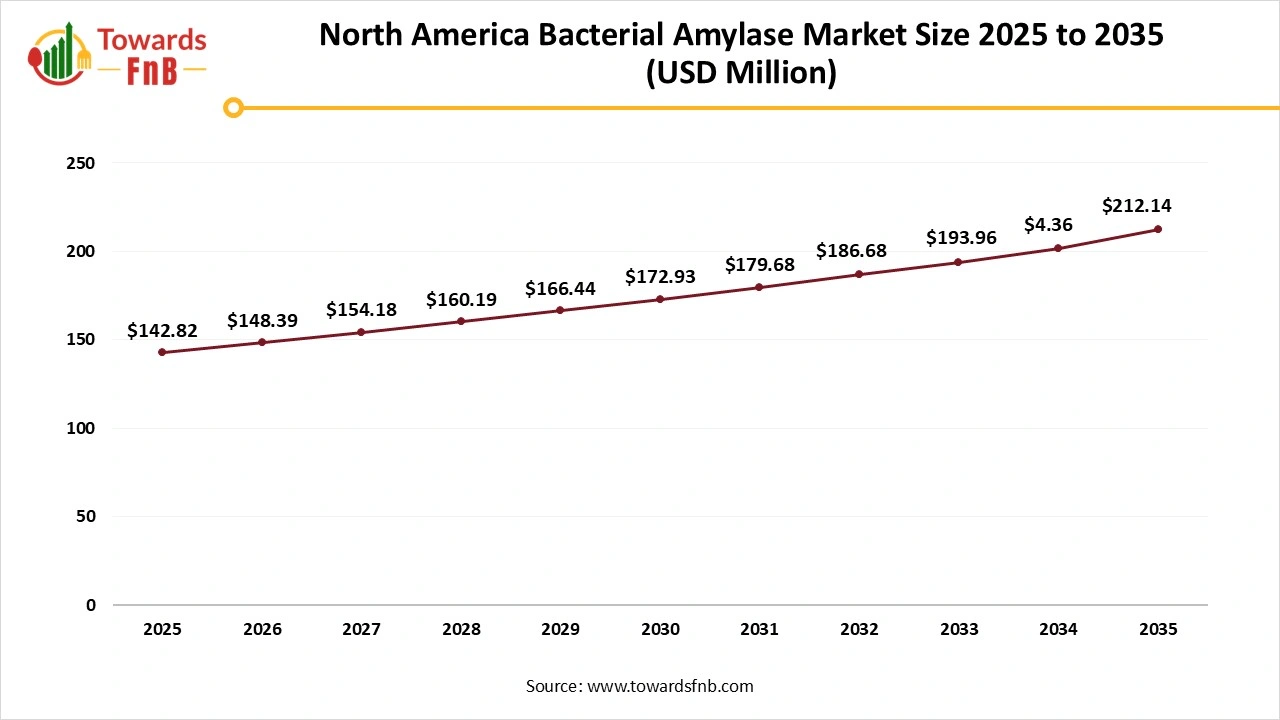
North America Bacterial Amylase Market Size 2025 to 2035
The North America bacterial amylase market size estimated at USD 142.82 million in 2025 and is predicted to increase from USD 148.39 million in 2026 to nearly reaching USD 212.14 million by 2035, growing at a CAGR of 4.04% during the forecast period from 2026 to 2035.
What Factors are Driving the Bacterial Amylase Market in the U.S.?
In the United States, the use of bacterial amylase has gained traction as food and beverage manufacturers, bio-processing plants, textile mills, and detergent producers seek efficient, enzyme-based solutions for starch conversion and cleaning operations. Looking ahead, demand for bacterial amylase in the USA is expected to grow due to the expansion of processed food production, the rise of the biofuel and bio-based chemical industries, and increasing interest in enzyme-enabled sustainability.
How Big is the U.S. Bacterial Amylase Market?
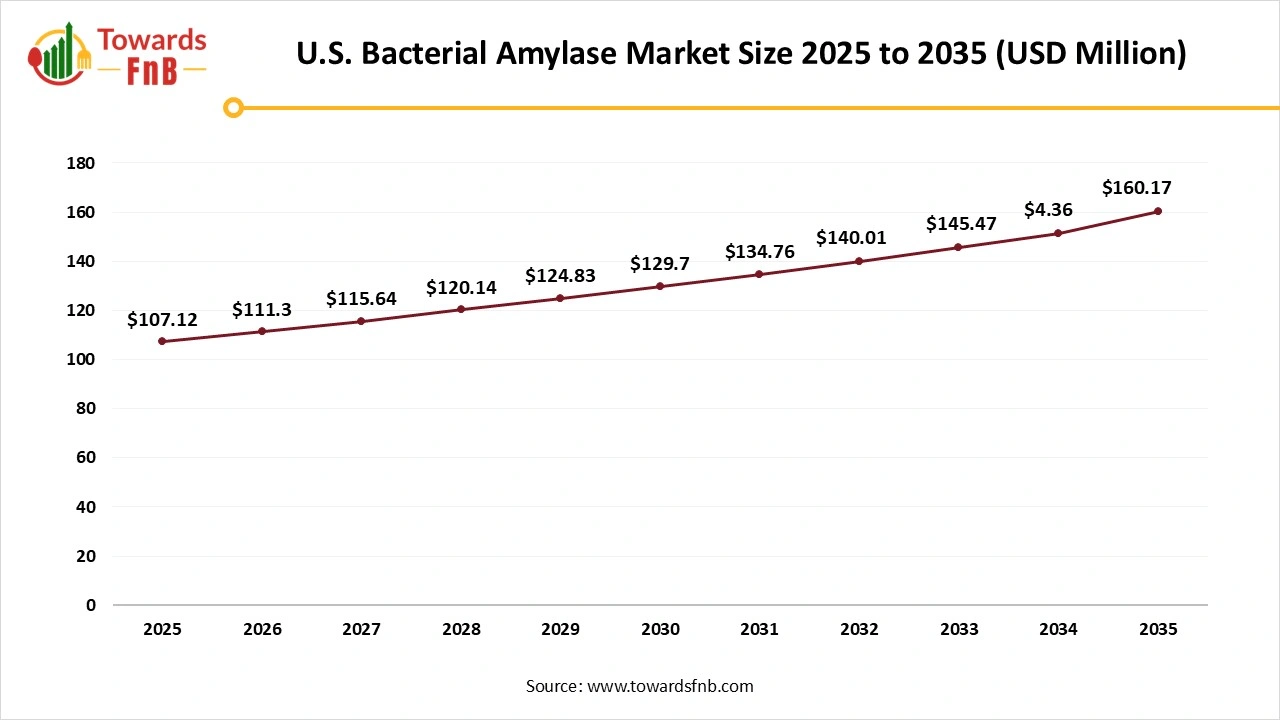
The U.S. bacterial amylase market size was calculated at USD 107.12 million in 2025 with projections indicating a rise from USD 111.3 million in 2026 to approximately USD 160.17 million by 2035, expanding at a CAGR of 4.1% throughout the forecast period from 2026 to 2035.
Asia Pacific: The Fastest Growing Region
Asia Pacific bacterial amylase market is rapidly expanding during the forecast period, due to rising industrialization, increasing food processing activities, and a growing emphasis on sustainable manufacturing practices. Countries such as China, India, and Japan are experiencing significant growth, driven by rising demand for processed foods, textiles, and biofuels. Government initiatives supporting biotechnological advancements and investments in research and development further accelerate market growth.
What are the Key Market Trends Shaping the China Bacterial Amylase Market?
Several new events and trends are actively shaping the China bacterial amylase market, reflecting broader shifts in the food industry and consumer behavior. Increasing emphasis on health and wellness, along with a demand for natural and clean-label ingredients, is driving significant innovation within the enzyme sector. Furthermore, advancements in biotechnology are enabling the development of more efficient and specialty enzyme products. For instance, Wuhan Bohai New Enzyme Biotechnology has raised a total of $2.18 million over two funding rounds.
Europe Bacterial Amylase Market Growth
Europe is another major market for bacterial amylase, driven by the region's focus on sustainability and eco-friendly practices. The enzyme's applications in biofuel production and the growing demand for high-quality textiles and detergents are significant growth drivers. Additionally, increasing investments in biotechnology research and development are expected to foster market growth. The European bacterial amylase market is anticipated to grow at a steady rate during the forecast period, supported by favorable regulatory frameworks and technological advancements.
Germany Bacterial Amylase Market Expansion
The German bacterial amylase market is at a pivotal inflection point, driven by surging demand in food, beverage, and industrial sectors, along with regulatory changes favoring enzyme-based solutions. Innovations in enzyme engineering and immobilization techniques are enhancing enzyme stability, activity, and cost-efficiency, thereby reducing the total cost of ownership for end-users. The merger of Novozymes and Chr. Hansen, along with DSM's acquisition of Amyris, has expanded major players' capabilities in bacterial amylase production across various sectors.
Bacterial Amylase Market Growth in the Middle East and Africa
The bacterial amylase market in the Middle East and Africa is growing significantly. This growth is underpinned by increasing demand from diverse industries such as food and beverage, pharmaceuticals, and biofuels, along with rising investments in sustainable and eco-friendly solutions. For example, in December 2024, six deals exceeding 3 billion Saudi riyals, approximately $798 million, were announced at the inaugural CPHI Middle East event in Riyadh, aimed at advancing research, logistics capabilities, and local manufacturing in the Kingdom’s pharmaceutical sector. As industries shift towards greener processes, microbial enzymes are emerging as critical catalysts for innovation, making this market a focal point for global players seeking to capitalize on the region's expanding industrial footprint and evolving regulatory landscape.
UAE Bacterial Amylase Market Investment
The bacterial amylase market in the United Arab Emirates (UAE) has experienced notable growth, driven by increasing adoption across diverse industrial sectors such as food and beverage, pharmaceuticals, agriculture, and industrial processing. Dubai Science Park (DuBiotech) is a business park located in Al Barsha, Dubai, UAE, that supports the biotechnology and pharmaceutical industries and supports the expansion of the market in the UAE. The UAE’s strategic geographic location, combined with its expanding industrial base and government initiatives promoting innovation and sustainability, has created a favorable environment for the growth of the market.
Key Drivers of the South America Bacterial Amylase Market
The market in South America is expanding swiftly. Key drivers fueling this expansion include the rising consumption of processed foods and beverages, particularly in countries like Brazil, Mexico, and Argentina. The increasing popularity of craft beers, spirits, and specialty baked goods has heightened the demand for beta-amylase enzymes, which are essential in starch hydrolysis processes. Additionally, the expanding bioethanol industry in South America, especially in Brazil, is significantly contributing to the market's growth.
The Brazilian Bacterial Amylase Market
The Brazilian bacterial amylase market is experiencing rising demand driven by various factors, including the expanding food and beverages industry, increased consumption of processed food products, and growing awareness of the benefits of enzymes in various applications. There is a noticeable shift towards natural and clean label ingredients, leading to a preference for amylases derived from microbial sources. Enzymes are also being utilized in other sectors like pharmaceuticals and textiles, further driving market growth.
Which Type Of Bacterial Amylase Dominated The Bacterial Amylase Market In 2025?
The alpha-amylase segment held the dominant share of the bacterial amylase market in 2025. As industries seek sustainable and cost-effective solutions, the adoption of alpha-amylase is expected to expand, fueling overall market growth. Alpha-amylase’s ability to enhance shelf life and improve baking volume makes it a valuable ingredient in bakery products. Bacterial alpha-amylases are increasingly favored in industrial bakeries, where rapid baking cycles demand high heat endurance and process flexibility.
The Beta Amylase Segment is Observed to Grow at the Fastest Rate During the Forecast Period.
Beta-amylase is primarily used in the production of maltose syrup and other maltose-rich products. The brewing industry, in particular, relies on beta-amylase for its ability to convert starch into maltose, a crucial sugar in the fermentation process. As the demand for craft beer and specialty malt products continues to rise, the market for beta-amylase is expected to see steady growth.
Which Application Segment Dominated the Bacterial Amylase Market in 2025?
The food and beverages segment dominated the market by holding the largest share in 2025. Amylases play a critical role in the food industry, particularly in baking and brewing. In baking, these enzymes convert starch into fermentable sugars during dough fermentation, which helps the dough rise and improves the texture of baked goods. In the broader food industry, amylases are utilized for starch liquefaction and saccharification, the production of corn syrups, anti-staling in baking, extending the shelf life of bread, and reducing chill haze formation in beverages.
The Textile Segment is Projected to Grow Significantly During the Forecast Period.
Amylases are employed to remove starch-based sizing agents to improve and standardize wet processing in the textile industry. These enzymes can be used for desizing processes at low temperatures (30-60ºC), with an optimal pH of 5.5-6.5. Amylases are commercially favored for desizing fabrics due to their efficiency, specificity, and ability to completely remove sizing without damaging the fabric.
Why did the Food-Grade Segment Dominate the Bacterial Amylase Market in 2025?
The food-grade segment held the largest market share in 2025, due to its extensive applications in baking, brewing, distilling, and starch hydrolysis. In baking, food-grade amylase enhances dough handling, improves crumb softness, and extends shelf life by facilitating starch breakdown during fermentation and baking. Breweries and distilleries depend on food-grade amylase to convert starch into fermentable sugars with controlled reaction kinetics. Large-scale food processors require stable enzymatic performance throughout long production cycles.
The Industrial-Grade Segment is Expected to Grow at the Fastest Rate During the Forecast Period.
Due to its extensive use in industries such as the textile and pharmaceutical sectors. These products cater to manufacturing sectors and include chemicals and raw materials. Their characteristics include cost-effectiveness and scalability, with demand bolstered by industrial growth and technological advancements.
BASF
Health Canada's Food and Nutrition Directorate
By Type
By Application
By Grade
By Region





Principal Consultant
Vidyesh Swar, Senior Research Analyst at Towards Food & Beverages, specializes in market research, focusing on supply-demand evaluation, pricing analysis, alternative proteins, plant-based foods, and sustainable food technologies within the industry.
Learn more about Vidyesh Swar
Reviewed By
Aditi Shivarkar, with 14+ years in Food and Beverages market research, specializes in food, beverage, and eco-friendly packaging. She ensures accurate, actionable insights, driving Towards FnB's excellence in industry trends and sustainability.
Learn more about Aditi ShivarkarApril 2026
April 2026
April 2026
April 2026

Bacterial Amylase Market

 +1 804-441-9344
 Download Sample
 Schedule a Meeting