April 2026



The global phycocyanin market size was calculated at USD 220.45 million in 2025 and is expected to grow steadily from USD 236.54 million in 2026 to reach nearly USD 445.97 million by 2035, with a CAGR of 7.3% during the forecast period from 2026 to 2035. The growth of the market is driven by increasing consumer demand for natural colors.

| Study Coverage | Details |
| Growth Rate from 2026 to 2035 | CAGR of 7.3% |
| Market Size in 2026 | USD 236.54 Million |
| Market Size in 2027 | USD 253.81 Million |
| Market Size by 2035 | USD 445.97 Million |
| Largest Market | North America |
| Base Year | 2025 |
| Forecast Period | 2026 to 2035 |
| Regions Covered | North America, Europe, Asia-Pacific, Latin America, and Middle East & Africa |
The phycocyanin market deals with a natural blue pigment-protein complex from red algae and cyanobacteria, known for its anti-inflammatory properties, antioxidant, fluorescence and blue color, acting as a light-harvesting accessory pigment for photosynthesis and used as a biomedical tracer, nutraceuticals and natural food colorant. It also offers major health benefits against diabetes, cancer and inflammation.
The market is driven by factors such as the rising technological advancements in algae extraction and farming, increased use in regulatory bans on synthetic dyes and supplements or nutraceuticals, health-conscious consumers looking for natural ingredients and increasing consumer demand for natural food colorants.
| Market Driver | (~) % Impact on CAGR Forecast | Geographic Relevance | Impact Timeline |
| Rising consumer demand for natural colors & clean label products | +3.5% to +4.5% | North America leads; Europe fastest growing; Asia Pacific gaining traction | Medium to Long term (2025–2035) |
| Growth of functional foods, beverages & nutraceutical applications | +2.5% to +3.5% | Global, especially in developed markets adopting clean label ingredients | Medium (2025–2032) |
| Expansion of health oriented formulations (antioxidant & phytonutrient positioning) | +2.0% to +3.0% | North America & Europe, growing interest in urban APAC markets | Short to Medium term (2025–2030) |
| Enhanced distribution via e commerce & natural ingredient channels | +1.5% to +2.5% | Global, with rapid growth in Asia Pacific and Latin America | Short to Medium term (2025–2030) |
| Market Restraint | (~) % Impact on CAGR Forecast | Geographic Relevance | Impact Timeline |
| High production & extraction costs | ~ 2.0% to 3.0% | Global particularly in markets without established algal cultivation infrastructure | Short term (2025–2028) |
| Limited large scale cultivation capacity (Spirulina) | ~ 1.5% to 2.5% | Asia Pacific and Latin America supply regions where cultivation is scaling | Medium term (2025–2032) |
| Stability & formulation challenges in some applications | ~ 1.0% to 1.8% | Global, impacting food/beverage & cosmetics manufacturers unfamiliar with pigment behavior | Medium term (2025–2030) |
| Regulatory scrutiny for additives in certain regions | ~ 1.0% to 1.5% | North America & Europe with strict food colorant regulations | Long term (2025–2035) |
The rise of technological advancements in the market focus on enhancing extraction purity and efficiency, using methods such as supercritical fluids, enzymes and ultrasound to enable higher-grade products for pharma and reduce costs. Major innovations such as AI/automation for smarter production, microencapsulation for better stability in food and beverages, synthetic biology for enhanced yield and sustainable large-scale cultivation. These advancements are meeting demand for natural ingredients.
Raw Material Procurement
Packaging and Branding
Waste Management and Recycling
| Country | Regulatory Body | Key Regulations | Focus Areas | Notable Notes |
| India | Food Safety and Standards Authority of India (FSSAI) | Food Safety and Standards (Packaging and Safety Regulations) and Licensing and Registration of Food Businesses) | Major focus areas in the phycocyanin market focuses on premium, clean-labels, high-quality and food and beverages industries and health-conscious, plant-based and clean-label food products | The phycocyanin industry is growing industry by expansion into diverse applications, increasing demand for organic and sustainable products, focus on nutritional benefits and premiumization and regulatory support. |
How does North America Dominating the Phycocyanin Market?
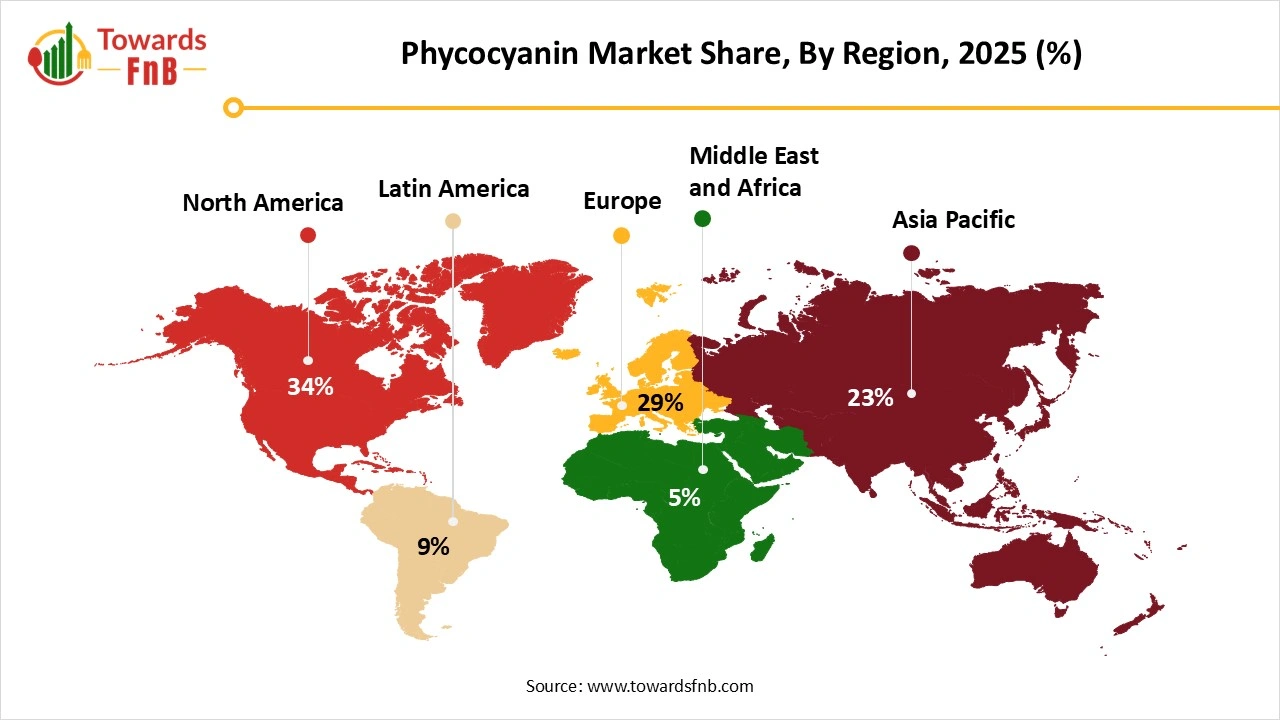
North America dominated the market in 2025, driven by increasing product usage in major industries including food and beverages, personal care and pharmaceuticals, beverages and foods, with major players expanding production to enhance growth, especially as consumers seek clean-label and sustainable options. Various manufacturers are focusing on natural and clean-label colors, and increasing prevalence of health illnesses, with ongoing innovation in application and formulation.
North America Phycocyanin Market Size 2025 to 2035
The North America phycocyanin market size was calculated at USD 74.95 million in 2025 with projections indicating a rise from USD 80.42 million in 2026 to approximately USD 153.86 million by 2035, expanding at a CAGR of 7.46% throughout the forecast period from 2026 to 2035.

The U.S. Phycocyanin Market Trends
The U.S. dominated the phycocyanin market revenue in 2025, driven by increasing consumer changing and busy lifestyles, waste reduction and digestive health, increasing prevalence of health illnesses, preference towards functional beverages, increasing use of products as anti-cancer ingredients, rising investment in drug development and increasing use in bakery, dairy items and confectionery.
How Big is the U.S. Phycocyanin Market?
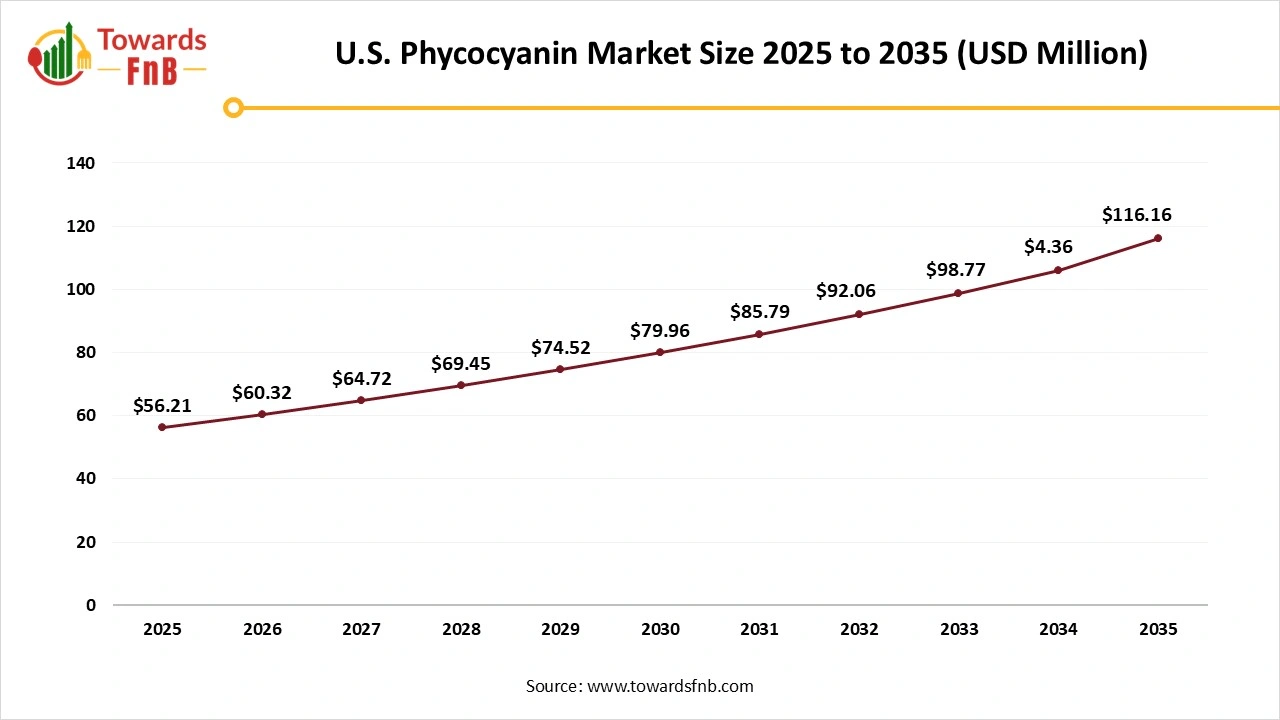
The U.S. phycocyanin market size estimated at USD 56.21 million in 2025 and is predicted to increase from USD 60.32 million in 2026 to nearly reaching USD 116.16 million by 2035, growing at a CAGR of 7.53% during the forecast period from 2026 to 2035.
Europe is expected to grow fastest during the forecast period. The market growth in Europe is driven by factors such as the increasing demand for functional food, growing rapid urbanization, increasing consumer health awareness, increasing clean-label and sustainable products, rising technological innovation in new food production, demand for vegan and vegetarian population and changing and busy lifestyles. The UK, France and Germany are the fastest growing countries driving the market growth.
The U.K. Phycocyanin Market Trends
U.K. is expected to grow fastest during the forecast period. The market growth in the UK is driven by increasing consumer health awareness, increasing preference towards sustainable and innovative packaging, growing food and beverage industry, and increasing consumption of vegan and veganism. The UK is a major producer in the region, leveraging functional properties and strategic moves and offering various purities for health, clean-label and sustainable products.
Why Does Asia Pacific Driving the Phycocyanin Market?
Asia Pacific is expected to grow at a notable rate during the forecast period. The market growth is driven by the growing robust regional production by major players, increasing disposable incomes, increasing strong shift from synthetic colors in food and beverages, high consumer consciousness of its natural antioxidant properties and increasing consumer demand for health-focused and clean-label products. China, India and South Korea are the notable countries in the region.
India Phycocyanin Market Trends
The India phycocyanin market is experiencing strong growth, driven by rising consumer awareness of health, natural ingredients, and clean-label products. Phycocyanin a vibrant blue pigment extracted primarily from Spirulina algae is increasingly adopted as a natural food colorant in beverages, dairy, and confectionery, replacing synthetic dyes as consumers demand safer, plant-based alternatives.
How does Middle East and Africa Driving Market Growth?
The phycocyanin market in Middle East and Africa is witnessing rapid growth, attributed to the rising investments in functional and aquaculture foods, rising plant-based trends, antioxidant properties, rising health awareness, strong food and beverage industries, and increasing demand for clean-label products, health supplements and natural blue food colorants.
South Arabia Phycocyanin Market Trends
The phycocyanin market in South Arabia is currently at an emerging stage but showing promising growth trends, driven largely by increasing consumer preference for natural and clean-label ingredients in food, beverages, nutraceuticals, and cosmetics. Rising health consciousness and demand for natural colorants as alternatives to synthetic additives are key trends supporting market adoption, especially in Saudi Arabia, the UAE, and other Gulf Cooperation Council (GCC) countries.
How does South America Driving the Market Growth?
The phycocyanin market in South America is witnessing significant growth, driven by increasing demand for antioxidant-rich ingredients in nutraceuticals, cosmetics and food and beverage, increasing health consciousness, and increasing consumer shift towards clean-label and natural products. Key factors also boosting the market include expanding applications, awareness of synthetic dye risks, and natural blue colorants.
Brazil Phycocyanin Market Trends
The phycocyanin market in Brazil is a growing and crucial industry, characterized by consumer interest in health benefits, consumer preference towards clean-label trends, increasing demand for natural ingredients in supplements and food and beverages. Major drivers include growing spirulina consumption, increasing health awareness and shift away from synthetic food colors, and further driving the market growth.
Why is Conventional Nature Segment Dominating the Phycocyanin Market?
The conventional nature segment dominated the global market revenue in 2025. Conventional nature plays an important role in the global market significantly due to its large-scale, established production methods and cost-effectiveness. Conventional phycocyanin is widely used as a functional ingredient and natural blue colorant, due to its broader availability and affordability in a huge range of products such as animal feed and food and beverages. Major drivers include consumer pressure against synthetic colorants, stricter regulations, rising technological innovation in stabilization and extraction and rise of organic alternatives, further driving the market growth.
The Organic Nature Segment is Expected to Grow Fastest During the Forecast Period.
The segment growth in the market is driven by factors such as increasing preference towards eco-friendly, organic and sustainable production, rise of plant-based and veganism trends, rising health consciousness, demand for high-quality and premium food supplement and rising innovation in personalized medicine and functional food and beverages.
Why Does the phycocyanin E18 Segment Dominating the Phycocyanin Market?
The phycocyanin E18 segment dominated the global market revenue in 2025. The segment growth in the global market is driven by factors such as rising food technology advancements cost-effectiveness and improving extraction, rising widespread use in dairy, beverages and sweets, health consciousness and clean-label trends, and increasing demand for natural alternatives in pharmaceuticals, nutraceuticals and food.
The Phycocyanin 30 Segment is Expected to Grow Fastest During the Forecast Period.
The phycocyanin 30 plays an important role in the market due to vibrant blue, stable and premium colorant for clean-label nutraceuticals, cosmetics and food and beverages. The phycocyanin 30 also provides a highly sought, natural blue and vibrant as a clean-label alternative.
What Factors Help Powder Segment to Grow in 2025?
The powder segment dominated the phycocyanin market revenue in 2025 and play a crucial role due to its high flexibility in dosing, ease of handling, longer shelf life and superior stability, making it ideal for pharma, cosmetics and food. Its ability to easily blended into several processed and products efficiently through spray or freeze drying, driving significant market share and enhancing its appeal over liquid forms.
The Liquid Segment is Expected to Grow Fastest During the Forecast Period.
The segment growth in the market is driven by the rise of better extraction technology, expanding applications in supplements, cosmetics and food, increasing health consciousness of its anti-inflammatory and antioxidants benefits, increasing consumer demand for clean-label and natural ingredients and rising improvements in algae extraction and cultivation methods enhance yield, purity, and production.
Why is Food and Beverage Segment Dominating the Phycocyanin Market?
The food and beverage segment dominated the global market revenue in 2025. The segment growth in the global market is driven by factors such as the rising advancements in algae cultivation improving cost-effectiveness and production efficiency, expanding applications in diverse range of products such as beverages, confectionery and dairy, increasing supportive regulatory approvals, demand for functional foods, and strong consumer shift towards clean-label and natural ingredients.
Northern Ireland’s Department of Agriculture, Environment and Rural Affairs
By Nature
By Grade
By Form
By End-use
By Region





Principal Consultant
Vidyesh Swar, Senior Research Analyst at Towards Food & Beverages, specializes in market research, focusing on supply-demand evaluation, pricing analysis, alternative proteins, plant-based foods, and sustainable food technologies within the industry.
Learn more about Vidyesh Swar
Reviewed By
Aditi Shivarkar, with 14+ years in Food and Beverages market research, specializes in food, beverage, and eco-friendly packaging. She ensures accurate, actionable insights, driving Towards FnB's excellence in industry trends and sustainability.
Learn more about Aditi ShivarkarApril 2026
April 2026
April 2026
April 2026

Phycocyanin Market


 +1 804-441-9344
 Download Sample
 Schedule a Meeting