April 2026



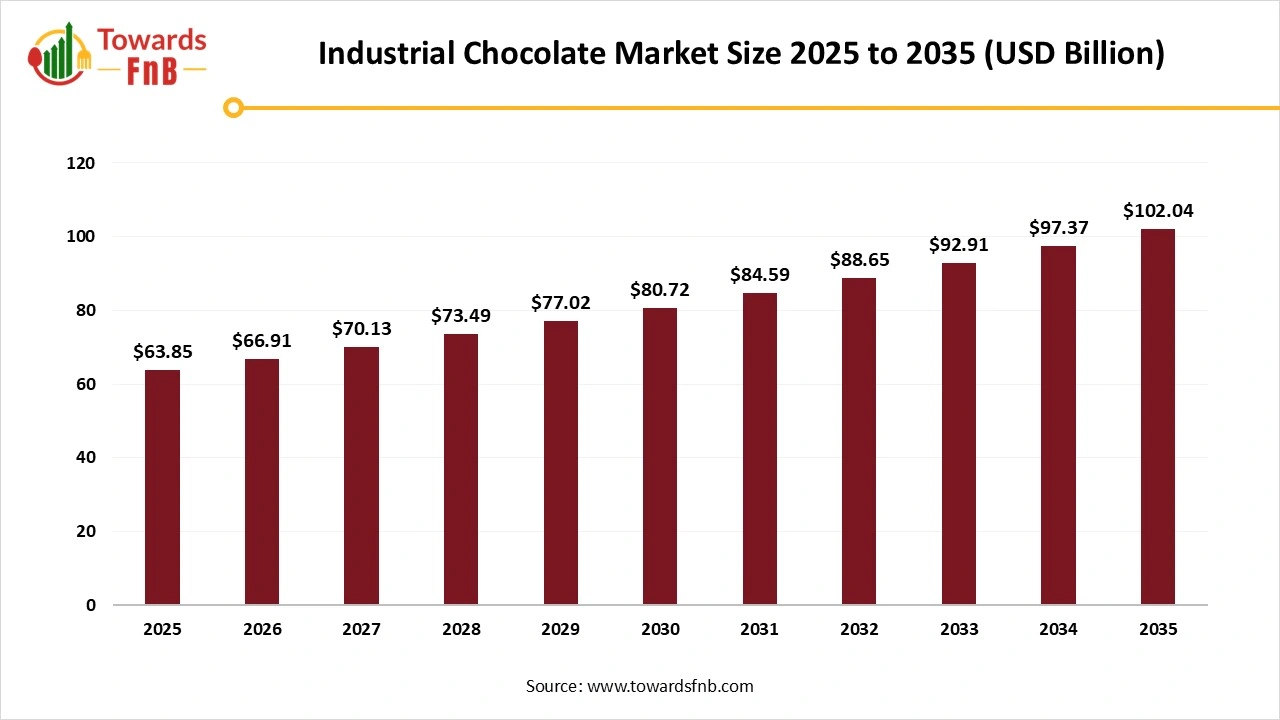
The global industrial chocolate market size was valued at USD 63.85 billion in 2025 and is expected to grow steadily from USD 66.91 billion in 2026 to reach nearly USD 102.04 billion by 2035, with a CAGR of 4.8% during the forecast period from 2026 to 2035. The high availability of on-the-go chocolate treats and the increased demand for snack bars drive market growth.
| Study Coverage | Details |
| Growth Rate from 2026 to 2035 | CAGR of 4.8% |
| Market Size in 2026 | USD 66.91 Billion |
| Market Size in 2027 | USD 70.13 Billion |
| Market Size by 2035 | USD 102.04 Billion |
| Largest Market | Europe |
| Base Year | 2025 |
| Forecast Period | 2026 to 2035 |
| Regions Covered | North America, Europe, Asia-Pacific, Latin America, and Middle East & Africa |
Industrial chocolate is the process of acquiring cocoa beans to manufacture large quantities of chocolate. It is available in various forms like slabs, chunks, solid blocks, and chips. The types of industrial chocolate are compound chocolate and real chocolate. The industrial chocolate offers characteristics like customization, refined texture, high consistency, reduced cost, customization, and form factor variety. Industrial chocolate is used in applications like bakery, beverages, snacks, confectionery, fillings, pastry, frozen dessert, and spreads.
The industrial chocolate market growth is driven by the high availability of functional chocolate varieties, the popularity of bakery items, the expanding dairy industry, growing distribution channels, increased consumption of cookies, the rising need for sugar-free chocolates, the growth in sustainably sourced cocoa, increased chocolate gifting, and the increased production of chocolate-based snacks.
The key technological shifts, like machine learning, 3D printing, smart packaging, IoT integration, smart manufacturing, automation, and digitalization, are undergoing in the industrial chocolate market, driven by demand for tailored flavor development, supply chain transparency, sustainability, and customization. The AI integration is the major shift in the market, driven by unique flavor development, ethical sourcing, and faster product development.
AI develops innovative combinations and manufactures chocolate in the faster speed. AI easily detects misshapen chocolate molds and predicts failures of equipment. AI develops high-quality finished chocolate and analyzes trendy flavor combinations. AI optimizes the ingredient sourcing process and offers personalized recommendations for chocolate. Overall, AI scales the development of new chocolate products.
Raw Material Procurement
Processing and Preservation
Quality Testing and Certifications
| Types | Ingredients Required | Major Application | Kay Companies |
| Milk Chocolate | Cocoa Butter Milk Solids Cocoa Solids Sugar |
Chocolate Bars Ganache Chocolate Sauces |
The Hershey Company Ferrero Group Barry Callebaut |
| Dark Chocolate | High Cocoa Solids | Truffles Gourmet Desserts Brownies Hot Chocolate Ice Cream |
Godiva Hershey’s Lindt & Sprungli Mondelez International |
| Compound Chocolate | Cocoa Powder Milk Solids Sweeteners Flavorings |
Biscuit Coating Cake Decorations Ice Cream Coatings Drizzling |
Cargill Incorporated Puratos Group Blommer Chocolate Company |
| White Chocolate | Sugar Cocoa Butter Milk Solids |
Frosting Muffins Fudge Coffee Drinks Dessert Sauces Cookies |
Nestlé S.A. Barry Callebaut The Hershey Company |
Why Europe Dominates the Industrial Chocolate Market?
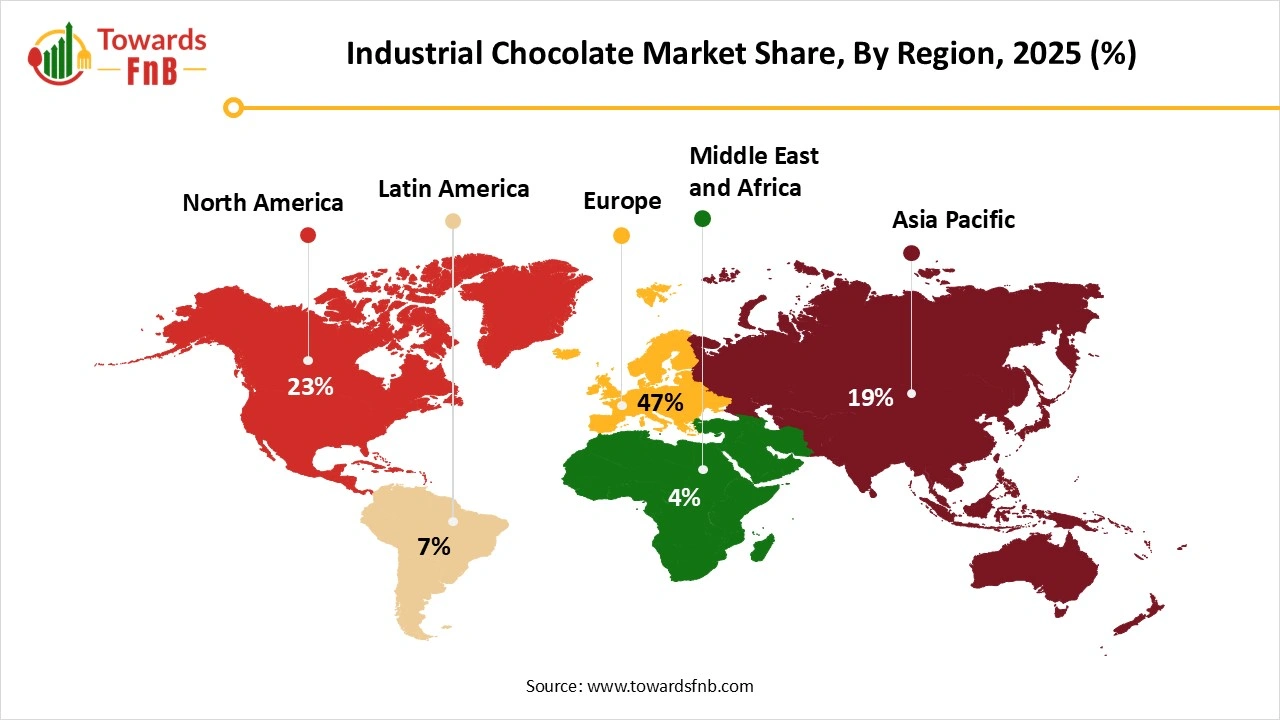
Europe dominated the industrial chocolate market with approximately 47% share in 2025. The strong presence of gifting culture and the robust growth in the premiumization trend increase demand for industrial chocolate. The celebrations of festivals like Christmas and the high preference for organic products increase the adoption of industrial chocolate. The well-established chocolate-making factories and the presence of sustainable cocoa sourcing drive the market growth.
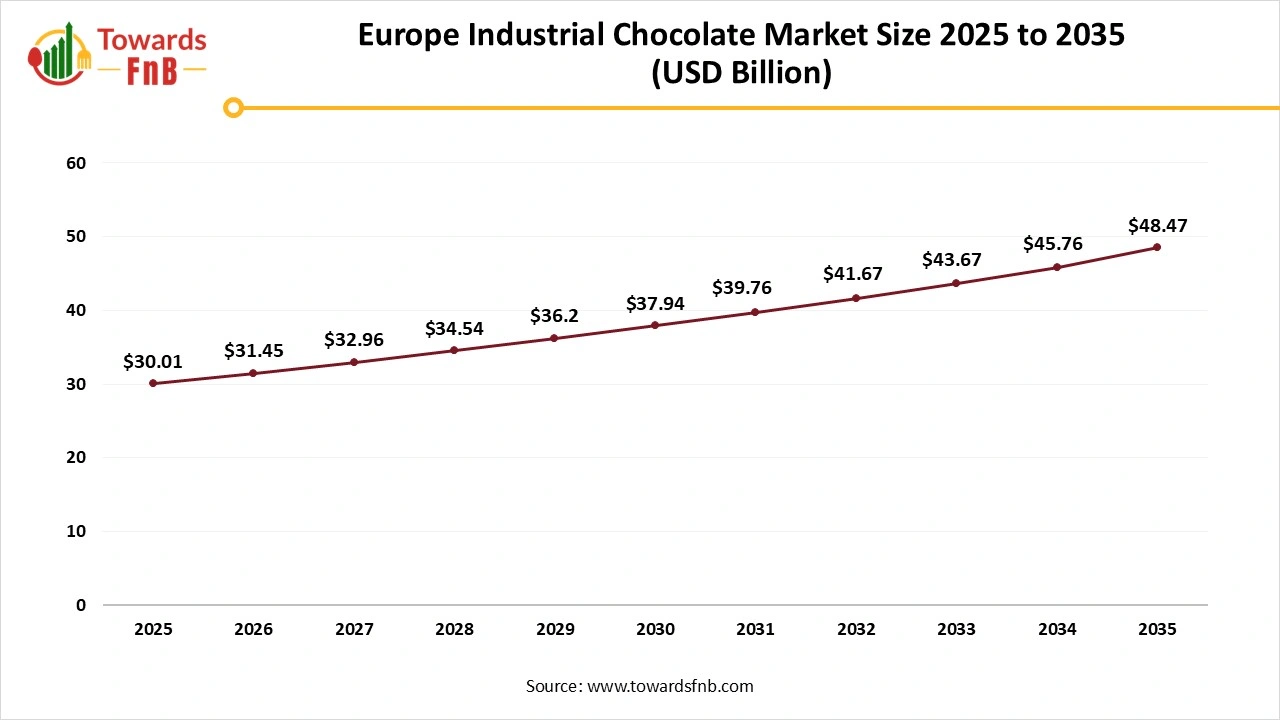
Europe Industrial Chocolate Market Size 2025 to 2035
The Europe industrial chocolate market size was calculated at USD 30.01 billion in 2025 with projections indicating a rise from USD 31.45 billion in 2026 to approximately USD 48.47 billion by 2035, expanding at a CAGR of 4.91% throughout the forecast period from 2026 to 2035.
Germany's Footprint in Industrial Chocolate Production
Germany is a major contributor to the market. The high rate of sweets consumption and the growing food service industry increase demand for industrial chocolate. The increasing adoption of Industry 4.0 and the well-established cocoa beans processing capabilities help market expansion. The high consumption of confectionery and the extensive local chocolate consumption support the overall market growth.
Asia Pacific Industrial Chocolate Market Trends
Asia Pacific is experiencing the fastest growth in the market during the forecast period. The growing popularity of western-style diets and gifting culture during festivals like Diwali increases demand for industrial chocolate. The increased expansion of the ice cream industry and the rising awareness of the health benefits of chocolate consumption increase demand for industrial chocolate. The increasing demand for confectionery products and the robust growth in dairy-based chocolate drive the market growth.
India’s Growing Expansion in Industrial Chocolate
India is rapidly expanding in the market. The consumer shift towards gourmet chocolates and the growing year-round gifting culture increase demand for industrial chocolate. The increased development of locally flavored chocolate and the rise in corporate gifting increase the adoption of industrial chocolate. The growing consumption of compound chocolate and the rising purchasing of chocolate support the overall market growth.
Why Milk/White Chocolate Segment Dominates the Industrial Chocolate Market?
The milk/white chocolate segment dominated the industrial chocolate market with approximately 50.2% share in 2025. The increasing use of coating agents in food applications and the rapid expansion of sweet confectionery increase demand for milk chocolate. The high rate of ice cream consumption and the increased production of cosmetic butter increases adoption of white chocolate. The increased popularity of beverages and the high production of a wide range of bakery items require milk chocolate, driving the overall market growth.
The Dark Chocolate Segment is the Fastest-Growing in the Market During the Forecast Period
The consumer demand for lower sugar content chocolate and the focus on artisanal products increase the demand for dark chocolate. The shift towards high-antioxidant product consumption and the rise in dairy-free diets increase demand for dark chocolate. The growing expansion of the dark chocolate product range and the development of dairy-free dark chocolate support the overall market growth.
Industrial Chocolate Market Share, By Product Type, 2025 (%)
| Segments | Shares (%) |
| Milk/White Chocolate | 50.2% |
| Dark Chocolate | 49.8% |
How did the Real Chocolate Segment hold the Largest Share in the Industrial Chocolate Market?
The real chocolate segment held the largest revenue share of approximately 88% in the market in 2025. The high consumer spending on authentic ingredients and the growth in high-end dairy applications increase demand for real chocolate. The strong consumer focus on ethical sourcing and authentic cocoa taste increases adoption of real chocolate. The superior quality, high nutritional value, rich flavor, and superior finish of real chocolate drive the market growth.
The Compound Chocolate Segment is the Fastest-Growing in the Market During the Forecast Period
The increased baked goods production and the growing number of confectioners increase demand for compound chocolate. The surge in the expansion of bakery items and the increasing use of toppings in bakery products increases demand for compound chocolate. The cost-effectiveness, ease of handling, efficient processing, and functional superiority of compound chocolate support market growth.
Industrial Chocolate Market Share, By Category, 2025 (%)
| Segments | Shares (%) |
| Real Chocolate | 88% |
| Compound Chocolate | 12% |
Which Application Dominated the Industrial Chocolate Market?
The confectionery segment dominated the industrial chocolate market with approximately 46% share in 2025. The high consumer spending on confectionery products and the rise in chocolate confectionery gifting trends help market expansion. The growth in daily consumption of chocolate truffles and the focus on enhancing the texture of confectionery increase demand for industrial chocolate. The heavy consumption of molded chocolate bars and the increased adoption of chocolate confectionery in celebrations drive the overall market growth.
The Bakery & Biscuits Segment is the Fastest-Growing in the Market During the Forecast Period
The consumer spending on gourmet chocolate-based bakery products and the popularity of portable snacks require industrial chocolate. The popularity of pastry bars and the increased use of chocolate fillings in cakes increases demand for industrial chocolate. The increased production of chocolate-coated biscuits and the higher demand for Western-style bakery product support the overall market growth.
Industrial Chocolate Market Share, By Application, 2025 (%)
| Segments | Shares (%) |
| Confectionery | 46% |
| Bakery & Biscuits | 27% |
| Dairy & Frozen Desserts | 27% |
Olam Food Ingredients
Corona Food Industries
Milkybar
By Product Type
By Category
By Application
By Region




Principal Consultant
Vidyesh Swar, Senior Research Analyst at Towards Food & Beverages, specializes in market research, focusing on supply-demand evaluation, pricing analysis, alternative proteins, plant-based foods, and sustainable food technologies within the industry.
Learn more about Vidyesh Swar
Reviewed By
Aditi Shivarkar, with 14+ years in Food and Beverages market research, specializes in food, beverage, and eco-friendly packaging. She ensures accurate, actionable insights, driving Towards FnB's excellence in industry trends and sustainability.
Learn more about Aditi ShivarkarApril 2026
April 2026
April 2026
April 2026

Industrial Chocolate Market

 +1 804-441-9344
 Download Sample
 Schedule a Meeting