April 2026



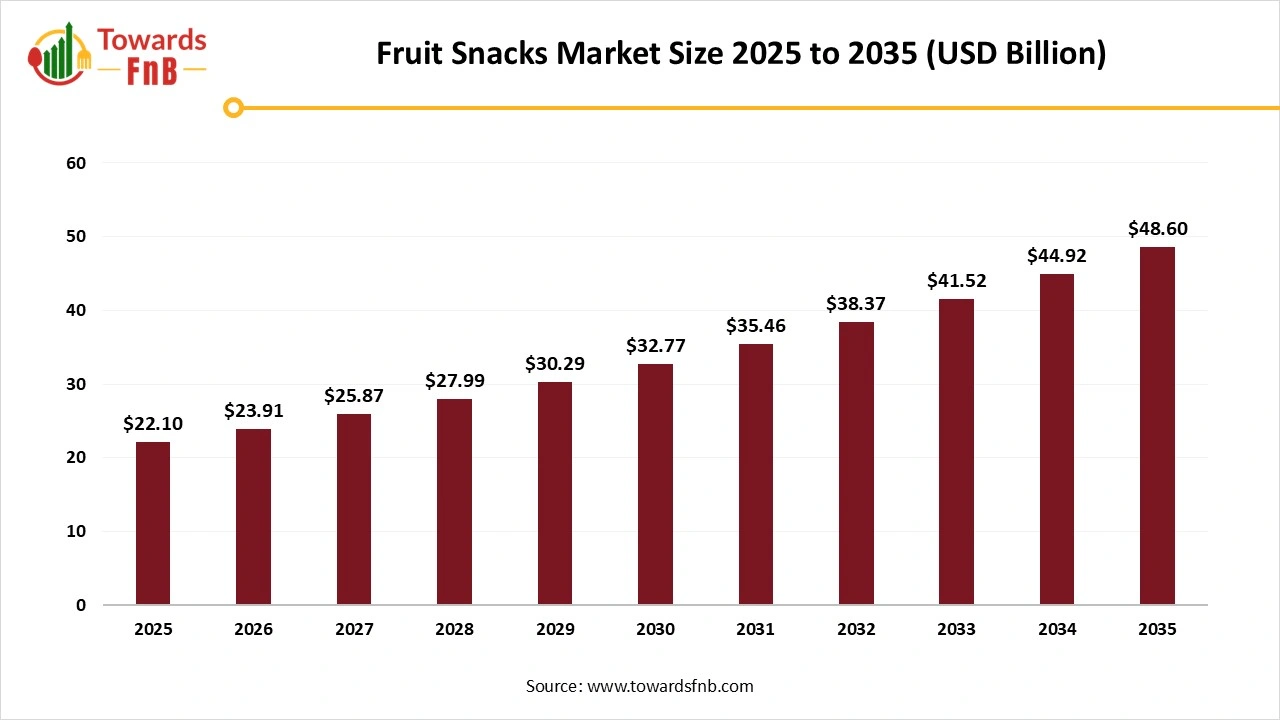
The global fruit snacks market size was calculated at USD 22.10 billion in 2025 and is expected to grow steadily from USD 23.91 billion in 2026 to reach nearly USD 48.60 billion by 2035, with a CAGR of 8.2% during the forecast period from 2025 to 2034. Rising health awareness and growing demand for low-calorie snacks are expanding the market.
| Study Coverage | Details |
| Growth Rate from 2026 to 2035 | CAGR of 8.2% |
| Market Size in 2026 | USD 23.91 Billion |
| Market Size in 2027 | USD 25.87 Billion |
| Market Size by 2035 | USD 48.60 Billion |
| Largest Market | North America |
| Base Year | 2025 |
| Forecast Period | 2026 to 2035 |
| Regions Covered | North America, Europe, Asia-Pacific, Latin America, and Middle East & Africa |
The fruit snacks market includes packaged snack products made from processed fruits, concentrates, purées, or infused fruit pieces designed as convenient, flavorful, and nutritious alternatives to traditional confectionery. These snacks cater to health-conscious consumers seeking clean-label, natural, and on-the-go options with reduced sugar and functional benefits. The market is driven by rising demand for healthy snacking, product innovation, fortified variants, diverse flavors, and growing distribution through retail, e-commerce, and foodservice channels across global consumer segments.
Recent advancements in food processing and packaging technologies have positively influenced the growth of the market, facilitating longer shelf life, preservation of nutritional value, and enhancement of product quality. There has been a significant increase in the popularity and availability of freeze-dried fruit snacks. This processing method retains a high proportion of the fruit's nutritional value, color, and natural flavor while providing a distinct crispy texture and extended shelf life. Furthermore, artificial intelligence and automation are playing a transformative role by streamlining manufacturing processes and improving quality control. Intelligent sorting systems and automated packaging solutions have enhanced efficiency, minimized human error, and reduced food waste.
Raw Material Procurement
Processing of Fruit Snacks
Packaging of Fruit Snacks
Why did North America Dominate the Fruit Snacks Market In 2025?
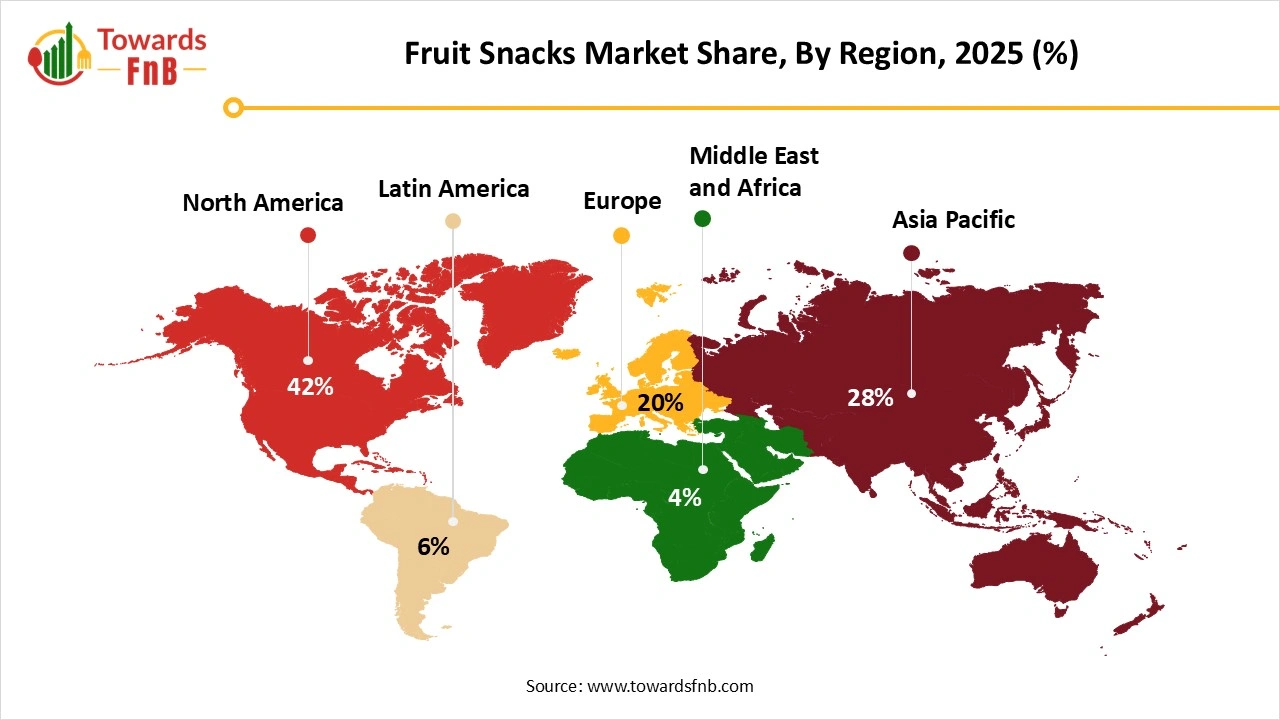
North America dominated the market with 42.8% share in 2025. The growth of the market is closely linked to consumers' preference for low-calorie snacks, a trend that aligns with the overall health and wellness movement. The market's expansion is supported by the availability of fruit snacks in grocery stores, convenience stores, and online retailers, coupled with the introduction of innovative flavors and products catering to dietary requirements such as gluten-free, low-calorie, and vegan options. The proliferation of supermarkets, hypermarkets, modern retail formats, and high demand also contributes to greater accessibility.
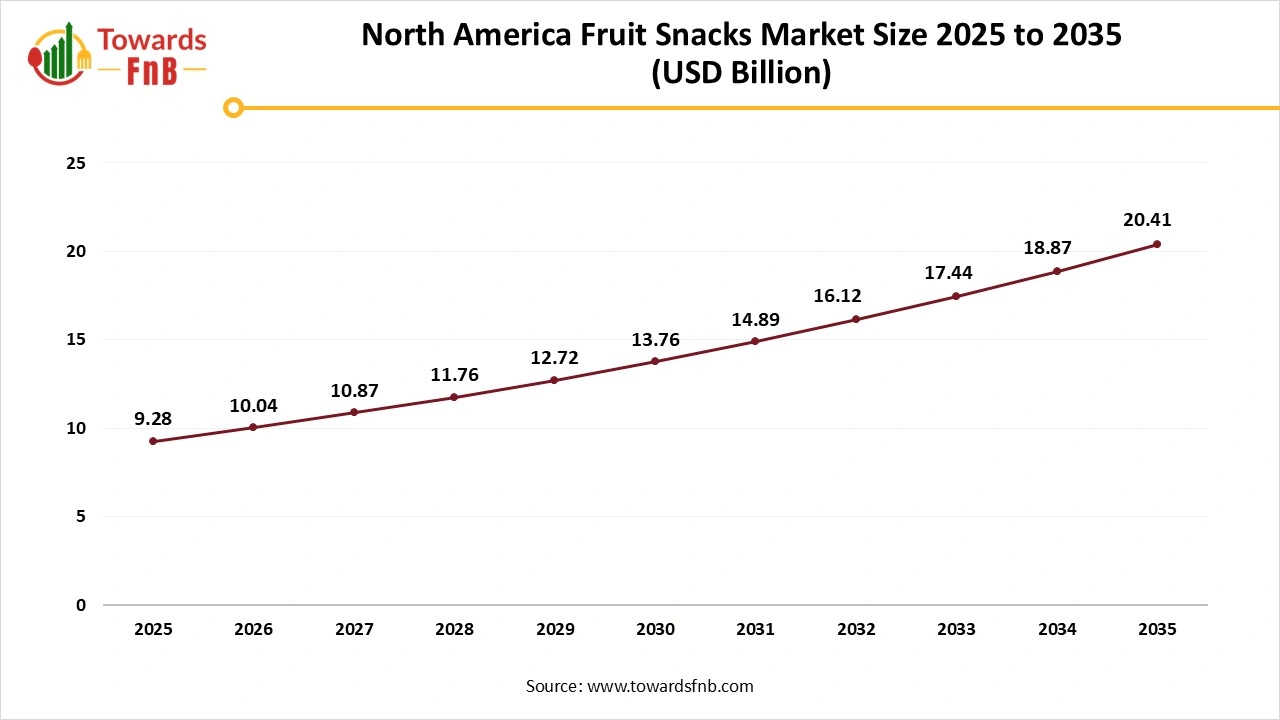
The North America fruit snacks market size estimated at USD 9.28 billion in 2025 and is predicted to increase from USD 10.04 billion in 2026 to nearly reaching USD 20.41 billion by 2035, growing at a CAGR of 8.2% during the forecast period from 2026 to 2035.
How is the United States Thriving in the Fruit Snacks Market?
In the United States, the demand for fruit snacks is increasing as consumers gravitate towards convenient and healthier snacking options. A significant driving force in this market is the elevation of consumer expectations regarding clean label ingredients, natural colors, low sugar content, and functional additives such as fiber or vitamins. Retail and online channels are expanding their shelf space and variety of fruit-based snacks in response to the preferences of younger demographics and families seeking superior alternatives.
Which Region is Fastest Growing in the Fruit Snacks Market?
Asia Pacific expects fastest growth during the forecast period. Across the Asia Pacific region, there is an increasing awareness regarding health and wellness, driven by rising income levels and enhanced access to information. Consumers are progressively seeking nutritious snack options that support healthier lifestyles, particularly in urban areas characterized by busy routines. This trend is notably evident in countries such as China, India, Japan, and South Korea, where the urban middle-class demographic is propelling the demand for healthier alternatives to traditional snacks, including fried and sugary foods. The emergence of modern retail formats, such as supermarkets, convenience stores, and e-commerce platforms, has further improved the availability and accessibility of fruit snacks within this region.
India's Fruit Snacks Market Analysis
The fruit snacks market in India has experienced a remarkable transformation, evolving from traditional delicacies like aam papad to modern fruit-based snacks that align with contemporary consumption patterns. The market is gravitating towards natural ingredients, clean labels, and sustainable sourcing, presenting significant export potential. Companies are leveraging technologies such as vacuum frying to produce healthy, natural snacks from abundant local produce. Major industry players and smaller manufacturers are actively engaging with this evolving market. A notable technique employed by brands such as FruitTreat is the low-temperature evaporation of water, which results in lightweight, crispy, nutrient-dense snacks with reduced oil content.
What are the Factors Driving the Fruit Snacks Market in Europe?
The market in Europe has witnessed substantial growth, prompted by increasing health consciousness among consumers and the rising demand for convenient, nutritious snack options. As consumers look for healthier alternatives to conventional snacks, manufacturers are innovating low sugar formulations and utilizing natural ingredients to capture market share. This trend is particularly pronounced in European countries with high levels of health awareness, resulting in a dynamic and expanding market landscape.
Fruit Snacks Market Growth in Germany
The market in Germany has been experiencing steady growth, driven by heightened consumer demand for healthier snack options. German consumers are increasingly health-conscious, actively seeking products that are low in sugar and composed of natural ingredients.
Expanding Fruit Snacks Market of the Middle East and Africa
The growth market in the Middle East and Africa is largely fueled by increasing health consciousness among consumers, rising urbanization, and evolving lifestyles that favor convenient, nutritious options. Heightened awareness of the advantages associated with natural and organic products has bolstered demand for healthier snack alternatives. Additionally, a rise in disposable incomes and a youthful demographic profile contribute to market expansion. The expansion of retail channels, encompassing supermarkets and online platforms, facilitates greater accessibility to these products. For instance, Norway’s development finance institution, Norfund, has committed up to US$6 million to support the farmer-led acquisition of Langeberg Foods, a prominent South African canned fruit producer.
Saudi Arabia Fruit Snacks Market Examination
The fruit snacks market in Saudi Arabia is experiencing a significant transformation, shifting from traditional dried dates, which have historically been viewed as a dietary staple, to more contemporary packaged fruit snack formats. Market segmentation indicates an increasing preference for natural, organic fruit snacks, driven by growing health consciousness among Saudi consumers, especially within urban centers such as Riyadh and Jeddah. In Saudi Arabia, there is a burgeoning market for "fruit-based chips" derived from apples, bananas, mangoes, and mixed fruits, highlighting a movement away from traditional fried snacks.
Growing Fruit Snacks Market in South America
South America's fruit snacks market is significantly influenced by the region's rich agricultural practices and the expanding urban middle class, which is experiencing an increase in disposable income. Furthermore, the ready availability of diverse tropical fruits provides local manufacturers with an exceptional opportunity to produce fruit snacks tailored to regional tastes and preferences, thereby bolstering market growth.
Analysis of Brazil's Fruit Snacks Market
The fruit snacks market in Brazil represents a burgeoning sector that is transitioning toward healthier, more portable options such as fruit bars and freeze-dried snacks. This shift is propelled by the country’s local biodiversity, including fruits such as açaí and guava, alongside a rising demand for natural snacks. Local enterprises, including Flormel, Jasmine Alimentos, and Native, have expanded their offerings of fruit bars, focusing on organic certification and natural ingredients. These businesses align with global trends in snack food consumption and effectively utilize the abundant variety of fruits found within Brazil.
Fruit Snacks Market Share, By Product Type, 2025 (%)
| Segments | Shares (%) |
| Fruit Rolls | 20% |
| Fruit Gummies & Chews | 34.5% |
| Fruit Bars | 15% |
| Freeze-Dried Fruits | 12% |
| Candied Fruits | 8% |
| Others | 19.5% |
Which Product Type Segment Dominated the Fruit Snacks Market in 2025?
The fruit gummies and chews segment led the fruit snacks market with 34.5% share in 2025. Growth within this category is attributed to the general appeal of confectionery, the demands of busy lifestyles for convenient snacks, and a significant shift towards healthier, functional options such as organic, sugar-free, or vitamin-fortified varieties. These products appeal to health-conscious adults and parents seeking quick, tasty treats that prioritize natural ingredients.
The Freeze-Dried Fruits Segment is Anticipated to Grow at the Fastest Rate During the Forecast Period.
An increasing consumer preference for healthier alternatives to traditional processed snacks drives the rising demand for freeze-dried fruits. These products deliver natural sweetness and nutritional benefits without the addition of sugars or preservatives, attracting health-conscious consumers. Innovations in drying technologies, including energy-efficient freeze-drying methods and advanced packaging solutions, further support this growth.
Fruit Snacks Market Share, By Fruit Type, 2025 (%)
| Segments | Shares (%) |
| Apple | 20% |
| Mango | 15% |
| Berries | 10% |
| Citrus | 12% |
| Tropical Fruits | 11% |
| Mixed Fruits | 32.5% |
Which Fruit Type Segment Dominated the Fruit Snacks Market in 2025?
The mixed fruits segment dominated the market with 32.5% share in 2025, as it provides variety, familiar flavors such as apple and strawberry, and a perceived enhanced value through blended compositions. This segment appeals to both children and adults seeking diverse taste experiences. Consumers enjoy the combination of flavors and textures, finding it more engaging than single-fruit options; additionally, these mixtures often contain essential vitamins and are notably fat-free, aligning with the trend towards healthier snacks.
The Berries Segment is Projected to Experience Notable Growth Throughout the Forecast Period.
This segment includes flavors such as cranberry, strawberry, blueberry, and mixed berries, which are favored by children due to their sweet and tart characteristics. Dried berries are extensively used in breakfast cereals, trail mixes, baked goods, and health supplements. Their rich antioxidant content and extended shelf life make them a preferred choice for both health-conscious consumers and food manufacturers.
Fruit Snacks Market Share, By Category, 2025 (%)
| Segments | Shares (%) |
| Conventional | 68.7% |
| Organic | 31.3% |
How did the Conventional Segment Dominate the Fruit Snacks Market in 2025?
The conventional segment held the largest share of 68.7% in the market in 2025. Conventional fruit snacks are typically produced using ingredients treated with synthetic chemicals, pesticides, or fertilizers. These products often remain more affordable than their organic counterparts and are generally more accessible in terms of availability. The high-volume production of conventional snacks allows for cost-effectiveness, while their convenient, ready-to-eat formats fulfill the demand for quick and accessible treats.
The Organic Segment is Expected to Grow at a Significant Rate During the Forecast Period.
Consumers are increasingly selective about their food choices, favoring products free from artificial additives, preservatives, genetically modified organisms, and pesticides. This shift in consumer preferences has driven growth in organic snack options, such as fruit chips. The rising fitness culture, heightened awareness regarding food allergies, and the desire for natural, minimally processed food have further catalyzed the popularity of organic snacks.
Which Distribution Channel Dominated the Fruit Snacks Market in 2025?
Supermarkets & hypermarkets held the largest share of 38.9% in the market in 2025. Consumers demonstrate a distinct preference for supermarkets and hypermarkets when selecting snack options, a trend attributable to several key factors. These retail formats offer a wide variety of nutritious snack alternatives, and their extensive global presence enables them to dominate the market as a primary distribution channel.
The Online Retail Segment is Projected to Experience Rapid Growth During the Forecast Period.
Reputable online platforms often prioritize quality assurance and transparency in their sourcing practices. Comprehensive product descriptions, information regarding origin, and customer reviews play a significant role in fostering trust among online shoppers concerning the quality of their purchases. Consequently, this is anticipated to drive expansion within this segment throughout the forecast period.
BranchOut Food Inc.
The Fruit Factory
By Product Type
By Fruit Type
By Category
By Distribution Channel
By Region




Principal Consultant
Vidyesh Swar, Senior Research Analyst at Towards Food & Beverages, specializes in market research, focusing on supply-demand evaluation, pricing analysis, alternative proteins, plant-based foods, and sustainable food technologies within the industry.
Learn more about Vidyesh Swar
Reviewed By
Aditi Shivarkar, with 14+ years in Food and Beverages market research, specializes in food, beverage, and eco-friendly packaging. She ensures accurate, actionable insights, driving Towards FnB's excellence in industry trends and sustainability.
Learn more about Aditi ShivarkarApril 2026
April 2026
April 2026
April 2026

Fruit Snacks Market


 +1 804-441-9344
 Download Sample
 Schedule a Meeting