April 2026



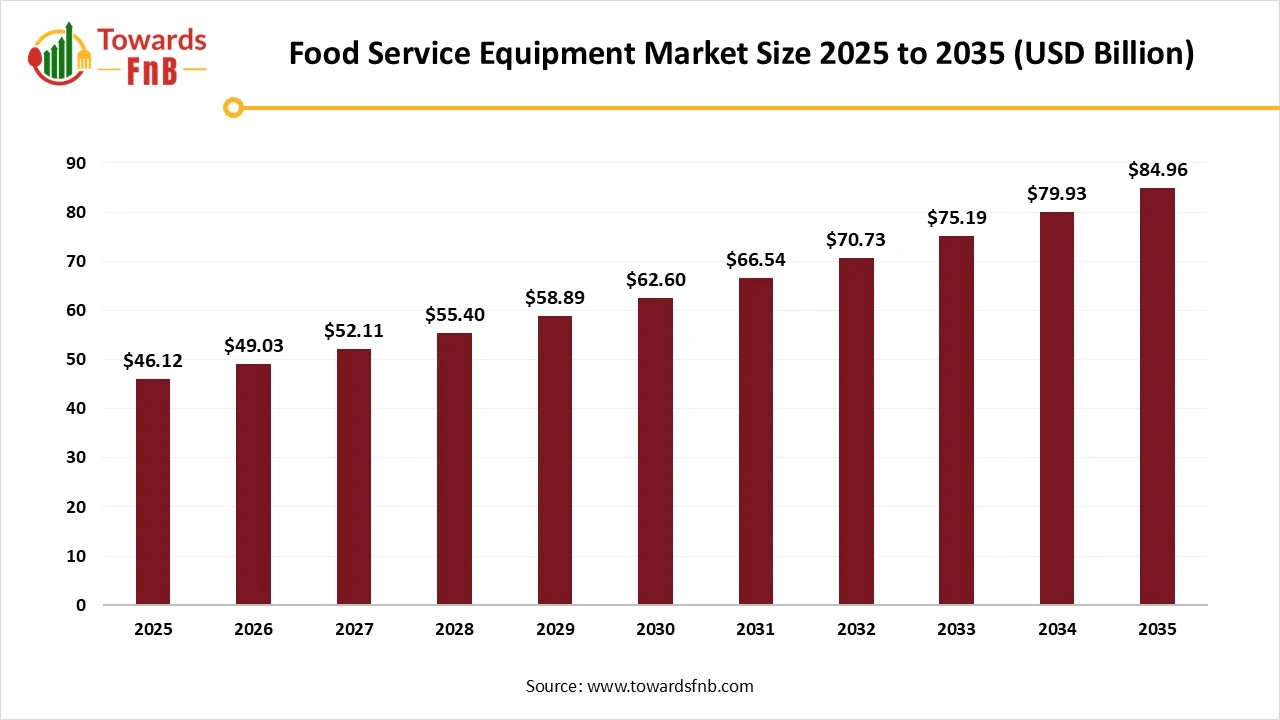
The global food service equipment market size reached at USD 46.12 billion in 2025 and is anticipated to increase from USD 49.03 billion in 2026 to an estimated USD 84.96 billion by 2035, witnessing a CAGR of 6.3% during the forecast period from 2026 to 2035. The growth of the market is driven by growing food delivery or hospitality sectors.
| Study Coverage | Details |
| Growth Rate from 2026 to 2035 | CAGR of 6.3% |
| Market Size in 2026 | USD 49.03 Billion |
| Market Size in 2027 | USD 52.11 Billion |
| Market Size by 2035 | USD 84.96 Billion |
| Largest Market | North America |
| Base Year | 2025 |
| Forecast Period | 2026 to 2035 |
| Regions Covered | North America, Europe, Asia-Pacific, Latin America, and Middle East & Africa |
The food service equipment market includes commercial-grade appliances and systems used for food preparation, cooking, storage, serving, and cleaning in restaurants, hotels, catering units, institutional kitchens, and quick-service outlets. Equipment ranges from cooking and refrigeration systems to warewashing, food preparation, and beverage machines. Market growth is driven by expansion of food service outlets, quick-service restaurants, cloud kitchen, tourism, and demand for energy-efficient, automated, and hygienic kitchen solutions across commercial and institutional settings.
The market growth is also driven by the increasing popularity of diverse dining experiences, cloud kitchen and QSRs, stricter food safety norms, increasing focus on energy-saving appliances and sustainability, and rising technological advancements such as smart kitchens and IoT for efficiency. In addition, increasing busy lifestyles, rapid urbanization, increasing demand from delivery, hotels and expanding restaurants, demand for convenience dining out and increasing environmental awareness, further drives the market growth.
The rise of technological advancements in foodservice equipment focus on sustainability such as waste reduction and automation, novel ingredients, advanced processing such as 3D printing, and personalization such as data and AI. Big data and AI help to analyze energy-efficient system, predictive maintenance, robotic fryers and smart oven that optimize, control and monitor operations, while supporting data analytics and cloud-based management for waste reduction and better inventory in traditional setups and cloud kitchens.
Connected appliances such as fryers, ovens and fridges communicate data for energy management, predictive maintenance, remote control, automated adjustments and real-time monitoring, further reducing downtime and errors.
Raw Material Procurement
Packaging and Branding
Waste Management and Recycling
| Country | Regulatory Body | Key Regulations | Focus Areas | Notable Notes |
| India | Food Safety and Standards Authority of India (FSSAI) | Food Safety and Standards (Packaging and Safety Regulations) and Licensing and Registration of Food Businesses) | Major focus areas in the foodservice equipment market focuses on innovation for hygiene, energy savings and efficiency, driven by trends such as stricter food safety, delivery services and cloud kitchens. | The foodservice equipment is focus on cloud kitchen expansion, sustainability, AI integration and digitalization and automation in labor. |
Why is North America Dominating the Food Service Equipment Market?
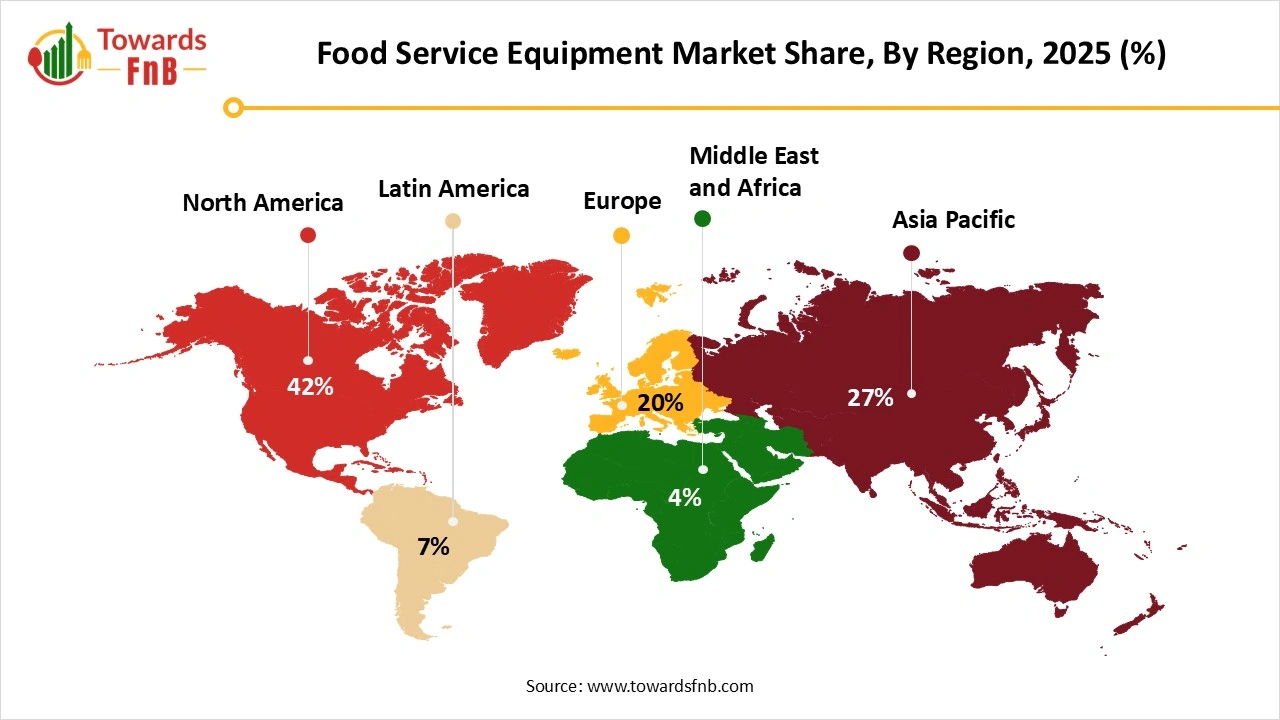
North America dominated the food service equipment market by 42.5% of revenue in 2025. The market growth in the global market is attributed to the increasing popularity of cloud kitchen, hotels and restaurants, rising innovation in preparation, refrigeration and cooking equipment, demand for advanced equipment and energy-efficient with major players such as Dover Corp, Electrolux and Middle Corp, and rising strict food safety regulations, sustainability trends, tech adoption such as smart kitchens and IoT and increasing fast/QSR-casual demand. The U.S. and Canada are dominating countries in the region.
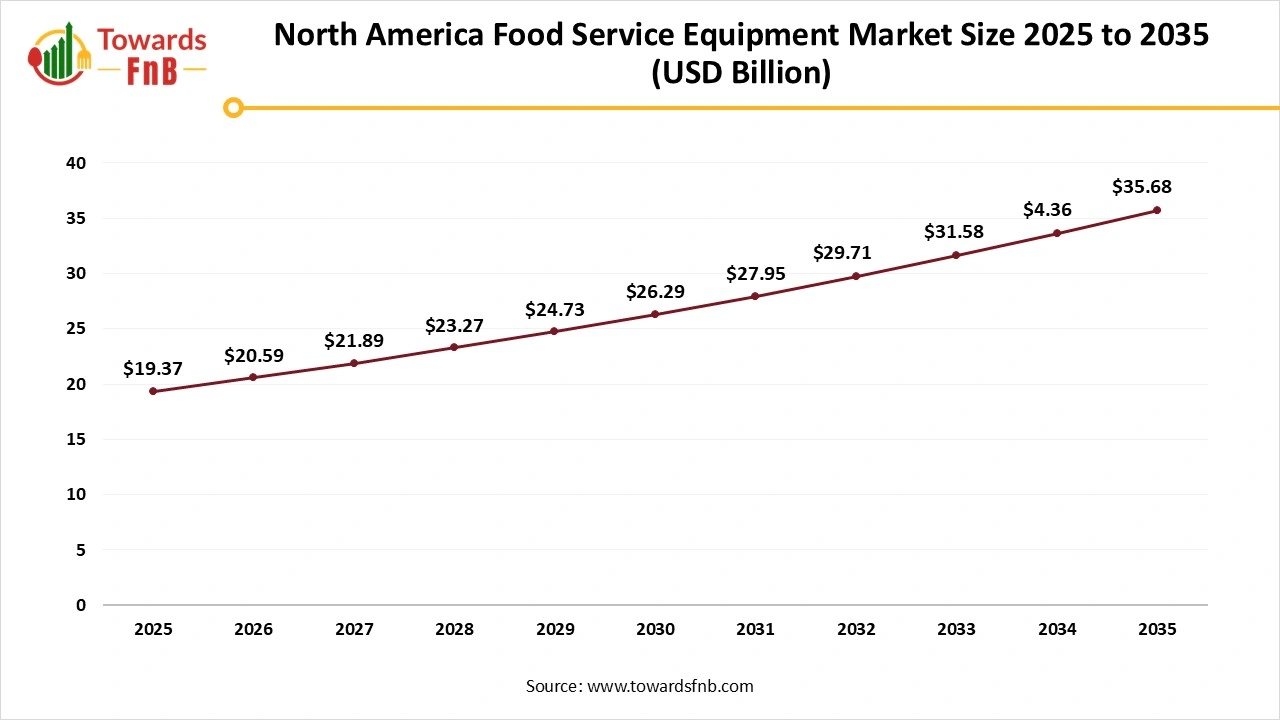
The North America food service equipment market size estimated at USD 19.37 billion in 2025 and is predicted to increase from USD 20.59 billion in 2026 to nearly reaching USD 35.68 billion by 2035, growing at a CAGR of 6.3% during the forecast period from 2026 to 2035.
The U.S. Food Service Equipment Market Trends
The foodservice equipment industry in the U.S. is a growing and large sector, driven by demand for efficiency, tech such as smart kitchens (IoT) and restaurant expansion, with major segments such as shift towards automation for labor savings and prep/cooking gear with innovation in integrated and energy-efficient systems for various food service systems from QSR to cloud kitchens. Various cloud kitchens, cafes and restaurants are needed more foodservice equipment in the U.S.
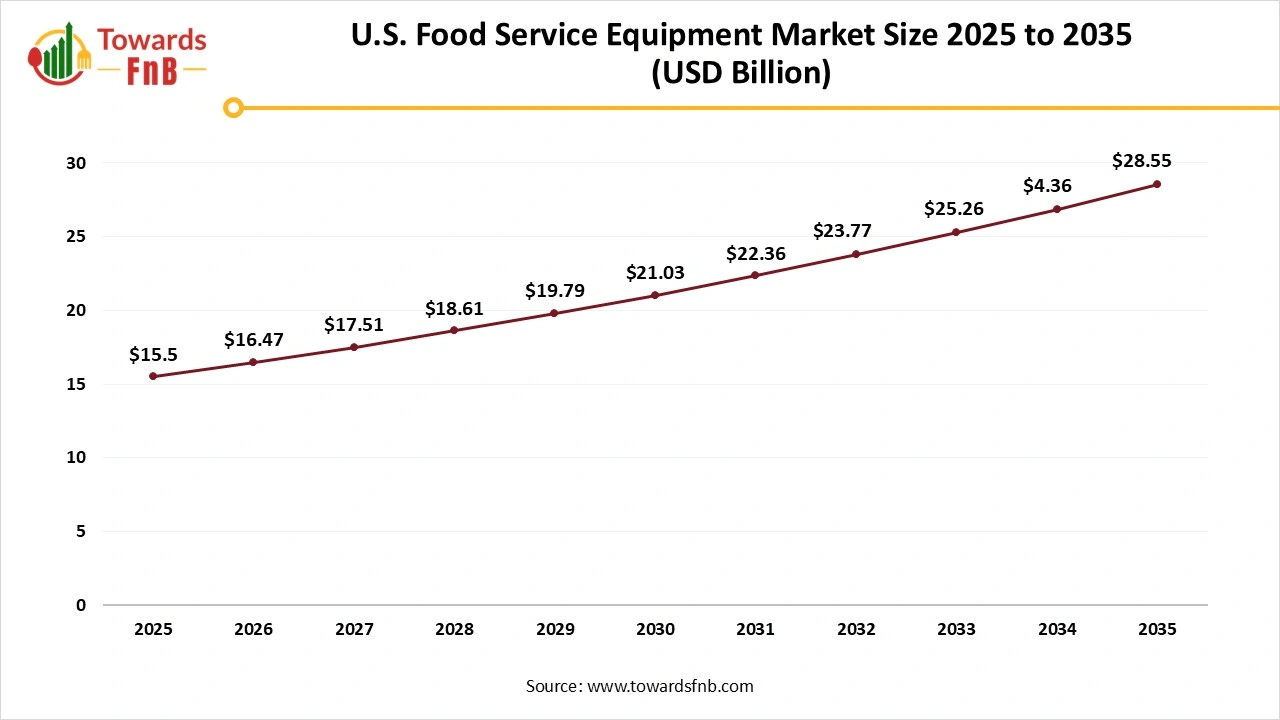
The U.S. food service equipment market size was calculated at USD 15.5 billion in 2025 with projections indicating a rise from USD 16.47 billion in 2026 to approximately USD 28.55 billion by 2035, expanding at a CAGR of 6.3% throughout the forecast period from 2026 to 2035.
Asia Pacific is Expected to Grow Fastest During the Forecast Period
The market in the region, driven by the increasing demand for tech-integrated and energy-efficient gear such as prep/cooking tools, the boom in FSR/QSR chains, growing tourism, increasing disposable incomes and rapid urbanization. Major growth areas are China and India, while operational efficiency and sustainability are major trends, driving demand for automated, eco-friendly and advanced equipment across various services from hotels to cloud kitchens.
India Food Service Equipment Market Trends
India is expected to grow fastest during the forecast period. The foodservice equipment industry in India is growing rapidly, driven by increasing focus on safety and hygiene, rising technological advancements, integration of smart kitchen technologies, automation solutions and IoT-enabled appliances, rise in online food delivery services to manage large order volumes, expansion of catering industry, restaurant and hotel, demand for convenient food options and dining out, changing lifestyles and increasing consumer income.
Why Does Europe Driving the Food Service Equipment Market?
Europe is expected to grow at a notable rate during the forecast period. The foodservice equipment industry in Europe is a growing and major sector, driven by factors such as increasing emphasis on energy efficiency and food safety, rise of cloud kitchens and digital ordering and increasing popularity towards strong dining-out culture. There is also stricter European regulations in Europe driving the need for sustainable, eco-friendly and energy-efficient equipment.
The Germany Food Service Equipment Market Trends
The foodservice equipment sector is witnessing rapid growth, driven by increasing demand for smart kitchens, sustainability, digitalization and convenience food, with kitchen purpose equipment. Key factors include rising innovation in smart appliances and induction cooking for hospitals and hotels, restaurants, expansion of QSRs strict German/EU eco-mandates, and increasing consumer preference for International or Asia cuisines, driving the market growth.
Why does the Middle East and Africa Driving the Food Service Equipment Market?
The foodservice equipment market in the region is witnessing robust growth, driven by demand from cloud kitchens, restaurants and hotels, government focus on food security, increasing disposable incomes, urbanization and increasing tourism. Key trends include shifting towards advanced solutions for sustainability, hygiene and efficiency, increasing adoption of modern handling or processing gear and high demand for smart, automated and energy-efficient equipment, which may expected to increase the demand for foodservice equipment in Middle East and Africa.
UAE Food Service Equipment Market Trends
The UAE foodservice equipment industry is experiencing robust growth, driven by the rising technological adoption such as automation and smart kitchens, increasing demand for delivery/out, growing mature hospitality sector and growing tourism. Various operators are investing in tech and automation for consistency and efficiency to create sustainable and high-tech solutions.
Why is South America Revolutionizing the Food Service Equipment Market
The market growth in the region is growing rapidly in South America, driven by growing hospitality sector, increasing disposable incomes and rapid urbanization, with strong demand in Brazil for energy-efficient solutions, smart appliances and modern kitchen tech. Major growth areas such as smart/IoT-enabled devices, QSR appliances and food prep equipment also helps to increase the demand for equipment in the region.
Brazil Food Service Equipment Market Trends
The foodservice equipment industry in Brazil is witnessing rapid growth, driven by the increasing demand for tech adoption and delivery such as cloud kitchens and rising dining out, with major trends such as sustainability focus, multi-functional, energy-efficient and smart equipment and demand for food storage or holding solutions.
Why is Cooking Equipment Segment Dominating the Food Service Equipment Market?
Cooking equipment dominated the global market by having 32.7% of revenue in 2025. Cooking equipment is the most crucial and largest segment in the foodservice equipment industry, driving growth by enabling cost reduction, food safety, consistency, and efficiency, through reliable and high-volume appliances such as fryers, grills and ovens, while also preferences trends energy-efficient and specialized and multifunctional tools. Commercial equipment streamlining operations and handles large quantities of food consistently and quickly, which may increase the demand for cooking equipment.
The Refrigeration Equipment Segment is Expected to Grow Fastest During the Forecast Period.
Refrigeration equipment plays a vital role in the market, reducing waste, extending shelf life, and ensuring food safety. By preserving prepared foods and ingredients, its significance lies in allowing the growth of huge foodservice sectors such as hospitals, QSRs and restaurants, driving innovation in energy efficiency and meeting strict safety regulations.
Food Service Equipment Market Share, By End Use, 2025 (%)
| Segments | Shares (%) |
| Full-service Restaurants (FSR) | 34.8% |
| Quick Service Restaurants (QSR) | 28.0% |
| Hotels & Resorts | 18.0% |
| Catering & Banquet Services | 9.0% |
| Institutional (Hospitals, Schools, Corporate) | 10.2% |
How Does Full Service Restaurants Segment Dominating the Food Service Equipment Market?
Full-service restaurants dominated the market by having 34.8% of revenue in 2025. Full-service restaurants are crucial in foodservice equipment, driving demand for a huge range of technologically advanced, diverse and high-quality equipment due to competitive pressures, high volumes and complex menus, leading to rapid innovation and upgrades in kitchen technology. Their trend towards modernizing operations and growth in developing areas significantly boosts the foodservice equipment industry.
The Quick Service Restaurants Segment is Expected to Grow Fastest During the Forecast Period.
The quick service restaurants play a crucial role in the market, driving demand for compact, automated, efficient and fast equipment such as self-service kiosks, compact grills, automated beverage dispensers and high-speed fryers, fueled by the need for consistent and high-volume output, technological integration and busy lifestyles, pushing innovation in touchless technology, energy efficient and space-saving technology for reduced operational costs and better speed.
Food Service Equipment Market Share, By Distribution Channel, 2025 (%)
| Segments | Shares (%) |
| Dealers & Distributors | 62.3% |
| Direct Sales | 27.7% |
| Online Channels | 10.0% |
What Factors Help Dealers and Distributors Segment to Grow in 2025?
The dealers and distributors segment dominated the market by 62.3% share in 2025. Dealers and distributors play an important role in the global market for bridging operators and manufacturers, offering vital-sales support, local expertise and extensive product access that ensures operational continuity, builds trust and minimizes downtime. They also manage complex supply chains and help businesses adapt to new trends, making them major partners for everything from startups to huge supply chains.
The Online Channels Segment is Expected to Grow Fastest During the Forecast Period.
The segment growth in the foodservice equipment market is driven by the increasing need for more tech- integrated kitchens to address digital demands, better traceability, reduced waste, higher sales, improving consumer experience, enabling data analytics for efficiency, increasing online orders and increasing demand for connected and smart equipment such as AI and IoT.
Food Service Equipment Market Share, By Application, 2025 (%)
| Segments | Shares (%) |
| Commercial Kitchens | 54.5% |
| Institutional Kitchens | 30.0% |
| Cloud/Ghost Kitchens | 15.5% |
Why is Commercial Kitchens Segment Dominating the Food Service Equipment Market?
The commercial kitchens segment dominated the market by having 54.5% revenue in 2025. The significance of commercial kitchens driving by increasing demand for high-performance and compact tools, rise of delivery services and cloud kitchens, increasing consumer demand for variety, speed and quality, increasing demand for automated equipment, energy-efficient, Constant upgrades for sustainability and efficiency-enables and Smart equipment and constant upgrades for sustainability and efficiency.
The Cloud/Ghost Kitchens Segment is Expected to Grow Fastest During the Forecast Period.
Cloud kitchens continuously impact the foodservice equipment market by increasing growth in agile and smaller for cost-effective virtual brands, increasing demand for data-driven solutions, shifting focus from front-of-house (FOH) to packaging technology and specialized cooking.
CrazyGoodBuy.com
The Wasserstrom Company
By Equipment Type
By End-user
By Distribution Channel
By Application
By Region





Principal Consultant
Vidyesh Swar, Senior Research Analyst at Towards Food & Beverages, specializes in market research, focusing on supply-demand evaluation, pricing analysis, alternative proteins, plant-based foods, and sustainable food technologies within the industry.
Learn more about Vidyesh Swar
Reviewed By
Aditi Shivarkar, with 14+ years in Food and Beverages market research, specializes in food, beverage, and eco-friendly packaging. She ensures accurate, actionable insights, driving Towards FnB's excellence in industry trends and sustainability.
Learn more about Aditi ShivarkarApril 2026
April 2026
April 2026
April 2026

Food Service Equipment Market


 +1 804-441-9344
 Download Sample
 Schedule a Meeting