April 2026



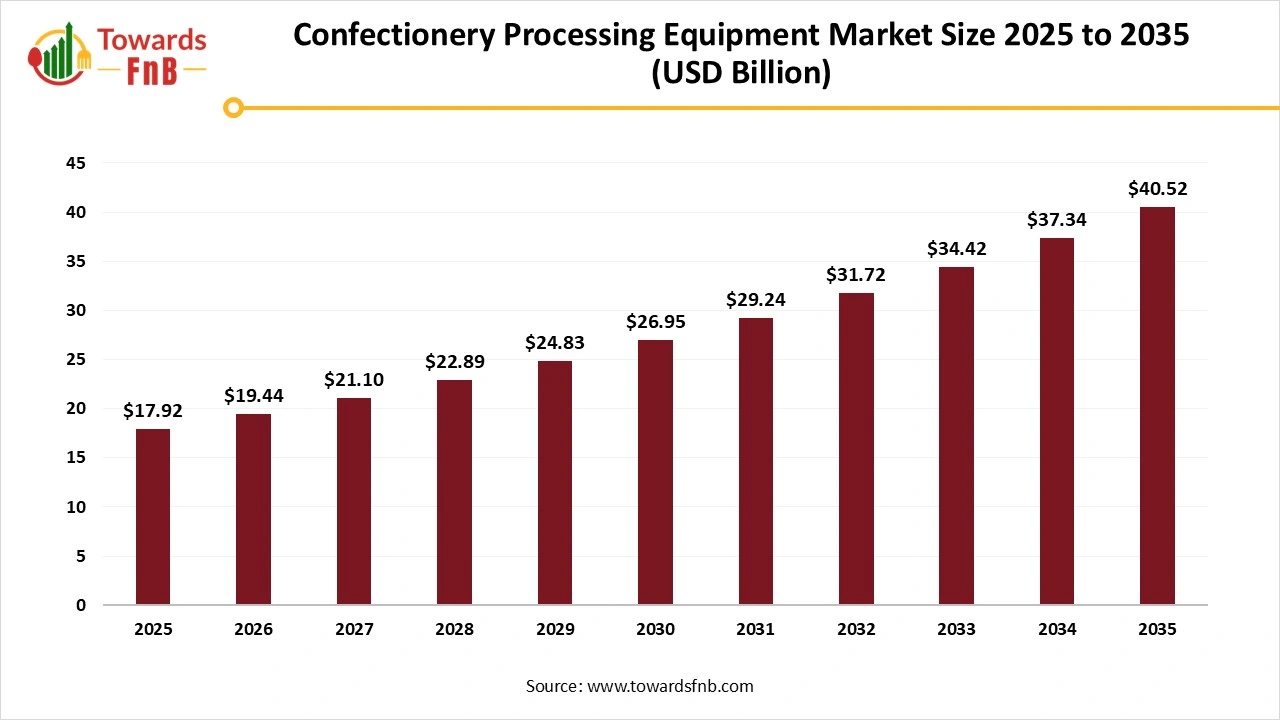
The global confectionery processing equipment market size reached at USD 17.92 billion in 2025 and is anticipated to increase from USD 19.44 billion in 2026 to an estimated USD 40.52 billion by 2035, witnessing a CAGR of 8.5% during the forecast period from 2026 to 2035. The market is primarily driven by rising consumer demand, rising growth in retail and e-commerce, and technological advancement.
| Study Coverage | Details |
| Growth Rate from 2026 to 2035 | CAGR of 8.5% |
| Market Size in 2026 | USD 19.44 Billion |
| Market Size in 2027 | USD 21.10 Billion |
| Market Size by 2035 | USD 40.52 Billion |
| Largest Market | North America |
| Base Year | 2025 |
| Forecast Period | 2026 to 2035 |
| Regions Covered | North America, Europe, Asia-Pacific, Latin America, and Middle East & Africa |
The confectionery processing equipment encompasses specialized capital assets, including mixers, cookers, molding systems, and automated lines, deployed to manufacture a diverse portfolio of confections such as chocolates, hard candies, and gummies. The core value proposition of this technology in commercial applications is the optimization of operational efficiency and product consistency, driven by integrated automation and precision controls that mitigate labor costs and material waste. Crucially, modern machinery enhances regulatory compliance and brand trust by implementing superior hygienic designs that minimize manual intervention and adhere to stringent food safety protocols.
The integration in automation beyond simple tasks to complex, delicate processes like modelling, decorating, and packaging, reducing manual labour, errors, and improving consistency. Industry 4.0 and smart manufacturing, in real-time monitoring, data collection, and remote diagnostics. AI and machine learning predictive maintenance, quality control, recipe optimization, and demand forecasting. The energy saving motors, precise heating controls, and systems that minimize waste, addressing environmental concerns and cutting cost, flexible and customization, and advanced control systems.
Inbound Logistics (Raw Material Supply)
Operations (Manufacturing and Assembly)
Outbound Logistics (Distribution and Sales)
Marketing & Sales
Why did North America Dominate the Confectionery Processing Equipment Market?
North America dominated the market in 2025, propelled by high consumer spending, rising disposable incomes, and sophisticated market demands for both premium and value-focused confectionery, which are key drivers of the region's robust processing equipment market. Early adoption of advanced technologies like automation, energy-efficient systems, and digital integration has boosted production quality and efficiency, necessitating continuous equipment upgrades.
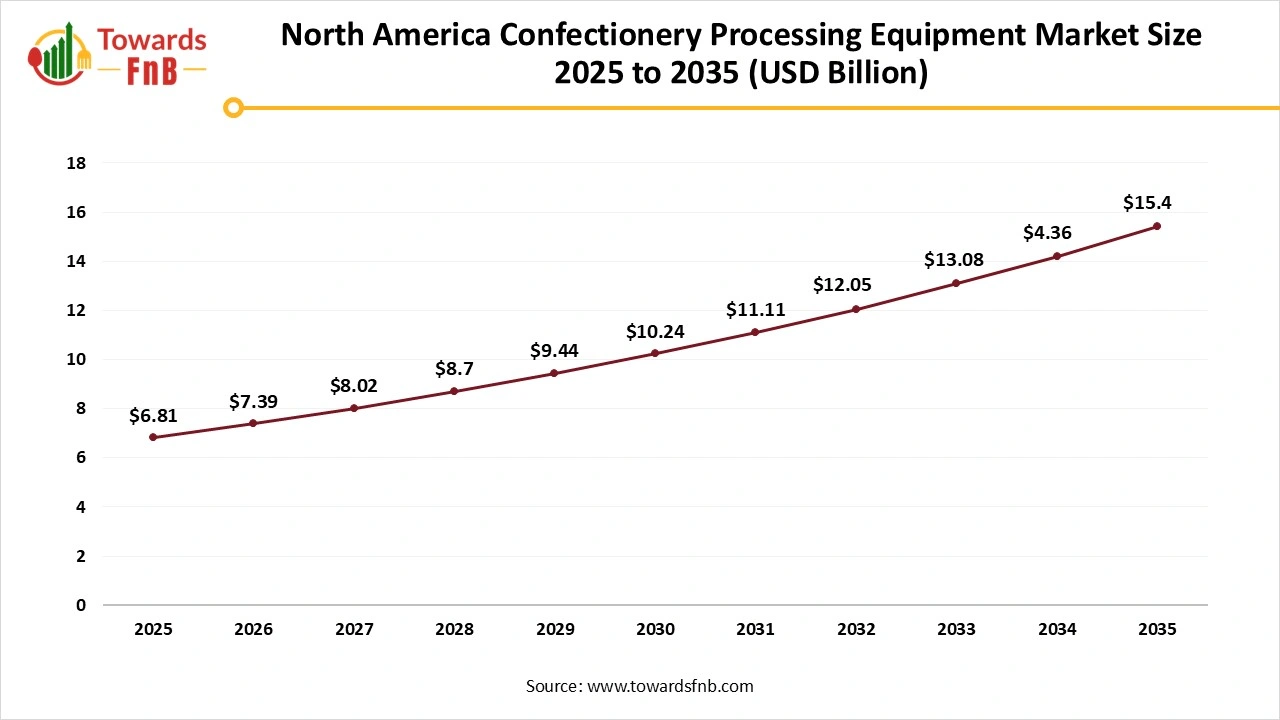
The North America confectionery processing equipment market size was valued at USD 6.81 billion in 2025 and is expected to grow steadily from USD 7.39 billion in 2026 to reach nearly USD 15.4 billion by 2035, with a CAGR of 8.5% during the forecast period from 2026 to 2035.
U.S. Confectionery Processing Equipment Market Analysis
The confectionery processing equipment market in the U.S. is transforming with the integration of Industry 4.0 technologies like AI and IoT, which enable remote monitoring and quality consistency while reducing human error. This technological leap supports the rising demand for health-focused and functional treats, requiring highly precise and versatile machinery to handle specialized ingredients and medicated formulations.
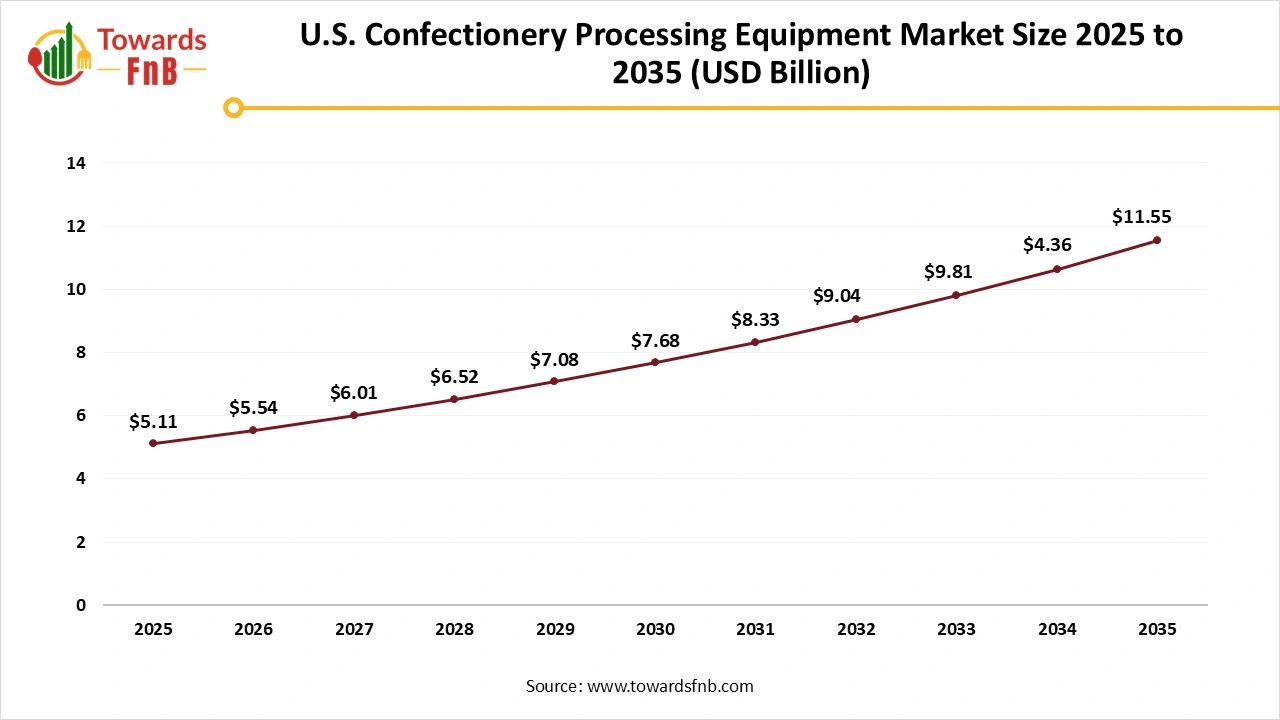
The U.S. confectionery processing equipment market size was calculated at USD 5.11 billion in 2025 with projections indicating a rise from USD 5.54 billion in 2026 to approximately USD 11.55 billion by 2035, expanding at a CAGR of 8.5% throughout the forecast period from 2026 to 2035.
Europe’s Fastest-Growing Confectionery Processing Equipment Market
Europe expects fastest growth during the forecast period. This growth is linked to significant investment in advanced processing technologies, including automation, robotics, AI, and IoT, to enhance production efficiency, quality control, and flexibility. Additionally, stringent food safety standards and a growing focus on sustainability, particularly strict EU regulations, are compelling manufacturers to adopt hygienic, energy-efficient, and eco-friendly equipment that can manage product diversification and support growing market channels like e-commerce.
Germany Confectionery Processing Equipment Market
Germany’s confectionery processing equipment market is driven by high adoption of robotics and smart manufacturing for efficiency, alongside a strong focus on sustainability and energy-efficient solutions. The growth in demand for artisanal, high-end, and customizable sweets, fueled by the premiumization trend, requires specialized and innovative processing solutions.

Asia Pacific's Confectionery Processing Equipment Market Expansion with Disposable Income and Urbanization
Asia Pacific has a rising middle class and rapid urbanization, which has heightened demand for premium and convenient treats across India, China, and Southeast Asia. This growth is supported by government initiatives and a global manufacturing shift to the region, prompting massive investments in AI and automation to ensure high-volume efficiency.
India Confectionery Processing Equipment Market
India’s strong consumer shift towards health-focused products, such as sugar-free, low-calorie, and natural ingredient confections. This necessitates the use of advanced, specialized equipment capable of handling these complex and often alternative formulations with precision. In response to rising demand for premium, artisan, and customizable treats, manufacturers are increasingly adopting highly automated, robotics-integrated, and energy-efficient solutions to ensure consistency and quality at scale.
Growing MEA Confectionery Processing Equipment Market
The confectionery processing equipment market in the Middle East and Africa (MEA) is anticipated to undergo significant growth. Evolving consumer preferences for exotic, functional, and premium packaged products necessitate versatile equipment for quality and attractive presentation. This trend, combined with significant economic diversification and infrastructure investment in countries like the UAE and Saudi Arabia, is fueling demand for modern manufacturing solutions.
UAE Confectionery Processing Equipment Market Analysis
In the UAE, the confectionery processing equipment market is witnessing considerable growth, fueled by Industry 4.0, with AI and robotics driving precise, scalable production and minimizing downtime. This technological surge is paired with a critical focus on health and wellness, necessitating specialized equipment for sugar-free, organic, and plant-based formulations. To meet modern standards, manufacturers are prioritizing multi-functional, energy-efficient machinery that can seamlessly transition between complex artisanal recipes and high-volume output.
South America Confectionery Processing Equipment Market Potential
The market for confectionery processing equipment in South America is driven by the rising disposable incomes and rapid urbanization, which are significantly boosting demand for innovative, convenient, and premium confectionery products across emerging markets. The strong health and wellness trend, in particular, is driving demand for specialized processing equipment capable of handling alternative ingredients like new sweeteners and fat replacements for sugar-free and low-calorie items.
Brazilian Confectionery Processing Equipment Market Analysis
The growing middle class drives demand for health-conscious, premium, and sugar-free treats. To maintain scalability and consistency, manufacturers are heavily investing in robotics, automation, and multi-functional machinery that offers precise ingredient handling and lower operating costs. This evolution is further supported by a strong push for sustainability, leading to the widespread adoption of energy-efficient and waste-reducing technologies across the expanding global food processing sector.
Confectionery Processing Equipment Market Share, By Type, 2025 (%)
| Segments | Shares (%) |
| Mixing and Blending Equipment | 30% |
| Molding and Shaping Equipment | 15% |
| Coating and Enrobing Equipment | 10% |
| Extrusion and Forming Equipment | 10% |
| Cutting and Dividing Equipment | 10% |
| Packaging and Wrapping Equipment | 25% |
Why did the Mixing and Blending Segment Dominate the Confectionery Processing Equipment Market?
The mixing and blending segment led the confectionery processing equipment market in 2025, due to the fundamental steps in creating uniform texture and flavour in a vast range of products, from chocolate to gummies. The adoption of advanced mixing technologies, such as high-shear mixers and automated, smart control systems, has driven market growth. Versatility and customization offer flexibility through modular designs and programmable controls, enabling manufacturers to handle diverse product varieties and recipes with minimal changeover time.
The Packaging and Wrapping Equipment Segment is Observed to Grow at the Fastest Rate During the Forecast Period.
The rising demand for convenient, portable, single-serve confectionery and on-the-go options fuels flexible packaging. The shift towards eco-friendly, recyclable materials, integration of robotic, AI, and machine learning in packaging lines increases speed, precision, and efficiency while lowering costs.
Why did the Chocolate Confectionery Segment Dominate the Confectionery Processing Equipment Market?
The chocolate confectionery segment held the dominating share of the market in 2025. The continuous innovation in premium and health-conscious products requires specialized machinery for new formulations like dark and plant-based chocolates. Furthermore, market expansion in emerging economies and the adoption of advanced automation technologies fueled significant investment in new equipment. Chocolate's enduring popularity for gifting and seasonal demand further solidified the segment's leading position.
The Gum Confectionery Segment is Seen to Grow at a Notable Rate During the Predicted Timeframe.
Because it offers a strong health and wellness trend, as consumers increasingly view gummies as ideal carriers for functional ingredients like vitamins and supplements. This shift demands highly versatile equipment capable of producing complex, health-oriented formulations, including sugar-free and plant-based options, to meet evolving regulatory environments and consumer preferences.
Confectionery Processing Equipment Market Share, By Automation Level, 2025 (%)
| Segments | Shares (%) |
| Manual | 25% |
| Semi-automatic | 30% |
| Automatic | 45% |
How did the Automatic Segment Dominate the Confectionery Processing Equipment Market?
The automatic segment dominated the market in 2025. The integration of AI, machine learning, and IoT enables data-driven insights, predictive maintenance, and seamless integration, leading to smarter, more adaptable factories. High volume of production, growing demand for customized, premium, and organic confectionery, and AI and real-time quality control fuel the market growth.
The Semi-Automatic Segment is Expected to Grow at the Fastest Rate in the Market During the Forecast Period.
The small & medium enterprises (SMEs) in developing regions like India, Indonesia, and Vietnam prioritize affordability and operational flexibility over the high capital investment of full automation. These systems provide a cost-effective solution, significantly boosting labor productivity while allowing for easy customization and rapid adjustment to dynamic consumer demands for new recipes and health-focused treats.
The manual segment is expanding significantly during the forecast period. The shift in consumer demand towards healthy, personalized, and niche confectionery products, which require a variety of ingredients and formats, is a primary driver for the increased adoption of semi-automatic processing equipment. Furthermore, factors such as labor market dynamics, rising labor costs, and the need for cost-effective solutions for smaller producers make semi-automatic options highly attractive, as they offer significant efficiency gains with lower upfront investment
Confectionery Processing Equipment Market Share, By Capacity, 2025 (%)
| Segments | Shares (%) |
| Small-scale | 20% |
| Medium-scale | 50% |
| Large-scale | 30% |
Which Capacity Segment Dominated the Confectionery Processing Equipment Market?
The medium-scale segment held the largest share of the market in 2025. The growing consumer demand across regions like Asia-Pacific for diverse treats, ranging from everyday snacks to premium, health-conscious options like vegan and sugar-free products. This demand is particularly driving the adoption of flexible, medium-scale, and semi-automatic equipment, which offers an ideal balance of cost-effectiveness and efficiency for small and medium enterprises (SMEs).
The Large-Scale Segment is Seen to Expand at the Fastest Rate During the Forecast Period.
With shifts toward Industry 4.0, with heavy investments in AI and robotics across Asia-Pacific to optimize efficiency and lower costs. This technological evolution is paired with a rising global demand for healthier, premium treats, forcing manufacturers to adopt adaptable machinery capable of handling complex, functional ingredients. Additionally, the boom in e-commerce and a heightened focus on sustainability are driving the adoption of customizable packaging systems and energy-efficient hardware.
The small-scale segment serves as a key growth catalyst in the market, mainly owing to the rising demand for confectionery processing equipment, particularly semi-automatic and modular systems, which is largely driven by rapid growth among SMEs in emerging markets like India, Indonesia, and Vietnam, where affordability and versatility are key. This trend is reinforced by evolving consumer preferences for health-focused, premium, and personalized treats, which necessitate smaller, flexible equipment for handling diverse ingredients and smaller batches efficiently.
Which Application Segment Dominated the Confectionery Processing Equipment Market?
The industrial segment held the largest share of the market in 2025. The shift toward Industry 4.0, with AI and robotics optimizing predictive maintenance and high-volume production efficiency. This technological surge is driven by the global demand for packaged, convenient snacks and the ongoing trend of premiumization, which requires precise machinery for complex formulations like functional and vegan treats.
The Artisanal Segment is Seen to Expand at the Fastest Rate During the Forecast Period.
Surging as adult consumers increasingly seek sophisticated, high-quality, and ethically sourced treats. This shift toward premiumization and health-conscious ingredients, such as sugar-free and plant-based options, necessitates specialized, flexible machinery capable of handling diverse formulations without sacrificing artisanal quality. To support this at scale, manufacturers are integrating smart technologies like AI and IoT for real-time quality control and predictive maintenance.
Bühler AG
By Type
By Candy Type
By Automation Level
By Capacity
By Application
By Region





Principal Consultant
Vidyesh Swar, Senior Research Analyst at Towards Food & Beverages, specializes in market research, focusing on supply-demand evaluation, pricing analysis, alternative proteins, plant-based foods, and sustainable food technologies within the industry.
Learn more about Vidyesh Swar
Reviewed By
Aditi Shivarkar, with 14+ years in Food and Beverages market research, specializes in food, beverage, and eco-friendly packaging. She ensures accurate, actionable insights, driving Towards FnB's excellence in industry trends and sustainability.
Learn more about Aditi ShivarkarApril 2026
April 2026
March 2026
March 2026

Confectionery Processing Equipment Market

 +1 804-441-9344
 Download Sample
 Schedule a Meeting