April 2026



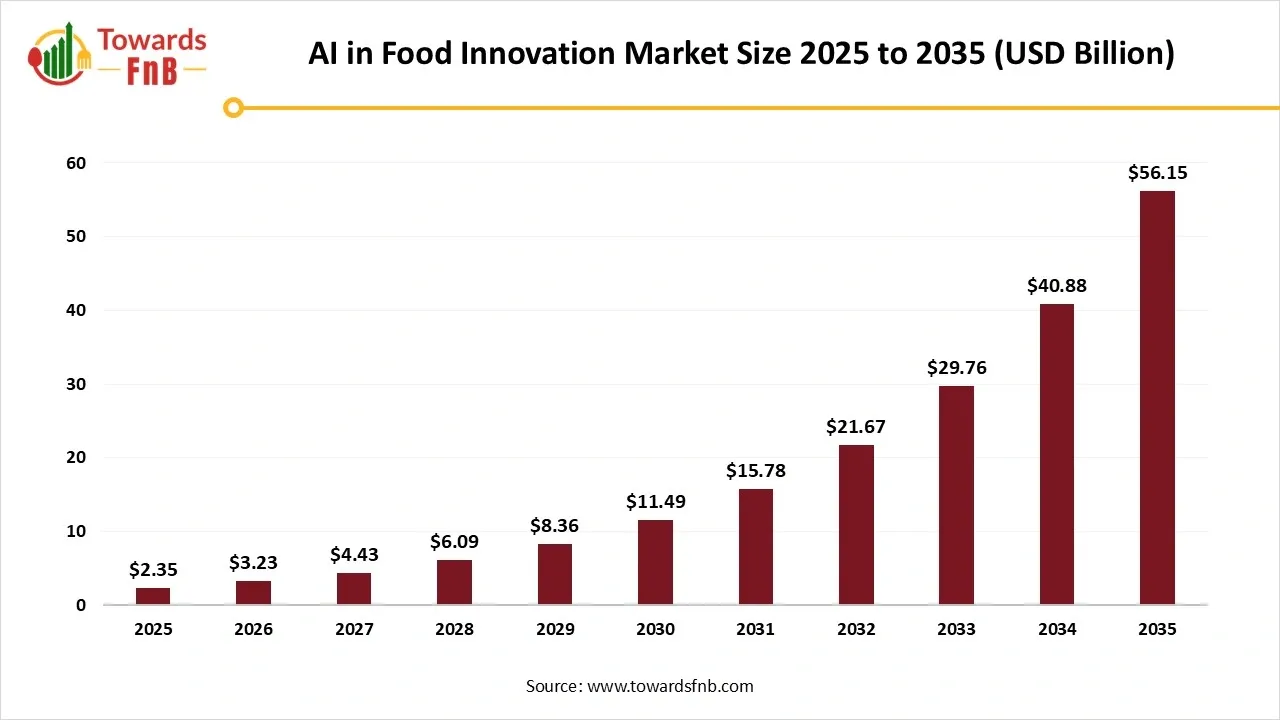
The global AI in food innovation market size reached at USD 2.35 billion in 2025 and is anticipated to increase from USD 3.23 billion in 2026 to reach around USD 56.15 billion by 2034, expanding at a CAGR of 37.35% during the forecast period from 2026 to 2035. The market has been experiencing significant growth in recent times, driven by a surge in demand for personalization, customization, and automation. Additionally, there has been a notable increase in the emphasis on food safety, further fueling the industry's expansion.
| Study Coverage | Details |
| Growth Rate from 2026 to 2035 | CAGR of 37.35% |
| Market Size in 2026 | USD 3.23 Billion |
| Market Size in 2027 | USD 4.43 Billion |
| Market Size by 2035 | USD 56.15 Billion |
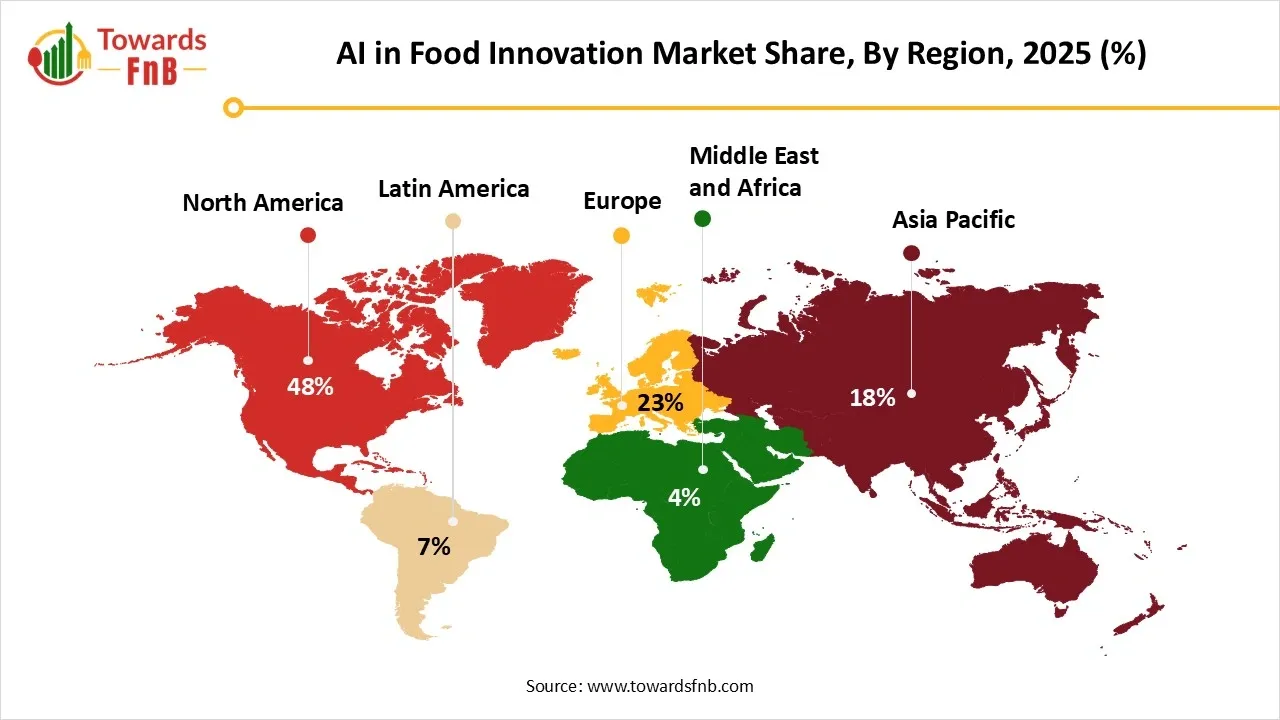
| Largest Market | North America |
| Base Year | 2025 |
| Forecast Period | 2026 to 2035 |
| Regions Covered | North America, Europe, Asia-Pacific, Latin America, and Middle East & Africa |
AI is a developing technology that is useful today in almost all segments. Advanced technology is helpful to understand, study, and analyze consumer demands and trends, which are helpful for food manufacturers. Advanced technology also helps food manufacturers and processors to understand consumer demands and suggest novel combinations and ingredient datasets helpful for the growth of the market. It also helps customization in nutrition development and tailored diet plans, further fueling the growth of the market. The technology also involves the use of sensors for real-time food safety and monitoring from the farm to the table journey.
AI plays a major role in the growth of the food innovation market. The technologically advanced method helps to enhance food quality, aid product innovation, enhance personal customer experience, and drive efficiency as well. The technologically advanced procedure also helps to enhance the supply chain and cater to the demands of consumers, which is helpful for the growth of the market. AI also helps to save time and enhance quality during the food manufacturing procedure, which is helpful for the market’s growth.
Agriculture and Farming
Food Processing and Manufacturing
Supply Chain and Logistics
Product Development and Consumer Insights
Food Safety
North America Dominated the AI in Food Innovation Market in 2025
North America led the AI in food innovation market due to advanced technology, enhanced food safety, and high demand for personalized consumer experiences. High usage of advanced technology for various aspects, such as product innovation, lowering wastage, predicting consumer behavior and trends, is further fueling the growth of market. Growing health-conscious consumers fueling demand for personalized functional food products is another major growth factor for the market in the region.
North America AI in Food Innovation Market Size 2025 to 2035
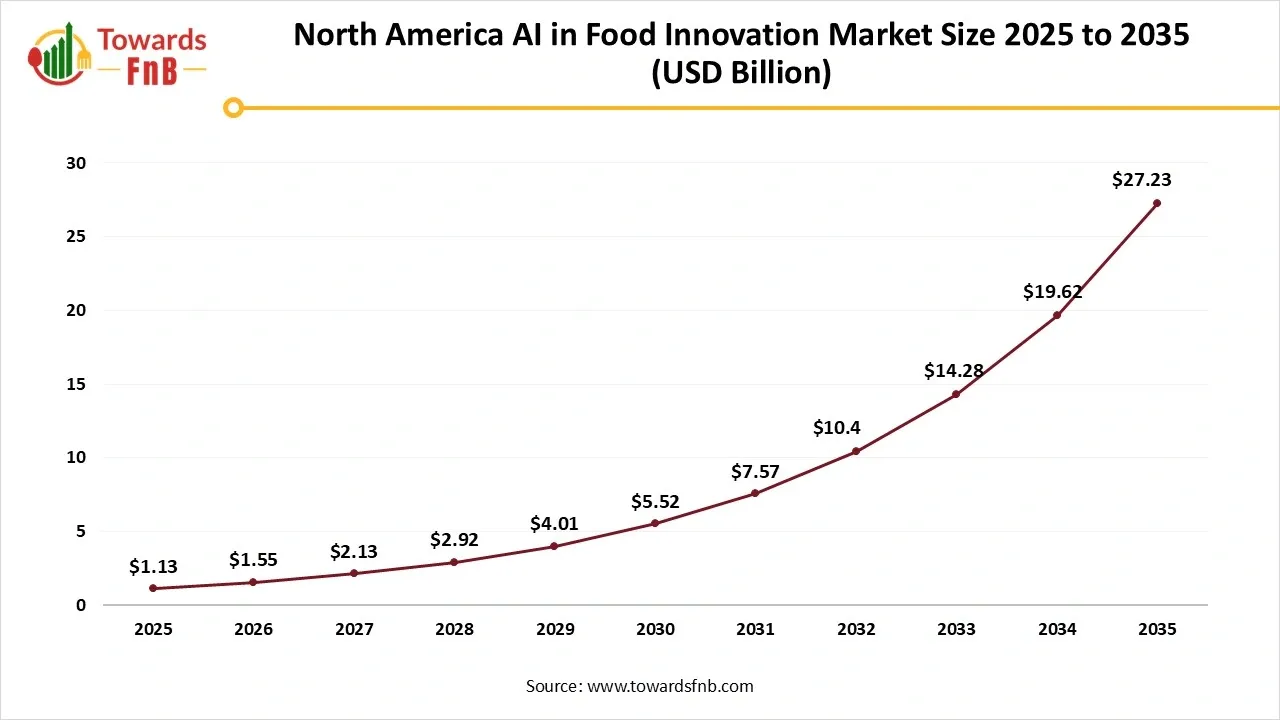
The North America AI in food innovation market size was valued at USD 1.13 billion in 2025 and is anticipated to increase from USD 1.55 billion in 2026 to reach around USD 27.23 billion by 2034, expanding at a CAGR of 37.47% during the forecast period from 2026 to 2035.
U.S. AI in Food Innovation Market Trends
In the United States, the market for AI in food innovation covering food and beverage production, processing, supply-chain management, quality control, and personalized nutrition is rapidly expanding. AI’s impact spans the entire food value chain: optimizing manufacturing efficiency, reducing waste, enhancing food safety, enabling supply-chain logistics, and even powering recipe personalization and consumer-centered product development.
Europe is Expected to Grow at Fastest Rate in the Market During the Foreseen Period
As the region focuses on various aspects such as farm-level optimization, new product development, personalized consumer experiences, and major investments from different startups. Hence, the region is observed to grow in the foreseen period. The region also utilizes predictive analysis to enhance product innovation and cater to the growing demands of the consumer.
Germany AI in Food Innovation Market Trends
In Germany, AI is increasingly shaping food innovation across production, supply-chain, nutrition, and sustainability trends. AI-powered solutions are also being used in smart agriculture and agritech to optimize resource use, improve crop yields and reduce waste, supporting Germany’s push toward more sustainable and efficient food systems.
Asia Pacific Expects Significant Growth During the Predicted Period
Driving this surge are factors such as urbanization, rising incomes, and a growing middle class, which increase demand for safer, higher-quality, personalized and convenient food products. Within food production and processing, AI is widely used for quality control, safety inspection, automation, robotics, supply-chain optimization and demand forecasting helping producers meet regulatory pressures, reduce waste, and improve efficiency
India AI in Food Innovation Market Trends
In India, AI is gradually reshaping food production, processing, and supply-chain operations. Government and industry initiatives are promoting AI and automation in the food-processing sector boosting efficiency, reducing waste, ensuring quality control, and improving food safety. Many food-processing plants are increasingly adopting smart technologies, IoT sensors, computer vision and robotics to automate tasks such as sorting, grading, packaging, and hygiene compliance.
Middle East and Africa Seen a Notable Growth in the Market
In the Middle East and Africa, AI is gradually transforming food innovation by improving production, supply chain management, food safety, and waste reduction. In Gulf countries such as the United Arab Emirates (UAE), Saudi Arabia and Qatar food security initiatives and modernization of food supply infrastructure are accelerating adoption of AI driven traceability, quality control, and supply chain systems.
UAE AI in Food Innovation Market Trends
In the United Arab Emirates (UAE), AI is rapidly reshaping the food innovation landscape from farms to factories to fine dining under the push of national strategies and rising demand for efficiency, safety, and personalization. Government and regulatory agencies such as Abu Dhabi Agriculture & Food Safety Authority (ADAFSA) are using AI and cloud based systems for food safety monitoring, sustainable agriculture, and supply chain traceability ADAFSA even became the world’s first agri food body to earn an ISO certification for AI management.
South America Seen a Significant Growth in the Market
In South America, AI is starting to transform the food and beverage market though adoption is still modest, growth prospects are promising. Much of this AI uptake is driven by large agricultural exporters and food processing companies especially in countries like Brazil and Argentina leveraging AI for smarter quality control, supply chain traceability, and efficiency improvements to meet global standards.
Brazil AI in Food Innovation Market Trends
In Brazil, AI is increasingly transforming food innovation especially across agriculture, food processing, supply chain, and consumer facing segments. Many farms and agribusinesses use AI and automation including sensors, satellite imagery and data driven platforms to improve crop yields, optimise irrigation and fertilizer use, monitor soil and weather conditions, and reduce waste.
AI in Food Innovation Market Share, By Technology/Platform, 2025 (%)
| Segments | Shares (%) |
| Machine Learning & Predictive Analytics | 40% |
| Big Data Analytics & Insights | 25% |
| AI-powered Recipe & Flavor Development Tools | 15% |
| Computer Vision & Quality Inspection Systems | 12% |
| Automation & Robotics in Food R&D | 8% |
Which Technology/Platform Dominated the AI in Food Innovation Market in 2025?
The machine learning and predictive analytics segment dominated market, as the segment provides future insights essential for the growth of a food manufacturing business. The segment utilizes algorithms and data analysis to predict future consumer demands to enhance product development and streamline supply chain operations for an efficient and sustainable approach.
The AI-powered recipe and flavor development tools segment is expected to grow in the foreseen period, as the segment helps to analyze the consumer demand, ingredient data, and identify novel combinations helpful to enhance consumer health as well. Hence, the procedure also helps to save R&D time and costs. It also helps companies to develop unique flavor profiles of their food products as per the consumer demands, which is helpful for the growth of the market.
Which Application Dominated the AI in Food Innovation Market in 2025?
The new product development and formulation optimization segment dominated the AI in food innovation market, as advanced technology is helpful to bring the required changes and transformation in the food and beverage industry with lightning speed and accuracy. With the help of data analytics and trends, advanced technology helps to detect future consumer preferences and allows food manufacturers to make required changes in the recipes and ingredients as per consumer demand for lowered wastage and growth of market.
The nutritional and health-focused product innovation segment is expected to grow in the foreseeable period due to rising health-conscious consumers, leading to demand for food products high in nutrition. AI platforms help to analyze consumer demand in the future with the help of predictive analysis and suggest product ingredients and methods helpful for the preparation of health-focused products, ideal for the growth of on market in the foreseeable period.
Why did the AI Software And Platform Solutions Segment Dominated the AI in Food Innovation Market in 2025?
The AI software and platform solutions segment dominated the AI in food innovation market, aiding in greater efficiency, personalization, and enhanced safety. The segment focuses on the use of AI-powered tools and platforms helpful for food production, supply chain management, safety personalization, and the growth of the market. The segment also focuses on consumer preferences to suggest the best dataset of recipes and flavors helpful to enhance the growth of the market.
Integration with IoT and smart manufacturing systems segment is expected to grow in the foreseeable period, as the segment is extremely important for the growth of the market. The segment highlights the importance of AI in food manufacturing as per consumer preferences in the future, lower wastage, enhanced supply chain management, and maintaining quality control as well. Hence, the segment plays a crucial role in the market’s growth.
AI in Food Innovation Market Share, By End User, 2025 (%)
| Segments | Shares (%) |
| Food & Beverage Manufacturers | 50% |
| Startups & SMEs in Food Innovation | 17% |
| Research & Development Institutes | 12% |
| Retail & Foodservice Companies | 8% |
| Ingredient & Flavor Companies | 13% |
Why did the Food And Beverage Manufacturers Segment Dominated the AI in Food Innovation Market in 2025?
The food and beverage manufacturers segment led the market due to the utilization of AI for various purposes, such as product innovation, enhancing food safety, and understanding consumer preferences for an ideal data set of food ingredients and novel food combinations. Advanced technology also helps to improve efficiency and lower food wastage, which is helpful for the growth of the market.
Startups and SMEs in the food innovation segment are expected to grow in the foreseeable period as they utilize AI for better food innovation, its development, and to identify consumer preferences. Such data helps the startups in manufacturing food options that are demanded by consumers in the future, as per their preferences. It helps them to compete with huge and established brands in the market and fuel the growth of market in the foreseeable period as well.
AI in Food Innovation Market Share, By Deployment Mode, 2025 (%)
| Segments | Shares (%) |
| Cloud-based Solutions | 80% |
| On-premise Solutions | 20% |
Why did the Cloud-Based Solutions Segment Dominated the AI in Food Innovation Market in 2025?
Cloud-based solutions segment led the market with the help of IoT and other technologically advanced platforms for the growth of the market. Such platforms help the food manufacturers to predict consumer demand in the future for ideal product innovation. The segment also focuses on precision agriculture, quality control, and generative AI for enhanced improvement of the AI in food innovation market.
The on-premise solutions segment is expected to grow in the foreseeable period due to its immediate quality control actions within the food manufacturing and serving premises, which are helpful for the growth of the market. The segment also helps with data control and customization, which is helpful to manage costs and fuel the market’s growth. Such solutions are an essential alternative to applications and software programs with recurring technical issues and problems that may hamper the market’s growth.
Why did the Direct to Enterprise Solutions Segment Dominated the AI in Food Innovation Market in 2025?
Direct-to-enterprise solutions segment led market as the segment provides customized solutions in the form of applications to enterprises rather than individual consumers. The segment also focuses on food and beverage manufacturers, retailers, and processors, to improve safety, efficiency, and product development, which is helpful for the growth of the market.
The B2B partnerships/collaborations segment is expected to grow in the foreseen period as the segment highlights the importance of collaboration between technology providers and food-sector businesses. Such collaborations are helpful to improve food safety, efficiency, and product development. In such situations, AI plays a major role in enhancing quality control, optimizing supply chains, and enabling novel product creation, which is helpful for the growth of market.
Why did the Health and Functional Food Innovation Segment Dominated the AI in Food Innovation Market in 2025?
The health and functional food innovation segment led the market, helping the food manufacturers to enhance the nutritional levels of functional foods, which is helpful for the growth of the market. The segment also helps the manufacturers to meet the growing consumer demand and cater to them as well. It also highlights the growing demands of health-conscious consumers, being the huge base for the segment.
The sustainability-focused product innovation segment is expected to grow in the foreseeable period as the segment helps in product innovations to maintain sustainability, lower wastage, and create resilient food systems. The segment also enhances the importance of environmental balance and a lower carbon footprint.
By Technology / Platform
By Application
By Service Type
By End-User
By Deployment Mode
By Distribution Channel
By Innovation Focus
By Region




Principal Consultant
Vidyesh Swar, Senior Research Analyst at Towards Food & Beverages, specializes in market research, focusing on supply-demand evaluation, pricing analysis, alternative proteins, plant-based foods, and sustainable food technologies within the industry.
Learn more about Vidyesh Swar
Reviewed By
Aditi Shivarkar, with 14+ years in Food and Beverages market research, specializes in food, beverage, and eco-friendly packaging. She ensures accurate, actionable insights, driving Towards FnB's excellence in industry trends and sustainability.
Learn more about Aditi ShivarkarApril 2026
April 2026
April 2026
April 2026

AI in Food Innovation Market


 +1 804-441-9344
 Download Sample
 Schedule a Meeting