April 2026



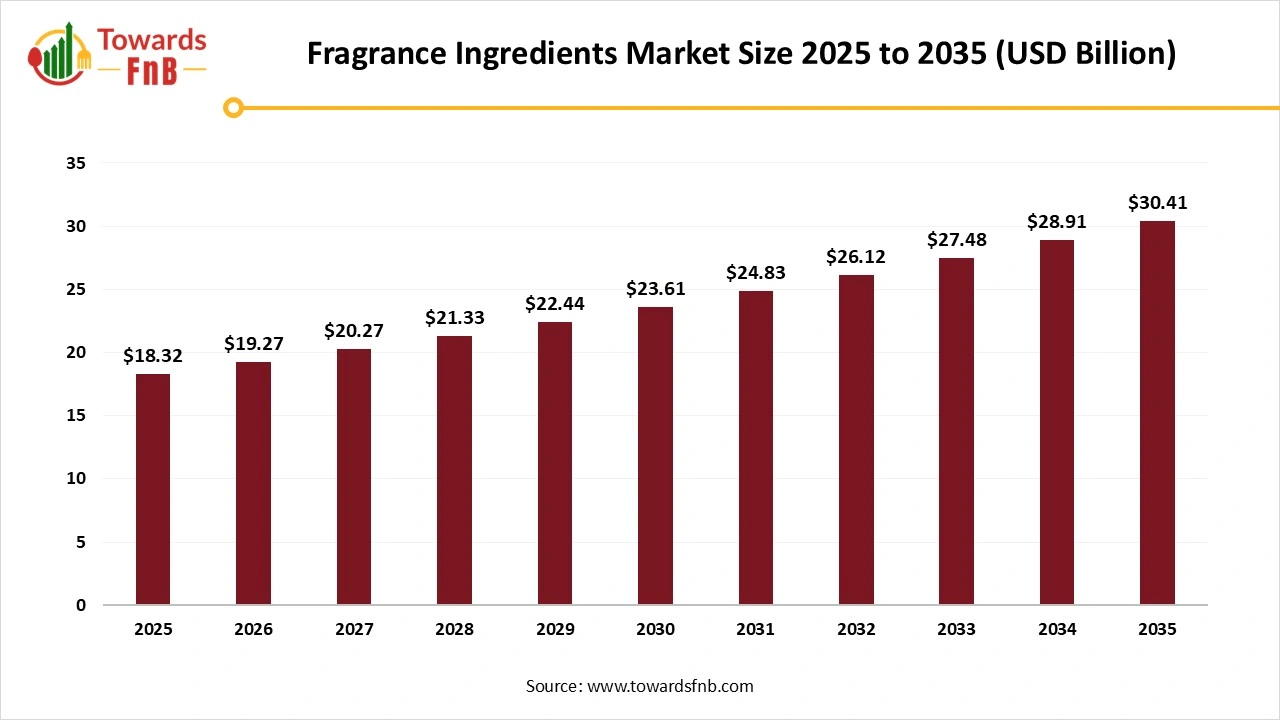
The global fragrance ingredients market size was calculated at USD 18.32 billion in 2025 and is expected to grow steadily from USD 19.27 billion in 2026 to reach nearly USD 30.41 billion by 2035, with a CAGR of 5.2% during the forecast period from 2026 to 2035. The rise in the demand for personal care products, cosmetics, and food & beverage products expands the market.
| Study Coverage | Details |
| Growth Rate from 2026 to 2035 | CAGR of 5.2% |
| Market Size in 2026 | USD 19.27 Billion |
| Market Size in 2027 | USD 20.27 Billion |
| Market Size by 2035 | USD 30.41 Billion |
| Largest Market | North America |
| Base Year | 2025 |
| Forecast Period | 2026 to 2035 |
| Regions Covered | North America, Europe, Asia-Pacific, Latin America, and Middle East & Africa |
The fragrance ingredients market is a global industry producing natural and synthetic compounds that provide scents for cosmetics, perfumes, soaps, food and beverages, and detergents. Market growth is driven by the growing demand for high-quality fragrance ingredients in the perfume and cosmetics sectors, as consumer interest in premium, personalized fragrances rises. Innovations in sustainable and natural ingredients also contribute to this expansion.
Technological advancements facilitate innovative ingredient uses and accuracy in fragrance distribution. Innovations encompass microencapsulation, controlled-release methods, and fragrance-infused packaging. AI is transforming the world of perfumery by analyzing extensive data to create fragrances that are ideally suited to your skin chemistry, surroundings, and even your mood. Biotechnology offers an eco-friendly alternative to the conventional resource-heavy techniques for obtaining fragrance components by generating scent molecules that accurately replicate their natural equivalents. This groundbreaking method aids in protecting our planet's fragile ecosystems while guaranteeing a reliable and premium supply of fragrance ingredients.
Raw Material Procurement
Fragrance ingredients are processed using methods like Steam Distillation, Solvent Extraction, Expression, CO₂ Extraction and older techniques such as Enfleurage and Maceration.
Distribution
Why did North America Dominate the Fragrance Ingredients Market in 2025?
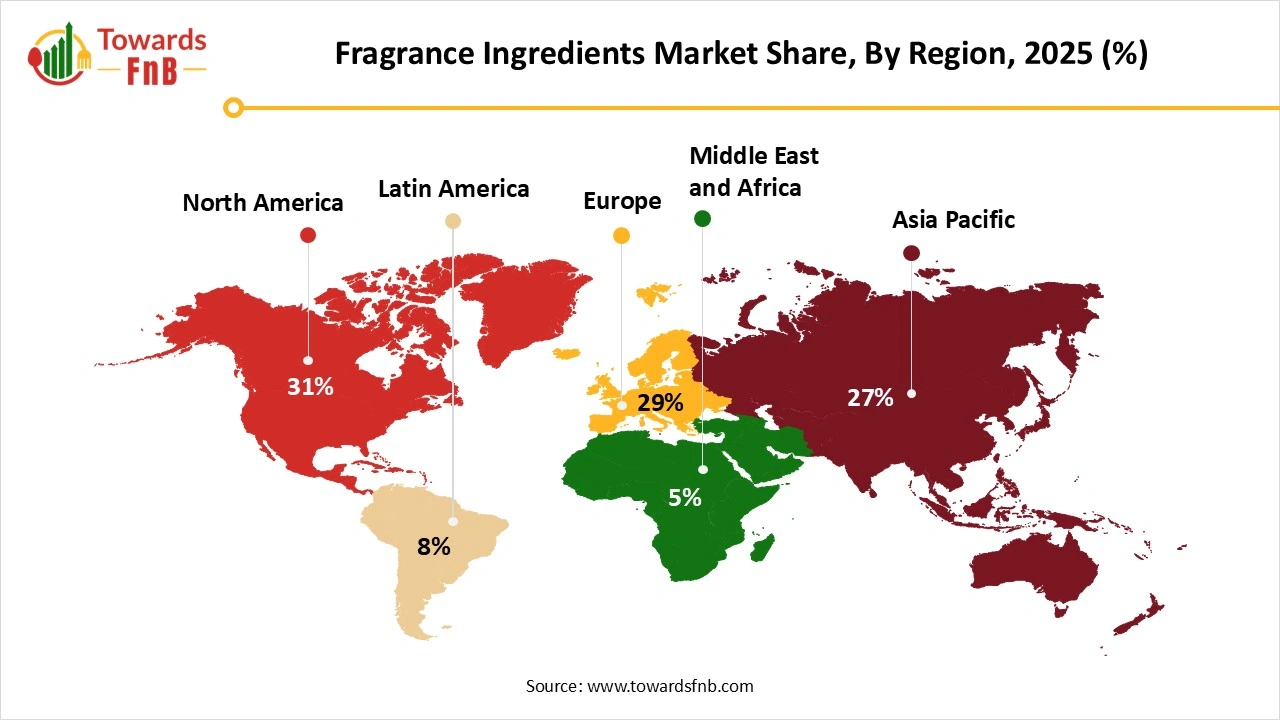
North America dominated the fragrance ingredients market in 2025, fueled by heightened consumer interest in personal care, fine fragrances, and household items, particularly in the U.S., the leading regional market. Consumers are progressively leaning towards high-quality, durable, and sustainably made fragrances, with a notable preference for wellness-focused and clean-label items. This demand is additionally bolstered by the rise of e-commerce, increasing purchasing power, and a cultural preference for high-end grooming and lifestyle items.
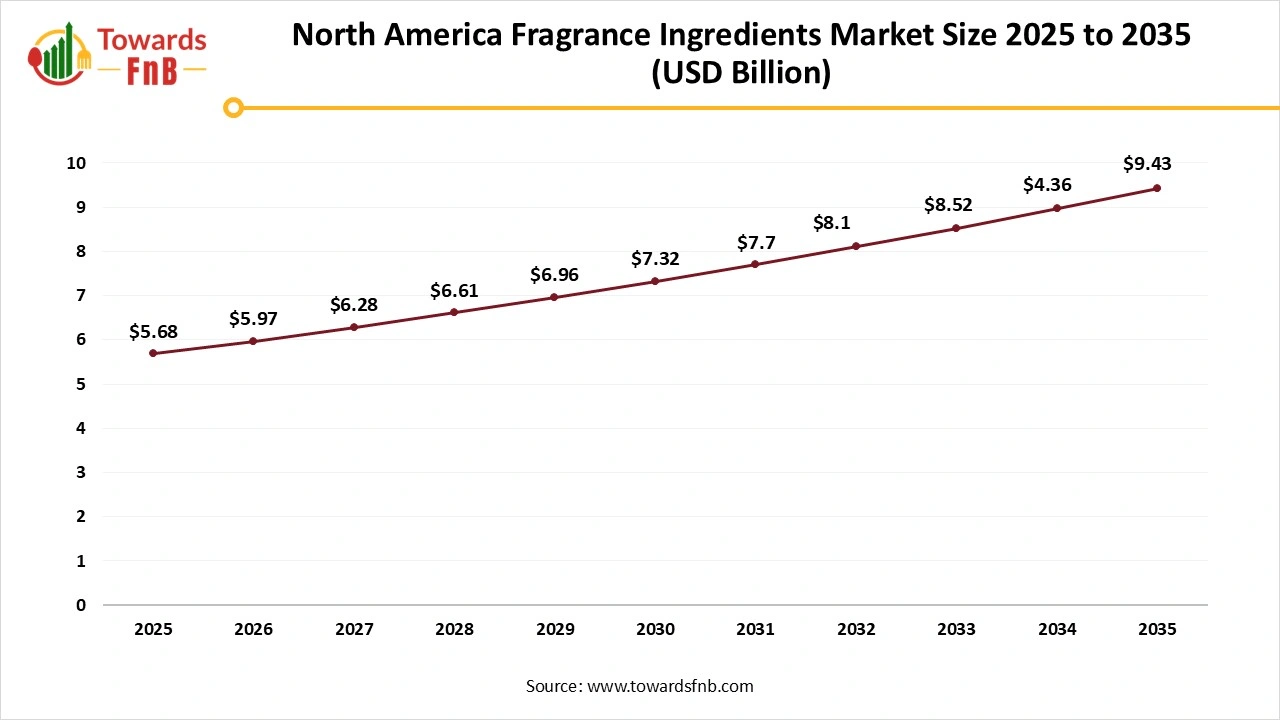
The North America fragrance ingredients market size was calculated at USD 5.68 billion in 2025 with projections indicating a rise from USD 5.97 billion in 2026 to approximately USD 9.43 billion by 2035, expanding at a CAGR of 5.2% throughout the forecast period from 2026 to 2035.
U.S. Fragrance Ingredients Market Trends
Increasing consumer spending on beauty, wellness, and personal care is greatly fueling the expansion of the U.S. fragrance ingredients market. The rising need for high-quality personal care products like perfumes, skincare, and haircare is fueling the use of advanced and enduring fragrance ingredients. Increasing demand for biodegradable, environmentally friendly, and sustainably obtained ingredients is transforming product development strategies throughout the industry. Producers are putting resources into green chemistry, sustainable raw materials, and circular production methods to meet sustainability objectives.
How Big is the U.S. Fragrance Ingredients Market?
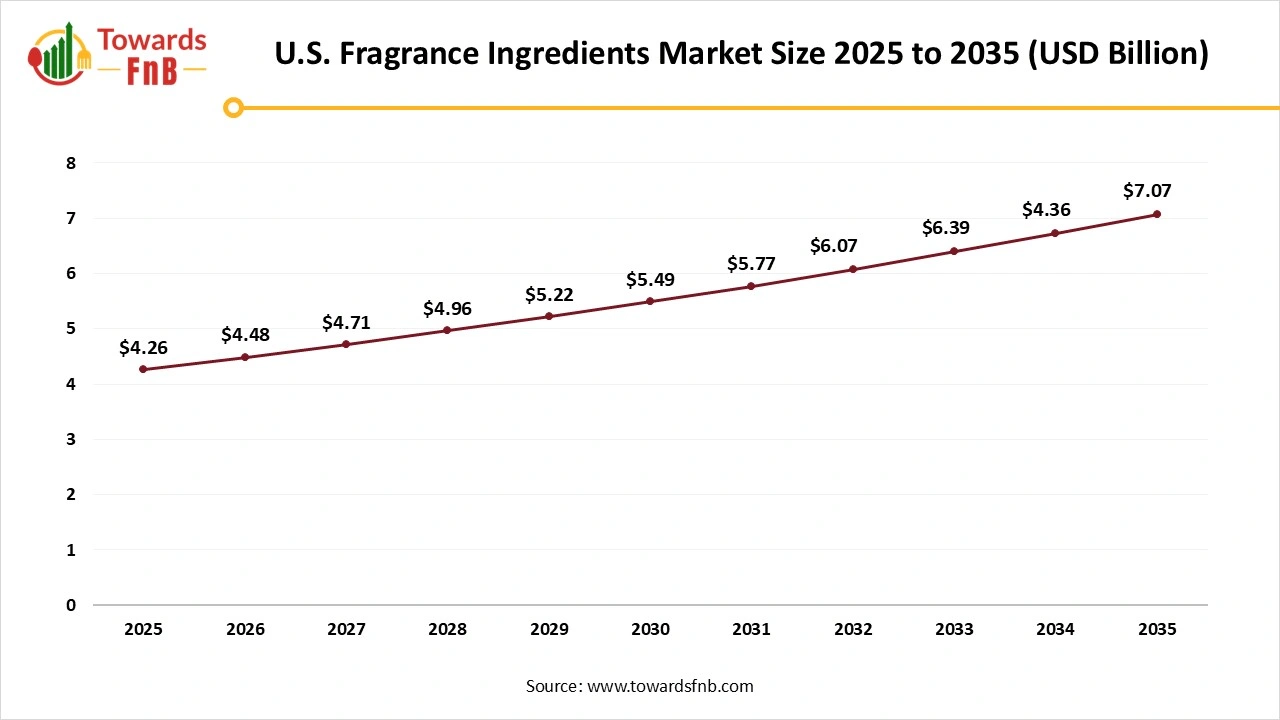
The U.S. fragrance ingredients market size reached at USD 4.26 billion in 2025 and is anticipated to increase from USD 4.48 billion in 2026 to an estimated USD 7.07 billion by 2035, witnessing a CAGR of 5.2% during the forecast period from 2026 to 2035.
What Factors are Driving the Fastest Growth of Fragrance Ingredients in the Asia Pacific?
Asia Pacific expects fastest growth during the forecast period. The Asia-Pacific is among the most varied and vibrant fragrance areas globally, and fragrance increasingly influences the lives, cultures, and economies of its inhabitants. From Australian sandalwood and Indonesian vetiver to Indian jasmine and Chinese tea extracts, the area boasts some of the globe's most prized fragrance ingredients. It is becoming an increasingly important centre for innovation, production, and consumer needs, with lively markets and new trends influencing the future of fragrance ingredients.
India Fragrance Ingredients Market Trends
Main factors driving market expansion encompass a growing middle-class demographic, urban development, and higher disposable income, all of which are stimulating the need for fragrance ingredients. India's varied plant life provides an abundance of ingredients that have established themselves as essentials in fragrance creation. From sandalwood to jasmine, from patchouli to vetiver, Indian land nurtures fragrant giants. India is a major producer of natural base ingredients due to the plentiful availability of raw materials in the nation, and serves as a key supplier to the international market. This segment is experiencing robust market demand due to its close connection to consumer-oriented sectors, such as personal care, food and beverages, and nutraceuticals.
Europe's Fragrance Ingredients Market Expansion
The market for fragrance ingredients in Europe shows consistent growth, bolstered by a strong cosmetics and personal care industry. As consumer preference grows for high-quality and natural scents, the market is widening in important countries. Market share is allocated to key players emphasizing sustainable and inventive ingredients, showcasing changing consumer preferences and regulatory requirements.
UK Fragrance Ingredients Market Trends
The UK fragrance ingredients market is fueled by the growing demand for personal care and cosmetic items, in which fragrances are essential for attracting consumers. The increasing demand for premium and niche perfumes, combined with the trend toward personalized fragrances, enhances the need for varied and superior fragrance components. Moreover, the expansion of the home care and cleaning products market, which incorporates fragrances to enhance user experience, contributes to market growth.
MEA Fragrance Ingredients Market Growth
The fragrance ingredients market in the Middle East and Africa (MEA) is witnessing consistent expansion, fueled by a distinctive combination of traditional scent preferences, changing consumer habits, and increasing industrial uses in personal care, home care, and high-end fragrances. Nations such as Saudi Arabia and the UAE lead the way because of their strong cultural connection to scents like oud, musk, amber, and rose, which has contributed to a continued high demand for both natural and synthetic components in the region. The market is anticipated to expand considerably, supported by rising disposable incomes, the impact of Western fragrance trends, and a vibrant youth demographic enthusiastic about luxury and personalization.
UAE Fragrance Ingredients Market Trends
In the United Arab Emirates, exquisite fragrance ingredients are intricately linked to cultural and religious traditions, holding significant importance in everyday life, rituals, and social events. The flourishing tourism industry in the UAE draws many tourists, boosting the need for fragrances, both for personal use and as keepsakes. As a top travel destination, the UAE attracts visitors drawn to scents, particularly high-end products and distinctive souvenirs.
South America Fragrance Ingredients Market Potential
The market for fragrance ingredients in South America is gaining momentum, driven by a growing youth demographic and higher urban consumption levels. Regional tastes for vibrant and assertive scent characteristics are shaping the creation of unique fragrance combinations. The increasing influence of social media and influencer culture is prompting experimentation with distinctive personal care items enriched with appealing fragrance ingredients.
Brazil Fragrance Ingredients Market Trends
Brazil plays a significant role in the fragrance ingredients market, marked by its rich natural resources, particularly in botanicals and essential oil. Brazil's perfume sector ranks among the largest and most vibrant globally, fueled by a culture that appreciates fragrance in everyday life and a market ready for innovation. The expanding cosmetic sector in the country, along with a rising consumer inclination towards natural and organic items, is boosting the need for locally sourced, sustainable fragrance ingredients. The nation’s varied biodiversity provides exceptional chances for creating distinctive fragrance compounds, establishing it as an essential center for sourcing natural ingredients in the worldwide market.
Fragrance Ingredients Market Share, By Type, 2025 (%)
| Segments | Shares (%) |
| Natural | 55% |
| Synthetic | 45% |
Why did the Natural Ingredients Segment Dominate the Fragrance Ingredients Market in 2025?
The natural ingredients segment led the fragrance ingredients market in 2025, propelled by the increasing acceptance of plant-derived, chemical-free, and eco-friendly formulations. Producers utilize natural aromatic extracts such as essential oils, floral absolutes, and fruit-derived compounds to enhance product quality and consumer satisfaction. This change indicates evolving likes for environmentally friendly and health-oriented products. Natural fragrance components are being utilized more and more in personal care, cosmetics, home care, and high-end perfumes. The Sensegen’s fragrance survey indicates that 74% of participants favor the natural scent idea rather than the synthetic alternative. This indicated a 5% enhancement over the consumers’ previous inclination before discovering the new natural scent.
The Synthetic Ingredients Segment is Seen to Experience the Highest Growth Rate Throughout the Forecast Period.
The economic impact suggests that synthetic fragrances can be produced on a large scale at a lower cost compared to natural substances that must be gathered and processed. Synthetic odours possess consistency, in contrast to natural fragrances, which can vary in scent profiles from one batch to another. Additionally, synthetics are more cost-effective than natural ingredients, offering a longer shelf life for fragrance components.
Fragrance Ingredients Market Share, By Application, 2025 (%)
| Segments | Shares (%) |
| Hair Care | 15% |
| Personal Care | 55% |
| Fabric Care | 20% |
| Others | 10% |
Which Application Segment Dominated the Fragrance Ingredients Market in 2025?
The personal care segment held the largest share of the market in 2025. Various products like soaps, air fresheners, toiletries, oral care products, and cosmetics are examples of personal care fragrance ingredients. Riding consumer demand for different cosmetics and skin care products results in the integration of sophisticated ingredients that help the market expand. The demand for distillates, oleoresins, fractions, concretes, and absolutes in perfumes and soaps has also grown as people become more interested in natural skin care items.
The Hair Care Segment is Expected to Grow at a Notable Rate During the Predicted Timeframe.
As consumers seek sophisticated scents, salon-level experiences at home, and clean beauty options. The use of natural and organic ingredients in hair care products also attracts health-conscious buyers who are wary of synthetic ingredients. Brands are investing in research and development to develop products that are gentle on the hair and scalp, ensuring that the products reach to a broader audience.
Debut
CPL Aromas
Osmo
By Type
By Application
By Region





Principal Consultant
Vidyesh Swar, Senior Research Analyst at Towards Food & Beverages, specializes in market research, focusing on supply-demand evaluation, pricing analysis, alternative proteins, plant-based foods, and sustainable food technologies within the industry.
Learn more about Vidyesh Swar
Reviewed By
Aditi Shivarkar, with 14+ years in Food and Beverages market research, specializes in food, beverage, and eco-friendly packaging. She ensures accurate, actionable insights, driving Towards FnB's excellence in industry trends and sustainability.
Learn more about Aditi ShivarkarApril 2026
April 2026
April 2026
April 2026

Fragrance Ingredients Market


 +1 804-441-9344
 Download Sample
 Schedule a Meeting