April 2026



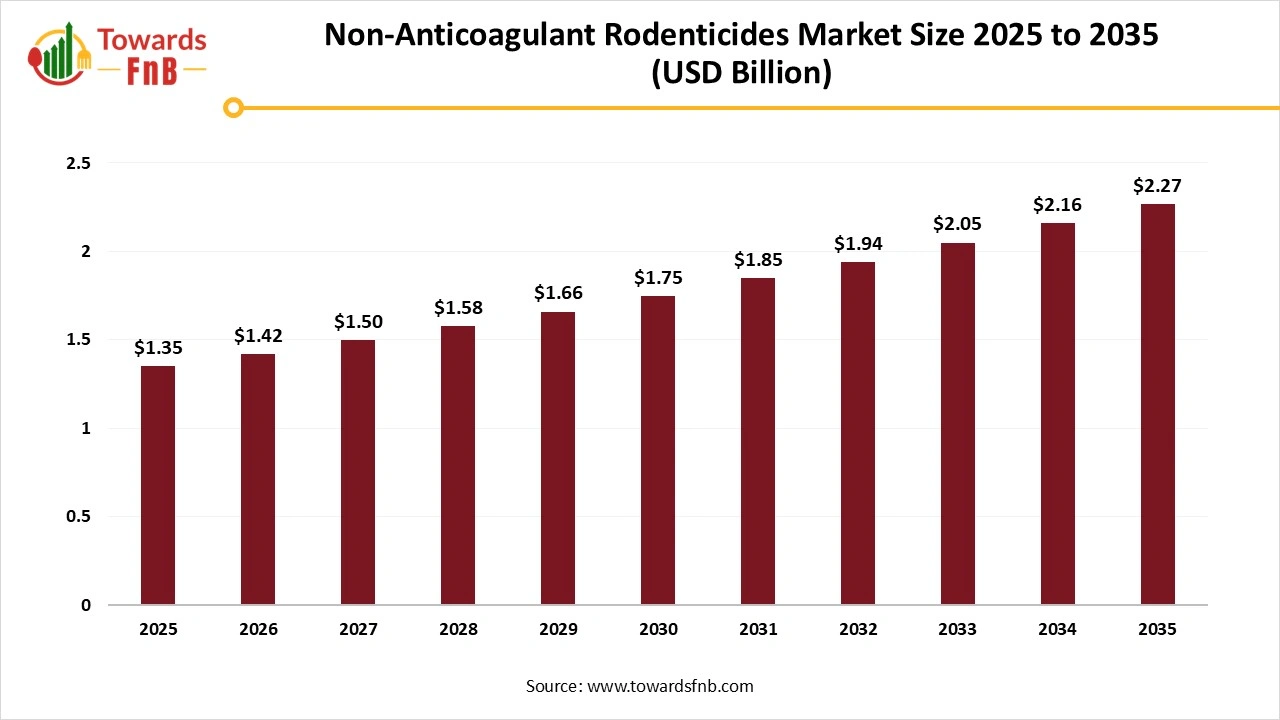
The global non-anticoagulant rodenticides market size estimated at USD 1.35 billion in 2025 and is predicted to increase from USD 1.42 billion in 2026 to nearly reaching USD 2.27 billion by 2035, growing at a CAGR of 5.35% during the forecast period from 2026 to 2035. The increased rodent resistance and the expanding grain storage industry drive market growth.
| Study Coverage | Details |
| Growth Rate from 2026 to 2035 | CAGR of 5.35% |
| Market Size in 2026 | USD 1.42 Billion |
| Market Size in 2027 | USD 1.50 Billion |
| Market Size by 2035 | USD 2.27 Billion |
| Largest Market | North America |
| Base Year | 2025 |
| Forecast Period | 2026 to 2035 |
| Regions Covered | North America, Europe, Asia-Pacific, Latin America, and Middle East & Africa |
Non-anticoagulant rodenticides are a type of pest control solution used to kill various rodents like hamsters, mice, and many others. They are fast-acting poisons used to manage the community of rodents. They offer benefits like management of large infestations, overcoming resistance, avoiding bait shyness, easy integration with IPM, lower ecological impact, and high efficacy. They are widely used in industrial pest control, IPM, residential infestations, commercial pest control, burrow fumigation, and agricultural protection. Their examples are cholecalciferol, strychnine, red squill, bromethalin, sodium fluoroacetate, and zinc phosphide.
The non-anticoagulant rodenticides market growth is fueled by the robust growth in rodent populations, transition to fast-acting solutions, presence of high-infestation areas, rising construction density, growth in the agriculture sector, trending IPM techniques, increased development of fast-acting rodenticides, surging operations in the agriculture sector, and government regulations for secondary poisoning.
The non-anticoagulant rodenticides market is undergoing major technological shifts driven by demand for high-palatability formulations, lowering non-target risks, enhancing safety, and improving sustainability. The diverse technological shifts like smart monitoring, digital tools integration, data analytics, drone deployment, and machine learning help to prevent infestations, improve safety, and lower chemical use. The prominent shift is the incorporation of AI, which enables predicting infestations and supports targeted pest management.
AI predicts the rodent activity and easily analyzes the pest behavior. AI provides predictive analytics of infestation patterns and analyzes the rodent resistance. AI develops sustainable formulations and understands precise species. AI predicts the targeted treatments and maximizes the rodent uptake. AI predicts the high-risk areas and ensures efficiency in urban environments. Overall, AI Rentokil Initial, Neogen Corporation, BASF, and Bell Laboratories use AI in pest control.
Raw Material Procurement
Processing and Preservation
Quality Testing and Certifications
What Made North America Dominate the Non-Anticoagulant Rodenticides Market?
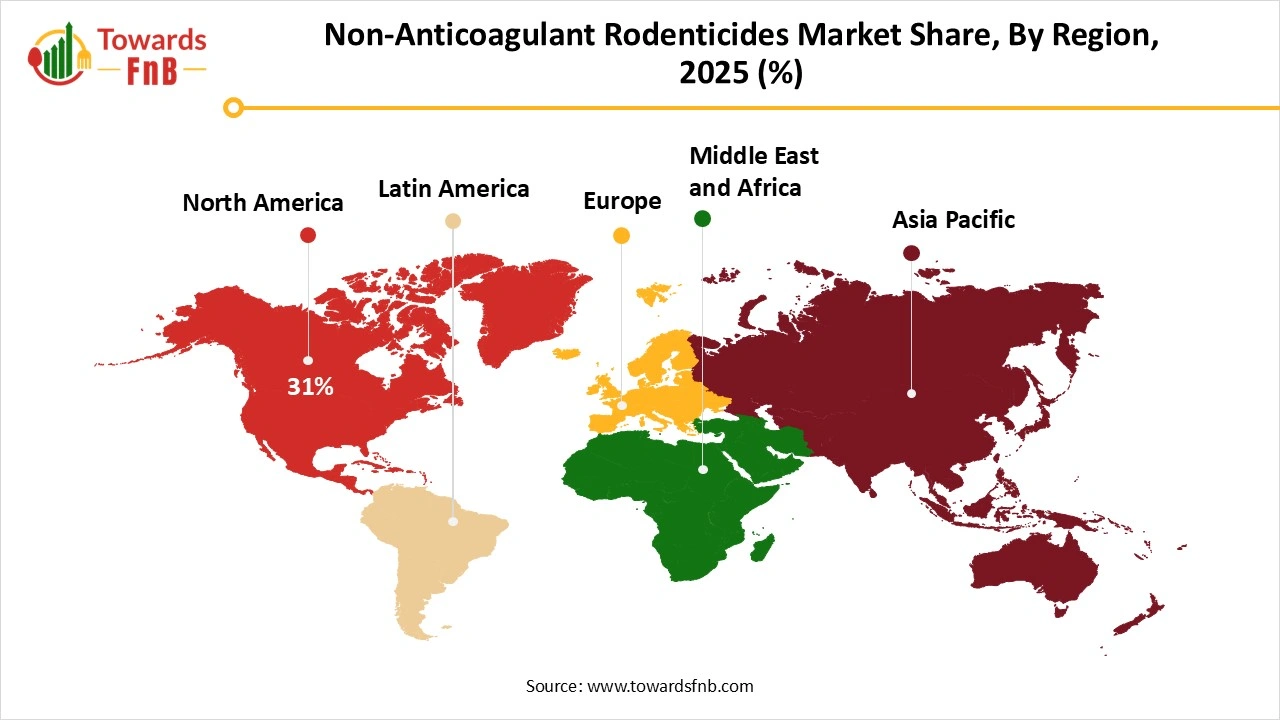
North America dominated the non-anticoagulant rodenticides market in 2025. The extensive rodent infestations and the presence of high-stakes environments increase demand for non-anticoagulant rodenticides. The stringent regulations on hygiene and the higher demand for rodent control across cities in the United States increase the adoption of non-anticoagulant rodenticides. The well-established food storage facilities and the rising house mouse outbreaks increase demand for non-anticoagulant rodenticides. Companies like Neogen Corporation and Bell Laboratories drive market growth.
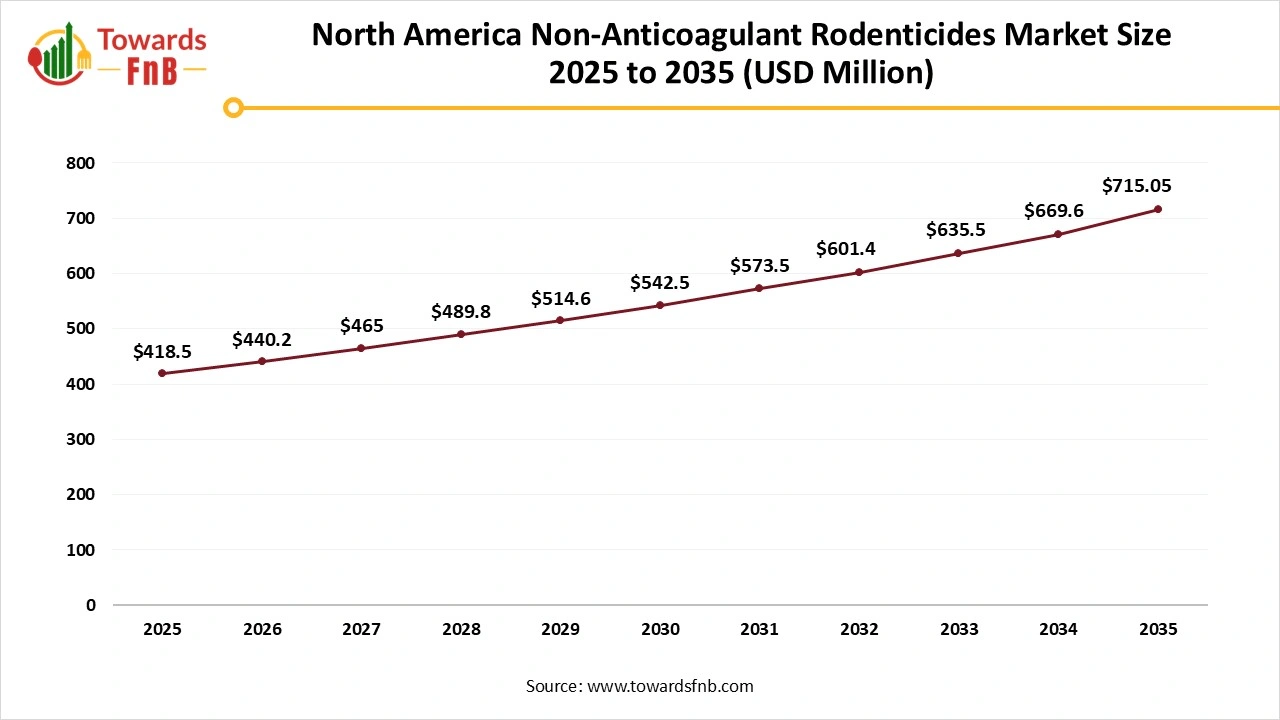
North America Non-Anticoagulant Rodenticides Market Size 2025 to 2035
The North America non-anticoagulant rodenticides market size was calculated at USD 418.5 million in 2025 with projections indicating a rise from USD 440.2 million in 2026 to approximately USD 715.05 million by 2035, expanding at a CAGR of 5.50% throughout the forecast period from 2026 to 2035.
The United States Role in Non-Anticoagulant Rodenticides
The United States is a robust contributor to the market due to high urbanization. The strong focus on food hygiene and the well-developed food-processing facilities increase demand for non-anticoagulant rodenticides. The extensive logistic hubs and a high-value agriculture base create higher demand for non-anticoagulant rodenticides. The high population of rodents supports the market growth.
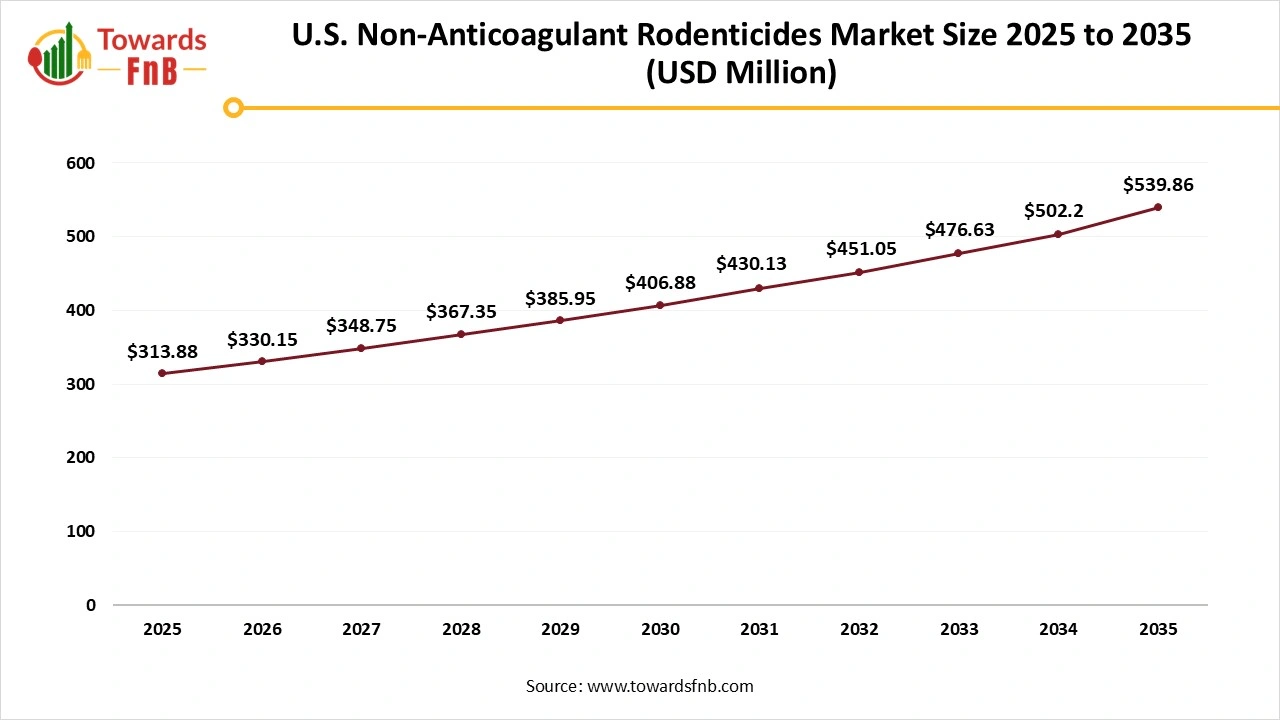
U.S. Non-Anticoagulant Rodenticides Market Size 2025 to 2035
The U.S. non-anticoagulant rodenticides market size was valued at USD 313.88 million in 2025 and is expected to grow steadily from USD 330.15 million in 2026 to reach nearly USD 539.86 million by 2035, with a CAGR of 5.57% during the forecast period from 2026 to 2035.
Asia Pacific Non-Anticoagulant Rodenticides Market Trends
Asia Pacific is experiencing the fastest growth in the market during the forecast period due to the huge agricultural operations. The rising rodent infestation in Asian countries and the transition to urban pest control increase demand for non-anticoagulant rodenticides. The growing utilization of eco-friendly products and increased agricultural rodent issues create a demand for non-anticoagulant rodenticides. The increased use of cholecalciferol-based baits and the focus on fast-acting control drive the market growth.
Food Security: India’s Rise in Non-Anticoagulant Rodenticides
India is witnessing the fastest growth in the market. The higher demand for protecting stored grains and the surging rodent resistance increase demand for non-anticoagulant rodenticides. The regulations on conventional anticoagulants and the growing urban infestations increase the adoption of non-anticoagulant rodenticides. The cost-effective zinc phosphide and the transition to effective control measures support the market growth.
Europe Non-Anticoagulant Rodenticides Market Trends
Europe is growing at a notable rate in the market. The government's backing for safer alternatives and the higher need for professional pest control increase demand for non-anticoagulant rodenticides. The surging construction density and the high hygiene standards increases use of non-anticoagulant rodenticides. The strong focus on rodent management in a natural way and the increased use of digital monitoring create a huge demand for non-anticoagulant rodenticides. The infrastructure density boosts the overall market growth.
Germany’s Impact on Non-Anticoagulant Rodenticides
Germany is substantially growing in the market. The regulatory restrictions and the shifting away from conventional anticoagulants increase demand for non-anticoagulant rodenticides. The high-density urban living and the strong focus on lowering environmental residues increases adoption of non-anticoagulant rodenticides. The protection of agricultural products and Germany’s emphasis on minimizing environmental persistence increase demand for non-anticoagulant rodenticides, fueling the overall market growth.
Non-Anticoagulant Rodenticides Market Share, By Type, 2025 (%)
| Segments | Shares (%) |
| Zinc Phosphide | 45% |
| Bromathelin | 20% |
| Cholecalciferol | 18% |
| Strychnine | 17% |
Why Zinc Phosphide Segment Dominates the Non-Anticoagulant Rodenticides Market?
The zinc phosphide segment dominated the non-anticoagulant rodenticides market in 2025. The strong focus on faster rodent killing and the need to control rodent populations increases demand for zinc phosphide. The focus on controlling rodents in storage facilities and crop protection requires zinc phosphide. The low cost, rapid action, targeted use, high efficacy, and safety profile of zinc phosphide drive market growth.
The Cholecalciferol Segment is the Fastest-Growing in the Market During the Forecast Period
The restrictions on SGARs and the popularity of modern IPM strategies increase demand for cholecalciferol. The strong need to combat resistance and the growth in food handling increases demand for cholecalciferol. The non-toxicity lowered secondary poisoning, quicker control, and a stop-feed effect of cholecalciferol support the market growth.
Non-Anticoagulant Rodenticides Market Share, By Mode of Application, 2025 (%)
| Segments | Shares (%) |
| Pellets | 60% |
| Spray/Liquid | 30% |
| Powder/Dust | 10% |
How did the Pellets Segment hold the Largest Share in the Non-Anticoagulant Rodenticides Market?
The pellets segment held the largest revenue share in the non-anticoagulant rodenticides market in 2025. The focus on high acceptance of rodent and the need to lower non-target exposure increases demand for pellets. The strong presence of storage facilities and the focus on avoiding over-application increase demand for pellets. The application efficiency, long shelf life, high palatability, measured dosing, and targeting resistance of pellets support the overall market growth.
The Spray/Liquid Segment is Experiencing the Fastest Growth in the Market During the Forecast Period
The growing issues in field crops and the higher demand for faster results increases adoption of spray/liquid. The bait shyness and severe infestations require a spray/liquid. The growing pest control in professional environments and the need to lower environmental contamination increase demand for spray/liquid. The increased use of spray or liquid form in food source areas drives the market growth.
Non-Anticoagulant Rodenticides Market Share, By End-Use, 2025 (%)
| Segments | Shares (%) |
| Agricultural Fields | 50% |
| Warehouses | 30% |
| Urban Centers | 20% |
Which End-Use Dominated the Non-Anticoagulant Rodenticides Market?
The agricultural fields segment dominated the non-anticoagulant rodenticides market in 2025. The focus on avoiding the damage of crops from diverse rodents and the need to reduce economic losses increases demand for non-anticoagulant rodenticides. The extensive agricultural land and the rising resistance to conventional chemicals increase the adoption of non-anticoagulant rodenticides. Farmers focus on stopping infestations in agricultural fields, and the focus on enhancing food output globally requires non-anticoagulant rodenticides, driving the overall market growth.
The Urban Centers Segment is the Fastest-Growing in the Market During the Forecast Period
The populated urban areas and the focus on avoiding bait shyness in cities require non-anticoagulant rodenticides. The growing knowledge about health concerns occurs due to rodents, and the expanding waste systems increase demand for non-anticoagulant rodenticides. The inadequate management of waste and the growth in crowded infrastructure increase demand for non-anticoagulant rodenticides, supporting the overall market growth.
Bell Laboratories
By Type
By Mode of Application
By End-Use
By Region





Principal Consultant
Vidyesh Swar, Senior Research Analyst at Towards Food & Beverages, specializes in market research, focusing on supply-demand evaluation, pricing analysis, alternative proteins, plant-based foods, and sustainable food technologies within the industry.
Learn more about Vidyesh Swar
Reviewed By
Aditi Shivarkar, with 14+ years in Food and Beverages market research, specializes in food, beverage, and eco-friendly packaging. She ensures accurate, actionable insights, driving Towards FnB's excellence in industry trends and sustainability.
Learn more about Aditi ShivarkarApril 2026
April 2026
April 2026
April 2026

Non-Anticoagulant Rodenticides Market

 +1 804-441-9344
 Download Sample
 Schedule a Meeting