Mexico Palm Oil Market Size 2025 to 2035
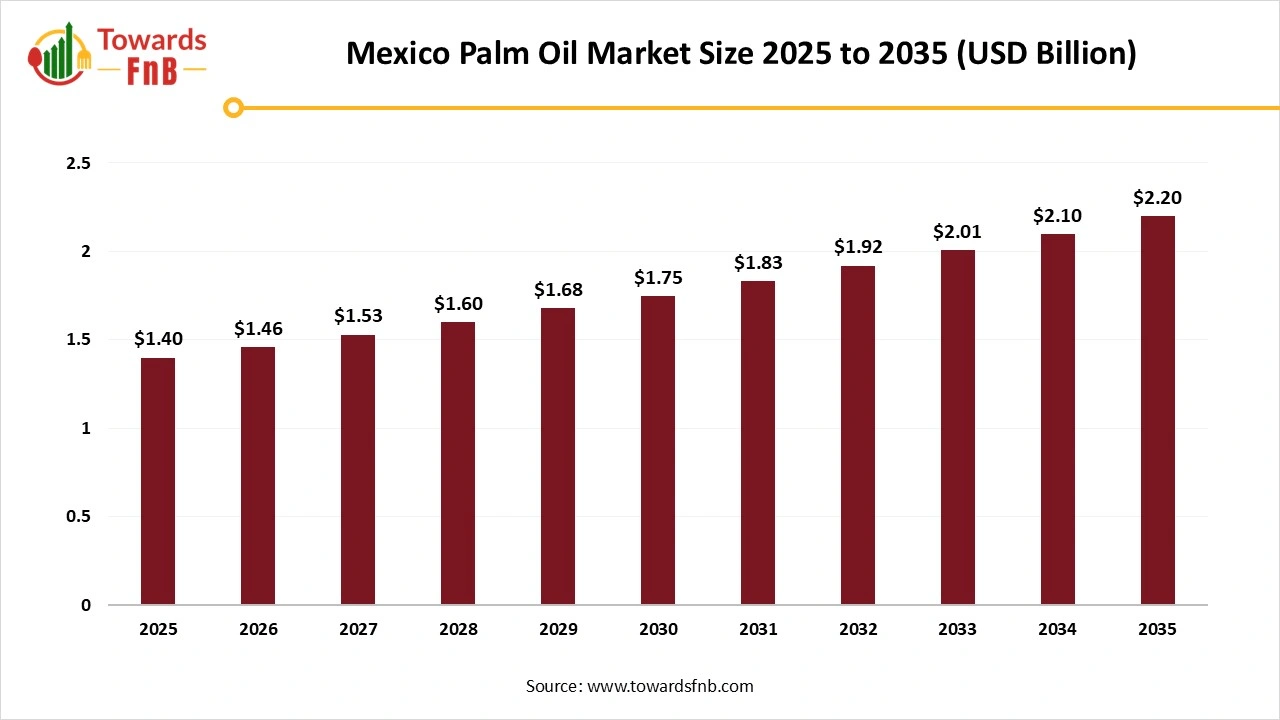
The Mexico palm oil market size reached at USD 1.40 billion in 2025 and is anticipated to increase from USD 1.46 billion in 2026 to an estimated USD 2.20 billion by 2035, witnessing a CAGR of 4.6% during the forecast period from 2026 to 2035. Surging demand from the food processing industry, its affordability, & versatility are significantly driving the market.
Key Highlights
- By product type, the crude palm oil segment held the major market share of 53.3% in 2025.
- By product type, the palm kernel oil segment is projected to grow at the fastest CAGR in between 2026 and 2035.
- By application, the food & edible oils segment contributed the biggest market share of 50.4% in 2025.
- By application, the oleochemicals segment is expanding at the fastest CAGR in between 2026 and 2035.
- By distribution channel, the distributors & traders segment dominated the Mexico palm oil market with 53.4% share in 2025.
- By distribution channel, the direct sales segment is expected to grow at the fastest CAGR over the projected period.
Mexico Palm Oil Industry Coverage
| Study Coverage |
Details |
| Growth Rate from 2026 to 2035 |
CAGR of 4.6% |
| Market Size in 2026 |
USD 1.46 Billion |
| Market Size in 2027 |
USD 1.53 Billion |
| Market Size by 2035 |
USD 2.20 Billion |
| Base Year |
2025 |
| Forecast Period |
2026 to 2035 |
What is the Mexico Palm Oil Market?
The Mexico palm oil market comprises the cultivation, processing, and commercialization of oil palm and its derivatives, primarily crude palm oil and palm kernel oil, produced within Mexico. The market supports domestic demand across food processing, edible oil, personal care, oleochemicals, and biofuel applications. Oil palm cultivation in Mexico is concentrated in southern states, driven by favorable agroclimatic conditions, rising edible oil consumption, and government-supported agricultural development, while sustainability practices and yield improvement initiatives increasingly shape market growth.
Mexico Palm Oil Market Trends
- Industry Growth Overview: In Mexico, the utilization of palm oil is gaining traction due to its affordability and versatility. It is increasingly being adopted in the food processing sector as a substitute for conventional oils, largely due to its cost-effectiveness and extended shelf life. Additionally, as the country endeavors to enhance its renewable energy framework, palm oil is being explored as a potential feedstock for biofuel production.
- Sustainability Trends: In response to new regulatory measures and emerging sustainability trends, Central America and Mexico are undertaking significant initiatives to align with market demands. Collaborative efforts among industry leaders, governmental bodies, and non-governmental organizations are yielding considerable advancements in the sector. Smallholder farmers are embracing innovative digital tools while prioritizing biodiversity conservation in their practices.
- For instance, within the context of the Sustainable Palm Programme, Solidaridad Honduras collaborated with the Industrial Association of Oil Producers of Honduras AIPAH, Grupo Jaremar, the Union of Palm Growers of the Atlantic Coast UNPALA, and the Roundtable on Sustainable Palm Oil RSPO to promote sustainable practices and bolster the competitiveness of the palm oil industry. (Source: Solidaridad)
- Startup Ecosystem: Mexico's startup ecosystem is robust and expanding, particularly in the fintech and e-commerce sectors, while the palm oil market is experiencing growth due to industrial demand. Mexico City serves as a hub for both international conglomerates and local enterprises, fostering an environment conducive to startup incubation. The presence of prominent national and international banks plays a pivotal role in providing capital financing to small and medium enterprises and startups.
Key Technological Shift in the Mexico Palm Oil Market
Technological advancements in palm oil processing have markedly enhanced efficiency, product quality, environmental sustainability, and profitability across the industry. New extraction methodologies have been developed to optimize oil yield and purity. Beyond crude palm oil, technology facilitates the production of higher-value products through fractionation processes that yield palm olein, palm stearin, and specialty fats. Additionally, the development of oleochemicals for cosmetics, pharmaceuticals, and biodegradable products is on the rise. The introduction of digital technologies into palm oil processing also includes the use of Internet of Things sensors for real-time monitoring of equipment parameters such as temperature, pressure, and oil quality, as well as artificial intelligence-driven predictive maintenance systems that anticipate equipment failures, thereby minimizing downtime.
Trade Analysis of the Mexico Palm Oil Market: Export and Import Statistics
- In 2023, Mexico exported $32.6 million worth of palm oil, ranking as the 39th largest exporter globally out of 150 countries. During this period, palm oil was identified as the 503rd most exported product within Mexico, amidst a total of 1,195 products.
- The primary destinations for Mexico's palm oil exports included the United States ($18.2 million), Guatemala ($13.9 million), Ecuador ($332k), Nicaragua ($73,4k), and Belize ($18k).
- The fastest growing markets for palm oil exports from Mexico, between 2022 and 2023, were Guatemala ($3.17 million), Colombia ($7,26k), and the Netherlands ($61).
- In 2023, Mexico imported $537 million of palm oil, positioning itself as the 21st largest importer globally out of 206 countries. That year, palm oil constituted the 184th most imported product in Mexico, amid a total of 1,217 products.
- Primary sources of palm oil imports included Guatemala ($107 million), Costa Rica ($83.7 million), Colombia ($80.3 million), Honduras ($79.9 million), and Peru ($52.3 million).
- The most rapidly growing sources of palm oil imports in Mexico between 2022 and 2023 were Honduras ($60.9 million), Costa Rica ($3.29 million), and the United States ($1.17 million).
Recent Investment in Mexico Palm Oil Market
- In December 2024, Prolade, a Mexican producer of sustainable palm oil, secured $15 million in debt financing from the Inter-American Development Bank. This funding will enable Prolade to expand its operations by an additional 2,000 hectares and implement advanced irrigation systems while reinforcing its commitment to local communities and environmental sustainability. (Source: Sustainability Online)
- In April 2022, to further promote sustainability and assist producers in addressing their challenges, the Mexican Federation of Oil Palm FEMEXPALMA and the High Conservation Value HCV Network entered into a five-year cooperation agreement aimed at promoting sustainable palm oil production through conservation, capacity building, and outreach initiatives. (Source: HCV Network)
Value Chain Analysis of Mexico Palm Oil Market
Raw Material Procurement
- Raw material procurement for palm oil in Mexico involves significant domestic production, concentrated in the Southeast, by smallholders focusing on traceability and responsible sourcing (RSPO).
- Key players: Oleopalma (Grupo Oleomex), and Oleofinos
Processing
- Palm oil processing includes fresh fruit being sterilised, stripped from bunches, mashed, and pressed to get crude palm oil and palm kernels. The CPO is then clarified, dried, and can be refined or fractionated into olein or stearin
- Key players: Industrializadora Oleofinos S.A. de C.V., Industrial Aceitera S.A. de C.V.
Distribution
- Mexico's palm oil market uses direct sales, indirect channels, and a strong offline retail presence for consumers, with Central Mexico (CDMX, Guadalajara) as a key hub.
Mexico Palm Oil Market Segmental Insights
Product Type Insights
Mexico Palm Oil Market Share, By Product Type, 2025 (%)
| Segments |
Shares (%) |
| Crude Palm Oil |
53.3% |
| Palm Kernel Oil (PKO) |
28.0% |
| Palm Kernel Cake |
18.7% |
- Crude Palm Oil (CPO): Dominant with 53.3%, as crude palm oil is the primary product derived from palm fruits, widely used in cooking oils, processed foods, and industrial applications.
- Palm Kernel Oil (PKO): Fastest-growing with 28.0%, driven by its increasing use in personal care, cosmetics, and as an ingredient in various food products.
- Palm Kernel Cake: Holds 18.7%, as a byproduct of palm kernel oil extraction, it is primarily used as animal feed and in biofuel production.
Why did the Crude Palm Oil Segment Dominate the Mexico Palm Oil Market in 2025?
The crude palm oil segment dominated the Mexico palm oil market with 53.3% share in 2025. The market is mainly driven by its massive production output and its usefulness in food, biofuel, and industrial uses. Because it's affordable and easy to get, big manufacturers often pick it, keeping it at the top of the market.
- In 2024, Ciudad de México, with US$145M and Estado de México, with US$573M, were the top states for importing Crude Palm Oil into Mexico. For international sales to Mexico in 2024, the leading countries were Colombia, which imported US$82.7M, Honduras with US$55.4M, Costa Rica with US$25.9M, Guatemala with US$21.2M, and Peru with US$19.3M.
The Palm Kernel Oil Part is Expected to Grow the Fastest Rate During the Forecast Period.
Palm kernel oil is commonly used in cooking, beauty products, lubricants, and soaps. It contains unsaturated fats, tocotrienols, and antioxidants that help fight aging. Compared to palm oil, palm kernel oil has more saturated fat and is used to make soap, cream, lotion, and milk.
Application Insights
Mexico Palm Oil Market Share, By Application, 2025 (%)
| Segments |
Shares (%) |
| Food & Edible Oils |
50.4% |
| Personal Care & Cosmetics |
15.0% |
| Oleochemicals |
14.0% |
| Biofuels |
10.0% |
| Animal Feed |
10.6% |
- Food & Edible Oils: Dominant with 50.4%, as palm oil remains one of the most commonly used oils in cooking, frying, and processed food production due to its versatility and cost-effectiveness.
- Personal Care & Cosmetics: Holds 15.0%, driven by palm-based oils being used in skincare, haircare, and cosmetic products for their moisturizing properties.
- Oleochemicals: Fastest-growing with 14.0%, as palm oil is increasingly used in the production of oleochemicals, which are essential in various industries such as soaps, detergents, and lubricants.
- Biofuels: Holds 10.0%, with palm oil being used in biofuel production due to its high yield and renewable nature.
- Animal Feed: Holds 10.6%, as palm kernel cake and other byproducts are used in animal feed, particularly in the livestock and poultry industries.
Which Application Segment Dominated the Mexico Palm Oil Market in 2025?
The food & edible oils segment held the largest share of 50.4% in the Mexico palm oil market in 2025. This is mostly because palm oil is used a lot in processed foods, sweets, and baked goods to improve their texture and make them last longer. Food makers like palm oil because it's cheap and can be used in many ways. Additionally, more people are buying ready-to-eat and packaged foods, which has increased palm oil use.
The Oleochemicals Segment is Predicted to Grow Significantly During the Forecast Period.
Palm-based oleochemicals are in high demand because palm and palm kernel oils can be used in many ways, due to their adaptable and strong chemical makeup. The need for oleochemical derivatives is steadily increasing due to greater use of personal care products, pharmaceuticals, and food products.
Distribution Channel Insights
Mexico Palm Oil Market Share, By Distribution Channel, 2025 (%)
| Segments |
Shares (%) |
| Distributors & Traders |
53.4% |
| Direct Sales |
30.0% |
| Cooperatives |
16.6% |
- Distributors & Traders: Dominant with 53.4%, as distributors and traders play a key role in the global supply chain, especially for palm oil products sold in bulk for various industries.
- Direct Sales: Fastest-growing with 30.0%, driven by the increasing shift toward direct sales, particularly for large-scale commercial buyers and industrial applications.
- Cooperatives: Holds 16.6%, with cooperatives providing a channel for small-scale producers and local farmers to sell their palm oil and products directly.
Which Distribution Channel Dominated the Mexico Palm Oil Market in 2025?
The distributors & traders segment held the dominating share of 53.4% in the market in 2025. The expansion of the distributors & traders’ channel is bolstered by the rising small-scale adoption and the globalization of supply chains, enabling palm oil to access a wider market. This growth is crucial for the overall stability and development of the palm oil market, addressing diverse market needs and customer segments. These intermediaries are essential in guaranteeing the oil satisfies the necessary quality and regulatory standards prior to arriving at the end-user.
The Direct Sales Segment is Anticipated to Expand at the Fastest Rate in the Market Throughout the Forecast Period.
Highlighting the preference of significant industrial purchasers, such as biodiesel makers, soap creators, food manufacturers, and biofuel generators, for securing long-term, bulk purchase agreements directly with palm oil suppliers. This channel provides cost savings and supply reliability, essential for operational stability in these sectors. This channel is preferred by major purchasers who need reliable and substantial amounts of palm oil.
Recent Developments in the Mexico Palm Oil Market
- Collaboration: In May 2025, Roundtable on Sustainable Palm Oil, AAK Mexico, Solidaridad, and the National Association of Edible Oils and Shortening Producers signed an extension of the Memorandum of Understanding originally established in 2024, aimed at furthering the promotion of sustainable and certified palm oil production in Mexico, particularly emphasizing zero deforestation. (Source: RSPO)
- Visit: In June 2025, Sustainability delegates from prominent consumer goods firms in the United States, Mexico, and Brazil, such as Hershey's, The J.M. Smucker Company, Blommer Chocolate Company, Edgewell Personal Care, Natura, and Grupo Bimbo, recently visited the Ucayali region in the Peruvian Amazon during a tour organized by the Roundtable on Sustainable Palm Oil. (Source: PR Newswire)
Key Players in the Mexico Palm Oil Market
- Grupo Oleopalma is a 100% Mexican company dedicated to the cultivation, production, processing and marketing of palm oil and its derivatives. It is part of the OLEOMEX GROUP, a multinational conglomerate involved in everything from establishing and maintaining plantations to the industrial processing, refining of oils, and their marketing within the food and pharmaceutical sectors.
- Agroindustrias de Palenque, a member of the broader Oleopalma group, which also includes Agroindustrias de Mapastepec is an important contributor to Mexico's expanding palm oil industry, concentrating on production in key southern regions such as Chiapas and striving for sustainability via certifications RSPO.
- Grupo Agroindustrial San Carlos is a major entity in the Mexican agro-industry, particularly in the palm oil sector, with its activities based in Nayarit, Mexico.
- Palmas de Chiapas serves as a central point for Mexico's palm oil sector, particularly for smallholders who control 70% of the land, fostering considerable regional development bolstered by government backing and EU interest.
Other Key Players in the Mexico Palm Oil Market
Segments Covered in the Report
By Product Type
- Crude Palm Oil (CPO)
- Palm Kernel Oil (PKO)
- Palm Kernel Cake
By Application
- Food & Edible Oils
- Personal Care & Cosmetics
- Oleochemicals
- Biofuels
- Animal Feed
By Distribution Channel
- Direct Sales
- Distributors & Traders
- Cooperatives








 +1 804-441-9344
 Download Sample
 Schedule a Meeting